Puting or Putting: Which Is Correct? (With Examples)
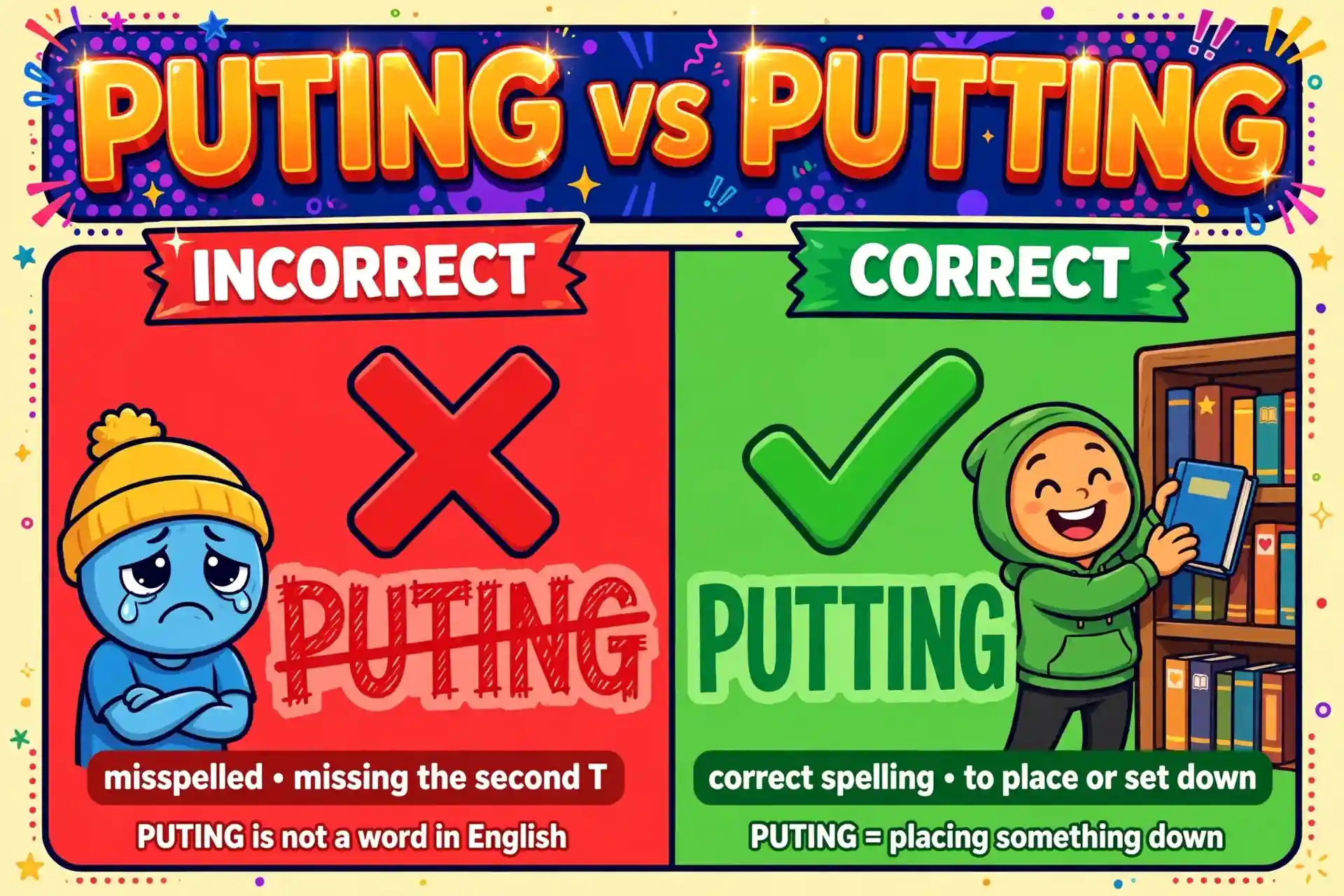
Puting or putting? Only one of these is a real word. Putting — with a double T — is the correct -ing form of the verb put. Puting with a single T is always a misspelling.
For example, “She is putting the books away” is correct. “She is puting the books away” is wrong. The rule behind it is simple: short verbs ending in consonant-vowel-consonant double their final letter before -ing.
Quick Answer
| Word | Part of Speech | Main Meaning | Example |
|---|---|---|---|
| Putting | Verb form | The -ing form of put | He is putting on his shoes. |
| Puting | — | Not a word; a misspelling | ❌ She is puting away the dishes. |
Simple rule: Putting always has two Ts. Puting with one T is never correct.
What Does Putting Mean?
Putting is the present participle of the verb put — the -ing form used for ongoing actions (“is putting,” “was putting”) and as a gerund (“Putting things off is a bad habit”).
Examples:
- She is putting the groceries away.
- He was putting on his jacket when the phone rang.
- Putting the kids to bed takes an hour.
- They are putting up new shelves this weekend.
- Stop putting words in my mouth!
Because put is irregular (put, put, put — no putted), learners sometimes guess at the -ing form too. There is no guessing needed: it is putting, every time.
See putting on Merriam-Webster for the full dictionary entry.
Why Is “Puting” Wrong?
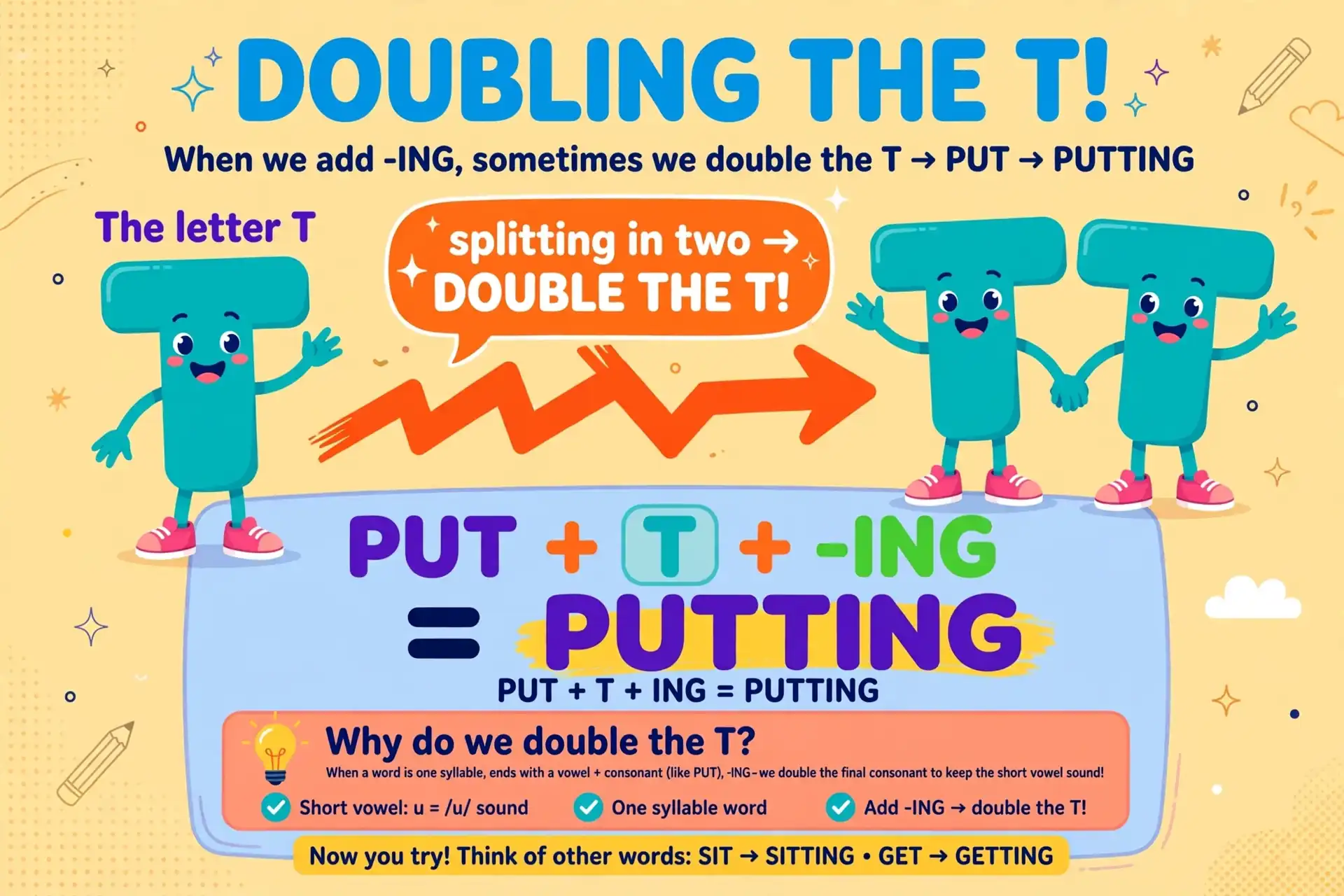
Puting with one T is simply a misspelling — it appears in no dictionary. The error comes from forgetting the doubling rule: one-syllable verbs that end in a consonant-vowel-consonant pattern (CVC) with a short vowel double the final consonant before adding -ing.
Put fits the pattern: p-u-t (consonant, short vowel, consonant). So:
- put → putting (not “puting”)
- run → running (not “runing”)
- sit → sitting (not “siting”)
- swim → swimming (not “swiming”)
- stop → stopping (not “stoping”)
The same doubling applies before -ed and -er: put gives putter (“golf putter”). This is the same family of doubling rules behind other easy-to-misspell verb forms.
Puting vs. Putting: Key Differences
| Feature | Putting | Puting |
|---|---|---|
| Correct? | Yes | No — misspelling |
| What it is | -ing form of put | Nothing; not a word |
| Why the double T | CVC doubling rule | — |
| Dictionary entry | Yes | No |
| Example | Putting away laundry. | ❌ Never use. |
There is no debate here and no regional variation: putting is right everywhere, puting is wrong everywhere — unlike pairs where both spellings can be legitimate words.
Examples of Putting in Real Sentences
At Home
Putting: “She is putting the clean sheets on the bed.”
Why it matters: “puting” would be flagged by every spellchecker; putting is the only accepted form.
At Work
Putting: “We are putting together the quarterly report.”
Why it matters: In professional writing, the double T signals you know the rule.
In Conversation
Putting: “Stop putting it off and just call them.”
Why it matters: Phrasal verbs with put (put off, put up with, put down) all take putting.
Common Mistakes With Puting and Putting
Mistake 1: Writing “Puting” With One T
❌ He is puting his keys in the drawer.
✅ He is putting his keys in the drawer.
Why: Put is CVC with a short vowel, so the T doubles: putting.
Mistake 2: Forgetting the Rule After Long Vowels
❌ She is writeing the report. (wrong for a different reason)
✅ She is writing the report.
Why: The doubling rule only applies with a short vowel. Write has a long vowel, so no doubling — but put has a short one, so it doubles.
Mistake 3: “Putted” Instead of “Put”
❌ He putted the box on the shelf.
✅ He put the box on the shelf.
Why: Put is irregular — past tense is also put, never putted. But the -ing form still doubles: putting.
Pronunciation: Puting vs. Putting
Putting is pronounced “PUT-ing” (/ˈpʊtɪŋ/), rhyming with footing. The misspelling puting has no standard pronunciation because it is not a word — though readers would likely sound it out as “PYOO-ting,” which shows why the double T matters: it keeps the vowel short.
How to Remember the Difference
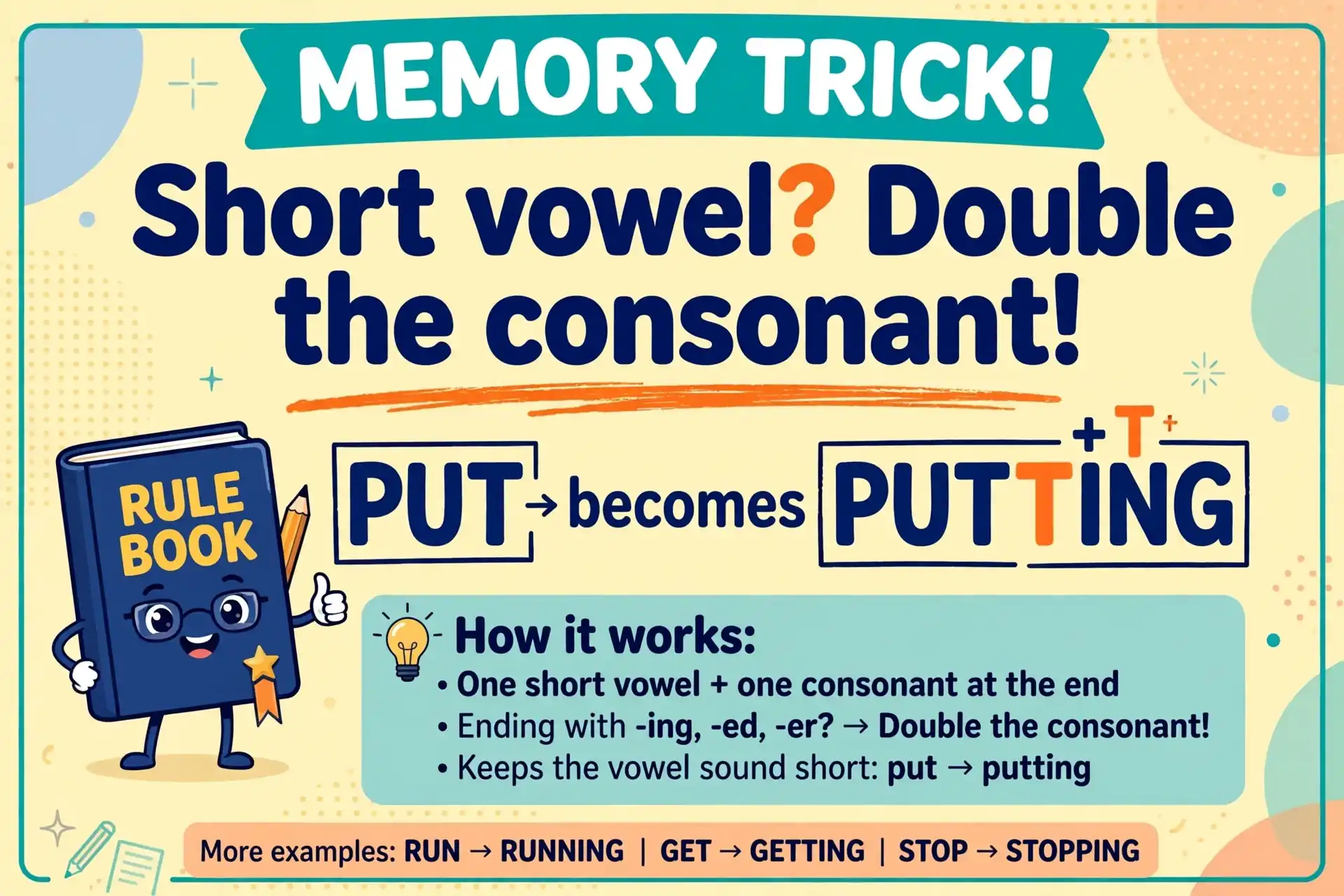
Memory trick: Short vowel? Double the consonant! Say “p-u-t” — the u is short (like cup), so the T doubles: putting.
- Put ends in Consonant-Vowel-Consonant → double the last letter.
- Same family: run → running, sit → sitting, swim → swimming.
- Two Ts, always: putting.
Frequently Asked Questions
Is it puting or putting?
Putting — always with two Ts. Puting with one T is a misspelling.
Why does putting have two Ts?
Because put is a one-syllable CVC word with a short vowel, English doubles the final consonant before -ing: put → putting.
What is the past tense of put?
Put — it is irregular and does not change: “I put it there yesterday.” There is no “putted.”
Does the doubling rule apply to all verbs?
No — only short CVC verbs with a stressed short vowel: run → running, stop → stopping. Longer words like “visit” do not double: visiting.
Is “puting” ever correct in golf?
No. Even in golf, the -ing form is putting (“putting green”), and the club is a putter.
Conclusion
Putting (two Ts) is the only correct -ing form of put; puting is always a misspelling. Remember the short-vowel doubling rule, and you will spell it right every time.