Steer or Stear: What’s the Difference? (With Examples)
Steer means to guide or direct the course of something — a car, a boat, a horse, or even a conversation. Stear looks like it could be a word, but you won’t find it in any dictionary: it’s simply a common misspelling of steer.
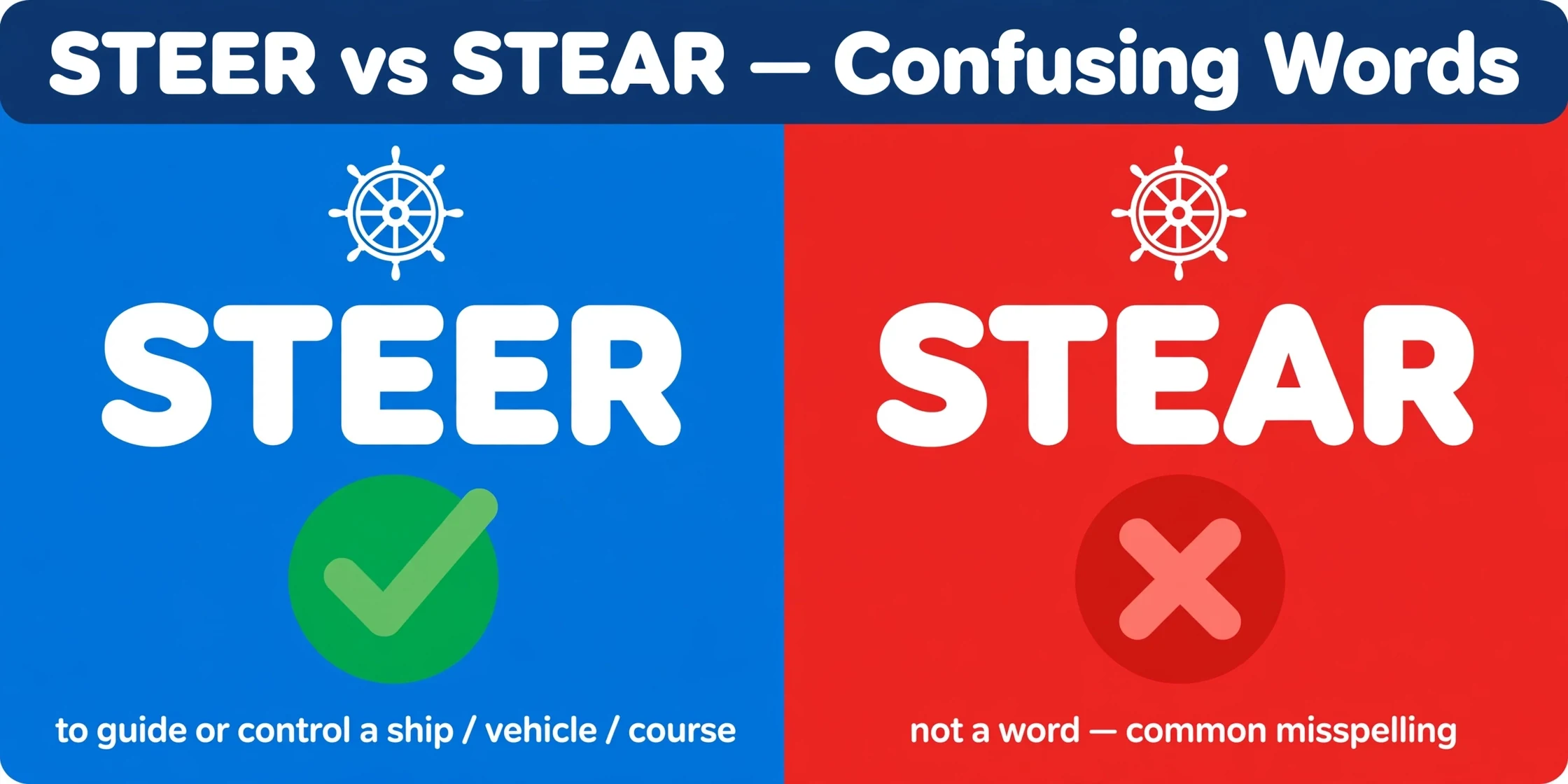
Table of Contents
Quick Answer
| Word | Part of Speech | Main Meaning | Example |
|---|---|---|---|
| Steer | verb; noun | to guide or direct the course of; a young ox | “She steered the boat into the harbor.” |
| Stear | misspelling | not a standard English word | ❌ “He tried to stear the conversation.” |
Simple rule: whenever you mean guide or direct, always write steer with a double e.
What Does Steer Mean?
As a verb, steer means to guide or direct the movement of something so it goes where you want. You steer a car with the wheel, a ship with the rudder, and a discussion with your words. Merriam-Webster also lists a second meaning: as a noun, a steer is a young ox, especially one raised for beef.
Examples:
- He learned to steer the tractor when he was twelve.
- The captain steered the ship safely through the storm.
- Let’s steer clear of that topic at dinner tonight.
- She steered the committee toward a decision everyone could accept.
- The ranch keeps about forty steers in the north pasture.
- Good leaders steer their teams without micromanaging.
- The pilot steered the small plane safely through the turbulence.
What Does Stear Mean?
Stear is not a recognized English word — it’s just a frequent misspelling of steer. It usually shows up because people sound the word out and guess at the vowel. There is no situation where “stear” is the correct choice; every meaning you’re reaching for belongs to steer.
Examples:
- ❌ “Can you stear while I check the map?” → ✅ “Can you steer while I check the map?”
- ❌ “The farmer sold ten stears.” → ✅ “The farmer sold ten steers.”
- ❌ “She stears the meeting well.” → ✅ “She steers the meeting well.”
- ❌ “Stear right at the next light.” → ✅ “Steer right at the next light.”
Steer vs. Stear: Key Differences
| Feature | Steer | Stear |
|---|---|---|
| Correctness | Correct spelling | Misspelling |
| Part of speech | Verb and noun | None — not a word |
| Verb meaning | To guide or direct | — |
| Noun meaning | A young ox | — |
| Related forms | steers, steered, steering, steerage | — |
| Example | “Steer with both hands.” | ❌ “Stear with both hands.” |
The bottom line is simple: steer does all the work, and stear never appears in correct writing.
Usage in Real Sentences
At Home
Steer: “Dad let me steer the shopping cart through the crowded aisle.”
❌ Stear: “Dad let me stear the shopping cart through the crowded aisle.”
Only steer is correct here — “stear” would be flagged as a spelling error in any document.
At Work
Steer: “Our manager steered the project back on schedule.”
❌ Stear: “Our manager steared the project back on schedule.”
Notice the past tense too: it’s steered, never “steared” — the double e stays in every form.
In Conversation
Steer: “Try to steer clear of politics with him tonight.”
❌ Stear: “Try to stear clear of politics with him tonight.”
The phrase “steer clear” (avoid) is one of the most common everyday uses of the word, and it always uses the double e.
On the Road
Steer: “She learned to steer with one hand while parking.”
❌ Stear: “She learned to stear with one hand while parking.”
Driving is the most literal use of steer — guiding a vehicle with the wheel — and the spelling never changes, whatever you’re guiding.
Phrases With Steer
Steer shows up in several everyday expressions: “steer clear of” (avoid), “steer someone right” (guide toward a good outcome), and “steer the ship” (be in charge). All of them use the double e — you’ll never see “stear clear” in correct writing.
Common Mistakes
These two are confused so often that spellcheckers earn their keep — much like the mix-ups in our guides to loose or lose and recieve or receive.
Mistake 1: Writing “stear” for “steer”
❌ Wrong: “Stear the boat toward the dock.”
✅ Right: “Steer the boat toward the dock.”
Why: “Stear” isn’t a word. The verb meaning guide is always spelled with a double e.
Mistake 2: Writing “steared” instead of “steered”
❌ Wrong: “She steared the discussion back on topic.”
✅ Right: “She steered the discussion back on topic.”
Why: The double e is kept in every form — steers, steered, steering.
Mistake 3: Mixing up “steer” and “stir”
❌ Wrong: “Steer the soup so it doesn’t burn.”
✅ Right: “Stir the soup so it doesn’t burn.”
Why: You steer things that move (cars, boats, conversations); you stir things you mix (soup, paint, batter).
Pronunciation
Steer is pronounced /stɪr/ — it rhymes with clear, dear, gear, peer, and near. Since “stear” isn’t a word, there’s no separate pronunciation to learn.
How to Remember the Difference
Think of it this way: to stEEr straight, you need both E’s — like two hands on the wheel. If one e goes missing, you’re off course, and so is your spelling.

- Steer = guide or direct (verb), or a young ox (noun).
- Stear = a misspelling — never correct.
- All forms keep the double e: steers, steered, steering.
FAQ
Is it steer or stear?
It’s steer. “Stear” is a common misspelling and isn’t a standard English word.
What does steer mean as a noun?
As a noun, a steer is a young ox, especially one raised for beef. The plural is steers, and the word is common in ranching and cattle country.
What is the past tense of steer?
The past tense is steered — the double e stays in every form of the verb.
Is “stear” ever correct?
No. There’s no standard English word spelled “stear” — use steer in every case.
What’s the difference between steer and stir?
You steer things that move in a direction (cars, ships, talks); you stir mixtures (soup, batter, paint).
Conclusion
Steer is the word you want every time — for guiding a car, a boat, a project, or a conversation, and for the young ox. Stear is simply a misspelling, so keep both e’s and you’ll always stay on course.