Loose or Lose: What Is the Difference?
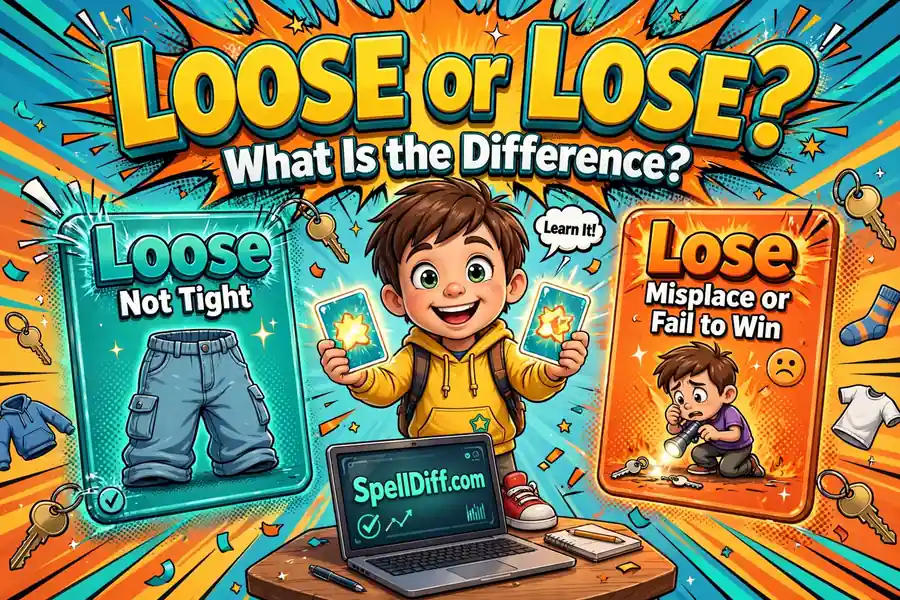
Loose and lose are both correct English words, but they have different meanings. Use loose to describe something that is not tight or firmly attached. Use lose when you mean to misplace something, stop having it, or fail to win.
For example, “My shoes are too loose” describes their fit. “I don’t want to lose my shoes” describes the possibility of misplacing them.
Quick Answer
|
Word |
Part of Speech |
Main Meaning |
Example |
|
Loose |
Usually an adjective; sometimes a verb |
Not tight, not firmly attached, or free |
This shirt is loose. |
|
Lose |
Verb |
To misplace, no longer have, or fail to win |
Don’t lose your ticket. |
Simple rule: Use loose when describing something that is not tight. Use lose when describing an action or a loss.
What Does Loose Mean?
Loose usually works as an adjective. It describes something that is not tight, firmly fixed, or securely held.
It can describe clothing, objects, body parts, animals, rules, and connections.
Loose as an Adjective
Use loose when something has room to move or is not held tightly.
Examples:
In each sentence, loose describes a condition rather than an action.
Loose as a Verb
Although less common, loose can also be a verb. It means to release something or set it free.
For example:
In everyday writing, release, free, or loosen may sound more natural than the verb loose.
Loose in Other Contexts
The word can also mean not strict, not exact, or not closely controlled.
Examples:
Here, loose does not mean physically untight. It suggests flexibility or a lack of exactness.
What Does Lose Mean?
Lose is a verb. It describes failing to keep, find, or win something.
It has several common uses.
Lose Something You Cannot Find
Use lose when you cannot find something you had.
Examples:
Lose Something You Had
Use lose when something is taken away or no longer belongs to you.
Examples:
Lose a Game or Competition
Use lose when someone does not win.
Examples:
Lose Weight, Interest, or Control
The verb also describes having less of something or no longer experiencing it.
Examples:
Loose vs. Lose: Key Differences
The easiest way to separate these words is to check their meaning and grammatical role.
|
Feature |
Loose |
Lose |
|
Main role |
Usually adjective |
Verb |
|
Meaning |
Not tight, fixed, or restricted |
Misplace, stop having, or fail to win |
|
Common use |
Describing a condition |
Describing an action or result |
|
Pronunciation |
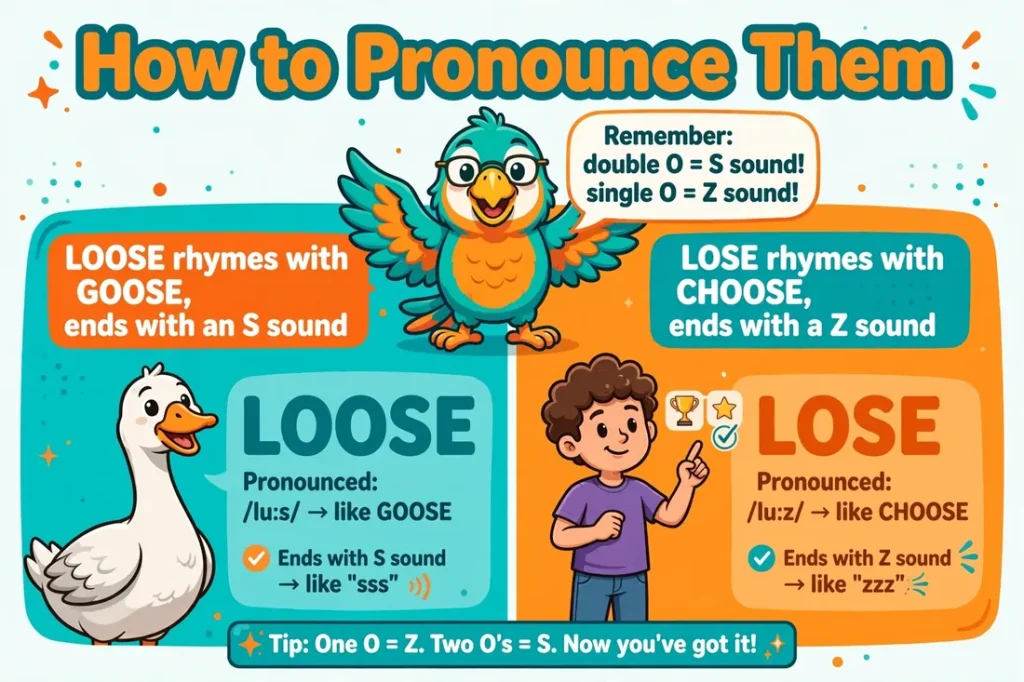
Ends with an s sound |
Ends with a z sound |
|
Example |
The screw is loose. |
Do not lose the screw. |
|
Related form |
Loosen, loosely, looseness |
Lost, losing, loser |
Both words are standard in American and British English. The difference is meaning, not regional spelling.
Loose or Lose: How to Use Each Word
When to Use Loose
Choose loose when describing something that is:
Everyday situation: You try on a shirt before buying it.
Natural sentence: “This shirt is too loose around the shoulders.”
The word describes how the shirt fits.
When to Use Lose
Choose lose when someone might:
Everyday situation: You are leaving home and cannot find your wallet.
Natural sentence: “I hope I don’t lose my wallet again.”
The word describes what might happen to the wallet.
Examples of Loose and Lose in Real Sentences
The following examples show how the words work in everyday communication.
At Home
Loose: The kitchen cabinet has a loose handle.
Lose: Be careful not to lose the small screws.
The first sentence describes the handle. The second describes an action.
At Work
Loose: The manager gave us a loose deadline for the first draft.
Lose: We could lose the client if we miss the final deadline.
The first sentence suggests flexibility. The second describes a possible loss.
In a Text Message
Loose: “Your watch strap looks loose. You should tighten it.”
Lose: “Don’t lose your phone while you’re travelling.”
Both are natural, but they express different ideas.
In Sports
Loose: The goalkeeper rushed toward the loose ball.
Lose: Our team cannot afford to lose another match.
A loose ball is not under either team’s control. Lose means to be defeated.
In School Writing
Loose: The essay follows a loose structure.
Lose: Students may lose marks if they ignore the instructions.
The first describes an arrangement. The second describes a possible result.
Common Mistakes With Loose and Lose
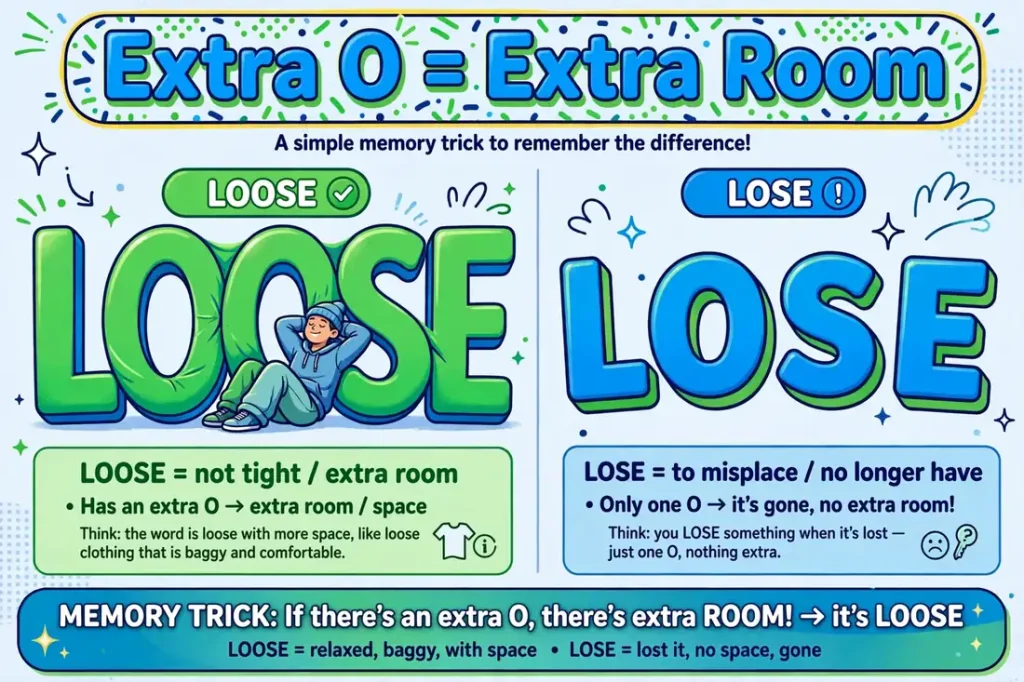
These words are often confused because their spellings are similar. The extra o does not make loose a form of lose.
Mistake 1: Using Loose Instead of Lose
❌ I do not want to loose my job.
✅ I do not want to lose my job.
Why: The sentence refers to no longer having a job. It needs the verb lose.
Mistake 2: Using Lose Instead of Loose
❌ These trousers are too lose.
✅ These trousers are too loose.
Why: The sentence describes how the trousers fit. Use the adjective loose.
Mistake 3: Writing “Loosing” Instead of “Losing”
❌ She is loosing interest in the course.
✅ She is losing interest in the course.
Why: The present participle of lose is losing, with one “o.”
Mistake 4: Confusing “Loose” With “Loosen”
❌ Can you loose this knot?
✅ Can you loosen this knot?
Why: Loosen is the usual verb meaning to make something less tight. Loose can be a verb meaning release, but it is not the usual choice here.
Loose, Lose, Loosen, and Lost
These related forms have different grammatical roles.
|
Word |
Grammar |
Meaning |
Example |
|
Loose |
Adjective or verb |
Not tight; release |
The lid is loose. |
|
Lose |
Verb |
Misplace or fail to keep |
Do not lose the key. |
|
Loosen |
Verb |
Make less tight |
Loosen the knot. |
|
Lost |
Past tense or past participle of lose; also an adjective |
Misplaced or no longer having something |
I lost my ticket. |
|
Losing |
-ing form of lose |
Misplacing or failing to keep |
He is losing patience. |
|
Loosely |
Adverb |
In a relaxed or not strict way |
The pages were loosely arranged. |
Remember that lost is the past form of lose, not loose.
Pronunciation: Loose vs. Lose
The two words sound different at the end.
Both have a long “oo” sound. The final consonant helps distinguish them when speaking.
This difference can also help when checking your writing. If the word needs to rhyme with choose, you probably mean lose.
How to Remember the Difference
Memory trick: Think of the extra o in loose as extra room.
You can also remember this sentence:
“I could lose my loose keys.”
Here, lose describes the action, while loose describes the keys.
Frequently Asked Questions
Is loose or lose correct?
Both are correct English words. Loose usually means not tight or firmly attached. Lose means to misplace something, stop having it, or fail to win.
How do you use loose in a sentence?
Use loose to describe something that is not tight or securely fixed. For example: “The button on my coat is loose.”
How do you use lose in a sentence?
Use lose as a verb when something is misplaced or no longer kept. For example: “I do not want to lose my passport.”
Is it losing or loosing?
Losing is the correct form of the verb lose. For example: “She is losing patience.” Loosing is a different, uncommon verb form related to releasing something.
Is loose an adjective or a verb?
Loose is most often an adjective, as in “loose shoes.” It can also be a verb meaning to release or set free, as in “They loosed the animals.”
What is the difference between lose and lost?
Lose is the present form, while lost is its past tense and past participle. For example: “I lose my keys often” and “I lost my keys yesterday.”
Do loose and lose sound the same?
No. Loose ends with an “s” sound and rhymes with goose. Lose ends with a “z” sound and rhymes with choose.
Conclusion
Loose describes something that is not tight, firmly attached, or restricted. Lose is a verb meaning to misplace, stop having, or fail to win something.
Check the meaning before choosing the spelling. If you are describing a condition, use loose. If you are describing an action or loss, use lose.