Whether or Wether: Which Spelling Is Correct?
Whether is the correct spelling when you mean “if,” “regardless of which,” or introduce two possible choices. Wether is also a real English word, but it has a completely different meaning. It refers to a castrated male sheep or goat. Most writers searching for “whether or wether” want to know which spelling to use in everyday writing. In most situations, whether is the word you need.

Quick Answer: Whether or Wether
Both spellings are correct English words. However, they are not interchangeable. Use whether for ordinary sentences about choices or uncertainty. Use wether only when discussing sheep, goats, or animal farming.
What Does Whether Mean?
Whether is a conjunction that introduces a choice, possibility, or indirect question. It helps connect ideas when someone considers two or more outcomes.
It often appears with words such as or, not, decide, know, and wonder.
1. Whether Means If
You can use whether when discussing something that may or may not happen.
Examples:
In these sentences, whether introduces uncertainty.
2. Whether Introduces Two Choices
Use whether when presenting two possible actions or outcomes.
Examples:
The word connects the alternatives and makes the sentence clear.
3. Whether Means Regardless of the Outcome
Whether can also express that something remains true regardless of what happens.
Examples:
In these examples, the main action does not depend on the outcome.
What Does Wether Mean?
Wether is a real but uncommon English noun. It refers to a male sheep that has been castrated. Some dictionaries also include castrated male goats in its definition.
English meaning – Cambridge Dictionary
+1
The word mainly appears in farming, animal husbandry, and agricultural writing.
Unlike whether, wether does not introduce choices or questions.
Wether in Animal Farming
Farmers use the term to identify a particular type of male sheep.
For example:
Wether as a Noun
Wether functions as a countable noun.
Its plural form is wethers.
|
Form |
Example |
|
Singular |
The wether is grazing near the fence. |
|
Plural |
Several wethers are standing beside the barn. |
|
With an article |
A wether joined the other sheep. |
|
Possessive |
The wether’s wool was recently sheared. |
The word has a specific agricultural meaning. You should not use it as a substitute for whether in everyday writing.
Whether vs Wether: Key Differences
The main difference involves meaning and grammatical function.
Whether works as a conjunction. Wether works as a noun.
Here is a closer comparison:
|
No rows |
Both words are correctly spelled, but their meanings are completely different.
Whether or Wether in American and British English
Neither spelling represents a regional variation of the other.
Both words exist in American and British English.
However, their everyday usage differs because of their meanings.
American English
American writers commonly use whether to express uncertainty or choices.
Example:
– I don’t know whether the store is open.
Wether appears mainly in agricultural contexts.
Example:
– The farmer moved the wether into another enclosure.
British English
British writers use whether in the same grammatical situations.
Example:
– She couldn’t decide whether to walk or take the bus.
Wether also appears in British livestock terminology.
Example:
– The shepherd checked the wethers before moving the flock.
Important: Wether is not a British alternative to whether. Both words have separate meanings in both varieties of English.
Whether or Wether: Examples in Sentences
Sentence examples make the spelling difference easier to understand.
Examples Using Whether
Examples Using Wether
Examples Showing Both Words
These sentences show how both spellings work in the same context.
Example 1:
The first sentence uses whether for uncertainty and wether for the animal.
Example 2:
The first sentence uses both words according to their meanings.
Example 3:
The correct sentence uses whether to introduce a decision and wether to identify an animal.
Whether or Not vs Wether
One common spelling mistake occurs in the phrase whether or not.
This expression means that something will happen regardless of a particular condition.
Examples:
Using wether in these sentences is incorrect because the phrase requires a conjunction.
Is Whether or Not Always Necessary?
Not always.
In many sentences, whether communicates the same idea without not.
For example:
Both sentences are correct.
However, whether or not can provide additional emphasis when the writer wants to highlight two possible outcomes.
Common Mistakes When Using Whether and Wether
Even experienced writers sometimes confuse these words. Their similar pronunciation makes spelling mistakes easy.
Here are common errors and their corrections.
Mistake 1: Writing Wether Instead of Whether
Incorrect: I don’t know wether he will come.
Correct: I don’t know whether he will come.
Use whether when expressing uncertainty.
Mistake 2: Using Whether to Describe an Animal
Incorrect: The whether is standing near the barn.
Correct: The wether is standing near the barn.
Use wether when referring to a castrated male sheep or goat.
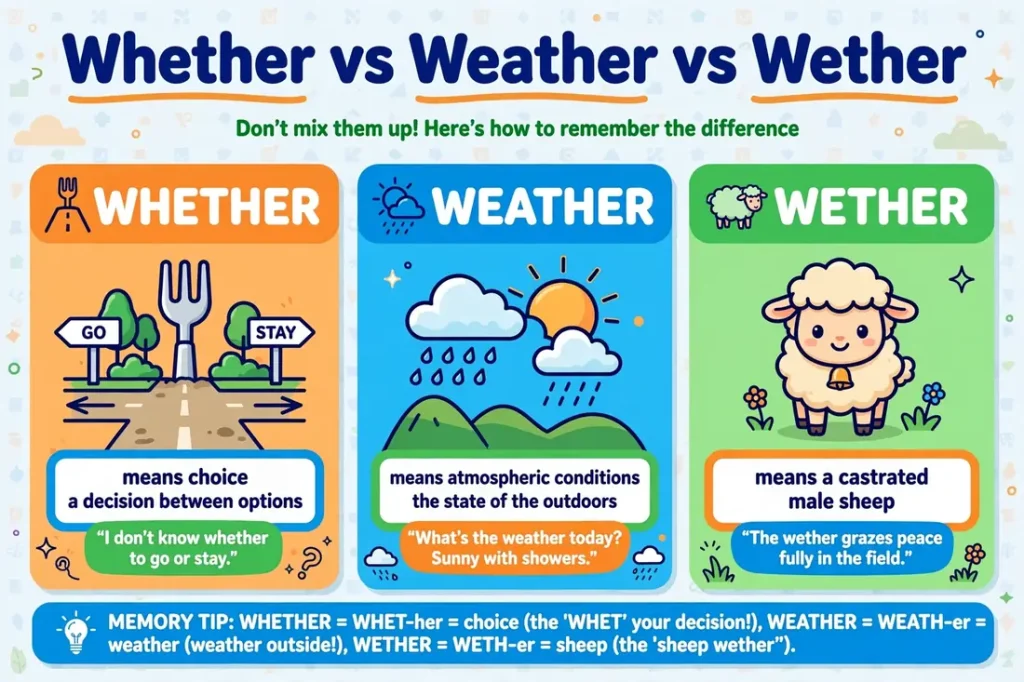
Mistake 3: Confusing Whether With Weather
Another commonly confused word is weather.
Weather refers to atmospheric conditions, such as rain, sunshine, wind, and temperature.
Examples:
These three words have different meanings:
|
Word |
Meaning |
Example |
|
Whether |
A choice or possibility |
I wonder whether she agrees. |
|
Wether |
A castrated male sheep or goat |
The wether is grazing. |
|
Weather |
Atmospheric conditions |
The weather is getting colder. |
Mistake 4: Thinking Wether Is Always a Misspelling
Wether is a legitimate dictionary word.
However, it is rarely needed in ordinary writing.
If your sentence discusses a decision, possibility, or indirect question, whether is usually the correct choice.
How to Remember the Difference Between Whether and Wether
A simple memory trick can help you choose the correct spelling.
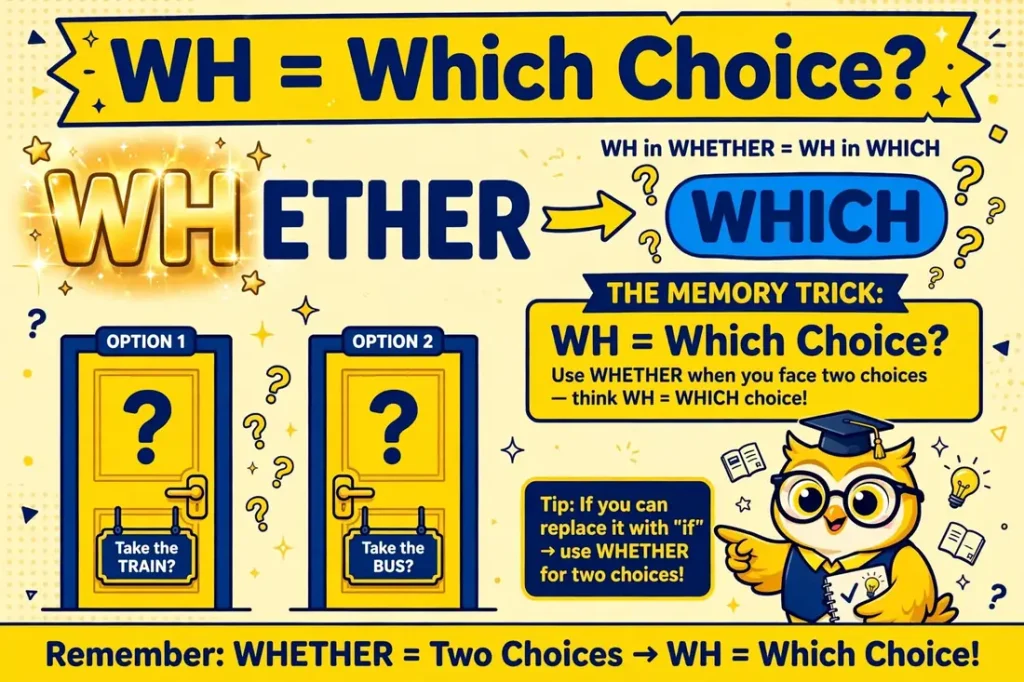
Remember the WH in Whether
Whether starts with WH, just like the question word which.
Both words can relate to choices.
For example:
This connection makes whether easier to remember.
Connect Wether With Sheep
Think of wether as a livestock term.
It refers to a castrated male sheep or goat.
Remembering its connection with farming can prevent confusion.
Use the Sentence Substitution Test
Ask yourself whether the sentence discusses a choice or an animal.
For example:
“I don’t know ___ she will arrive.”
You can write “I don’t know if she will arrive.”
Therefore, whether is correct.
“The farmer purchased a ___.”
If the farmer purchased a castrated male sheep, wether is correct.
Frequently Asked Questions
Is Whether or Wether the Correct Spelling?
Both are correct English words, but they have different meanings. Whether introduces choices, uncertainty, or indirect questions. Wether refers to a castrated male sheep or goat.
Is Wether a Real Word?
Yes. Wether is a recognized English noun used in livestock terminology. It describes a castrated male sheep or goat. Its plural form is wethers.
Are Whether and Wether Homophones?
They are pronounced alike in many English accents. However, pronunciation can vary between speakers. Their meanings and grammatical functions remain different.
What Is the Difference Between Whether and Weather?
Whether is a conjunction used to express choices or possibilities. Weather is a noun describing atmospheric conditions. For example, “I wonder whether the weather will improve.”
Can I Use Whether Without Or?
Yes. Whether does not always need or. You can write, “I don’t know whether she is available.” The alternative is understood from the context.
How Do You Use Whether or Not in a Sentence?
Use whether or not to express that something remains true regardless of an outcome. For example, “I will finish the work whether or not I receive help.”
Conclusion
Whether and wether are both correct English spellings, but they serve different purposes. Whether introduces choices, uncertainty, and indirect questions. Wether identifies a castrated male sheep or goat.
For everyday writing, whether is usually the spelling you need. Reserve wether for agricultural and livestock-related discussions. Remembering their meanings will help you avoid this common spelling mistake.