Sergeant or Sargent: Which Is Correct?
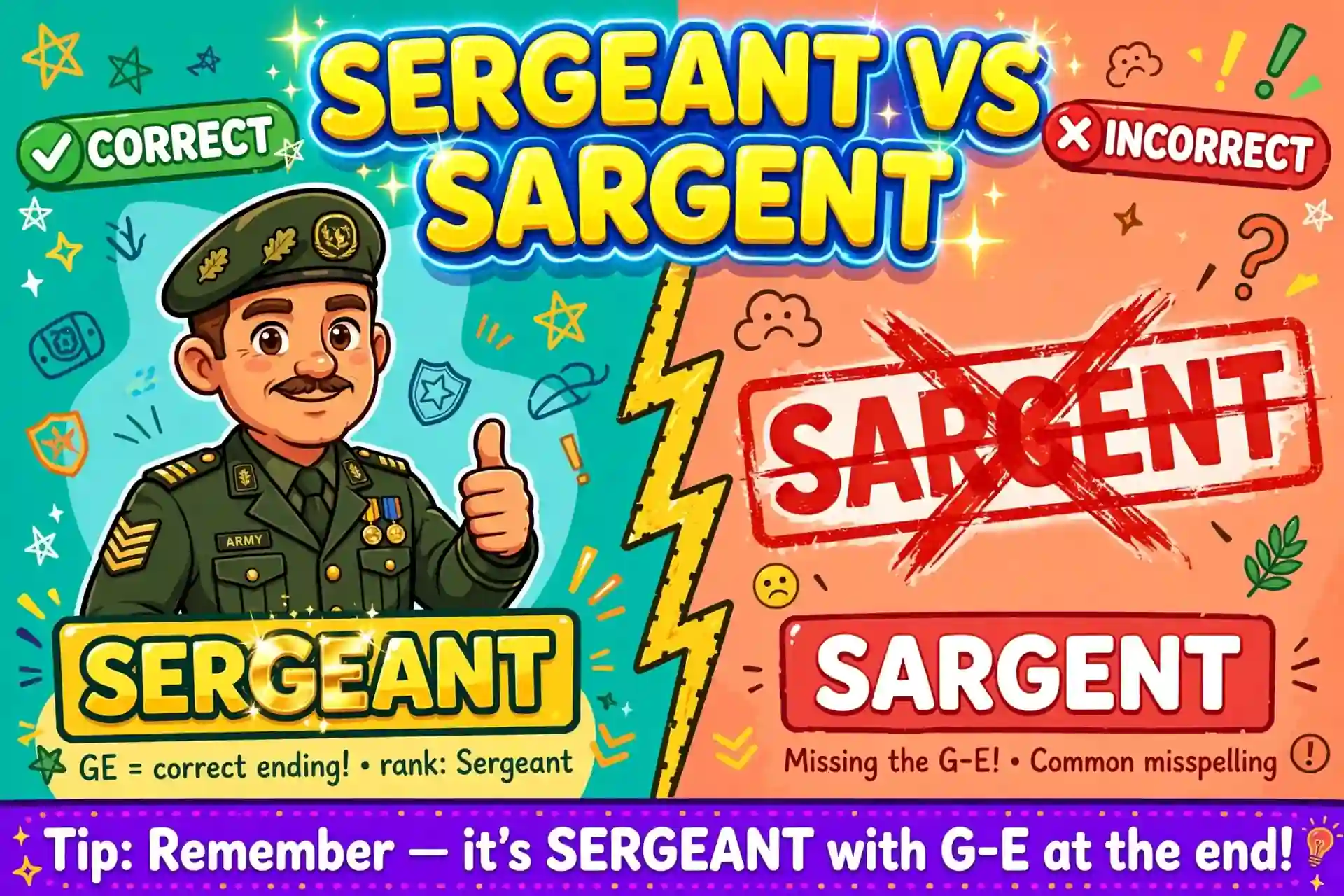
Sergeant is the correct spelling for the military and police rank. Sargent is a misspelling when you mean the rank — though Sargent is a real surname, as in the painter John Singer Sargent. The tricky part: sergeant is pronounced “SAR-jent,” exactly like the misspelling sounds.
For example, “The sergeant inspected the troops” is correct. “The sargent inspected the troops” will get marked wrong, even though it sounds identical.
Quick Answer
| Word | Part of Speech | Main Meaning | Example |
|---|---|---|---|
| Sergeant | Noun | Correct — military/police rank | The sergeant led the drill. |
| Sargent | — | Misspelling (but a real surname) | ❌ The sargent led the drill. |
Simple rule: The rank is always sergeant with ge. Sargent is only correct as someone’s last name.
What Does Sergeant Mean?
Sergeant is a noun naming a non-commissioned officer rank in armies, air forces, marines, and police forces. A sergeant typically leads a squad or section and wears chevron insignia on the sleeve.
Examples:
- The sergeant ordered the squad to fall in.
- She was promoted to sergeant after six years of service.
- A police sergeant supervised the night shift.
- The drill sergeant’s voice carried across the parade ground.
- He saluted the sergeant and reported for duty.
- The sergeant’s calm orders steadied the new recruits.
- Every sergeant in the unit earned the rank the hard way.
For the full dictionary entry, see sergeant on Merriam-Webster.
What Does Sargent Mean?
Sargent as a common noun is a misspelling — it is not the rank. It survives only as a proper name: Sargent is an English surname, most famously borne by the portrait painter John Singer Sargent.
So “Hello, Mr. Sargent” can be perfectly correct, while “hello, sargent” as a rank never is. The pronunciation trap — sergeant is said “SAR-jent” — is why the error is so widespread, much like other common misspellings like loose vs lose.
Examples of the mistake:
- ❌ The sargent major addressed the troops. (rank → wrong)
- ✅ Sergeant Major addressed the troops. (rank → right)
- ✅ John Singer Sargent painted the portrait. (surname → right)

Sergeant vs. Sargent: Key Differences
| Feature | Sergeant | Sargent |
|---|---|---|
| Correct for the rank? | Yes | No |
| Spelling | ser-ge-ant (with ge) | sar-gent (with a) |
| As a surname | No | Yes (e.g., John Singer Sargent) |
| Pronunciation | “SAR-jent” | “SAR-jent” (same sound!) |
The identical pronunciation is the whole problem: your ear says “sargent,” but the rank demands sergeant — a mismatch as sneaky as dieing vs dying.
Examples in Real Sentences
In the Army
✅ “The sergeant inspected every rifle in the rack.”
❌ “The sargent inspected every rifle in the rack.”
Military writing is formal; the misspelling stands out immediately.
At the Police Station
✅ “Sergeant Rivera took the witness statement.”
Police ranks follow the same spelling — sergeant, always.
Talking About the Painter
✅ “Sargent’s portraits hang in the museum.”
Here Sargent is a surname, so the a spelling is correct.
Common Mistakes With Sergeant and Sargent
Mistake 1: Writing “Sargent” for the Rank
❌ He was promoted to sargent last spring.
✅ He was promoted to sergeant last spring.
Why: The rank is spelled with ser-ge, regardless of how it sounds.
Mistake 2: “Sargeant” With an Extra A
❌ The sargeant called roll.
✅ The sergeant called roll.
Why: Some writers split the difference with sargeant. That is wrong too — there is no a after the r.
Mistake 3: Lowercasing the Rank Title
❌ sergeant Davis, report!
✅ Sergeant Davis, report!
Why: Used as a title directly before a name, the rank is capitalized.

How to Remember the Difference
Memory trick: The serGEant has charGE of the troops — both contain GE.
- serGEant → the rank (think GE like General).
- Sargent → only a surname (John Singer Sargent).
Your ear will always say “sargent.” Let the ge overrule it every time you write the rank, and the SAR-jent in your head will finally match the sergeant on the page.
Frequently Asked Questions
Is it sergeant or sargent?
Sergeant is correct for the military and police rank. Sargent is a misspelling of the rank, though it is a legitimate surname.
Why is “sergeant” pronounced “sargent”?
The pronunciation shifted centuries ago while the French-derived spelling stayed put. English kept the old letters and updated the sound — the classic recipe for a spelling trap.
How do you spell the plural of sergeant?
Sergeants — just add s. “Two sergeants led the exercise.”
Is “sargeant” ever correct?
No. Sargeant with an a after the r is simply a misspelling of sergeant.
What rank is above sergeant?
In most armies, a staff sergeant (or equivalent) outranks a sergeant. The spelling lesson stays the same either way.
What is a “drill sergeant”?
A sergeant assigned to train new recruits — famous for a loud, demanding style. The spelling is the same sergeant; only the job description changes.
How is “sergeant” abbreviated?
The standard abbreviation is Sgt. (with a period in American English, often written Sgt without one in British English). It is pronounced “sarge,” as in “Sgt. Johnson reported for duty.” The abbreviation drops the tricky middle of the word entirely — which is one reason the full spelling trips people up, since you rarely have to write it out.
Conclusion
Sergeant with ge is the rank; sargent with a is only a surname. The pronunciation says “sargent,” but your fingers must write sergeant — link the ge to charge and the spelling will stick.