Dieing or Dying: Which Spelling Is Correct?
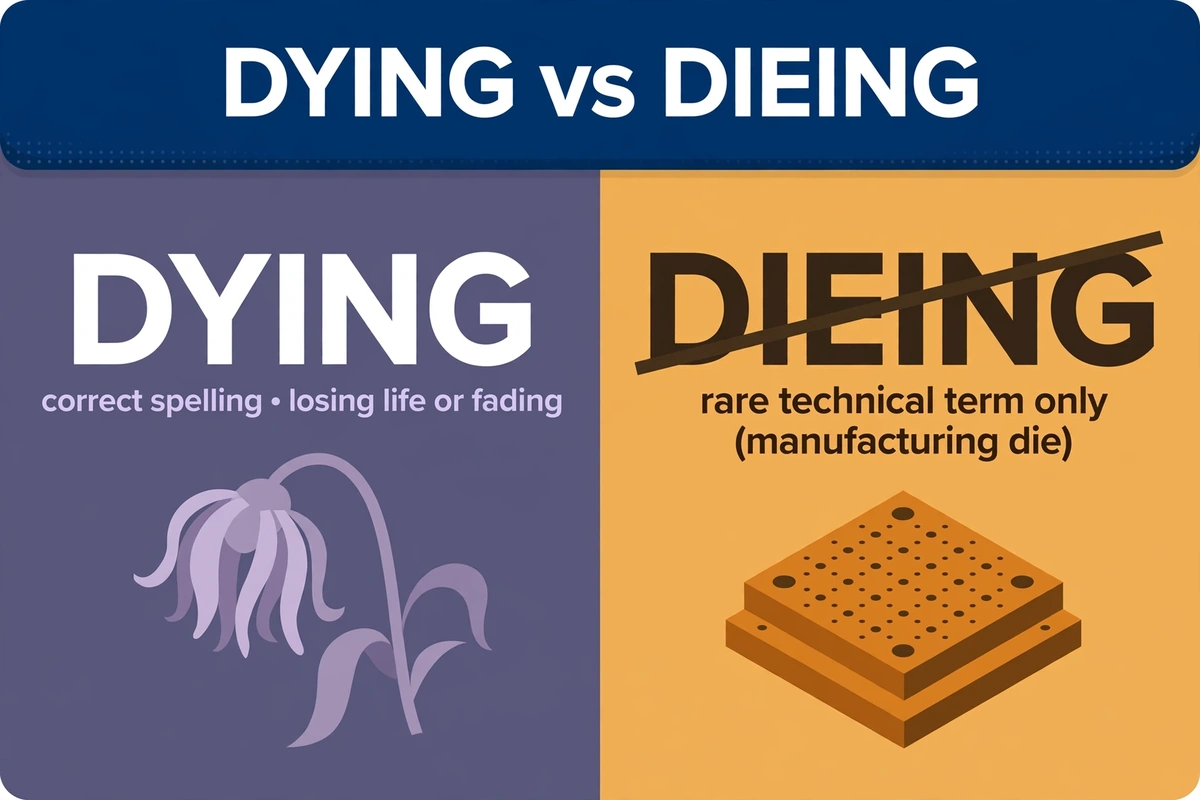
Dying is the correct spelling when you mean losing life or coming to the end of life. Dieing is generally a misspelling of this word. However, dieing is a rare technical term related to cutting or shaping materials with a die.
The confusion happens because the verb “die” changes its spelling when adding “-ing.” Unlike many regular verbs, it drops its final “e” and becomes “dying.”
Quick Answer: Dieing or Dying?
Use dying when referring to death, fading, or something coming to an end. Do not use “dieing” for these meanings.
Examples:
- Correct: The old tree is dying.
- Incorrect: The old tree is dieing.
- Correct: His grandmother is dying.
- Incorrect: His grandmother is dieing.
The spelling “dieing” has a separate, specialized meaning in manufacturing. It refers to the process of using a die to cut, shape, or form a material.
Quick Facts About Dieing and Dying
| Feature | Dying | Dieing |
| Standard spelling | Yes | No, for ordinary meanings |
| Meaning | Approaching death or coming to an end | Rare technical usage related to a manufacturing die |
| Part of speech | Gerund or present participle | Rare technical form |
| American English | Correct | Not standard |
| British English | Correct | Not standard |
| Pronunciation | /ˈdaɪ.ɪŋ/ | Depends on technical context |
| Everyday usage | Very common | Extremely rare |
What Does Dying Mean?
Dying is the present participle and gerund of the verb die. It describes the process of losing life or gradually coming to an end.
The word also has several figurative meanings. It can describe something losing strength, fading away, or becoming less active.
1. Dying Meaning Losing Life
The most common meaning refers to a person, animal, or living thing approaching death.
Examples:
- The doctor said the patient was dying.
- The injured bird was dying.
- The family stayed beside their dying grandfather.
- The flowers are dying without enough water.
- The rescue team found a dying animal.
In these sentences, dying describes the condition of a living organism.
2. Dying Meaning Gradually Disappearing
Dying can also describe something becoming weaker or disappearing over time.
This figurative meaning applies to traditions, industries, languages, businesses, and other nonliving things.
Examples:
- The old tradition is slowly dying.
- Interest in that fashion trend is dying.
- The small business is dying because of declining sales.
- Many people worry that the local language is dying.
- The ancient custom is dying out.
Here, the word does not refer to literal death. It describes a gradual decline or disappearance.
3. Dying Meaning Losing Power or Function
People also use dying to describe machines, electronic devices, and other things that are about to stop working.
This usage is common in everyday conversations.
Examples:
- My phone battery is dying.
- The car engine sounds like it is dying.
- The laptop is dying because its battery is almost empty.
- The old generator is slowly dying.
- The internet connection keeps dying during meetings.
These examples describe something losing its ability to function.
4. Dying in the Expression “Dying to Know”
The phrase “dying to know” is an informal expression.
It means wanting to know something very much.
It does not describe actual death.
Examples:
- I am dying to know what happened.
- She is dying to see the final results.
- We are dying to hear your news.
- He was dying to ask her a question.
This expression communicates strong curiosity or excitement.
What Does Dieing Mean?
Dieing is not the standard spelling of the ordinary verb die when adding “-ing.”
However, it has a rare technical connection with the noun die.
In manufacturing, a die is a specialized tool used to cut, stamp, shape, or form materials.
The word dieing may appear in specialized contexts involving the operation of such tools.
However, modern technical writing often uses clearer expressions, such as die cutting, die forming, or die stamping.
For everyday writing, avoid using dieing.
When Is Dieing Used?
The rare technical meaning is connected to manufacturing processes.
For example, a technical text might use dieing to describe an operation involving a manufacturing die.
However, this form is uncommon and may confuse readers.
If you are discussing someone losing life, a plant fading, or a battery running out, use dying.
Remember: The rare technical use does not make dieing an accepted alternative spelling of dying.
Why Is Dying Correct Instead of Dieing?
The answer comes from an English spelling rule.
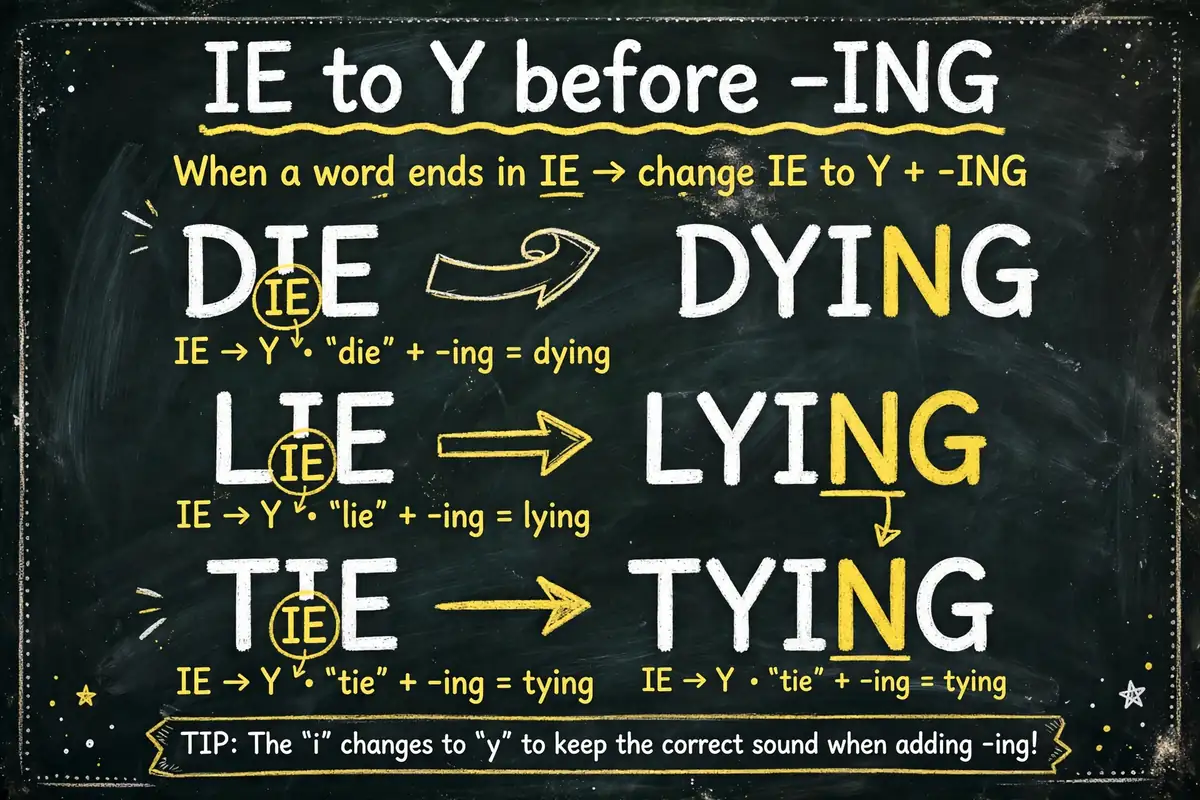
When certain verbs end in “-ie,” the letters “ie” change to “y” before adding “-ing.”
This gives us:
The same pattern appears in several other verbs.
| Base Verb | Correct -ing Form |
| Die | Dying |
| Lie | Lying |
| Tie | Tying |
| Vie | Vying |
For example:
- She is dying.
- He is lying.
- I am tying my shoes.
- The competitors are vying for first place.
The spelling change helps maintain a clear and established word form.
Why Doesn’t Die Become Dieing?
Many verbs simply take “-ing” without changing their spelling.
For example:
- Walk → Walking
- Read → Reading
- Play → Playing
- Talk → Talking
However, verbs ending in “-ie” follow a different pattern.
The final “-ie” changes to “y” before adding “-ing.”
Therefore:
- Dieing = incorrect for the ordinary meaning.
- Dying = correct.

Dieing vs Dying vs Dyeing: What’s the Difference?
Another word creates confusion between these spellings: dyeing.
Although dying and dyeing look similar, they have completely different meanings.
| Word | Meaning | Example |
| Dying | Losing life or gradually ending | The plant is dying. |
| Dieing | Rare technical term related to a manufacturing die | A specialized dieing process |
| Dyeing | Changing the color of something using dye | She is dyeing her hair. |
Dying: Related to Death
Dying comes from the verb die.
Example: The flowers are dying because nobody watered them.
Dyeing: Related to Color
Dyeing comes from the verb dye.
It means adding or changing color using a coloring substance.
Examples:
- She is dyeing her hair brown.
- They are dyeing the fabric blue.
- My mother is dyeing an old dress.
- The workers are dyeing cotton materials.
- He is dyeing his shoes black.
The spelling follows a different rule:
Unlike die, the verb dye keeps its final e.
An Easy Way to Compare All Three
- Dying = Someone or something is losing life or strength.
- Dyeing = Someone is changing a material’s color.
- Dieing = A rare technical term related to a manufacturing tool.
Examples:
- The flower is dying.
- The worker is dyeing the fabric.
- The manufacturer is using a specialized die.
Dying or Dieing in American and British English
Unlike some spelling differences between American and British English, this pair does not follow a regional spelling pattern.
Both American and British English use dying as the standard spelling.
| English Variety | Correct Spelling |
| American English | Dying |
| British English | Dying |
| Canadian English | Dying |
| Australian English | Dying |
| Indian English | Dying |
| Pakistani English | Dying |
There is no standard American spelling called dieing.
Similarly, British English does not use dieing as an alternative spelling for ordinary meanings.
Whether you write for a US, UK, or international audience, choose dying.
Examples of Dying in Different Sentence Structures
Understanding how the word functions in sentences can help you use it correctly.
1. Dying as a Present Participle
A present participle describes an ongoing action.
It often appears with helping verbs such as is, are, was, and were.
Examples:
- The patient is dying.
- The plants are dying in the heat.
- The old machine was dying slowly.
- The battery is dying quickly.
- The business is dying because of poor management.
2. Dying as a Gerund
A gerund is a verb ending in “-ing” that functions as a noun.
Examples:
- Dying is a natural part of life.
- He was afraid of dying.
- The dying of the old tree saddened the children.
- They discussed the dying tradition.
- She worried about dying alone.
In these examples, dying performs a noun-like function or appears as part of a noun phrase.
3. Dying as an Adjective
Dying can also describe a noun.
It refers to someone or something approaching an end.
Examples:
- The dying patient received medical attention.
- They saved the dying animal.
- The dying industry needs new investment.
- A dying tradition can disappear over generations.
- The rescue team helped the dying bird.
4. Dying in Figurative Expressions
The word appears in several common expressions.
Examples:
- I am dying to meet your family.
- The fire is dying down.
- The sound was slowly dying away.
- Their friendship was dying out.
- She was dying of laughter.
These expressions have different meanings depending on their context.
For example, “dying of laughter” means laughing very hard. It does not describe actual death.
Common Mistakes When Using Dieing or Dying
Even experienced writers sometimes confuse these spellings.
The following mistakes are easy to avoid once you understand the rule.
Mistake 1: Adding -ing Directly to Die
Some writers assume that die becomes dieing.
However, the correct spelling changes “-ie” to “y.”
Incorrect: The plant is dieing.
Correct: The plant is dying.
Mistake 2: Confusing Dying With Dyeing
These words have different meanings.
Incorrect: She is dying her hair red.
Correct: She is dyeing her hair red.
Dying relates to death or decline. Dyeing means changing color.
Mistake 3: Using Dieing in Formal Writing
Using dieing instead of dying can create a spelling error in essays, reports, articles, and professional documents.
Always use dying when referring to death or decline.
Mistake 4: Assuming Every Verb Adds -ing Directly
English has several spelling patterns for adding “-ing.”
For example:
| Base Verb | Correct Form |
| Make | Making |
| Write | Writing |
| Run | Running |
| Lie | Lying |
| Die | Dying |
| Tie | Tying |
The spelling depends on the ending and spelling pattern of the original verb.
Mistake 5: Treating Dieing as a British or American Variant
Dieing is not a regional alternative to dying.
Both British and American English use dying for the ordinary meaning.
How to Remember the Correct Spelling
The easiest way to remember dying is to connect it with similar verbs.
Think about these three transformations:
The IE to Y Spelling Pattern
DIE → DYING
Related to death or decline
LIE → LYING
Related to telling an untruth or resting
TIE → TYING
Related to fastening something
Remember this simple rule:
When a verb ends in “-ie,” change “-ie” to “y” before adding “-ing.”
This pattern makes the correct spelling easier to recognize.
Frequently Asked Questions
Is dieing ever a correct word?
Dieing has a rare technical use related to manufacturing dies, which are tools used to shape or cut materials. However, it is not the correct spelling of the ordinary verb die in its “-ing” form.
Why is dying spelled with a Y?
English changes the final “-ie” to “y” before adding “-ing” in certain verbs. Therefore, die becomes dying. The same pattern appears in lie becoming lying and tie becoming tying.
Is dying correct in British English?
Yes. Dying is the standard spelling in British English. American, Canadian, and Australian English also use dying for the ordinary meaning.
What is the difference between dying and dyeing?
Dying refers to losing life or gradually coming to an end. Dyeing means changing the color of something using dye. For example, a plant is dying, but someone is dyeing their hair.
Is it dying to know or dieing to know?
The correct expression is “dying to know.” It means being extremely curious about something. For example, “I am dying to know what happened at the meeting.”
What is the past tense of die?
The past tense of die is died. For example, “The plant died because nobody watered it.” Dying is the present participle, while died describes a completed action.
Conclusion
When choosing between dieing or dying, dying is the correct spelling for ordinary English.
It describes losing life, fading, weakening, or gradually coming to an end. The spelling follows the “-ie” to “-y” pattern before adding “-ing.”
Although dieing has a rare technical connection with manufacturing tools, it is not the standard alternative.
Also, remember that dyeing means changing color. Keeping these three words separate will help you avoid common spelling mistakes.