Adress or Address: What’s the Difference?
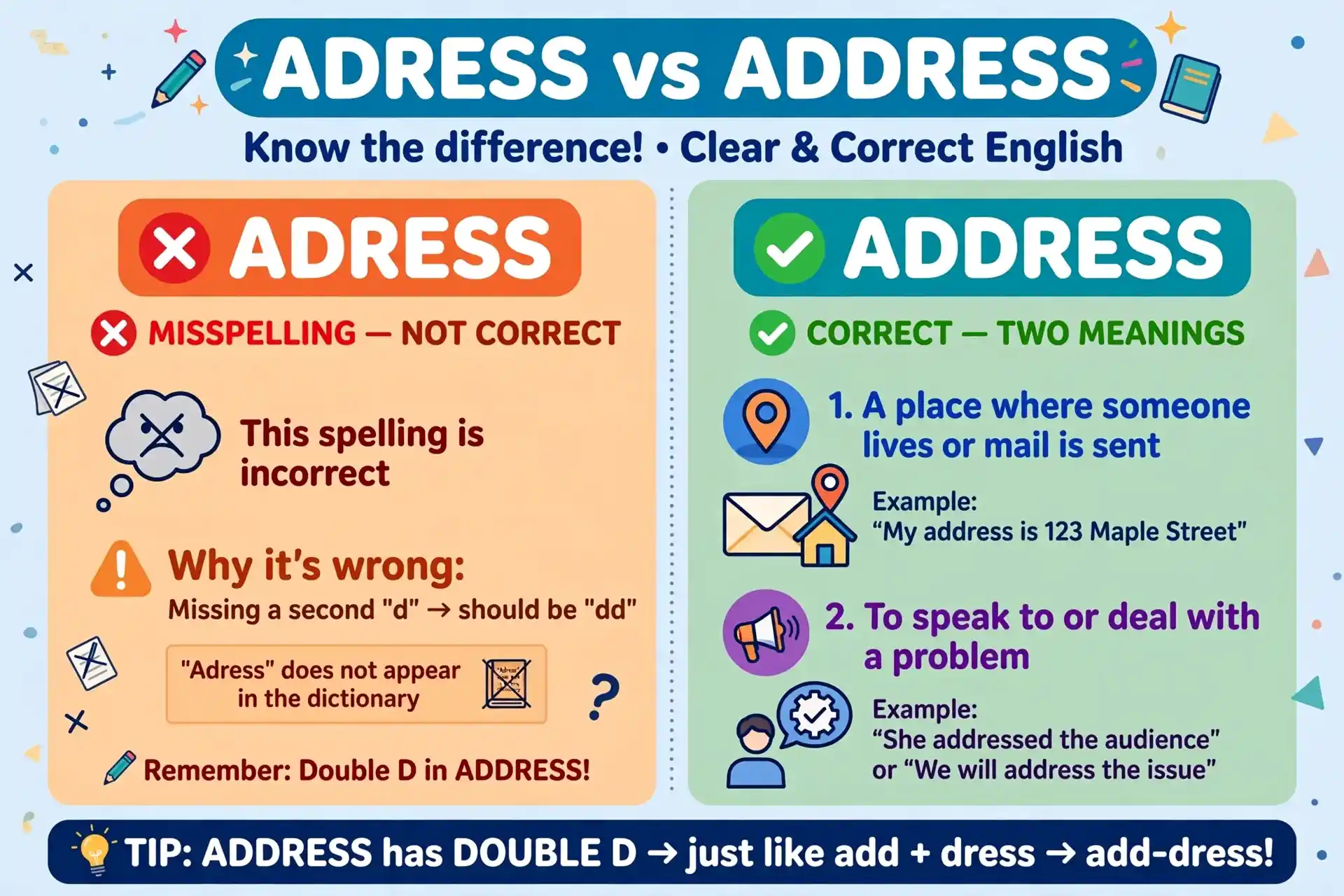
Adress is missing a letter, and one missing letter is all it takes to turn a correct word into an error. The right spelling is address, with a double D and a double S. As a noun it means where someone lives or a formal speech; as a verb it means to speak to someone or to deal with an issue — “Please address all questions to the manager.”
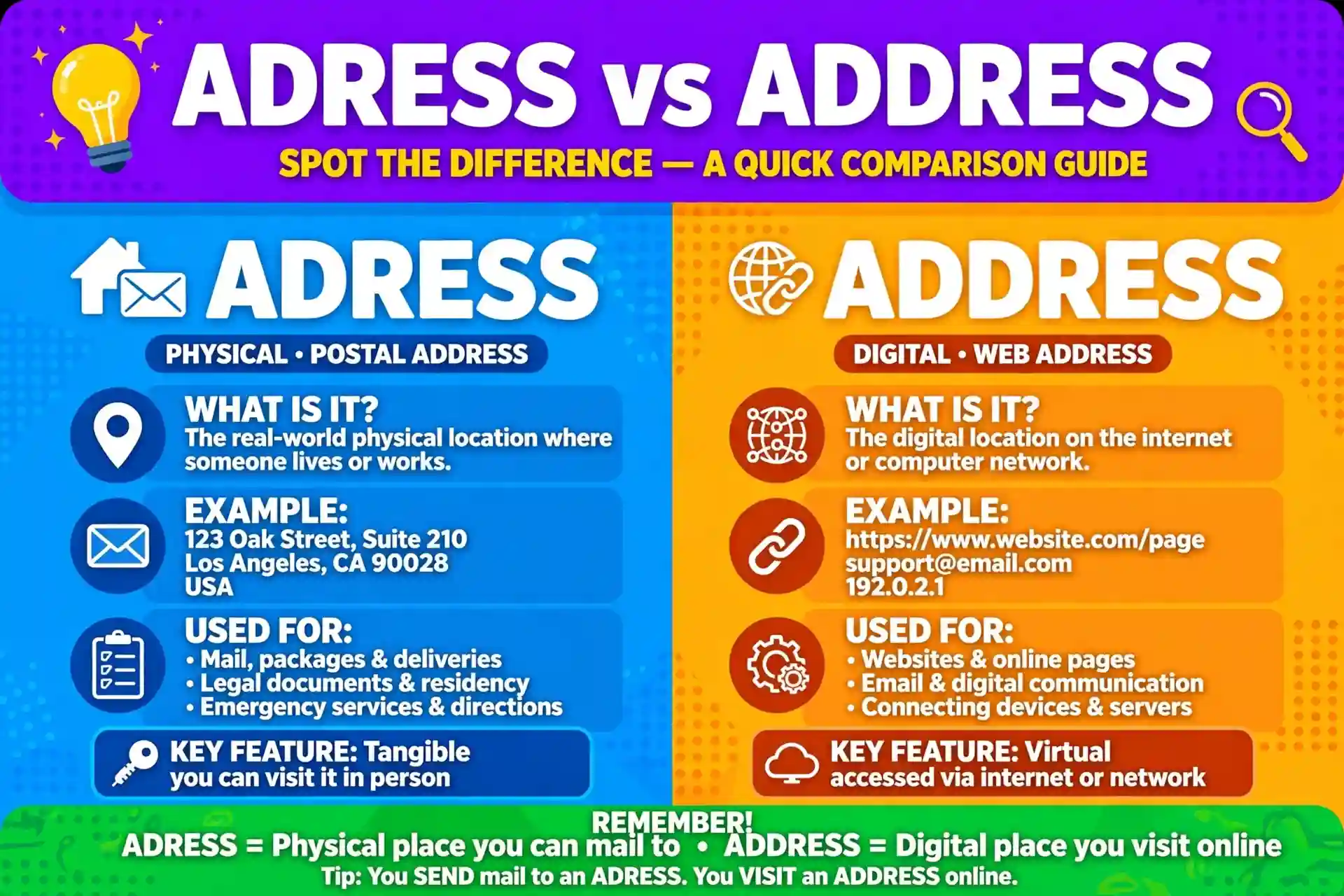
Quick Answer
| Word | Part of Speech | Main Meaning | Example |
|---|---|---|---|
| adress | — (misspelling) | Not a standard English word | ❌ “What is your adress?” |
| address | Noun / Verb | Location; a speech; to speak to or deal with | ✅ “What is your address?” |
Simple rule: Always write address with two Ds and two Ss. Adress with a single D is always wrong.
What Does Adress Mean?
Nothing in standard English. Adress is a straightforward misspelling of address, caused by writers doubling the S but forgetting to double the D — or the other way around. The word address demands two doubled letters, and dropping either one breaks it.
Examples of how this misspelling usually shows up (all incorrect):
- ❌ “Send the package to this adress.”
- ❌ “He gave an inspiring adress at the ceremony.”
- ❌ “We need to adress the problem before Friday.”
- ❌ “What is your email adress?”
The meaning in each sentence is perfectly clear, which is why the error survives — readers understand it, so writers never get corrected. But in any formal or published writing, adress marks you as careless.
What Does Address Mean?
Address is a versatile word with two main jobs. As a noun, it means a location where someone lives or works, or a formal speech delivered to an audience. As a verb, it means to speak to someone directly or to deal with a problem. Merriam-Webster’s entry for “address” covers both the location and the speech-to-an-audience senses.
As a noun
- “Please write your name and address on the form.”
- “The mayor gave a short address at the opening ceremony.”
- “I don’t know his home address, only his phone number.”
As a verb
- “The principal addressed the students about the new rules.”
- “We need to address the budget problem before the meeting.”
- “She addressed the letter to her grandmother in Lahore.”
Adress vs. Address: Key Differences
| Feature | Adress | Address |
|---|---|---|
| Spelling status | Misspelling — not a real word | Correct standard spelling |
| Letter pattern | Single D, double S | Double D, double S |
| Meanings | None | Location; speech; to speak to; to deal with |
| Dictionary entry | No entry | Listed in every major dictionary |
| Pronunciation | — | uh-DRESS (stress on the second syllable) |
| Example | ❌ “Enter your adress.” | ✅ “Enter your address.” |
The whole difference is one letter: address doubles both the D and the S, while adress drops one of the Ds. Double letters are the entire game here.
Adress and Address in Real Sentences
At Home
❌ “I wrote the wrong adress on the envelope.”
✅ “I wrote the wrong address on the envelope.”
Mailing labels are where this error shows up most — double-check the spelling before the package leaves your hands.
At Work
❌ “The CEO will adress the team at noon.”
✅ “The CEO will address the team at noon.”
In work emails and announcements, the verb form is common, and the single-D spelling undermines an otherwise professional message.
In Conversation
❌ “Can you adress this issue with him?”
✅ “Can you address this issue with him?”
“Address the issue” is one of the most frequent business phrases in English, so getting this spelling right pays off daily.
Common Mistakes
Double-letter words trip up even strong spellers — the “recieve” vs “receive” spelling mix-up comes from a similar instinct to simplify, and the cancelled or canceled double-consonant pattern shows how one extra letter changes everything. With address, these are the traps:
Mistake 1: Doubling only the S
❌ “What is your adress?”
✅ “What is your address?”
Why: Writers remember one double letter but forget the other. Address doubles both: ad-dress.
Mistake 2: Doubling only the D
❌ “The package arrived at the addres yesterday.”
✅ “The package arrived at the address yesterday.”
Why: The mirror-image mistake — one double letter is not enough. Both pairs must be there.
Mistake 3: Confusing the noun and verb stress
❌ “He gave an ADD-ress at the wedding.”
✅ The noun meaning “speech” is also pronounced uh-DRESS — same as the verb.
Why: Unlike words like “record” that shift stress between noun and verb, address keeps its stress on the second syllable in both roles.
Mistake 4: Typing “adress” in email fields
❌ Typing “adress” into a shipping form and not noticing.
✅ Slow down on double-letter words when filling forms.
Why: Autocomplete and muscle memory rush you past the spelling. On labels and forms, the error becomes permanent the moment you hit submit.
Pronunciation
Address is pronounced uh-DRESS, with the stress on the second syllable — whether it is a noun or a verb. It rhymes with “undress,” “redress,” and “caress.” The double D and double S each produce a single sound; doubled letters in English usually do not change pronunciation, they just anchor the spelling.
How to Remember the Difference
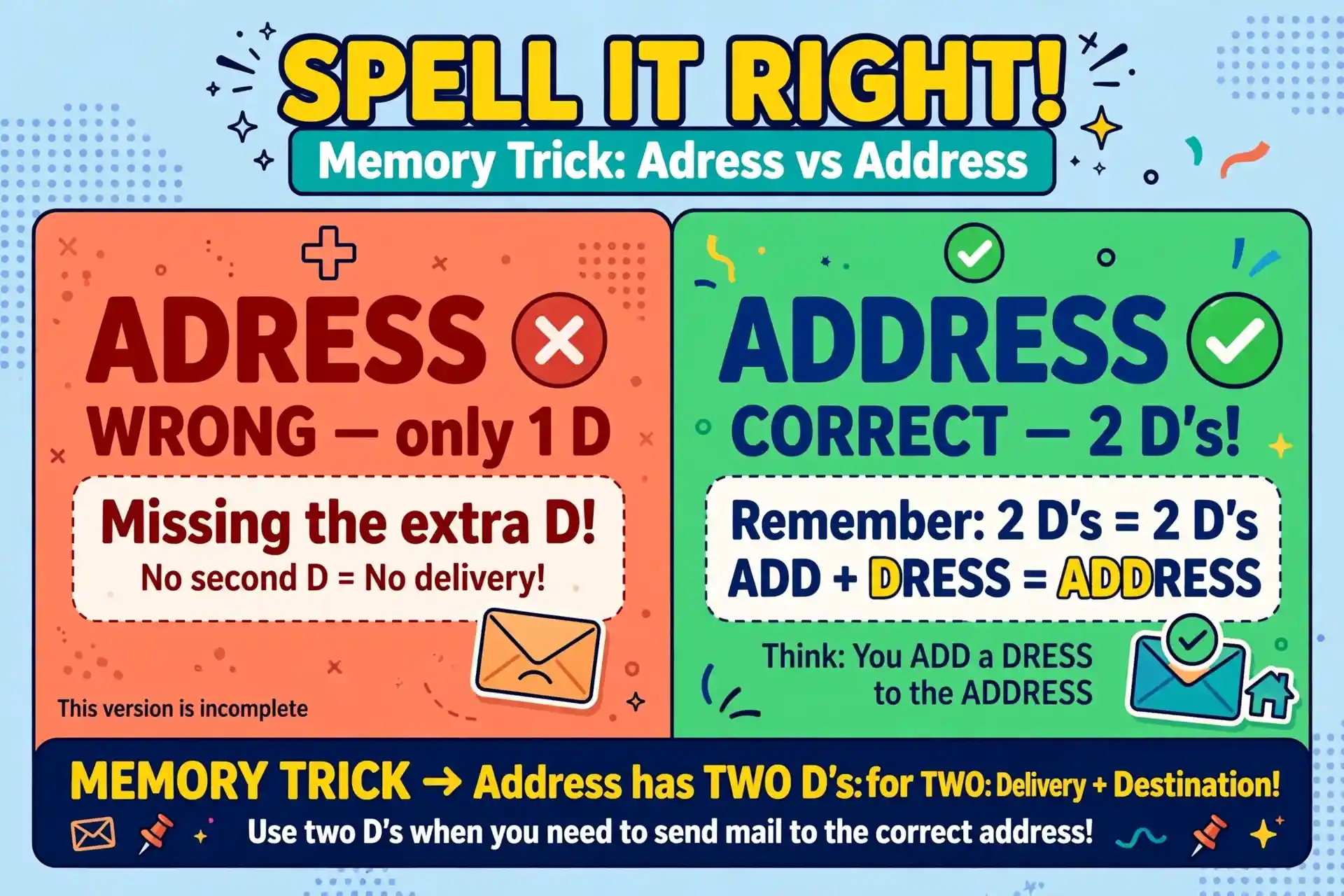
Address has double Ds and double Ss — think of it as a word with two pairs of twins. A handy picture: the “dd” is the house number and the “ss” is the street — you need both to deliver the mail.
- Break it down: ad-dress. The prefix “ad-” (meaning “toward”) plus “dress” — dress it up with two pairs of doubles.
- Count the doubles: a-dd-re-ss. Two sets of doubles, no exceptions.
- Spell it aloud: A-D-D-R-E-S-S. Saying the doubles out loud once cements the pattern.
Frequently Asked Questions
Is it adress or address?
Address. Adress is a misspelling and is never correct in standard English.
Is “adress” ever acceptable?
No. No major dictionary lists it, and it is not recognized as a variant in any register.
Why is “address” spelled with double D and double S?
It comes from the prefix “ad-” plus an old root related to directing or guiding. Over centuries the spelling settled with both consonants doubled, and English kept them.
Is “address” a noun or a verb?
Both. The noun means a location or a formal speech; the verb means to speak to someone or to deal with something.
What is the plural of “address”?
Addresses — just add “-es”: “We collected everyone’s addresses before sending the invitations.”
How do you use “address” as a verb in a sentence?
“The manager addressed the team’s concerns at the meeting” — meaning she spoke to them and dealt with the issue.
Conclusion
Address is the only correct spelling, and it always carries two Ds and two Ss — adress is simply missing a letter. Remember the two pairs of twins, and this word will never trip you up again.