Dived or Dove: What’s the Difference? (With Examples)
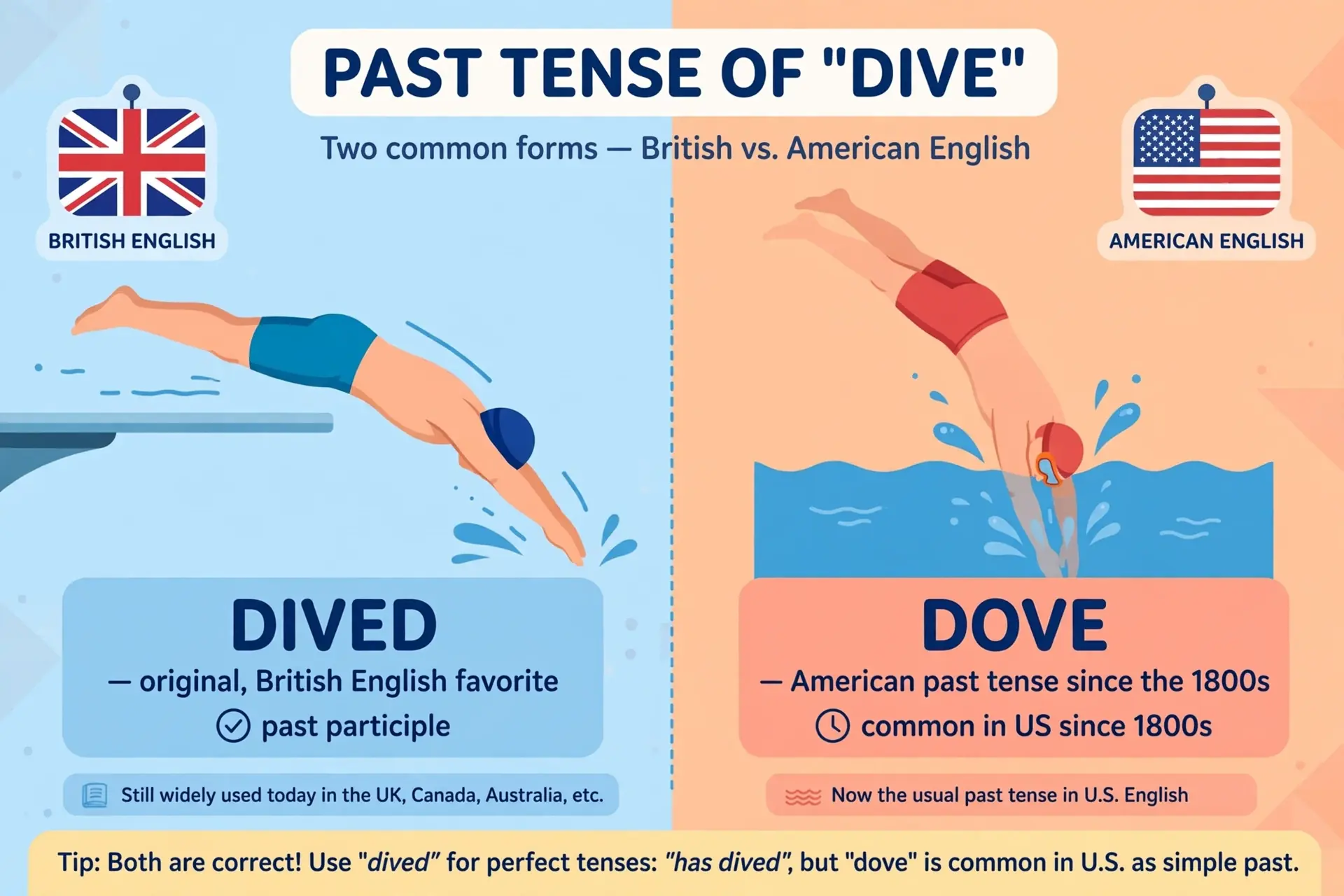
Dived and dove are both the past tense of the verb dive, and both are correct. Dived is the original form and is preferred in British English and as the past participle everywhere; dove developed in the 1800s in North America and is now the more common past tense there.
You can say “She dove off the boat” or “She dived off the boat” — both are grammatical. The safest choice, especially in writing, is dived, because it is also the past participle: “He has dived here before.”
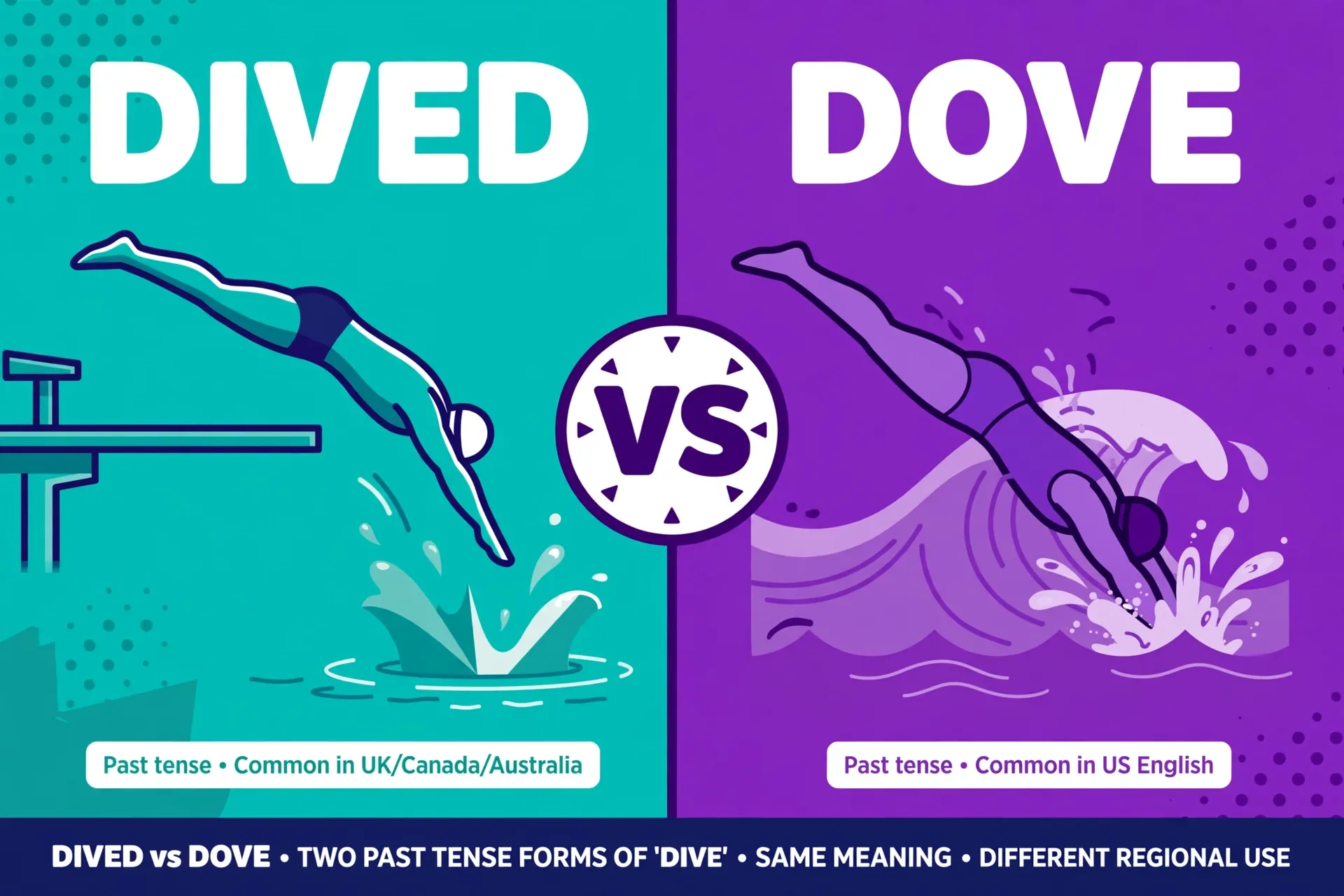
Table of Contents
Quick Answer
| Word | Part of Speech | Main Meaning | Example |
|---|---|---|---|
| dived | verb (past tense / past participle) | plunged into water or into an activity; standard everywhere, preferred outside North America | “They dived into the project on Monday.” |
| dove | verb (past tense) | same meaning as dived; more common in North American English | “They dove into the project on Monday.” |
Simple rule: meaning is identical — dove is the North American favorite, dived is the safe choice everywhere, especially for the past participle.
What Does “Dived” Mean?
Dived is the original past tense of dive — to plunge headfirst into water, to drop sharply, or to plunge into an activity. It is also the standard past participle (“have dived”). It is the preferred form in British English and remains correct everywhere.
Examples:
- “The lifeguard dived in and reached the swimmer in seconds.”
- “Share prices dived after the announcement.”
- “We have dived off this reef many times.”
- “She dived into her books and barely looked up all evening.”
- “The goalkeeper dived to his left and saved the penalty.”
Dived as past participle
This is where dived is non-negotiable. After have, has, or had, use dived: “He has dived in colder water.” The form “has dove” is considered nonstandard by most dictionaries and style guides.
What Does “Dove” Mean?
Dove is the alternate past tense of dive that emerged in the 1800s, probably by analogy with drive/drove. It means exactly the same thing as dived but is far more common in the United States and Canada, especially in speech and sports writing.
Examples:
- “He dove off the high board and barely made a splash.”
- “The outfielder dove for the ball and caught it.”
- “She dove into her studies the moment school started.”
- “The submarine dove to three hundred meters.”
- “They dove for cover when the fireworks started.”
Watch out for the bird
Dove is also the name of the gentle gray bird, pronounced /dʌv/ (rhyming with “love”). As the past tense of dive, it is pronounced /doʊv/ (rhyming with “rove”). Same spelling, two meanings, two pronunciations — context tells you which one it is.
Dived vs. Dove: Key Differences
| Feature | Dived | Dove |
|---|---|---|
| Meaning | past of dive | past of dive — identical meaning |
| History | original form, centuries old | developed in the 1800s, by analogy with drive/drove |
| Regional preference | preferred in British English; fine everywhere | more common in North American English |
| Past participle | yes — “has dived” is standard | not standard — “has dove” is avoided |
| Pronunciation | /daɪvd/ — one syllable, “dived” | /doʊv/ — rhymes with “rove” (verb); /dʌv/ (bird) |
| Tone | neutral, safe in formal writing | natural in American speech and sports writing |
The two are interchangeable as simple past tense; the difference is one of geography and habit, not meaning.
Usage Examples in Real Sentences
At the Pool
“He dived in to rescue the beach ball.” / “He dove in to rescue the beach ball.” — Same event, same meaning; the first sounds more British, the second more American.
In Sports
“The keeper dived right and blocked the shot.” / “The center fielder dove and made the catch.” — Sports commentators in the US overwhelmingly favor dove, while British ones favor dived.
In Conversation
“Prices dived overnight.” / “She dove into the new novel and finished it in two days.” — Figurative uses (plunging into prices, books, or topics) accept either form.
Common Mistakes
Verb-form confusions are common in English — similar headaches include the spelling of dying and lose or loose. Here is what to avoid with dived and dove:
Mistake 1: Using dove as the past participle
❌ “I have dove off that cliff before.”
✅ “I have dived off that cliff before.”
Why: the past participle is dived everywhere; “has dove” is nonstandard.
Mistake 2: Thinking dove is always wrong
❌ “Dove is not a real word — only dived is correct.”
✅ Both are correct as the simple past tense of dive.
Why: dictionaries record dove as a fully standard American past tense of dive — see Merriam-Webster’s entry for dive, which notes dove developed in the 1800s and is now more common in North American English.
Mistake 3: Using dove in a British exam
❌ (in a UK context) “The submarine dove beneath the waves.”
✅ (in a UK context) “The submarine dived beneath the waves.”
Why: dived remains the preferred form in British English; using dove there can read as an error.
Mistake 4: Pronouncing the verb like the bird
❌ “She dove (like ‘love’) into the pool.”
✅ “She dove (like ‘rove’) into the pool.”
Why: the verb dove is /doʊv/; the bird is /dʌv/.
Pronunciation
Dived = /daɪvd/, one syllable, rhyming with “lived”. Dove (the verb) = /doʊv/, rhyming with “rove” and “strove”. The bird dove = /dʌv/, rhyming with “love” and “shove”. Context makes clear which one you mean.

How to Remember the Difference
Think of dove as the American cousin — it flew over to North America in the 1800s. Dived is the original and the only one that follows “have”: have dived, never “have dove”. When in doubt, dived is never wrong.
- Dived = original past tense; also the past participle (“has dived”).
- Dove = American past tense; not used after “have”.
- Meaning is identical — the choice is regional.
- Verb dove rhymes with “rove”; the bird rhymes with “love”.
Frequently Asked Questions
Is it dived or dove?
Both are correct as the past tense of dive. Dived is the original and the safe choice everywhere; dove is more common in North American English.
Is “has dove” correct?
No — use dived as the past participle: “has dived”, “had dived”. “Has dove” is nonstandard.
Which is correct in British English?
Dived. British style guides prefer dived, and most UK speakers rarely use dove as a verb.
When did dove become a word?
Dove as the past tense of dive developed in the 1800s, probably by analogy with drive/drove, and is now more common than dived in spoken North American English.
How is the verb dove pronounced?
/doʊv/ — rhyming with “rove”. Do not confuse it with the bird dove, pronounced /dʌv/ like “love”.
Conclusion
Dived and dove mean the same thing as the past tense of dive. Use dove in American speech if you like, but remember that dived is the original form, the British preference, and the only standard past participle.