Eery or Eerie: What’s the Difference? (With Examples)
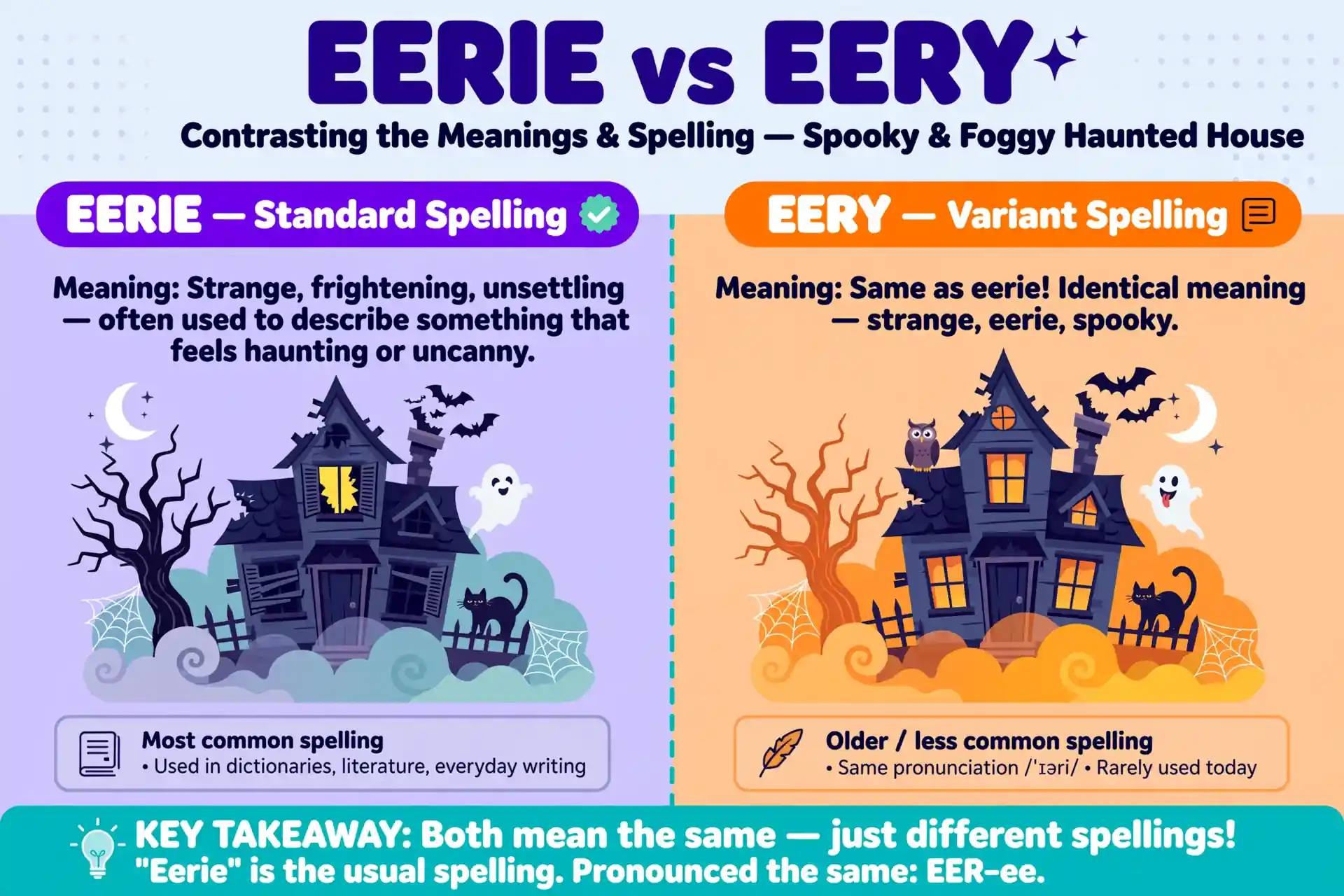
Eerie is the standard, dictionary-approved spelling for the word meaning strange and mysterious, while eery is an older variant that most style guides now consider outdated. The one-line difference: eerie is the spelling you should use everywhere, and eery is the one you’ll mostly find in older books. For example, ‘an eerie silence fell over the empty house’ is correct modern usage, while ‘an eery silence’ looks like a typo to most readers today.
Table of Contents
Quick Answer
| Word | Part of Speech | Main Meaning | Example |
|---|---|---|---|
| Eerie | Adjective | Strange and frightening in a mysterious way | An eerie glow came from the abandoned house. |
| Eery | Adjective | Variant spelling of eerie (rare/dated) | He wrote of an eery quiet in his journal. |
Simple rule: always spell it eerie in modern writing — eery will look like a mistake to almost every reader.
What Does Eerie Mean?
Eerie (pronounced “EAR-ee”) is an adjective describing something strange, mysterious, or frightening in a way that gives you a chill. It’s the standard spelling in every major dictionary and the only form your spellchecker will accept without complaint.
Examples:
- An eerie silence settled over the courtroom after the verdict was read.
- The fog rolled in, giving the old lighthouse an eerie glow.
- It felt eerie walking through the empty school at midnight.
- She had an eerie feeling that someone had been in her room.
- The song’s eerie melody stayed with him for days.
- It was eerie how closely the twins resembled each other.
- The old photographs had an eerie quality, as if the subjects knew they were being watched.
- An eerie calm settled over the stadium before the penalty kick.
Eerie differs from words like scary or terrifying because it describes a quieter, creepier feeling — the sense that something is off without an obvious threat. A horror film jumpscare is scary; an empty playground at dusk is eerie. That distinction is why the word shows up so often in ghost stories, thrillers, and reviews of unsettling art.
What Does Eery Mean?
Eery is simply a variant spelling of eerie — it means the same thing, but it’s far less common and considered dated. Some older dictionaries list it as an alternative, but modern style guides and editors treat it as a misspelling. You’ll mostly encounter eery in 19th-century literature or very old publications.
Examples:
- A 19th-century poem might describe an “eery calm” over the sea — that was the accepted variant then.
- In modern writing, “eery” almost always gets flagged as an error.
- Quoting old texts is the one safe place for “eery” today.
Eerie vs. Eery: Key Differences
| Feature | Eerie | Eery |
|---|---|---|
| Correctness | Standard, dictionary-approved | Variant / considered a misspelling today |
| Usage frequency | Extremely common | Rare, mostly historical |
| Spellchecker | Accepted everywhere | Flagged as an error |
| Recommended in essays/exams | Yes — the only safe choice | No — will be marked wrong |
| Meaning | Strange, mysterious, unsettling | Same meaning |
The difference is purely about spelling convention: one is the modern standard, the other a relic.
Usage Examples in Real Sentences
Describing a Place
“The abandoned mall had an eerie atmosphere” — use the standard spelling for a modern reader. “The abandoned mall had an eery atmosphere” would likely be read as a typo.
In Literature
Classic ghost stories lean on eerie constantly — “an eerie stillness hung over the moor” is the kind of line that sets the tone of an entire chapter. Modern authors choose eerie over eery without thinking twice, since the older variant would pull the reader out of the story.
Describing a Photo or Video
“That abandoned-theme-park footage is genuinely eerie” — a natural comment on social media. The word works well for anything that feels familiar but wrong, the same quality psychologists call the uncanny.
In Storytelling
“The woods grew eerie after sunset” fits any modern horror story. Only historical fiction set before 1900 might use “eery” for period flavor.
In Conversation
“It was so eerie — the power went out right as the storm hit” sounds natural. Nobody spells it eery in a text message.
Common Mistakes
Writers sometimes get confused by extra letters like in desert and dessert, and here the question is which letter count is right. These words that sound identical but mean different things follow the same rule: learn the standard form and stick with it.
Mistake 1: Using “eery” in a school essay
❌ “The forest was eery in the moonlight.”
✅ “The forest was eerie in the moonlight.”
Why: modern teachers and dictionaries recognize only eerie.
Mistake 2: Assuming “eery” is the British spelling
❌ “Maybe eery is British English like colour?”
✅ “Eerie is standard in both American and British English.”
Why: this isn’t a US/UK split — eerie wins everywhere.
Mistake 3: Keeping “eery” in a spellchecker-off document
❌ Leaving “eery” in a printed article.
✅ Search your document for “eery” and replace with eerie.
Why: readers will assume it’s a typo even if you found it in an old dictionary.
Pronunciation
Eerie is pronounced “EAR-ee” — it rhymes with weary, dreary, and leery. The old variant eery is pronounced exactly the same, since it was never a different word, only a different spelling.
How to Remember the Difference
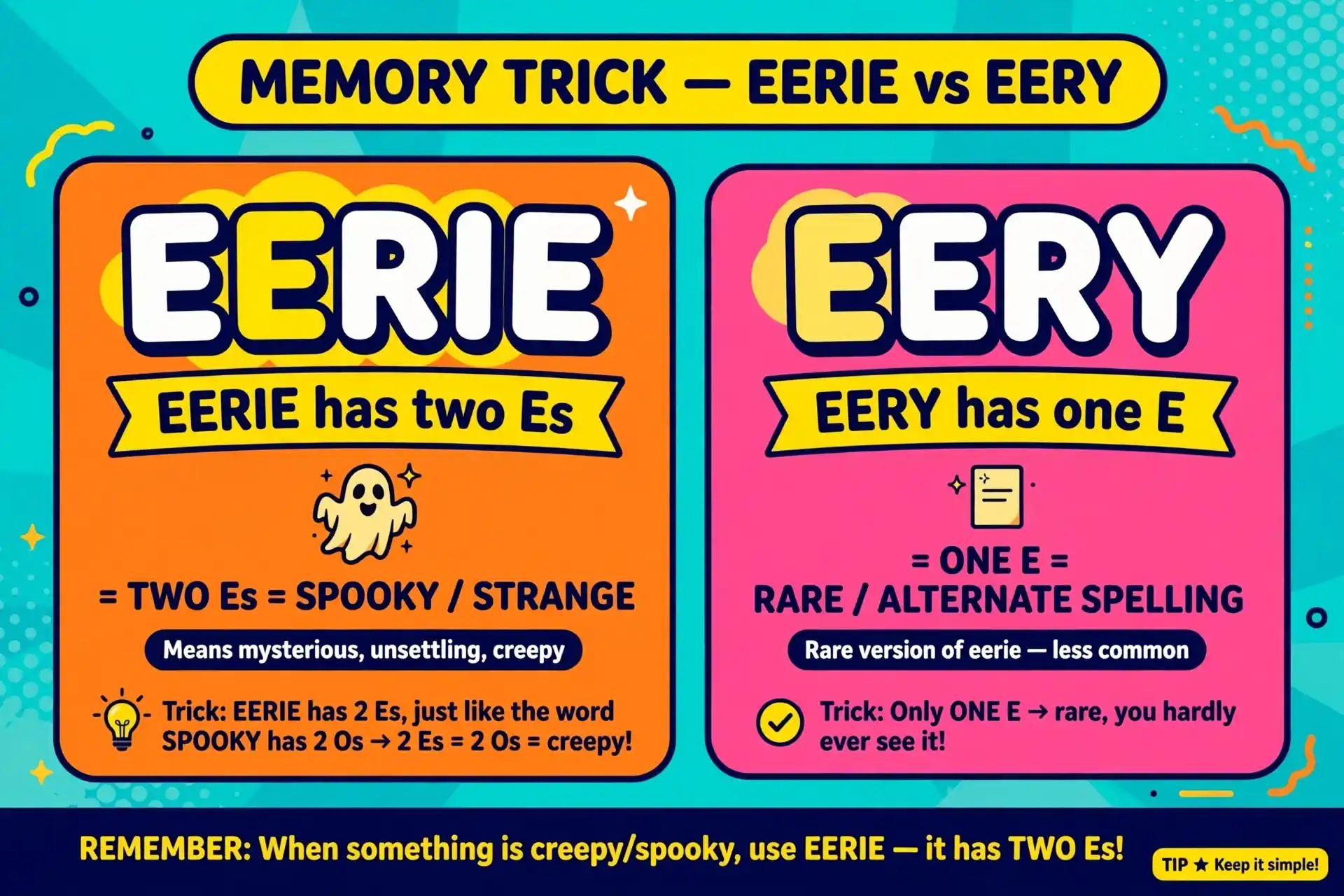
Think of the double EE in eerie as two wide-open eyes staring at something scary — creepy scenes give you eerie feelings. Just remember:
- Eerie = two Es, the modern standard spelling
- Eery = one E after the R, an outdated variant to avoid
- When in doubt, write eerie — it’s always correct
Frequently Asked Questions
Is it eery or eerie?
It’s eerie. That is the correct modern spelling; eery is an outdated variant that most readers will treat as a misspelling.
Is “eery” a word?
Technically yes — it’s listed as a variant of eerie in some older dictionaries. But in practice, use eerie to avoid confusion. Language works on shared expectations, and the shared expectation today is the double-E spelling.
Why does “eerie” have so many vowels?
The word traces back through Scots and Old Norse roots, and its spelling reflects centuries of vowel shifts rather than any logical system. Words like eerie, weird, and weary all carry this old vowel-heavy DNA — which is exactly why the memory trick about wide-open eyes fits so well.
Do British people spell it “eery”?
No. Both British and American English use eerie as the standard spelling.
What does eerie mean?
Eerie means strangely frightening or mysterious in a way that gives you an uneasy feeling. See Merriam-Webster’s definition of eerie for more.
Can I use “eery” in creative writing?
You could use it for deliberate historical flavor, but readers will likely assume it’s a typo, so eerie is the safer choice even there.
Conclusion
Eerie is the standard modern spelling and the one you should always use. Eery means the same thing but is an outdated variant that looks like a mistake to today’s readers. When the letters could go either way, the extra E wins.