Desert or Dessert: Meaning, Difference, and Examples
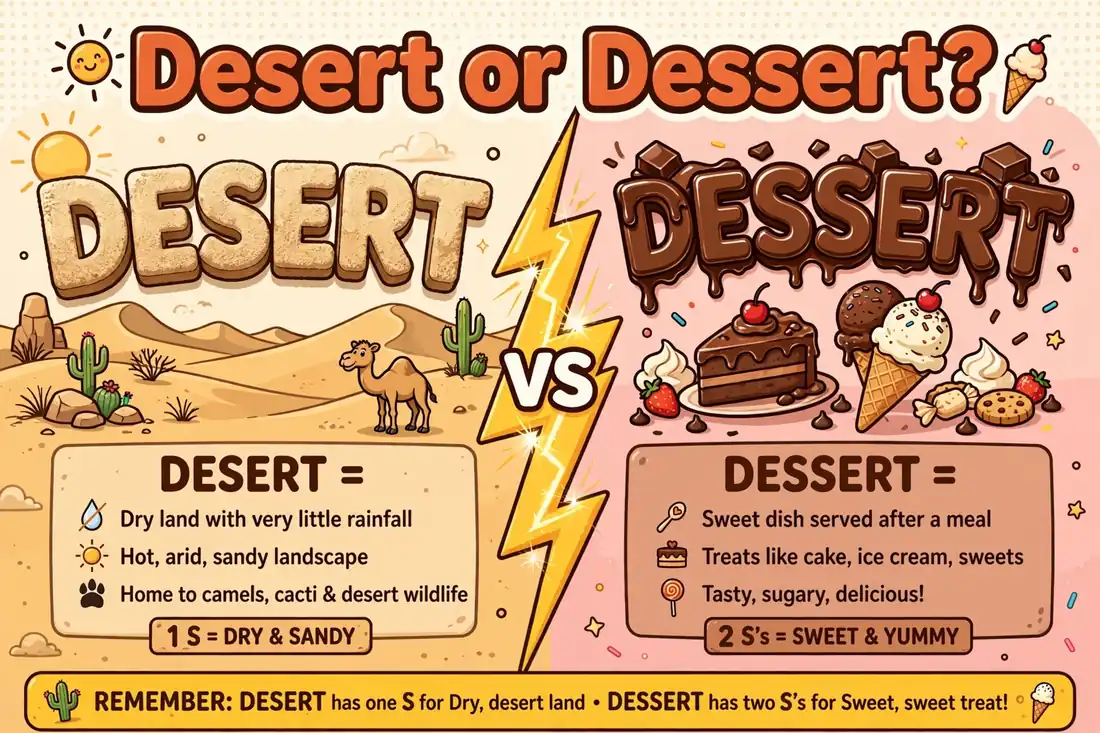
Desert and dessert are both correct English words, but they have different meanings. A desert is a dry region that receives very little rainfall. A dessert is a sweet food usually served after a meal.
The main spelling difference is one extra s. Use desert for a dry landscape and dessert for a sweet treat.
Quick Answer: Desert or Dessert?
- Desert means a dry region: The explorers crossed the desert.
- Dessert means sweet food served after a meal: We had chocolate cake for dessert.
- Desert can also be a verb meaning to abandon someone or something: He would never desert his family.
Both spellings are correct. The right choice depends on the meaning you want to express.
Quick Facts About Desert and Dessert
| Feature | Desert | Dessert |
| Main meaning | A dry region | A sweet course after a meal |
| Part of speech | Noun and verb | Noun |
| Number of “s” letters | One | Two |
| Noun pronunciation | DEZ-ert | dih-ZERT |
| Verb pronunciation | dih-ZERT | Not commonly used as a verb |
| Example | The desert is vast. | We ordered dessert. |
| Memory clue | One “s” for a dry place | Two “s” letters for a second serving |
What Does Desert Mean?
Desert has two main meanings. It can describe a dry geographical region or the act of abandoning someone or something.
Its pronunciation depends on how you use it in a sentence.
1. Desert as a Noun
As a noun, desert means a large area that receives very little rainfall. Deserts often have limited vegetation, but they are not always sandy or hot.
Some deserts contain rocks, gravel, or snow. Their defining feature is a lack of precipitation.
Examples:
- The travelers crossed the desert before sunset.
- A camel can survive in harsh desert conditions.
- The Atacama is known for its extremely dry climate.
- We watched the sun disappear behind the desert hills.
- Few plants can survive in some parts of the desert.
- The researchers studied wildlife in the desert.
A desert can be hot or cold. The word does not always refer to a sandy landscape.
2. Desert as a Verb
As a verb, desert means to leave someone, a place, or a responsibility behind. It can also describe leaving military service without permission.
Examples:
- He promised he would never desert his family.
- The soldiers were accused of deserting their posts.
- Many residents deserted the town after the flood.
- She felt that her friends had deserted her.
- His confidence deserted him during the interview.
In these sentences, desert describes abandonment or leaving.
3. Desert in Figurative Expressions
The word can also describe a place that lacks a particular quality.
For example, a cultural desert is a place considered to have little cultural activity or variety.
Examples:
- Without libraries or theaters, the town felt like a cultural desert.
- The empty office became a desert after the company moved.
- The garden turned into a desert during the drought.
These examples use desert figuratively rather than geographically.
What Does Dessert Mean?
Dessert is a noun that refers to sweet food served at the end of a meal. Common examples include cake, ice cream, pudding, fruit, and pastries.
It can describe one sweet dish or the final sweet course.
Examples:
- We ordered chocolate cake for dessert.
- Would you like ice cream or fruit for dessert?
- She prepared a special dessert for the guests.
- The restaurant offers several desserts on its menu.
- I was too full to eat dessert.
- My grandmother makes a delicious dessert for family gatherings.
A dessert does not have to be baked or contain chocolate. Fresh fruit can also be served as dessert.
Common Types of Dessert
Desserts come in many forms. They can be cold, warm, baked, or prepared without cooking.
Common examples include:
- Cakes and cupcakes
- Ice cream and frozen yogurt
- Pies and tarts
- Puddings and custards
- Cookies and pastries
- Fruit-based sweet dishes
- Sweet rice dishes
The word dessert refers to the sweet course, not one specific recipe.
Key Differences Between Desert and Dessert
The spelling, meaning, pronunciation, and grammatical use distinguish these words.
| Feature | Desert | Dessert |
| Meaning | Dry region or to abandon | Sweet food after a meal |
| Part of speech | Noun and verb | Noun |
| Spelling | One “s” | Two “s” letters |
| Noun stress | First syllable | Second syllable |
| Verb form | Desert, deserted, deserting | Not used in the same sense |
| Example | They crossed the desert. | They ate dessert. |
The easiest way to choose is to identify the meaning first. If you mean a dry place, use desert. If you mean a sweet dish, use dessert.
Desert vs. Dessert Pronunciation
The words have different stress patterns.
- Desert as a noun: DEZ-ert
- Desert as a verb: dih-ZERT
- Dessert as a noun: dih-ZERT
The geographical noun has stress on the first syllable. The verb and the sweet food have stress on the second syllable.
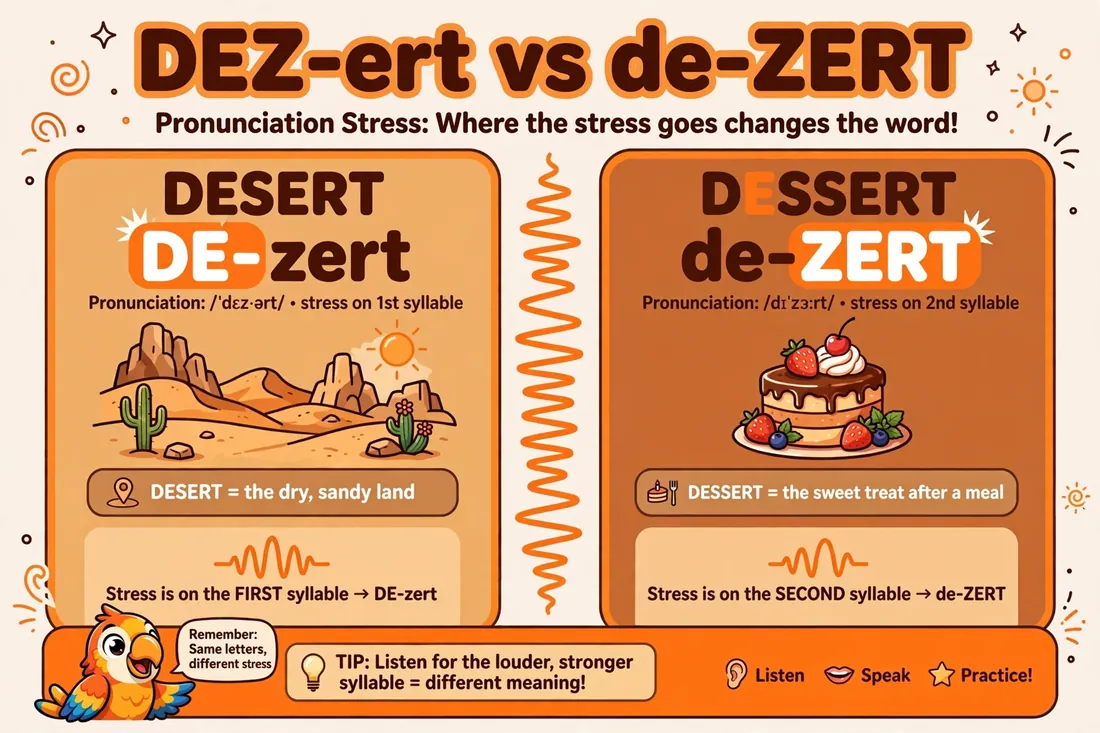
Why Do Desert and Dessert Sound Different?
The stress pattern helps distinguish the geographical noun from the other forms.
Say the first syllable more strongly when referring to dry land:
DEZ-ert
For the sweet course or the verb meaning abandon, stress the second syllable:
de-ZERT
The verb desert and the noun dessert sound alike in many English accents. Their meanings and sentence contexts help identify the correct word.
When to Use Desert or Dessert
Choose the word based on what you want to describe.
Use Desert for a Dry Region
Use desert when discussing geography, climate, land, or travel through a dry area.
Examples:
- The researchers studied plants in the desert.
- We drove across a desert landscape.
- The desert receives very little rainfall.
- They camped near the edge of the desert.
- The desert became cooler after sunset.
Use Desert for Abandoning Someone or Something
Use the verb desert when someone leaves a person, place, duty, or position behind.
Examples:
- A loyal friend would not desert you during a difficult time.
- The soldiers were punished for deserting their unit.
- The workers did not desert the project.
- She refused to desert her responsibilities.
- He deserted the vehicle after the accident.
Use Dessert for Sweet Food
Use dessert when referring to the sweet course after a meal.
Examples:
- We served fruit salad for dessert.
- The children chose their desserts from the menu.
- My favorite dessert is cheesecake.
- Would you like something for dessert?
- She baked an apple pie for dessert.
A useful clue is the phrase “for dessert.” If you are talking about food after a meal, use the spelling with two s’s.
Desert or Dessert in Sentences
These examples show how the meaning changes with the spelling.
| Sentence | Correct word | Reason |
| The explorers crossed the ___ on foot. | Desert | Refers to dry land |
| We ordered ice cream for ___. | Dessert | Refers to sweet food |
| He refused to ___ his friends. | Desert | Means abandon |
| The restaurant serves a chocolate ___. | Dessert | Names a sweet dish |
| The village sits near the edge of the ___. | Desert | Refers to a geographical area |
| She made a lemon tart for ___. | Dessert | Refers to food |
| The soldiers did not ___ their posts. | Desert | Means leave a duty |
| They watched the sunset over the ___. | Desert | Refers to dry land |
More Examples With Desert
- The desert was cold after sunset.
- A small village stood beside the desert.
- The researchers measured rainfall in the desert.
- The heat made the desert journey difficult.
- He would never desert his teammates.
- The captain warned the crew not to desert the ship.
More Examples With Dessert
- We shared a dessert after dinner.
- The café introduced a new dessert menu.
- She baked an apple pie for dessert.
- The children asked for dessert before finishing dinner.
- The dessert included fresh berries and cream.
- He chose a small dessert with his coffee.
Common Mistakes With Desert and Dessert
Because the words differ by only one letter, writers often mix them up. These mistakes become easier to avoid when you identify the intended meaning.
Mistake 1: Writing Desert When You Mean Sweet Food
Incorrect: We had cake for desert.
Correct: We had cake for dessert.
Cake is a sweet dish. Therefore, the correct spelling has two s’s.
Mistake 2: Writing Dessert When You Mean a Dry Region
Incorrect: The travelers crossed the dessert.
Correct: The travelers crossed the desert.
The sentence describes a geographical area, not a sweet course.
Mistake 3: Using Dessert as a Verb
Incorrect: He desserted his family.
Correct: He deserted his family.
Dessert is a noun. The verb meaning “to abandon” is desert.
Mistake 4: Confusing the Pronunciation of Desert
The geographical noun desert does not have the same stress as dessert.
- Geographical noun: DEZ-ert
- Sweet food: de-ZERT
- Verb meaning abandon: de-ZERT
Stress can help you recognize the intended word when speaking.
Mistake 5: Forgetting the Extra S in Dessert
A common spelling error is writing dessert with one “s.”
Remember that dessert has two s’s. The extra letter helps distinguish it from the geographical noun.
How to Remember the Difference
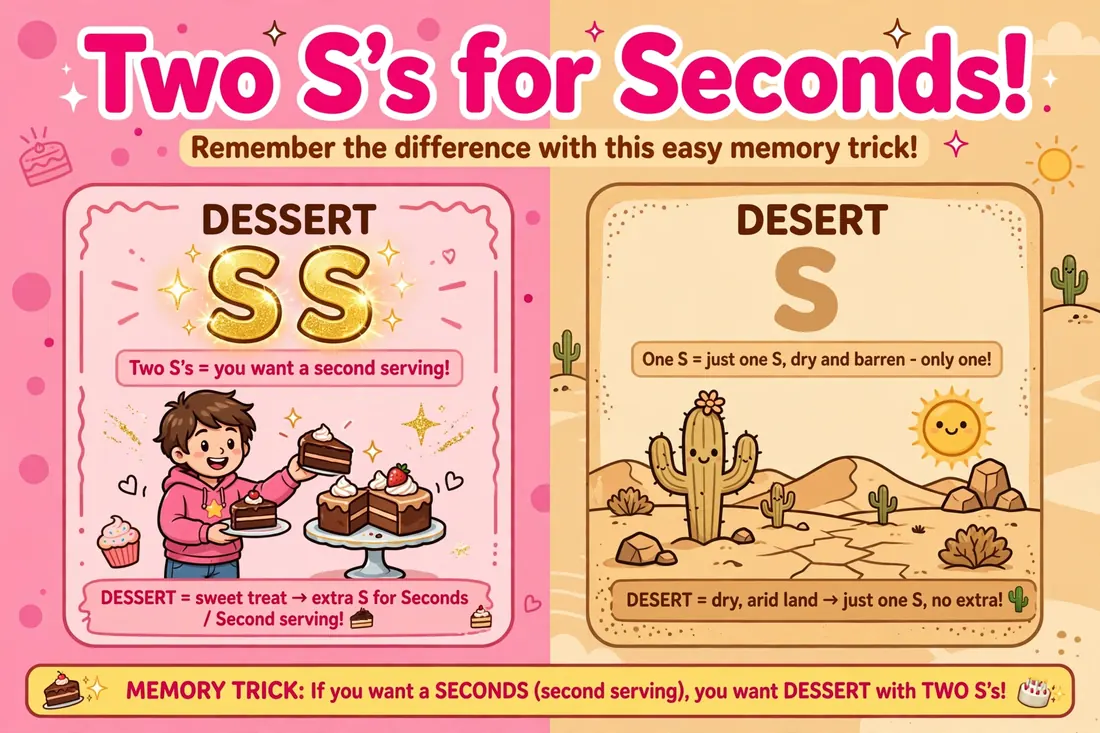
Use the phrase “Dessert has two S’s because you may want seconds.”
This memory trick connects the spelling with the idea of having another serving.
For desert, remember:
- Desert has one “s.”
- A desert is a dry place.
- The geographical noun has stress on its first syllable.
You can also remember the pronunciation:
- DEZ-ert: dry land.
- dih-ZERT: sweet food or the verb meaning abandon.
The spelling and stress patterns give you two ways to identify the correct word.
Is It “Just Deserts” or “Just Desserts”?
The established expression is just deserts, with one “s” in deserts. It means the punishment or reward someone deserves.
Examples:
- After years of dishonest behavior, he finally got his just deserts.
- The team received its just deserts after months of hard work.
- She believed the award was her just deserts.
Although the phrase sounds like it refers to sweet food, it uses deserts in a different sense. Here, the word relates to what a person deserves.
Do not change it to just desserts when you mean a deserved outcome.
Frequently Asked Questions
Is desert or dessert correct?
Both words are correct. Desert means a dry region or to abandon someone or something. Dessert means sweet food served after a meal.
How do you spell dessert?
Spell the sweet food dessert, with two “s” letters. A useful memory trick is that dessert has two s’s because you may want seconds.
Why does dessert have two S’s?
The spelling helps distinguish dessert from desert. The words have different meanings, even though their spellings are similar.
Is desert pronounced the same as dessert?
Not always. The noun desert, meaning dry land, is pronounced DEZ-ert. Dessert is pronounced dih-ZERT. The verb desert, meaning abandon, also has stress on the second syllable.
Can desert be used as a verb?
Yes. Desert means to abandon or leave someone, a place, or a responsibility. For example, “He would never desert his family.”
Is “just deserts” spelled with one S or two?
The established expression is just deserts, with one “s” in deserts. It refers to what someone deserves, whether a reward or punishment.
Conclusion
Desert and dessert are both correct, but they are not interchangeable.
Use desert for a dry region or the act of abandoning someone or something. Use dessert for sweet food served after a meal.
Remember: dessert has two s’s because you might want seconds. This simple clue can help you choose the right spelling.