Began or Begun: What’s the Difference?
Both began and begun are correct — they’re two different past forms of the verb begin. Began is the simple past tense (“The movie began at eight”), while begun is the past participle that only works with a helper verb (“The movie has begun”). The one-line version: began stands alone, begun never does.
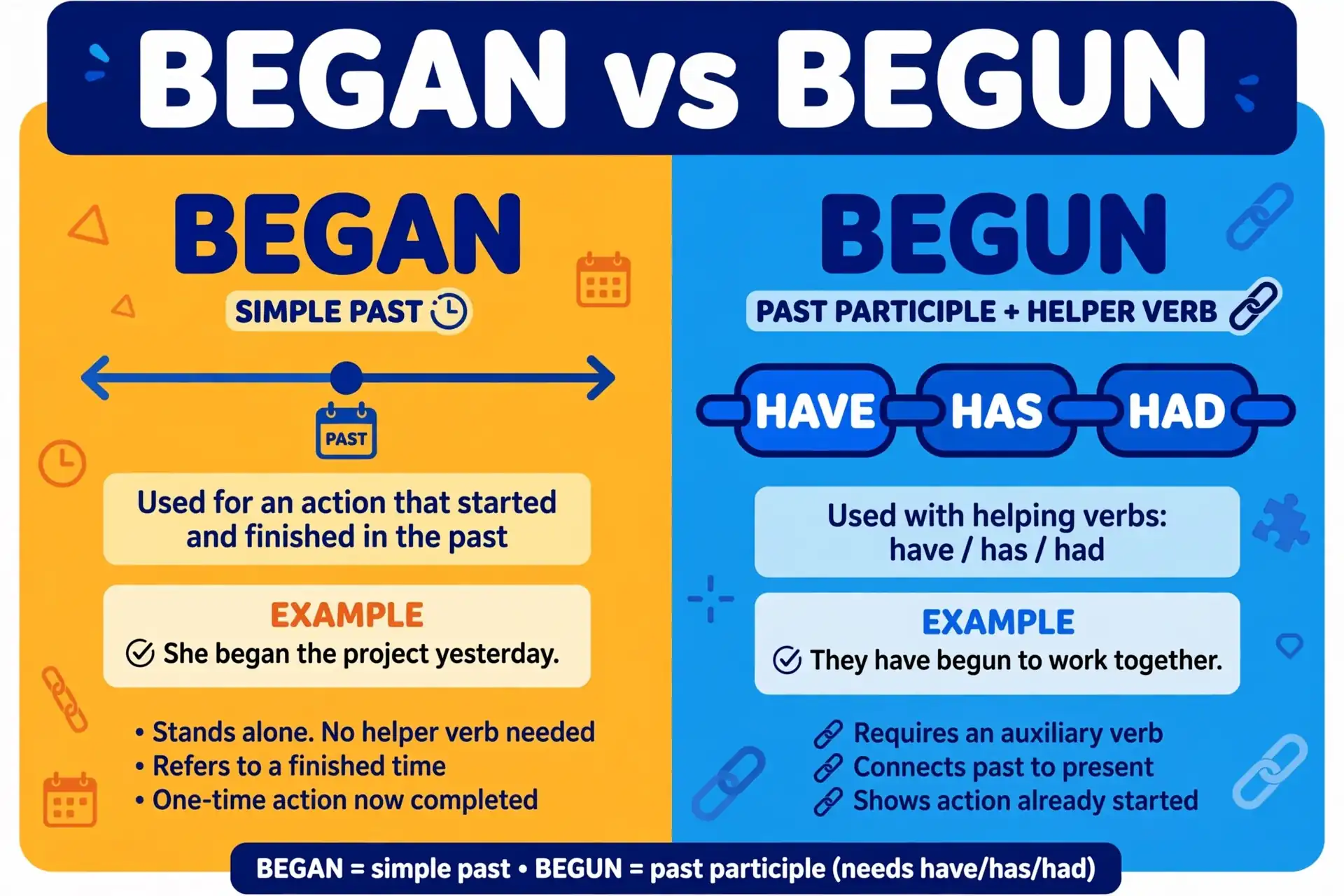
Table of Contents
Quick Answer
| Word | Part of Speech | Main Meaning | Example |
|---|---|---|---|
| began | Verb (simple past) | Started something at a specific point in the past | “The movie began at eight.” |
| begun | Verb (past participle) | Started something; always used with has, have, or had | “The movie has begun.” |
Simple rule: if there is no has, have, or had in front of it, you want began.
What Does Began Mean?
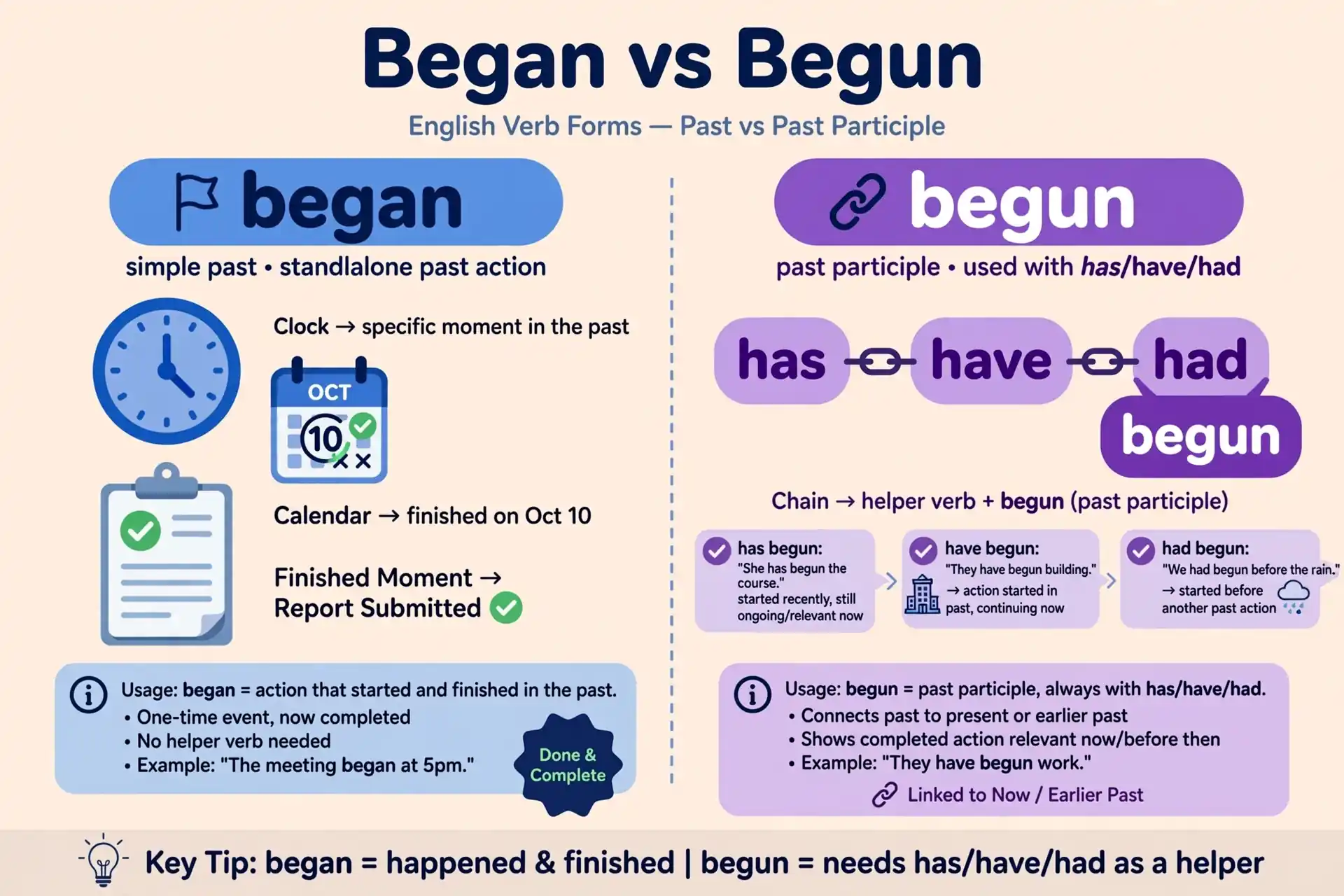
Began is the simple past tense of begin, meaning something started at a finished point in the past. It carries the whole verb job by itself — no helper needed. You can check Merriam-Webster’s entry for “begin” to see the full conjugation.
Writers also reach for began to open narratives and mark turning points — “the trouble began when…” — and it pairs happily with both an infinitive and an -ing form: “she began to laugh” and “she began laughing” say the same thing.
Examples:
- The concert began an hour ago.
- We began packing as soon as the sun came up.
- He began his career washing dishes in a diner.
- The baby began crying the moment her mother left the room.
- They began renovating the kitchen last spring.
- The trouble began the night the lights went out.
What Does Begun Mean?
Begun is the past participle of begin. It can’t stand on its own — it always teams up with has, have, or had to build perfect tenses.
Examples:
- The show has already begun.
- We had just begun eating when the power went out.
- Have you begun studying for the exam?
- The leaves have begun to fall.
- By the time I arrived, the meeting had begun.
- Registration has begun for the fall semester.
- The thaw had hardly begun before the freeze returned.
Begun also turns up in the old saying “well begun is half done” and in formal announcements — “boarding has begun,” “the sale has begun” — where the helper verb does the grammatical heavy lifting.
Began vs. Begun: Key Differences
| Feature | Began | Begun |
|---|---|---|
| Verb form | Simple past | Past participle |
| Stands alone | Yes — “I began.” | No — “I begun.” is wrong |
| Needs has/have/had | Never | Always |
| Time feel | A finished starting moment in the past | A start tied to another moment in time |
| Rhymes with | ran, can, pan | run, fun, sun |
Once you decide whether the sentence needs a standalone past action or a participle with a helper, the choice makes itself.
Usage in Real Sentences
At Home
Began: “The kids began arguing the second the Wi-Fi dropped.”
Begun: “We’ve already begun dinner, but there’s plenty left.”
The first sentence names the moment the arguing started; the second connects a started dinner to right now.
Began: “The movie began before we found our seats.”
Begun: “The movie has only just begun — you haven’t missed anything.”
One pins the start to the past; the other reassures you that the start still matters in the present.
At Work
Began: “The meeting began ten minutes late.”
Begun: “We have begun onboarding the new hire.”
One reports a finished fact about the meeting; the other describes a process that is still underway.
In Conversation
Began: “The rain began just as we left the stadium.”
Begun: “It has begun raining again.”
The simple past locks the rain to that moment; the participle form stretches it into the present.
In Writing
Began: “The story began with a single knock on the door.”
Begun: “He had hardly begun the letter when the phone rang.”
Storytellers reach for began to open scenes and begun to layer one past event behind another.
Common Mistakes
This mix-up usually comes from the two words sounding alike and both belonging to begin — the same family of confusion as verb-form slip-ups like dieing or dying and lookalike pairs like loose or lose.
Mistake 1: Using “begun” without a helper verb
❌ “The party begun at nine.”
✅ “The party began at nine.”
Why: Begun is a participle, so on its own the sentence has no main verb. Began carries the sentence alone.
Mistake 2: Putting “began” after has/have/had
❌ “We have began the project.”
✅ “We have begun the project.”
Why: Perfect tenses always use the past participle — and for begin, that participle is begun.
Mistake 3: Writing “had began” in past-perfect sentences
❌ “By noon, she had began the report.”
✅ “By noon, she had begun the report.”
Why: Had signals the past perfect, which demands the participle form.
Mistake 4: Dropping the helper in casual speech
❌ “Work begun already.”
✅ “Work has already begun.”
Why: Even informally, begun needs its helper. If you want to drop has, switch to began: “Work began already.”
Pronunciation
Began is pronounced “bih-GAN,” rhyming with ran, can, and pan. Begun is “bih-GUN,” rhyming with run, fun, and sun. Both put the stress on the second syllable.
How to Remember the Difference
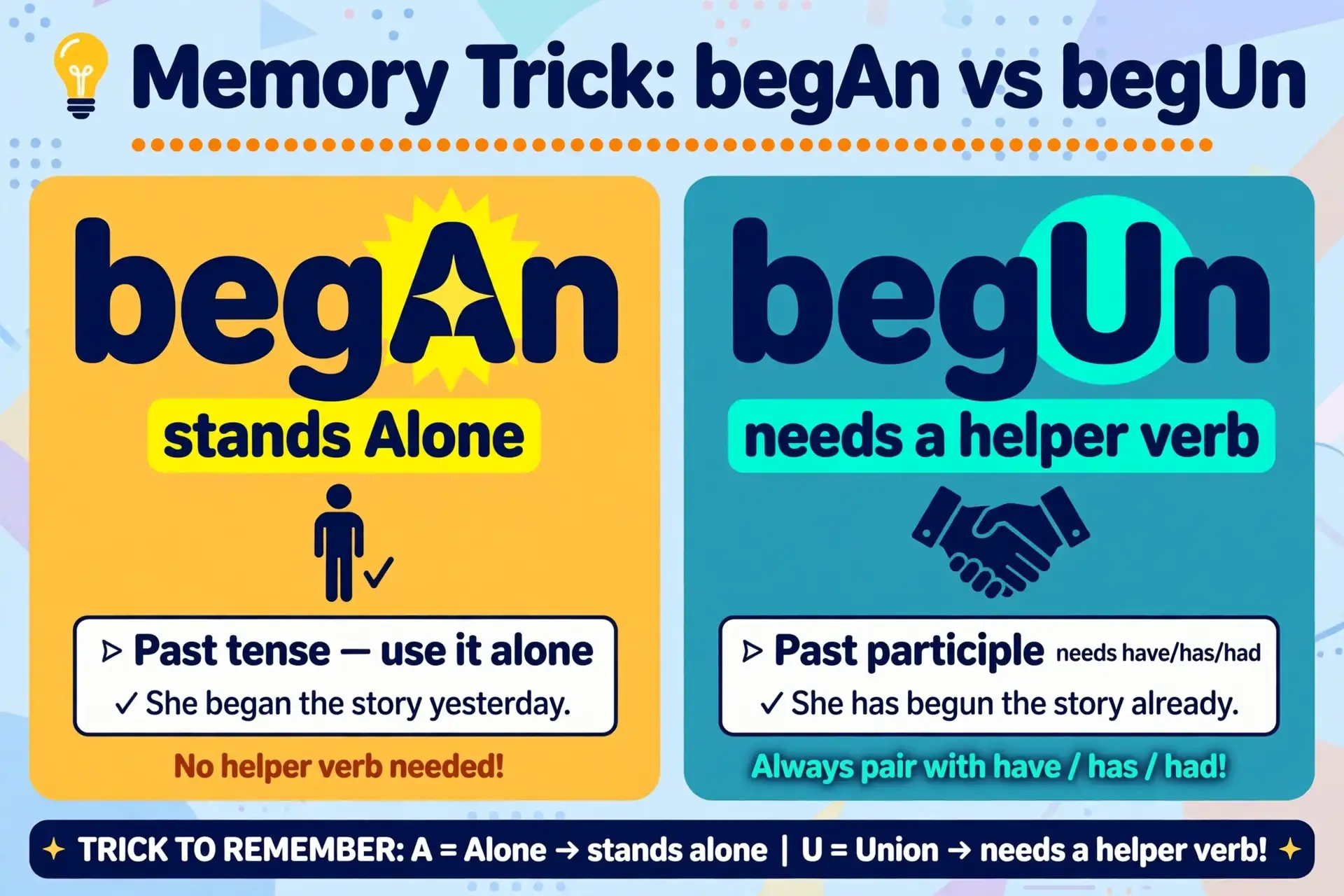
Began = action finished on its own — the A stands alone, no helper needed. Begun = u need a helper — the U always leans on has, have, or had.
- Began = simple past, stands alone: “The game began.”
- Begun = past participle, needs has/have/had: “The game has begun.”
- Began rhymes with ran; begun rhymes with run.
Frequently Asked Questions
Is it began or begun?
Both exist. Use began for a simple past action (“It began yesterday”) and begun after has, have, or had (“It has begun”). If you can point to the moment it started and the sentence is over and done, began is your word; if the starting action still connects to the present, reach for begun.
Can I say “I have began”?
No — that’s probably the single most frequent began/begun error in everyday writing. After have, always use the participle: “I have begun.” Swapping in begun takes a second and fixes it instantly.
Is “begun” ever used without a helper verb?
Not in standard English. It always appears with has, have, or had, as in “The ceremony has begun.” You’ll only see it alone when it’s quoted as a word being discussed, not working as the verb of the clause.
What is the base form of began and begun?
The base form is begin. The full set runs: begin (base), begins (third person), beginning (-ing form), began (simple past), begun (past participle). It’s an irregular verb, so the forms ignore the usual -ed pattern — worth memorizing as a set.
Is “beginned” a word?
No. “Beginned” isn’t standard English — pick began or begun based on whether a helper verb is present. Spellcheckers flag it for a reason, so if you see that red underline, trust it.
Conclusion
Began and begun are a team, not rivals: began handles the standalone past, and begun takes over whenever has, have, or had is in the picture. Check for the helper verb, and you’ll never mix them up again.