Acception or Exception: What’s the Difference?
The word you almost always want is exception — the noun for something excluded from a rule or pattern. Acception, by contrast, is an archaic noun meaning ‘acceptance’ that has virtually disappeared from modern English.
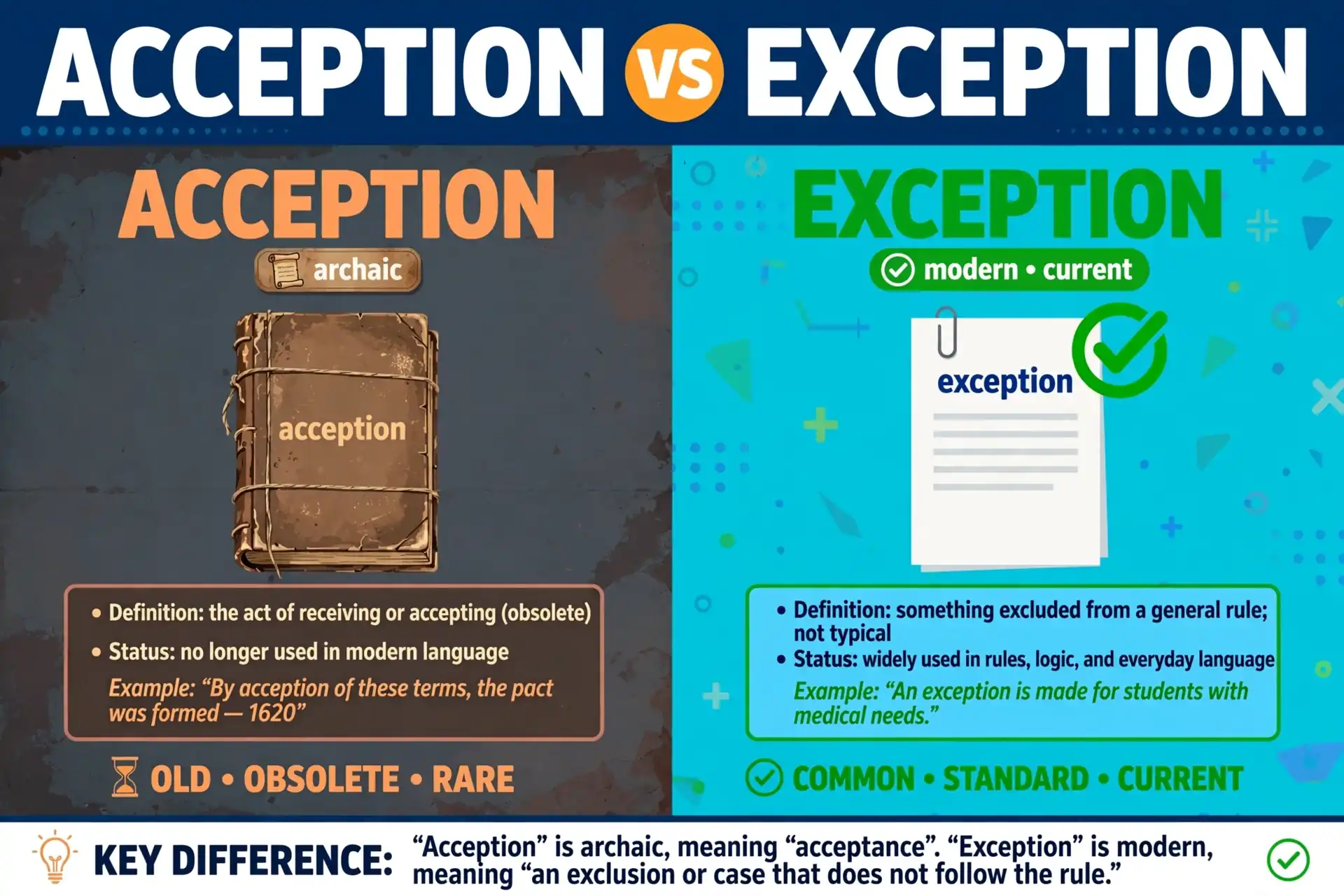
Table of Contents
Quick Answer
| Word | Part of Speech | Main Meaning | Example |
|---|---|---|---|
| Acception | Noun (archaic/rare) | Acceptance — receiving something favorably | “The acception of the treaty sealed the alliance.” (archaic) |
| Exception | Noun | Something excluded from a rule; a case that doesn’t follow the pattern | “The teacher made an exception for late homework.” |
Simple rule: if you mean “something excluded from a rule,” always write exception — with an E and an X.
What Does Acception Mean?
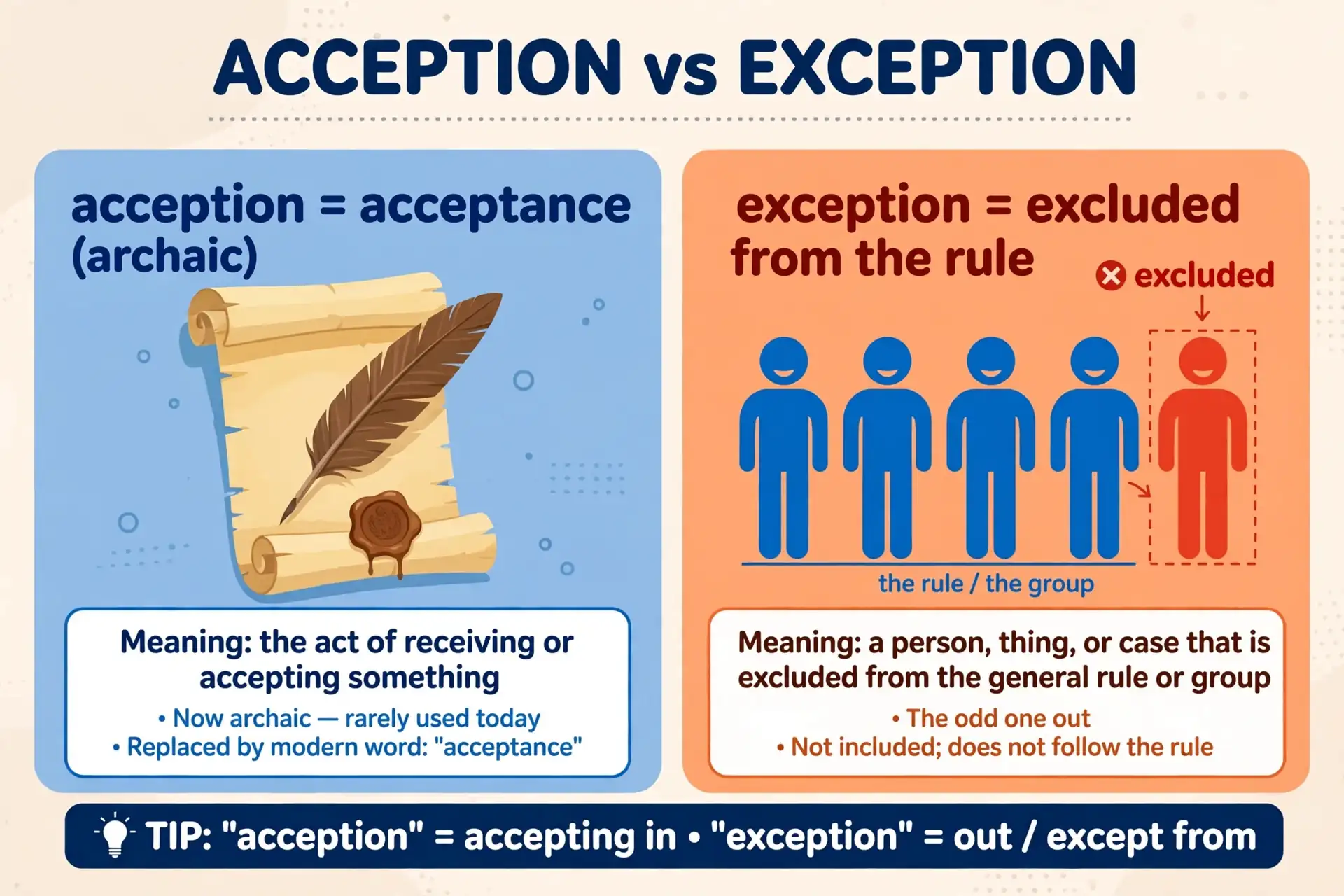
Acception is an obsolete noun meaning acceptance — the act of accepting or receiving something favorably. It appears in older English texts and historical dictionaries, but it dropped out of everyday use centuries ago. Modern readers will essentially never meet it outside literary or legal history, and no modern usage dictionary lists it as standard.
Examples:
- In older legal language, acception meant the formal acceptance of an offer.
- Writers of earlier centuries used acception where we would now write acceptance.
- The archaic phrase “acception of persons” meant showing favor or partiality.
- You will not find acception in any modern dictionary of current English.
- Type acception today and your spellchecker will almost certainly flag it.
What Does Exception Mean?
Exception is a common noun with three everyday senses: something excluded from a rule, an objection to something (“take exception to”), and an unexpected event that interrupts normal flow. All three share the same root idea — something standing apart from the rest.
Examples:
- The restaurant made an exception and seated us without a reservation.
- With the exception of Maya, everyone finished the test on time.
- He took exception to the suggestion that he had been late.
- The program stopped when it hit an unexpected exception.
- Every rule has its exceptions — and this one is no different.
Acception vs. Exception: Key Differences
| Feature | Acception | Exception |
|---|---|---|
| Meaning | Acceptance (archaic) | Something excluded from a rule |
| Current status | Obsolete; absent from modern usage | Standard, everyday word |
| Frequency | Almost never used | Very common |
| First letter | A, like accept | E, from Latin excipere (“take out”) |
| Root idea | Receiving, taking in | Excluding, taking out |
| What to write | Almost never | Use for all modern contexts |
The two words point in opposite directions: acception is about taking something in, while exception is about taking something out of a rule.
Acception and Exception in Real Sentences
At Home
Exception: “We have a no-phones rule at dinner, but Grandma is the one exception.”
Acception (archaic): “In the old charter, the acception of the treaty sealed the alliance.”
The contrast: exception describes a real, everyday situation; acception only ever appears in sentences about the distant past.
At Work
Exception: “The manager approved an exception to the travel policy for the urgent trip.”
Acception (archaic): “The scribe recorded the acception of the king’s decree.”
The contrast: at work you make exceptions to policies; acception belongs to documents from centuries ago.
In Conversation
Exception: “Everyone passed, with the exception of one student.”
Acception (archaic): “The poem’s acception by the court pleased its author.”
The contrast: exception flows naturally in modern speech, while acception sounds like a quotation from an old book.
Common Mistakes
Because the two words look so similar, acception slips into drafts where exception belongs — the same kind of spelling slip that produces recieve vs receive.
Mistake 1: Writing acception for an exclusion
❌ There will be no acceptions to this rule.
✅ There will be no exceptions to this rule.
Why: exclusions from a rule always take exception, with an E.
Mistake 2: Using acception in “with the exception of”
❌ With the acception of Ali, the team is ready.
✅ With the exception of Ali, the team is ready.
Why: the fixed phrase is “with the exception of” — acception never fits there.
Mistake 3: “Take acception to”
❌ She took acception to his remark.
✅ She took exception to his remark.
Why: to object to something is to “take exception to” it.
Mistake 4: Using acception as a modern synonym of acceptance
❌ His acception into the club was celebrated.
✅ His acceptance into the club was celebrated.
Why: if you mean acceptance, write acceptance — acception is archaic and will read as a typo.
Pronunciation
Acception is pronounced “ak-SEP-shun” — it rhymes with deception and perception. Exception is pronounced “ik-SEP-shun” — rhyming with reception. They differ only in the first syllable.

How to Remember the Difference
Watch the first letters: EXception contains EX, which means “out” — an exception is something taken out of the rule. Acception starts like acceptance, the meaning it carried in older English.
- EXception = excluded from the rule.
- Acception = acceptance in archaic English.
- In modern writing, you want exception virtually every time.
Frequently Asked Questions
Is it acception or exception?
Almost always exception. Acception is an archaic noun meaning acceptance and is not used in modern English — if you typed it, you almost certainly meant exception.
Is acception a real word?
Yes, in the historical sense: it meant “acceptance” in older English. But no modern dictionary of current usage lists it as standard, so treat it as obsolete.
What is an exception?
An exception is a case excluded from a rule, an objection (“take exception to”), or anything that does not follow the general pattern — see the exception entry in Merriam-Webster’s dictionary for the full definition.
Can I use acception instead of acceptance?
Not in modern writing — readers will read it as a typo. Write acceptance.
Why do people mix up acception and exception?
They differ by a single first letter and share the “-ception” ending, so acception looks like a plausible word — much like other easily confused pairs such as loose or lose.
How do you spell exception?
E-X-C-E-P-T-I-O-N — start with EX, as in excluded.
Conclusion
Exception is the modern, everyday noun for something excluded from a rule, while acception is an archaic word for acceptance with no place in current writing. When in doubt, remember the EX in exception stands for “excluded” — and you will spell it right every time.