Sown or Sewn: What’s the Difference? (With Examples)
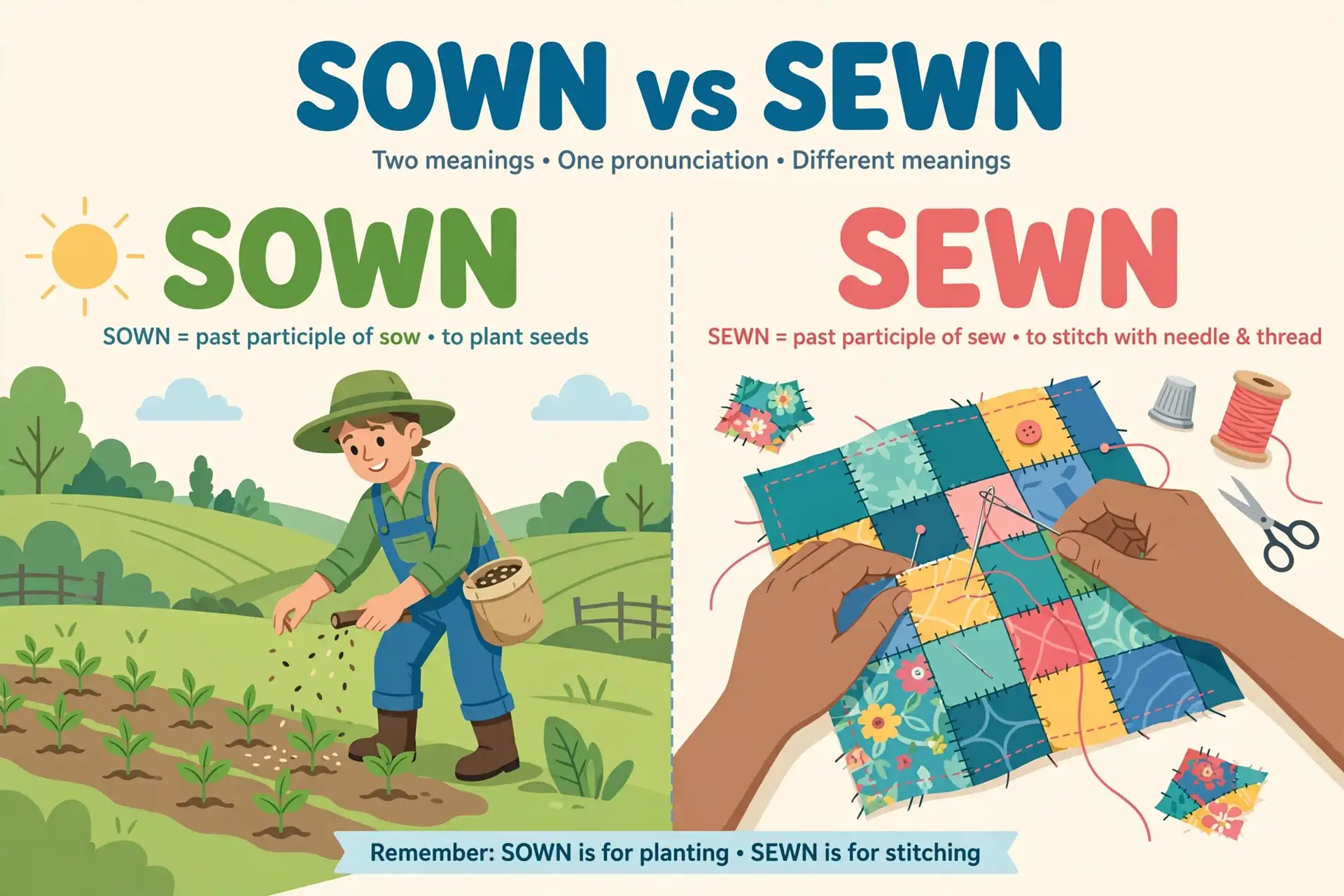
Sown is the past participle of sow — to plant seeds in the ground — while sewn is the past participle of sew — to stitch fabric with a needle and thread. They sound exactly alike but come from different verbs entirely.
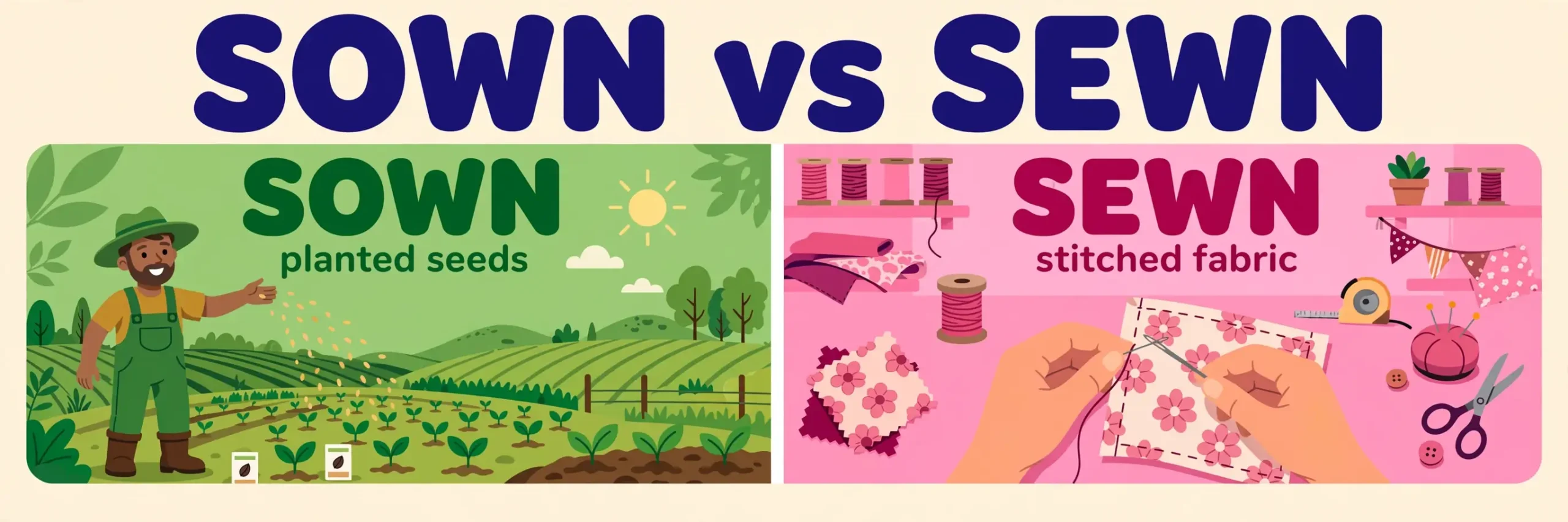
Table of Contents
Quick Answer
| Word | Part of Speech | Main Meaning | Example |
|---|---|---|---|
| Sown | Verb (past participle of sow) | Planted seeds in the ground | The field has been sown with barley. |
| Sewn | Verb (past participle of sew) | Stitched with needle and thread | She has sewn a patch onto the jeans. |
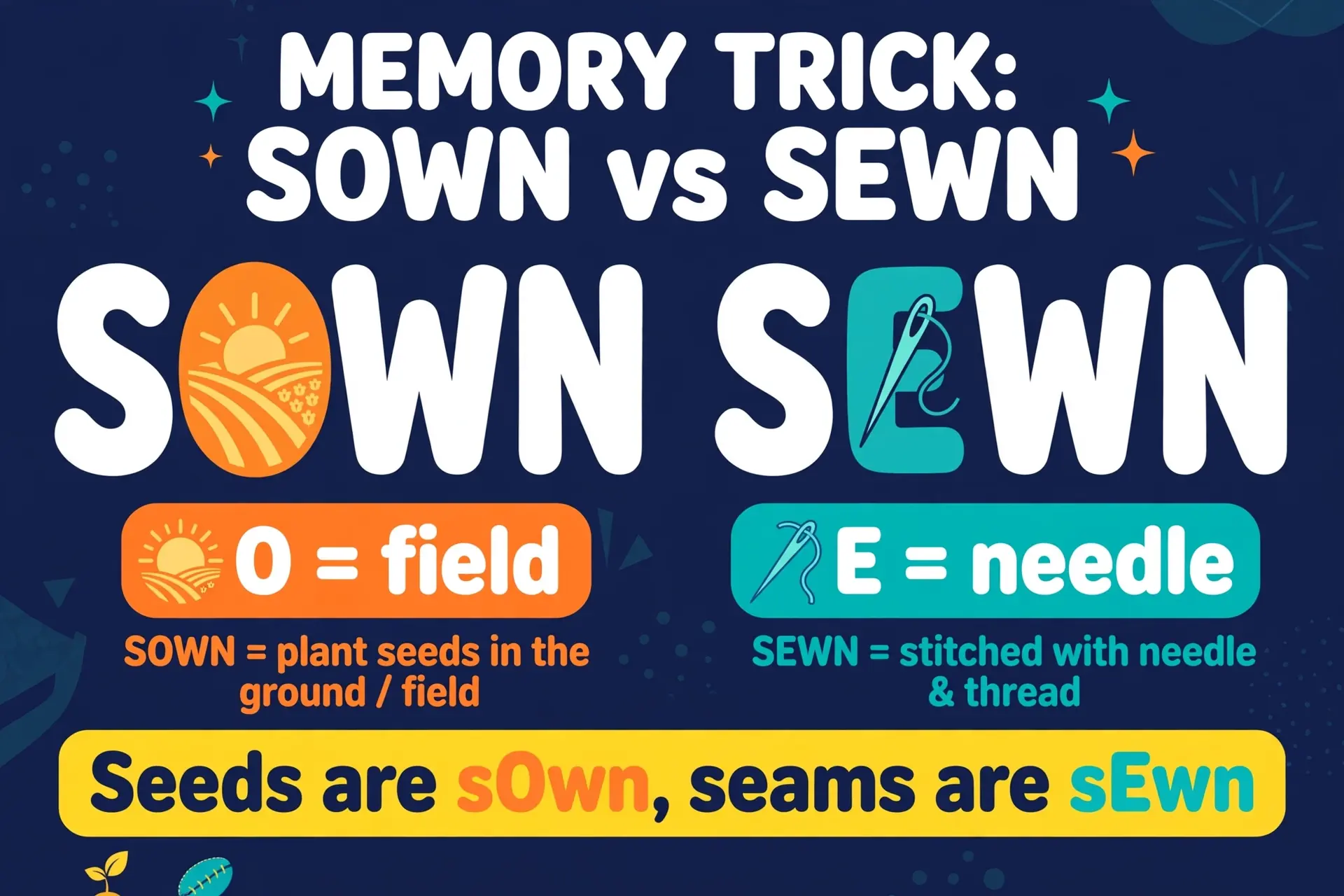
Simple rule: seeds are sown, seams are sewn.
What Does Sown Mean?
Sown (pronounced “sohn”) is the past participle of sow, the verb for planting seeds — scattering them over soil so they grow. It appears in farming, gardening, and the classic saying “you reap what you sow.” See Merriam-Webster’s entry for sow for both the literal and figurative senses.
Examples:
- The farmer has sown the north field with wheat.
- The wildflower seeds were sown just before the spring rains.
- She’d sown doubt with a single careless remark.
- These fields have been sown with barley for generations.
- The community garden was sown entirely by volunteers.
- The gardener had sown the lawn with fresh seed in autumn.
- Wild oats had been sown along the fence line by the wind itself.
What Does Sewn Mean?
Sewn (also pronounced “sohn” — identical to sown) is the past participle of sew: to join or fasten fabric with stitches made by needle and thread. You’ll see it on clothing labels (“hand-sewn“), in craft rooms, and anywhere fabric gets repaired.
Examples:
- She has sewn the button back onto his coat.
- The quilt was lovingly sewn by his grandmother.
- He’d sewn a patch over the tear in his jeans.
- The dress was sewn entirely by hand.
- Each sail was sewn from heavy canvas.
- The flag was sewn from two panels of red silk.
- Her wedding veil had been sewn with tiny pearl beads.
Sown vs. Sewn: Key Differences
| Feature | Sown | Sewn |
|---|---|---|
| Base verb | sow (to plant) | sew (to stitch) |
| Meaning | Seeds planted in soil | Fabric joined by stitches |
| Typical setting | Farms, gardens, figurative speech | Tailoring, crafts, clothing |
| Pronunciation | “sohn” | “sohn” — identical |
| Simple past | sowed | sewed |
| Common idioms | “reap what you sow,” “sow the seeds of doubt” | “sew up” (finish decisively) |
Same sound, different verbs — the spelling tells you whether you’re standing in a field or at a sewing machine.
Usage Examples in Real Sentences
On the Farm
“The wheat has been sown early this year.”
“The wheat has been sewn early this year” — wrong; you can’t stitch a crop.
Sown belongs to the soil; sewn belongs to fabric.
In the Craft Room
“Grandma has sewn every quilt in this house.”
“Grandma has sown every quilt in this house” — unless she’s planting quilts, no.
Stitches mean sewn; seeds mean sown.
In Conversation
“His lies had sown distrust in the group.”
“The tailor had sewn distrust” — this makes no sense at all.
Figurative “planting” takes sown; literal stitching takes sewn.
In Idioms
“They’ve sown the seeds of their own success.”
“She’s sewn up the nomination” — “sew up” means to secure or finish something decisively.
The first plants an idea (sown); the second finishes a job with finality (sewn).
Common Mistakes
Homophone traps like this one sit alongside whose or who’s and desert or dessert — identical sounds, different spellings, different meanings.
Mistake 1: “She sown the button back on”
❌ “She sown the button back on.”
✅ “She has sewn the button back on.”
Why: buttons are stitched, not planted — sewn comes from sew.
Mistake 2: “The seeds were sewn in March”
❌ “The seeds were sewn in March.”
✅ “The seeds were sown in March.”
Why: seeds go into soil — sown comes from sow.
Mistake 3: “Sew the seeds in rows”
❌ “Sew the seeds in neat rows.”
✅ “Sow the seeds in neat rows.”
Why: planting is always sow; sew is only ever about needle and thread.
Mistake 4: “a hand-sown quilt”
❌ “A hand-sown quilt.”
✅ “A hand-sewn quilt.”
Why: quilts are stitched, so the E in sew stays — hand-sewn.
Pronunciation
Here’s the tricky part: sown and sewn are pronounced exactly the same — “sohn,” a single syllable. Both rhyme with shown, blown, and grown. Context is the only way to tell them apart when spoken.
The base verbs run into the same wall: sow (“soh,” to plant) and sew (“soh,” to stitch) are also exact homophones — the confusion runs through the whole word family, not just the participles.
How to Remember the Difference
Link the spelling to the scene: sown has an O like the round sun hanging over a freshly planted field. sewn has an E like a needle and thread. Seeds = sOwn; seams = sEwn.
- Sown = sown — think sowing seeds in the soil
- Sewn = sewn — think sewing with needle and thread
- One bolded vowel carries the whole meaning: O for the field, E for the needle
Frequently Asked Questions
Is it sown or sewn?
Use sown for planted seeds and sewn for stitched fabric.
Are “sown” and “sewn” pronounced the same?
Yes — both are pronounced “sohn,” rhyming with shown. Only the spelling reveals the meaning.
What does “sown” mean?
Sown is the past participle of sow (to plant seeds). See Merriam-Webster’s definition of sow for examples.
What does “sewn” mean?
Sewn is the past participle of sew (to stitch with needle and thread), as in “hand-sewn leather.”
What’s the difference between “sowed” and “sown”?
Sowed is the simple past (“he sowed the field yesterday”), while sown is the past participle used with helpers (“the field has been sown”).
Is it “sewed” or “sewn”?
Both exist, but they play different roles. Sewed is the simple past (“she sewed the hem yesterday”); sewn is the past participle (“the hem was sewn by hand”) and also works as an adjective (“a sewn seam,” “hand-sewn”).
What does “reap what you sow” mean?
It means your actions have consequences — good or bad — just as a farmer harvests whatever was planted. The verb is sow, so the participle is “what you have sown.”
Conclusion
Sown comes from sow — planting seeds — and sewn comes from sew — stitching fabric. Same sound, different verbs, different spellings. Keep the O in the field and the E at the sewing machine.