Combatting or Combating: What’s the Difference? (With Examples)
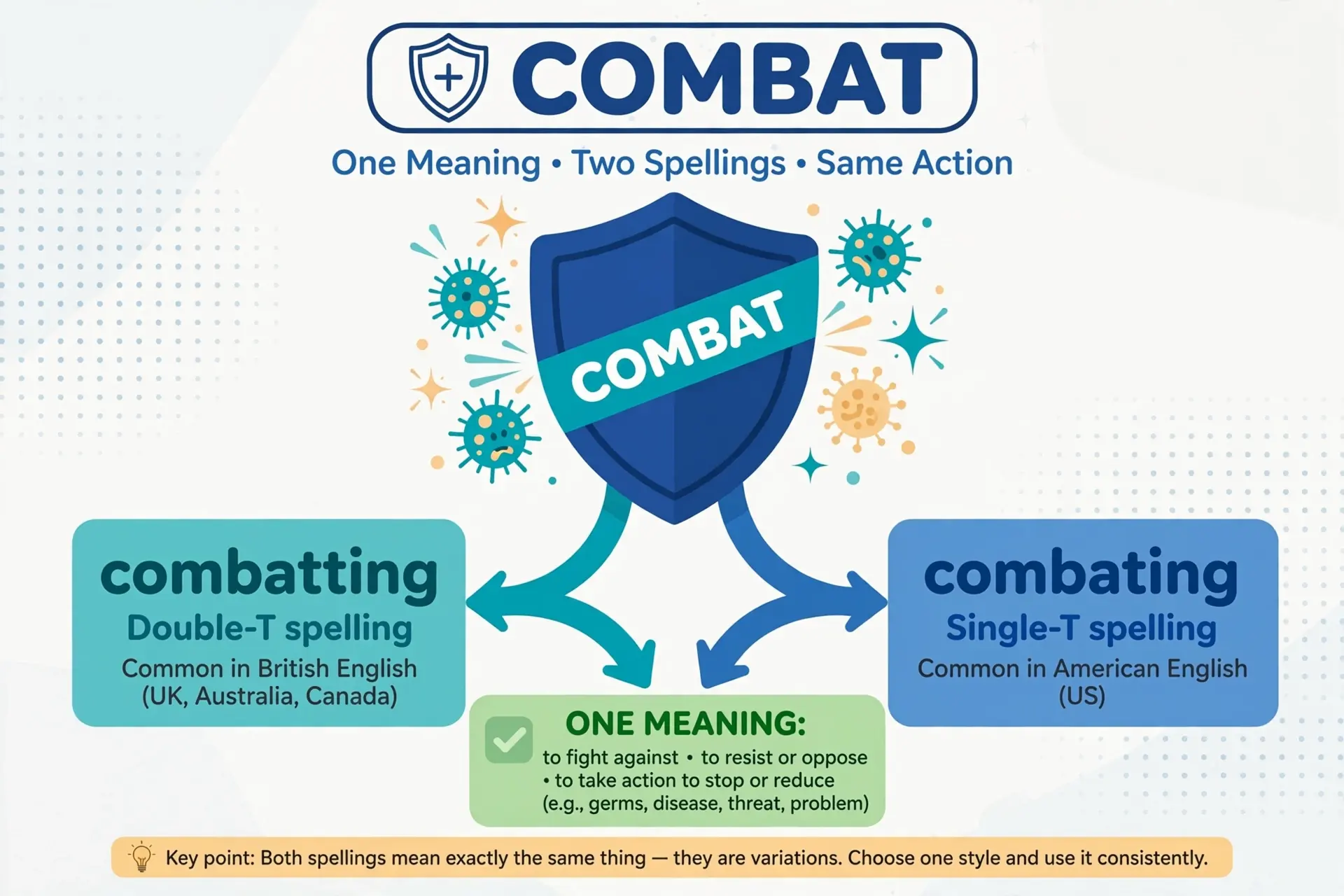
Here’s a pleasant surprise: both combatting and combating are correct. They’re two accepted spellings of the present participle of combat — to fight or struggle against something. The double-T spelling, combatting, is the older, more traditional form (still preferred in much British writing), while combating is the streamlined form you see most in American English. “Crews are combatting the wildfire.” / “Crews are combating the wildfire.”

Table of Contents
Quick Answer
| Word | Part of Speech | Main Meaning | Example |
|---|---|---|---|
| combatting | Verb (present participle) | Fighting against; traditional spelling with a double t | “Firefighters are combatting the blaze.” |
| combating | Verb (present participle) | Fighting against; widely used American spelling | “Firefighters are combating the blaze.” |
Simple rule: either spelling is fine — just don’t switch between them inside the same document.
What Does Combatting Mean?
Combatting is the present participle of combat, spelled with a doubled t. It means actively fighting or struggling against something, and it’s the more traditional of the two spellings. You can see both accepted forms in Merriam-Webster’s definition of “combat”.
The double t comes from the old habit of doubling the final consonant in two-syllable verbs stressed on the second syllable — think commit → committing. Combat, though, is stressed on the first syllable (COM-bat), which is exactly why American style settled on the single t, the same way target gives targeting and benefit gives benefiting.
Examples:
- Firefighters are combatting a blaze that started on Tuesday.
- The startup is combatting customer churn with better onboarding.
- Doctors are combatting the outbreak with a vaccination drive.
- She spent her career combatting workplace discrimination.
- The city is combatting rising rents with new housing rules.
- The charity is combatting hunger one neighborhood at a time.
What Does Combating Mean?
Combating is the exact same -ing form of combat, spelled with a single t. The meaning doesn’t change at all — this spelling is simply the leaner, more common choice in American writing, and it follows the standard rule: no doubling when the stress sits on the first syllable.
Examples:
- The airline is combating delays with a new scheduling system.
- Local groups are combating food insecurity in the neighborhood.
- He dedicated his life to combating corruption.
- Scientists are combating the disease with a new vaccine.
- Parents are combating screen time with weekend hikes.
- The council is combating traffic with wider bike lanes.
Combatting vs. Combating: Key Differences
| Feature | Combatting | Combating |
|---|---|---|
| Spelling | Double t: -tt- | Single t: -t- |
| Tradition | Older, traditional form; common in British English | Modern streamlined form; dominant in American English |
| Dictionary status | Fully accepted variant | Listed as the primary form in most dictionaries |
| Pronunciation | Identical | Identical |
| Matching past tense | Combatted | Combated |
| Rule of thumb | Pick one spelling and stay consistent within a document | |
The meaning never changes between the two spellings — only the letter count does.
Usage in Real Sentences
At Home
Combatting: “We’re combatting the clutter by donating a box every week.”
Combating: “We’re combating the clutter by donating a box every week.”
Same sentence, same meaning — the only difference is how traditional the spelling looks.
At Work
Combatting: “The team is combatting burnout with a four-day week.”
Combating: “The team is combating burnout with a four-day week.”
A British report might favor the double t; an American memo would almost always use the single t.
Combatting: “The clinic is combatting long wait times with online check-in.”
Combating: “The clinic is combating long wait times with online check-in.”
Same policy, same sentence — whichever spelling your house style prefers works fine.
In the News
Combatting: “Police are combatting a rise in car thefts.”
Combating: “Police are combating a rise in car thefts.”
News outlets on both sides of the Atlantic write sentences like these daily, each with their house spelling.
Common Mistakes
With this pair, the trap isn’t picking the “wrong” word — it’s inconsistency and stray typos, the same territory as consonant-doubling pairs like cancelled or canceled and spelling traps like recieve vs receive.
Mistake 1: Mixing spellings in one document
❌ “…combating inflation… later, combatting unemployment…”
✅ “…combating inflation… combating unemployment…”
Why: Both spellings are fine, but switching between them looks careless. Consistency is what reads as professional.
Mistake 2: The triple-t typo
❌ “They are combattting the problem.”
✅ “They are combatting the problem.”
Why: The doubled consonant is exactly two t’s — a third one is always a slip of the finger.
Mistake 3: “Correcting” someone’s combating as an error
❌ Marking “combating” wrong and changing it to “combatting.”
✅ Leave it — combating is a fully accepted spelling, the preferred one in American dictionaries.
Why: Not every variant spelling is a mistake. This one is listed as the primary form in most references.
Mistake 4: Using the -ing form without a helper verb
❌ “They combatting the fire last week.”
✅ “They combated the fire last week.” (or “They were combating the fire last week.”)
Why: A present participle needs a helper like were — otherwise use the past tense, combated or combatted.
Pronunciation
Both are pronounced “COM-bat-ing,” with the stress on the first syllable, rhyming with batting and chatting. One t or two makes no difference to the sound at all.
How to Remember the Difference
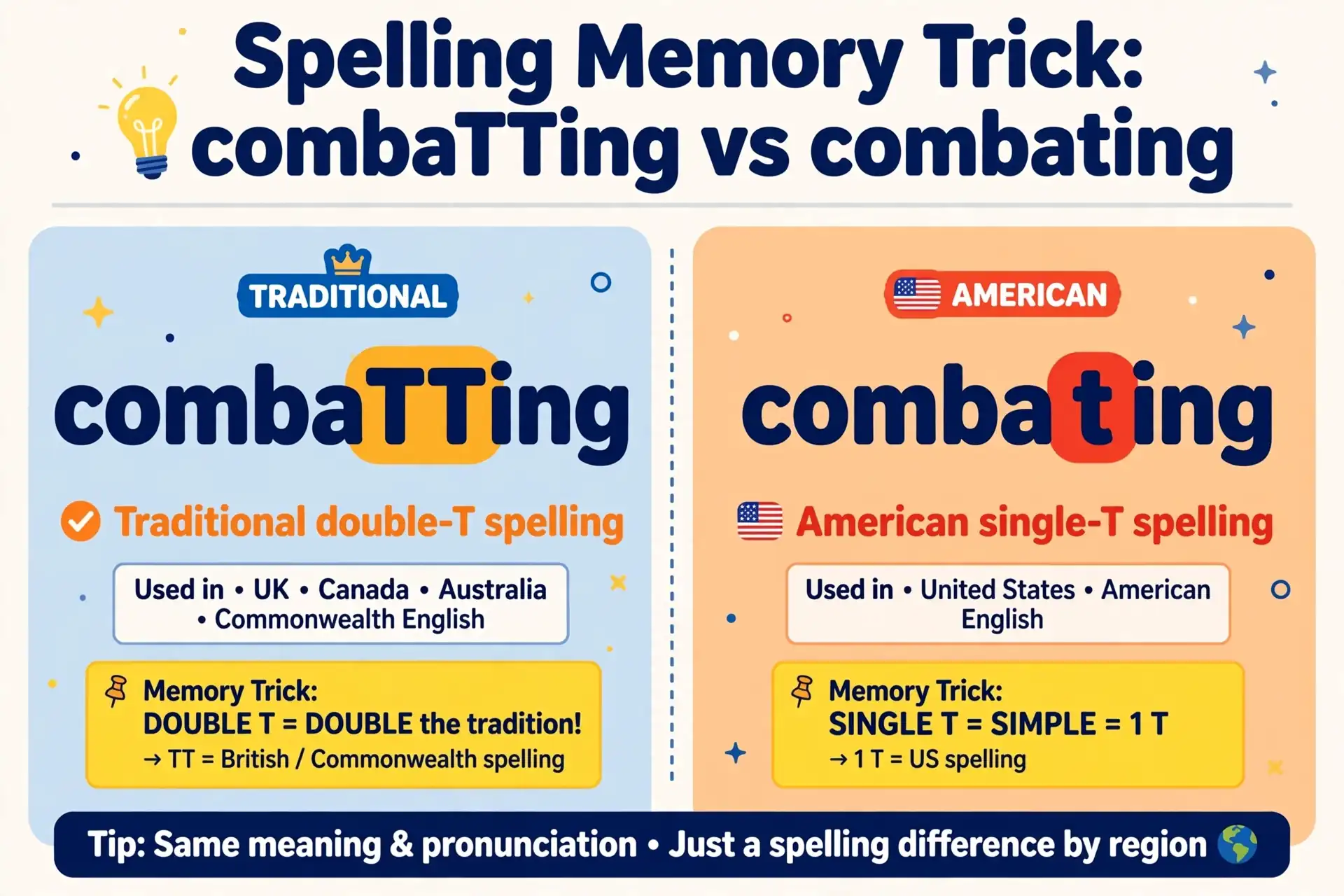
Double T = Traditional. Want the older, British-leaning spelling? Keep the extra T: combatting. Prefer the American streamline? Drop the second t and write combating.
- Combatting (double t) = traditional, British-leaning spelling.
- Combating (single t) = common American spelling.
- Both mean exactly the same thing and sound exactly the same.
- Match your past tense to your pick: combatting → combatted, combating → combated.
Frequently Asked Questions
Is it combatting or combating?
Either. Both are accepted spellings of the present participle of combat; combatting is the traditional double-t form and combating is the common American single-t form. The only real rule is to pick one and use it consistently within a document.
Which spelling is American?
Combating (single t) dominates in American usage and is listed first in most American dictionaries. Combatting shows up more often in British writing, where the traditional double-t habit has held on longer.
Is “combatting” a typo?
No. It’s a recognized variant spelling, not a mistake — though your spellchecker may prefer the single-t form depending on its dictionary. If a checker flags it, check which regional dictionary it’s using before “fixing” anything.
Does doubling the t change the pronunciation?
Not at all. Both are pronounced “COM-bat-ing,” with the stress on the first syllable. The extra letter is pure spelling tradition — your mouth never knows the difference.
What about combated vs. combatted?
The same pattern applies: combated pairs with the single-t spelling and combatted with the double-t one. Whichever pair you choose, keep it through the whole piece — “combating/combated” or “combatting/combatted.”
Conclusion
Combatting and combating are simply two spellings of one word — the double-t version is the traditional choice, the single-t version the American favorite. Pick the one that fits your audience, use it consistently, and you’ll never go wrong.