Occurred or Occured: What’s the Difference?
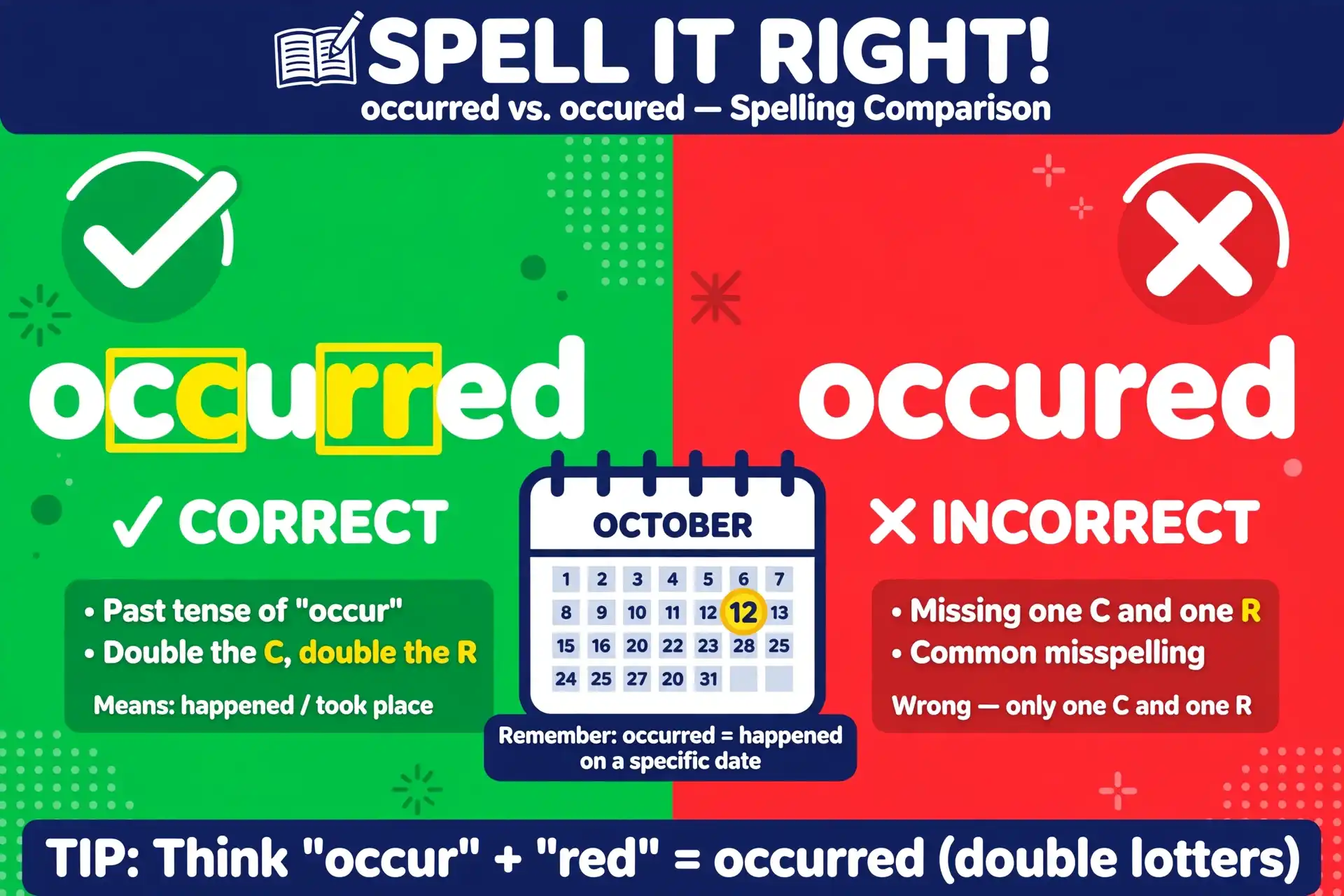
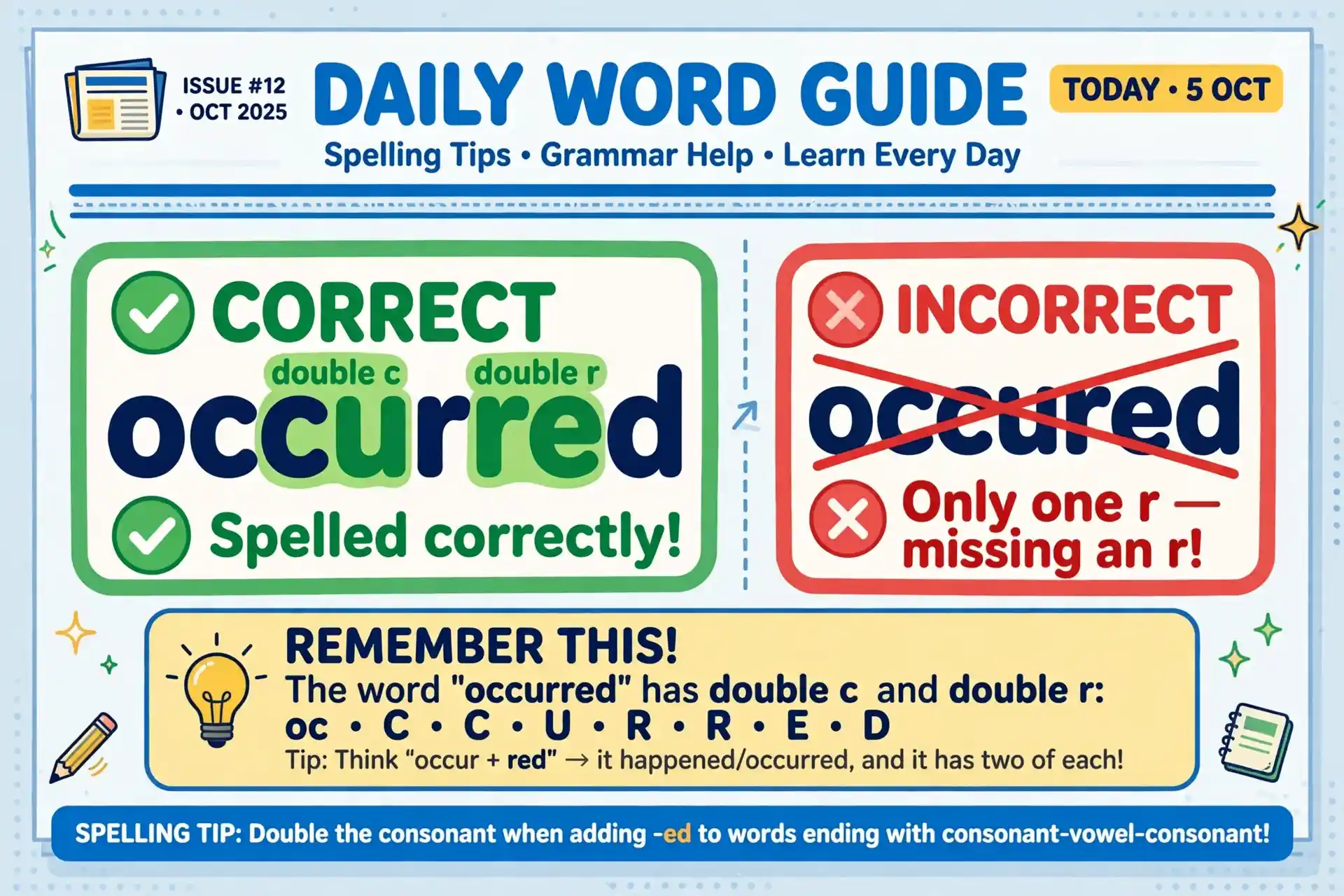
Occurred with a double R is the past tense of “occur” — to happen or take place. Occured with a single R is a misspelling, and one of English’s most persistent: the base verb “occur” already ends in a double R, so writers assume the past tense needs nothing more. “The accident occurred at noon” is correct; “occured” will earn a red underline every time.
Quick Answer
| Word | Part of Speech | Main Meaning | Example |
|---|---|---|---|
| occurred | Verb (past tense / past participle) | Happened; took place; came to mind | ✅ “The error occurred during the update.” |
| occured | — (misspelling) | Not a standard English word | ❌ “The error occured during the update.” |
Simple rule: “Occur” is stressed on its final syllable (oc-CUR) and ends in one vowel plus one consonant, so the R doubles before -ed — occurred, with two C’s and two R’s.
What Does Occurred Mean?
Occurred is the past tense and past participle of “occur.” Its main job is “happened”: accidents occur, meetings occur, changes occur. It also covers “came to mind” (“it occurred to me that…”) and formal “was found or met with” (“a rare bird occurred in the region”). Merriam-Webster’s entry for “occur” traces these senses from everyday events to the “occur to” idiom.
Examples:
- “The power cut occurred just before midnight.”
- “It never occurred to me to check the back seat.”
- “Several delays occurred during the project.”
- “The idea occurred to her in the shower.”
- “The festival has occurred every summer since 1998.”
The present participle “occurring” doubles the R as well, and the noun “occurrence” keeps both doubles — two C’s, two R’s — so the pattern runs through the entire word family.
What Does Occured Mean?
Occured with one R means nothing, because no dictionary lists it. The trap is unusually sneaky: the base verb “occur” already ends in “rr,” so the writer’s brain registers “doubling done” and adds a plain -ed. But the doubling rule applies at the moment you add the suffix — oc-CUR + ed still demands a doubled R, giving “occurred.” Spellcheckers catch it, professors circle it, and autocomplete often “fixes” it to “occurred” before you even notice.
Examples of where the error shows up:
- ❌ “The meeting occured yesterday.” (meant: occurred)
- ❌ “It occured to me later.” (meant: occurred)
- ❌ “No injuries occured in the crash.” (meant: occurred)
- ❌ “The same bug occured twice.” (meant: occurred)
- ❌ “Changes occured overnight.” (meant: occurred)
Every instance is repaired the same way: restore the second R. There is no register, region, or style manual where “occured” passes.
Occurred vs. Occured: Key Differences
| Feature | occurred | occured |
|---|---|---|
| Status | Correct standard spelling | Misspelling — not a word |
| Verb base | occur (stress on final syllable → double the R) | — (no verb produces this form) |
| Doubled letters | Two C’s, two R’s (oc-cur-red) | Two C’s, one R — incorrect |
| Part of speech | Verb (past tense / participle) | None |
| Accepted in dictionaries | Yes | No |
| Example | ✅ “It occurred suddenly.” | ❌ “It occured suddenly.” |
The base verb’s built-in double R is what fools people — but adding -ed re-triggers the doubling rule, and “occured” skips the step.
Occurred and Occured in Real Sentences
At Home
✅ “The leak occurred while we were away.”
❌ “The leak occured while we were away.”
Plumbers don’t care how you spell it, but your insurance claim letter should.
At Work
✅ “The outage occurred during peak hours.”
❌ “The outage occured during peak hours.”
Incident reports are formal documents — the double R is part of looking competent under pressure.
In Conversation
✅ “It occurred to me that we forgot the keys.”
❌ “It occured to me that we forgot the keys.”
The “occur to” idiom is the word’s most conversational use, and the one where the misspelling appears most in texts.
In the News
✅ “The earthquake occurred at dawn.”
❌ “The earthquake occured at dawn.”
Journalists write “occurred” daily; newsroom style guides treat the single-R version as an outright error.
Common Mistakes
Doubling rules confuse even careful writers — the “cancelled” vs “canceled” doubling rule shows the same logic at work in another verb, and the “dieing” or “dying” spelling rule shows what happens when suffixes meet tricky verb endings. The occurred traps:
Mistake 1: Assuming the base verb’s double R is enough (“occured”)
❌ “The problem occured again.”
✅ “The problem occurred again.”
Why: The doubling rule fires when you attach the suffix, not when you look at the base. Oc-CUR + ed → double the R → “occurred,” regardless of the RR already sitting in “occur.”
Mistake 2: Doubling the wrong letter (“occured” → “occcurred”)
❌ “It occcurred to me.” (three C’s)
✅ “It occurred to me.” (two C’s, two R’s)
Why: Only the final consonant doubles. The C’s were already doubled in the base verb “occur” — the suffix only ever touches the R.
Mistake 3: Writing “occurance” for the noun
❌ “It was a rare occurance.”
✅ “It was a rare occurrence.”
Why: The noun is “occurrence” — double C, double R, ending in -ence. If you can spell “occurred,” you can spell “occurrence”: same doubles, different ending.
Mistake 4: Using “occured” in the “occur to” idiom
❌ “It occured to her mid-sentence.”
✅ “It occurred to her mid-sentence.”
Why: “It occurred to me” is one of the most-typed phrases in English emails, so the error gets maximum exposure here. Autocorrect usually saves you — but only if you let it.
Pronunciation
Occurred is pronounced uh-KURD, stress on the second syllable, rhyming with “referred,” “preferred,” and “concurred.” That stressed “CUR” is the audible signal for the doubling: stressed final syllable, single vowel + consonant, double the R.
How to Remember the Difference
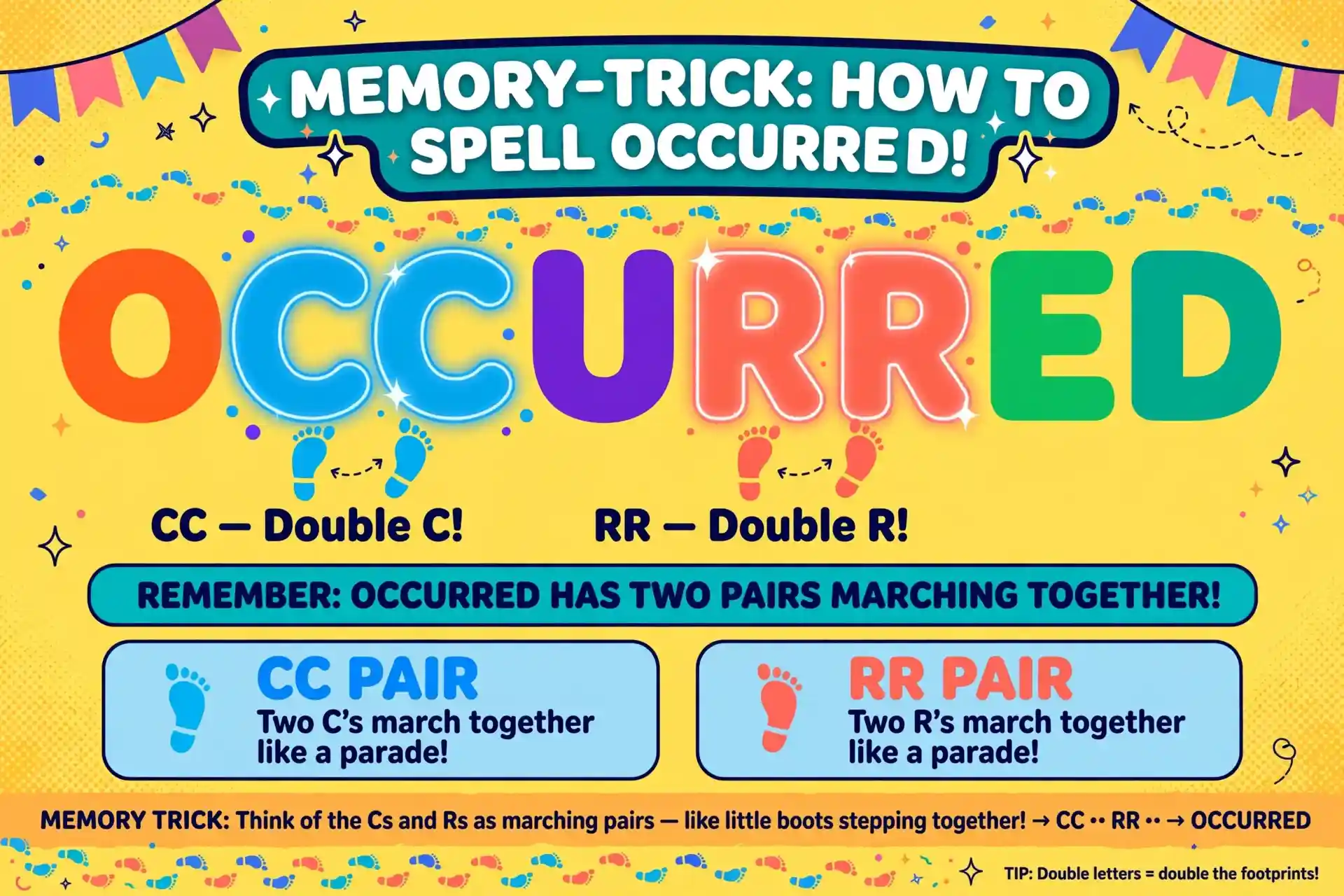
Letters march in pairs: oc-CUR-red — two C’s, two R’s, a perfect parade of doubles. Say it in three beats — oc / CUR / red — and picture each beat carrying a twin. “Occured” breaks the parade with a lone R limping at the end, and your eye can learn to spot the missing partner instantly.
- Pair test: count the doubles — occurred needs CC and RR. One pair missing means a misspelling.
- Stress test: oc-CUR is stressed at the end, so the final R doubles — same as re-FER → referred.
- Noun link: “occurrence” keeps both doubles, so learning one spelling teaches you two words.
Frequently Asked Questions
Is it occurred or occured?
It is occurred with two R’s. “Occured” with one R is a misspelling found in no standard dictionary.
Why does “occurred” have a double R when “occur” already ends in RR?
Because the doubling rule applies when the suffix is added. Oc-CUR ends in one vowel plus one consonant with stress on the final syllable, so attaching -ed doubles the R — the base verb’s own double R doesn’t exempt it.
How do you spell the -ing form?
“Occurring” — same rule, same double R: oc-CUR + ing → occurring.
Is it “occurrence” or “occurance”?
“Occurrence” — double C, double R, ending in -ence. It keeps both doubles from the verb family.
What does “it occurred to me” mean?
It means the thought came into your mind — “it occurred to me that I’d left the oven on” is a natural way to describe a sudden realization.
Is “occured” acceptable in British English?
No. Both American and British English spell it “occurred.” The US/UK doubling split affects words like “cancelled/canceled,” but “occurred” is doubled on both sides of the Atlantic.
Conclusion
Occurred keeps its parade of doubles — two C’s, two R’s — because the stressed final syllable of oc-CUR demands it, the same rule behind “referred.” Count the pairs, stress the ending, and “occured” loses its hiding place.