Men or Man: What’s the Difference?
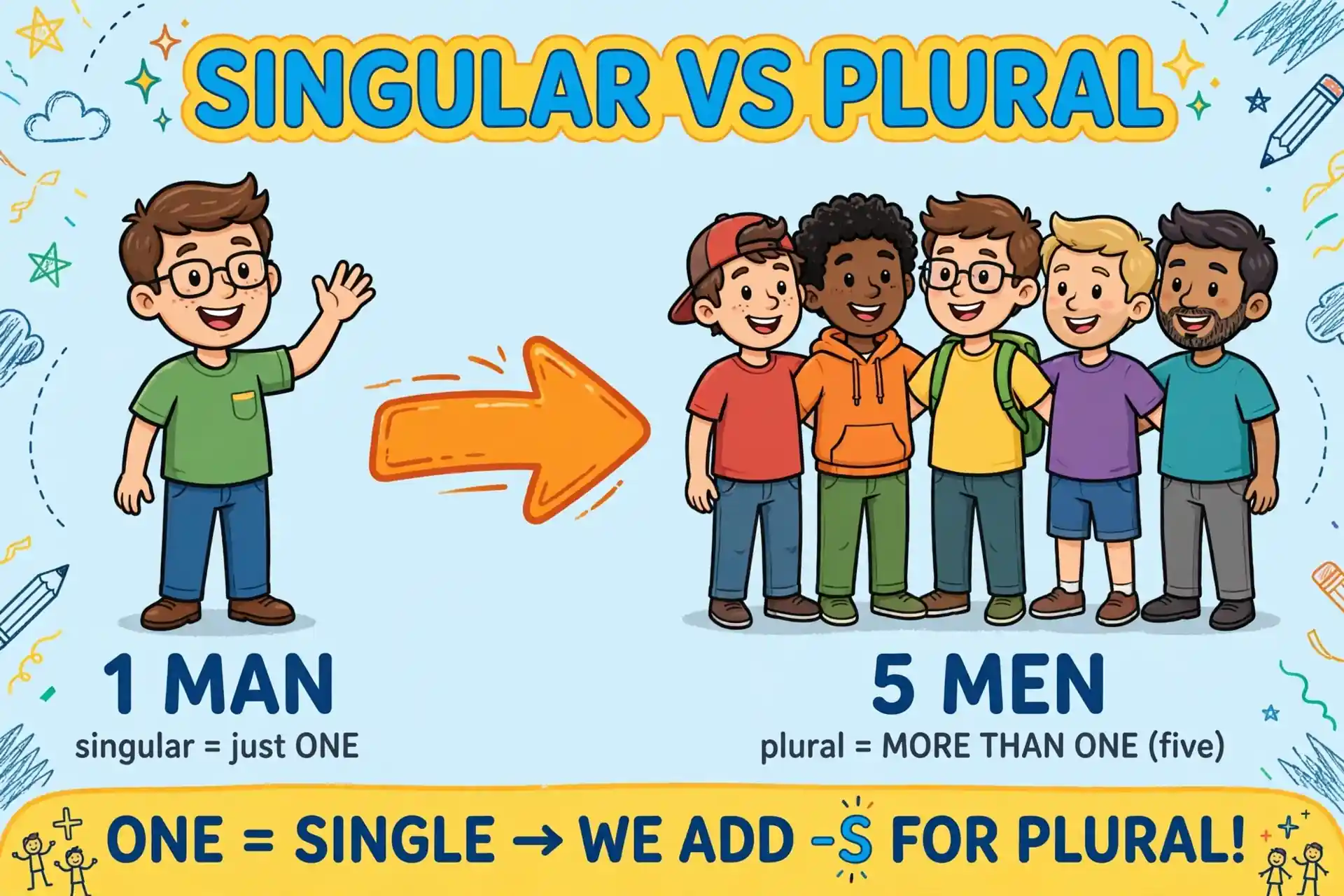
Man is singular — one adult male. Men is its plural — two or more. They are not interchangeable: use man when you mean one person, men when you mean several.
For example, “A man walked in” describes one person. “Three men walked in” describes three. English forms this plural irregularly — you change the vowel instead of adding an -s.

Quick Answer
| Word | Part of Speech | Main Meaning | Example |
|---|---|---|---|
| Man | Noun (singular) | One adult male; also “human being” | A man is waiting outside. |
| Men | Noun (plural) | More than one adult male | Two men are waiting outside. |
Simple rule: One = man. Two or more = men. The vowel changes from a to e, with no -s added.
What Does Man Mean?
Man has two main uses. Most commonly, it means one adult male human. It can also mean humanity in general (“man’s greatest achievement”), though that use is becoming less common.
As a verb, man means to staff or operate: “to man the phones.”
Examples:
- A man in a blue coat asked for directions.
- He is a kind and honest man.
- No man is an island. (humanity in general)
- They hired a man to fix the roof.
- We need someone to man the front desk tonight. (verb)
What Does Men Mean?
Men is simply the plural of man — more than one adult male. It follows the same ancient vowel-change pattern as foot → feet, tooth → teeth, and goose → geese.
Examples:
- Three men carried the piano upstairs.
- The men on the team celebrated together.
- All men must register at the desk.
- She manages a group of twelve men and women.
Note: never write “mens” — the plural is already complete as men. For possession, use men’s (“the men’s room”), with the apostrophe after the whole plural word. See man on Merriam-Webster.
Men vs. Man: Key Differences
| Feature | Man | Men |
|---|---|---|
| Number | Singular (one) | Plural (two or more) |
| Plural form | — (this is the base) | Men (irregular) |
| Possessive | Man’s (the man’s hat) | Men’s (the men’s room) |
| Pronunciation | /mæn/ (rhymes with can) | /mɛn/ (rhymes with pen) |
| Example | One man volunteered. | Five men volunteered. |
Irregular plurals like this one are old — they predate the modern -s rule by centuries. That is why man/men behaves like foot/feet rather than like regular everyday words.
Examples of Men and Man in Real Sentences
At Home
Man: “A man from the power company is at the door.”
Men: “Two men from the power company are at the door.”
One visitor vs. two — the noun changes, and so does the verb (is vs. are).
At Work
Man: “Every man on the crew has safety training.”
Men: “All the men on the crew have safety training.”
Every pairs with the singular; all pairs with the plural.
In Conversation
Man: “He’s a good man.”
Men: “They’re good men.”
The adjective stays the same; only the noun (and the verb) shift for number.
Common Mistakes With Men and Man
Most errors come from treating this irregular pair like a regular one — a trap that also catches learners with other tricky forms.
Mistake 1: Writing “Mens” as the Plural
❌ Three mens arrived late.
✅ Three men arrived late.
Why: The plural of man is men — the -s is never added.
Mistake 2: Wrong Apostrophe in the Possessive
❌ The mens’ locker room was empty.
✅ The men’s locker room was empty.
Why: The plural is men, so the possessive adds ‘s to the whole word: men’s.
Mistake 3: Mixing Up “Man” and “Men” With Numbers
❌ One men stood at the gate.
✅ One man stood at the gate.
Why: “One” is singular, so it needs man. Use men with two or more.
Mistake 4: Using “Man” as a Plural Verb Subject
❌ The man were happy.
✅ The man was happy. / The men were happy.
Why: Singular subject takes was; plural subject takes were.
Pronunciation: Men vs. Man
Man is pronounced /mæn/, rhyming with can, pan, and ran.
Men is pronounced /mɛn/, rhyming with pen, ten, and when.
The vowel shift from “a” to “e” is audible — unlike some confusing pairs, you can hear this difference clearly.

How to Remember the Difference
Memory trick: Man → men follows the same a-to-e jump as foot → feet and tooth → teeth.
- One a: man (single person, single vowel “a”).
- Many e‘s: men (think “many men”).
- Never add -s: “mens” is always wrong.
Frequently Asked Questions
Is it men or man for two people?
Use men for two or more people. Man is strictly singular — one person only.
What is the plural of man?
Men. It is an irregular plural formed by changing the vowel, not by adding -s.
Is “mens” ever correct?
No. “Mens” is always a misspelling. The plural is men; the possessive plural is men’s.
What is the possessive of men?
Men’s — add ‘s to the plural word: “the men’s department,” “the men’s team.”
Can “man” mean people in general?
Yes, traditionally man could mean humanity (“man’s best friend”), but modern writing usually prefers “people,” “humans,” or “humankind” for inclusivity.
Conclusion
Man is one person; men is more than one — an irregular vowel-change plural like foot/feet. Never write “mens,” and remember the possessive is men’s. Count the people, pick the vowel, and you will always be right.