Yours or Your’s: Which Is Correct?
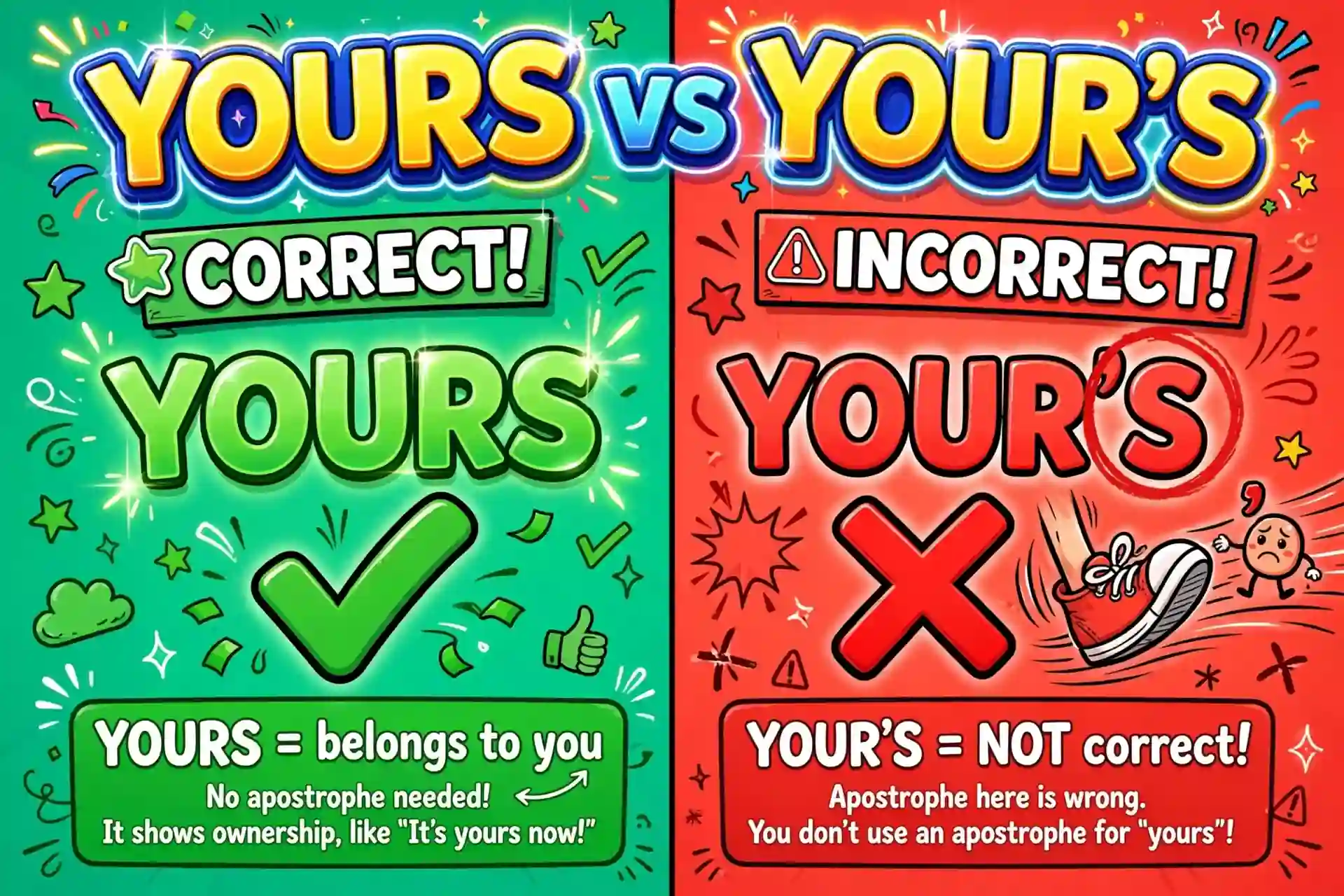
Yours is the correct spelling. It is a possessive pronoun meaning “belonging to you.” Your’s is never correct — possessive pronouns do not take apostrophes, ever.
For example, “The choice is yours” is correct. “The choice is your’s” is wrong. The apostrophe adds nothing and means nothing here; it is a pure mistake.
Quick Answer
| Word | Part of Speech | Main Meaning | Example |
|---|---|---|---|
| Yours | Possessive pronoun | Belonging to you | The victory is yours. |
| Your’s | — | Not a word; always a misspelling | ❌ The victory is your’s. |
Simple rule: Possessive pronouns (yours, hers, ours, theirs, its) never use apostrophes. If you see “your’s,” delete the apostrophe.
What Does Yours Mean?
Yours is a possessive pronoun. It replaces a noun phrase to show that something belongs to the person you are addressing: “your book” becomes “yours.”
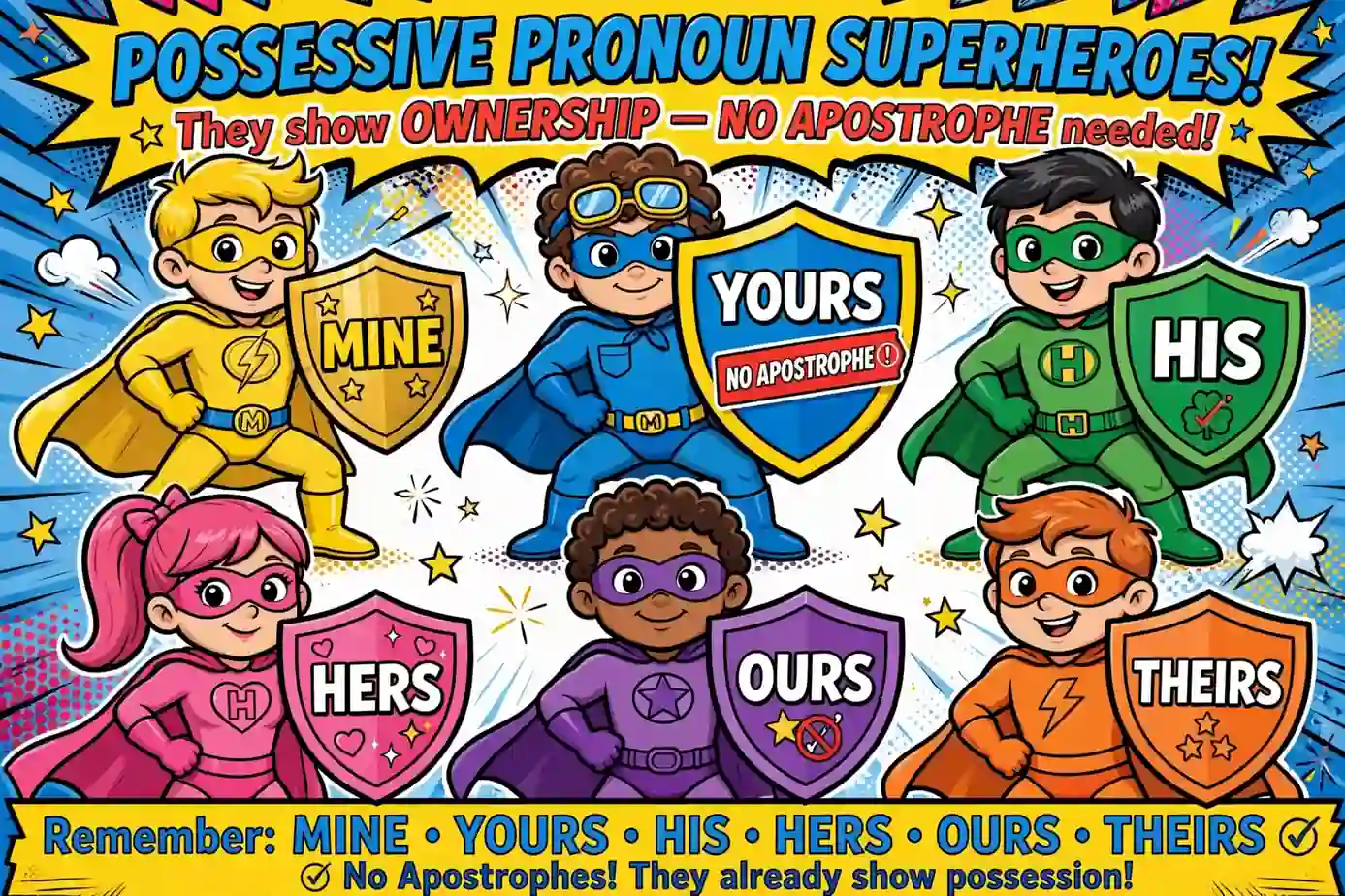
It works exactly like hers, ours, and theirs — none of which take apostrophes either. English possessive pronouns are already possessive by form, so adding an apostrophe is redundant and wrong.
Examples:
- Is this bag yours or mine?
- Yours is the blue one on the left.
- The decision is yours to make.
- Our house is small, but yours is beautiful.
- Yours truly, Erika
That last example — the standard letter sign-off “yours truly” — is proof of how established the apostrophe-free spelling is. See yours on Merriam-Webster.
What Does Your’s Mean?
Your’s means nothing. It is not a word in any dictionary and never has been. It is a misspelling born of a reasonable misunderstanding.
The misunderstanding goes like this: many possessives do use apostrophes (“the dog’s bone,” “Sarah’s car”), so writers assume the pronoun form needs one too. But pronouns play by different rules. Just as “her’s” and “their’s” are wrong, “your’s” is wrong.
Examples of the error:
- ❌ Is this seat your’s?
- ❌ The fault was your’s, not mine.
- ❌ Your’s is on the table.
Each should be yours, no apostrophe.
Yours vs. Your’s: Key Differences
| Feature | Yours | Your’s |
|---|---|---|
| Correct? | Yes | Never |
| What it is | Possessive pronoun | Misspelling |
| Apostrophe | None — and must stay that way | Wrongly added |
| Like | Hers, ours, theirs, its | Her’s, our’s, their’s (also wrong) |
| Example | The win is yours. | ❌ The win is your’s. |
The pattern is consistent across English: possessive pronouns stand alone. The same logic that settles whose vs. who’s applies here — the possessive form never takes the apostrophe.
Examples of Yours in Real Sentences
At Home
Yours: “Mom, is this jacket yours?”
The pronoun replaces “your jacket” — no apostrophe needed.
At Work
Yours: “The final call on this project is yours.”
Formal or casual, yours is the only correct form in professional writing too.
In Conversation
Yours: “Ours broke down, so can we borrow yours?”
Notice ours and yours side by side — both apostrophe-free, as all possessive pronouns are.
In Writing
Yours: “Yours sincerely, James”
The classic letter closing. Nobody has ever correctly written “your’s sincerely.”
Common Mistakes With Yours and Your’s
These errors come from over-applying the apostrophe rule for nouns — much like other easily confused everyday words, the fix is learning the one exception-free rule.
Mistake 1: Adding an Apostrophe to Yours
❌ The choice is your’s.
✅ The choice is yours.
Why: Possessive pronouns never take apostrophes. Delete it.
Mistake 2: Confusing “Your” and “Yours”
❌ Yours car is parked outside.
✅ Your car is parked outside.
Why: Your goes before a noun (your car); yours stands alone in place of the noun (the car is yours).
Mistake 3: Writing “Your’s” by Analogy With “It’s”
❌ The dog wagged your’s tail. (intended: its tail)
✅ The dog wagged its tail.
Why: It’s means “it is” — the apostrophe marks a contraction, not possession. Possessive its, like yours, has no apostrophe.
Pronunciation: Yours vs. Your’s
Yours is pronounced /jɔːrz/, rhyming with doors and floors.
“Your’s” has no pronunciation because it is not a word. Anyone reading it aloud would just say “yours” — which is exactly how it should have been spelled.

How to Remember the Difference
Memory trick: Possessive pronouns are already possessive — hers, ours, yours, theirs, its. The apostrophe has nothing left to do, so it stays home.
- If you can replace it with “hers” and the sentence still works, you want yours.
- Test: “The book is hers” ✓ → “The book is yours” ✓ (never “her’s” or “your’s”).
- The only “your” with an apostrophe you will ever meet is in “y’all” — a contraction, not a possessive.
Frequently Asked Questions
Is it yours or your’s?
Always yours. “Your’s” is never correct in any context — possessive pronouns do not take apostrophes.
Why doesn’t “yours” have an apostrophe?
Because possessive pronouns (yours, hers, ours, theirs, its) show possession through their form alone. Apostrophes in possessives belong to nouns (“the cat’s toy”), not pronouns.
What is the difference between “your” and “yours”?
Your is a determiner used before a noun: “your keys.” Yours is a pronoun that replaces the whole noun phrase: “the keys are yours.”
Is “yours truly” correct?
Yes — “yours truly” and “yours sincerely” are the standard formal letter sign-offs, and both use the apostrophe-free yours.
Are “her’s” and “their’s” also wrong?
Yes. The rule covers all possessive pronouns: hers, ours, yours, theirs, and its never take apostrophes.
Conclusion
Yours is the only correct spelling — a possessive pronoun that needs no apostrophe, exactly like hers and theirs. Your’s is always a mistake. When in doubt, try swapping in “hers”: if the sentence works, yours is your word.