Benefiting or Benefitting: Which Is Correct?
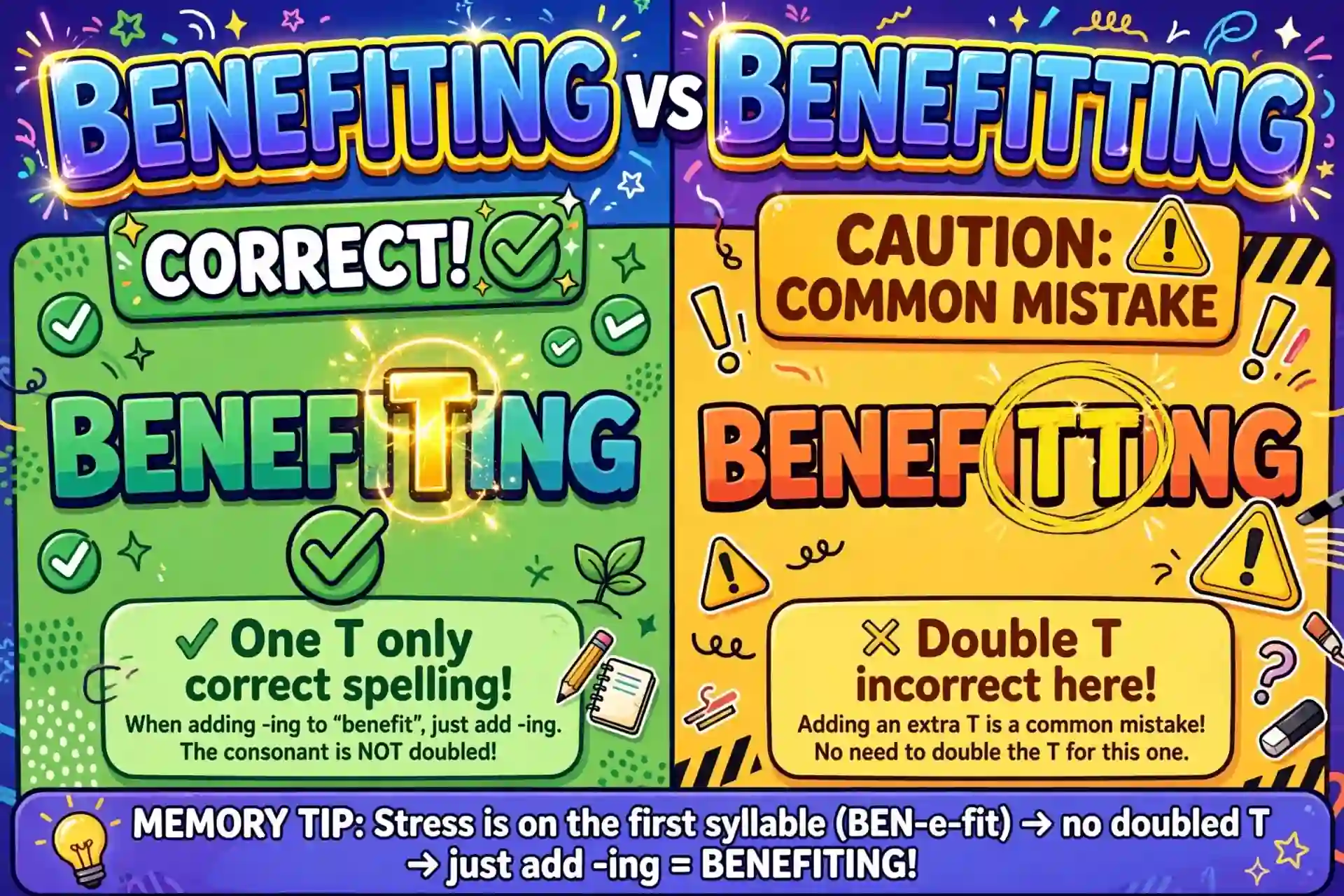
Benefiting is the standard spelling, with a single t. It is the -ing form of the verb benefit. Benefitting, with a double t, is a less common variant — not exactly wrong everywhere, but not the preferred form.
For example, “She is benefiting from the new policy” follows standard usage. The reason comes down to stress: you double a final consonant only when the last syllable is stressed, and benefit is stressed on its first syllable (BEN-e-fit).
Quick Answer
| Spelling | Status | Example |
|---|---|---|
| Benefiting | Standard (US and UK) | He is benefiting from the training. |
| Benefitting | Less common variant | He is benefitting from the training. |
Simple rule: Stress falls on BEN, not on fit, so the t does not double — write benefiting.
What Does Benefiting Mean?
Benefiting is the present participle of benefit: receiving an advantage, or giving one to someone else.
Examples:
- She is benefiting from the new study program.
- The whole town is benefiting from the new hospital.
- Regular exercise is benefiting his health.
- Students are benefiting from smaller class sizes.
- The charity is benefiting hundreds of families.
Major dictionaries list benefited and benefiting as the principal forms. This matches the pattern of similar verbs: profit → profiting, target → targeting, visit → visiting. See benefit on Merriam-Webster.
What Does Benefitting Mean?
Benefitting is a variant spelling with a doubled t. Some dictionaries list it as an acceptable alternative, and you will see it in print — but style guides and editors overwhelmingly prefer the single-t form.
Why does the variant exist? Because of verbs like permit → permitting and commit → committing, where the final consonant does double. Writers apply that pattern to benefit by analogy. The difference: in permit, the stress falls on the final syllable (per-MIT), which triggers doubling. In benefit, the stress is on the first syllable (BEN-e-fit), so no doubling happens.
Examples of the variant in use:
- The new law is benefitting small businesses. (variant)
- She is benefitting from daily practice. (variant)
Both would be more standard as benefiting. In exams, formal writing, and published work, use the single t.

Benefiting vs. Benefitting: Key Differences
| Feature | Benefiting | Benefitting |
|---|---|---|
| Status | Standard, preferred | Variant, less common |
| Regions | US and UK | US and UK (rare) |
| Follows the rule? | Yes — no doubling without final stress | No — doubles by analogy |
| Dictionary headword form | Yes | Listed as variant |
| Example | Benefiting the community. | Benefitting the community. |
The doubling rule is the same one behind cancelled vs. canceled and labelled vs. labeled — final-syllable stress decides whether the consonant doubles.
Examples of Benefiting in Real Sentences
At Home
Benefiting: “The kids are benefiting from the new bedtime routine.”
A parent describing positive results — standard single-t spelling.
At Work
Benefiting: “Our team is benefiting from the flexible schedule.”
In business writing, benefiting is the expected form.
In the News
Benefiting: “Local farmers are benefiting from the rainfall.”
News style guides (AP, Chicago) prescribe the single t.
Compare With a Doubling Verb
Permitting: “The law is permitting new construction.” (per-MIT — final stress, so double the t.)
Benefiting: “The law is benefiting new homeowners.” (BEN-e-fit — first-syllable stress, so single t.)
The contrast shows the rule working exactly as it should.
Common Mistakes With Benefiting and Benefitting
Mistake 1: Doubling the T by Analogy
❌ She is benefitting from the course.
✅ She is benefiting from the course.
Why: Benefit is stressed on the first syllable, so the t stays single.
Mistake 2: Thinking the Double-T Form Is Standard
❌ “Benefitting is the correct spelling.”
✅ “Benefitting is a variant; benefiting is the standard spelling.”
Why: Dictionaries list benefiting first. Use it in anything formal.
Mistake 3: Applying the Wrong Stress Pattern
❌ Profitting from the deal. (wrong)
✅ Profiting from the deal.
Why: Same rule — PROF-it is stressed on the first syllable, so no doubling, just like benefiting.
Pronunciation: Benefiting vs. Benefitting
Both are pronounced /ˈbɛnəfɪtɪŋ/ — BEN-uh-fit-ing. The spelling difference is invisible in speech.
The pronunciation actually proves the rule: you can hear that the stress lands on BEN, the first syllable, which is exactly why the final t does not double.

How to Remember the Difference
Memory trick: Say it out loud — BEN-e-fit. The drumbeat lands on BEN, far from the final t. No stress on the last syllable, no double letter.
- Stressed last syllable → double: per-MIT → permitting, re-FER → referring.
- Stressed first syllable → single: BEN-e-fit → benefiting, PROF-it → profiting, TAR-get → targeting.
- Clap the syllables: BEN (loud) – e – fit (quiet). Quiet ending = single t.
Frequently Asked Questions
Is it benefiting or benefitting?
Use benefiting (single t). It is the standard spelling in both American and British English. Benefitting is a less common variant.
Why doesn’t benefit double the T?
English doubles a final consonant before -ing only when the last syllable is stressed. Benefit is stressed on the first syllable (BEN-e-fit), so the t stays single.
Is “benefitted” also wrong?
The same rule applies: benefited is standard; benefitted is the less common variant. Use the single-t forms in formal writing.
Do Americans and Brits differ here?
No — unlike true US/UK pairs, both regions prefer benefiting. The single t is standard on both sides of the Atlantic.
What about “benefiter”?
The agent noun is benefiter (single t), following the same rule — though “beneficiary” is the more common word for someone who benefits.
Conclusion
Benefiting, with one t, is the standard spelling — say BEN-e-fit and let the first-syllable stress remind you that the final consonant never doubles. Benefitting survives only as a rare variant. One t is all you need.