Labelled or Labeled: Which Spelling Is Correct?
Both labelled and labeled are correct English spellings. The difference depends on regional spelling conventions. Labelled is the standard spelling in British English, while labeled is preferred in American English.
Both words have the same meaning. They are the past tense and past participle of the verb label, which means to attach a label, identify something, or describe someone or something.
For example, British writers use “The package was labelled yesterday.” American writers usually write “The package was labeled yesterday.”
Neither spelling is incorrect. Choose the version that matches your audience and keep it consistent.
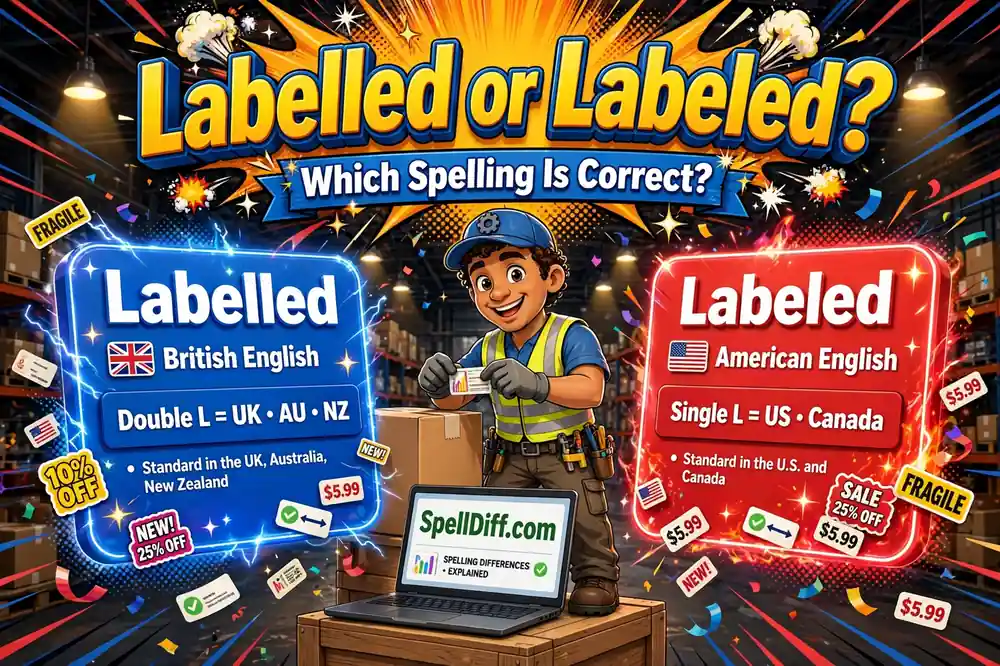
Quick Answer: Labelled or Labeled?
British English: The boxes were labelled before shipping.
American English: The boxes were labeled before shipping.
Quick Facts: Labelled vs. Labeled
|
Feature |
Labelled |
Labeled |
|
Spelling status |
Correct |
Correct |
|
Preferred region |
British English |
American English |
|
Part of speech |
Verb form |
Verb form |
|
Base verb |
Label |
Label |
|
Past tense |
Labelled |
Labeled |
|
Past participle |
Labelled |
Labeled |
|
Pronunciation |
Same |
Same |
|
Meaning |
Marked or identified |
Marked or identified |
What Does Labelled Mean?
Labelled is the British English spelling of the past tense and past participle of label.
The word describes something that received a label, identification, or description.
Examples:
British English usually doubles the final consonant when adding certain suffixes to words like label.
Therefore:
This spelling convention is common in British English.
Labelled as a Verb
Labelled functions as a verb when describing an action performed in the past or an action completed before another event.
Examples:
In these sentences, labelled describes the action of identifying or marking something.
Labelled in Passive Sentences
Labelled also appears in passive constructions. These sentences focus on the object receiving the label rather than the person performing the action.
Examples:
In these examples, labelled works with auxiliary verbs such as was, were, and had been.
What Does Labeled Mean?
Labeled is the American English spelling of the past tense and past participle of label.
It has exactly the same meaning as labelled. The only difference is the spelling.
Examples:
American English generally uses a single final consonant when adding certain suffixes to words like label.
Therefore:
Labeled as a Verb
Labeled describes an action that identifies, marks, or names something.
Examples:
The spelling remains labeled in American English, whether the sentence uses past tense or a participle.
Labeled in Passive Sentences
American writers also use labeled in passive constructions.
Examples:
Both labelled and labeled work in these sentence structures. The choice depends on the spelling convention being followed.
Key Differences Between Labelled and Labeled
The difference between these spellings is regional, not grammatical or semantic.
British English doubles the final consonant in labelled. American English generally keeps one final L in labeled.
|
Comparison |
Labelled |
Labeled |
|
English variety |
British English |
American English |
|
Final consonant |
Double L |
Single L |
|
Meaning |
Marked or identified |
Marked or identified |
|
Pronunciation |
/ˈleɪbəld/ |
/ˈleɪbəld/ |
|
Past tense |
Yes |
Yes |
|
Past participle |
Yes |
Yes |
|
Present participle |
Labelling |
Labeling |
|
Example |
The box was labelled. |
The box was labeled. |
Neither spelling changes the meaning of the sentence.
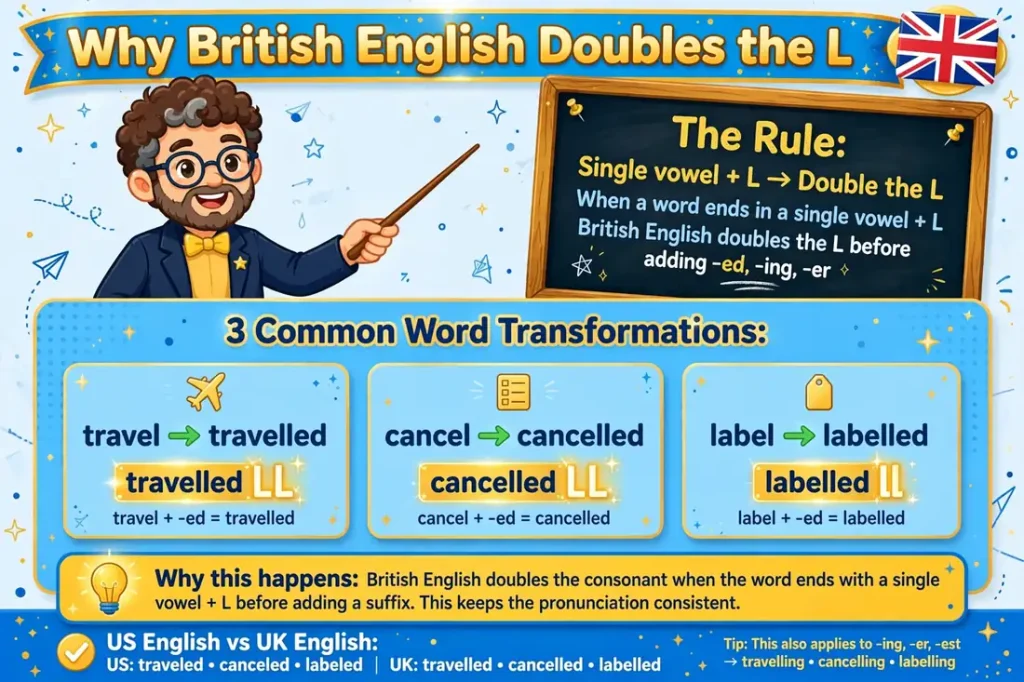
Why Does British English Use Double L?
British English commonly doubles the final consonant in certain words when adding suffixes.
The spelling follows a pattern found in words such as:
However, this is not an absolute rule for every English word.
Why Does American English Use One L?
American English generally retains one final L in these forms.
Examples include:
This difference reflects established regional spelling conventions.
Both systems are accepted forms of standard English.
Labelled or Labeled: British vs. American English
The main distinction comes from the English variety used by the writer.
British English generally prefers labelled, while American English prefers labeled.
Other English-speaking regions often follow British spelling conventions, but usage can vary by country, publication, and style guide.
British English Usage
In British English, labelled is the standard spelling.
It is commonly used in education, business writing, product descriptions, and everyday communication.
Examples:
British English also uses labelling rather than labeling.
American English Usage
In American English, labeled is the preferred spelling.
Examples:
American English also uses labeling instead of labelling.
What About Australian and Canadian English?
Australian English generally follows British spelling conventions and prefers labelled and labelling.
Canadian English can show variation. Both British-style and American-style spellings appear in Canadian writing, depending on the word and the style guide.
For labelled, the British-style double L is commonly used in Canadian English.
If you write for a Canadian audience, follow the relevant publication or organization’s spelling guide.
Which Spelling Should You Use?
Choose the spelling based on your intended audience.
|
Target Audience |
Recommended Spelling |
|
United States |
Labeled |
|
United Kingdom |
Labelled |
|
Australia |
Labelled |
|
Canada |
Labelled is commonly used |
|
International audience |
Follow one consistent style |
|
Academic publication |
Follow its style guide |
For an American website, use labeled throughout the content. For a British website, use labelled.
Consistency matters more than choosing one regional spelling over another.
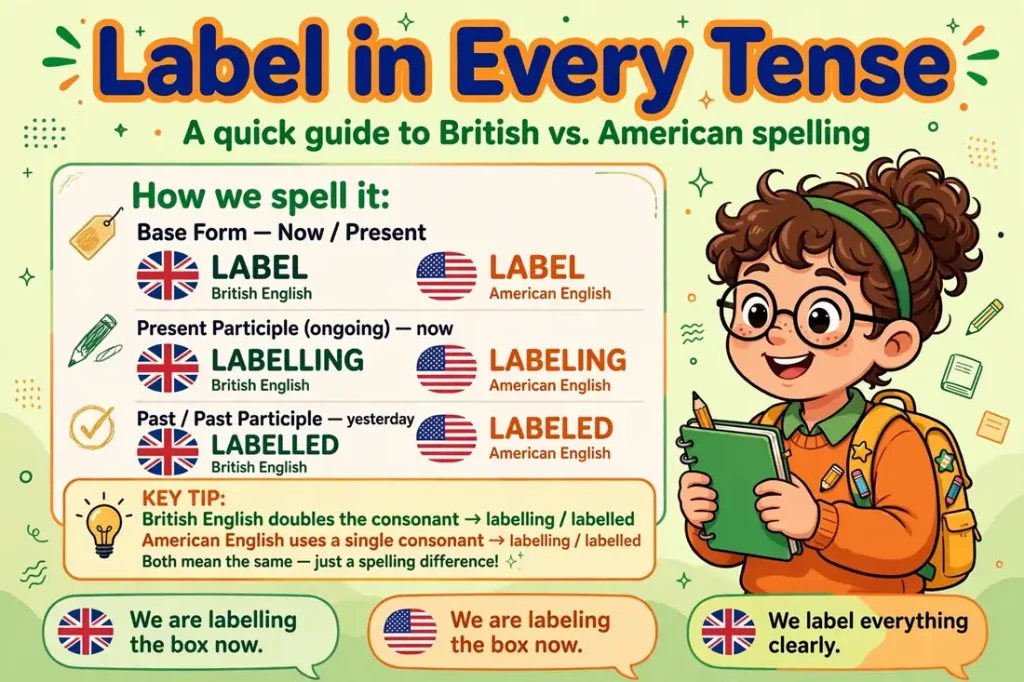
Labelled or Labeled in Different Tenses
Both spellings follow the same grammatical pattern. Only the number of L’s changes.
Understanding their verb forms helps prevent mistakes.
|
Verb Form |
British English |
American English |
|
Base form |
Label |
Label |
|
Third-person singular |
Labels |
Labels |
|
Present participle |
Labelling |
Labeling |
|
Past tense |
Labelled |
Labeled |
|
Past participle |
Labelled |
Labeled |
Present Tense: Label
The base form is identical in both varieties.
Examples:
Present Continuous: Labelling or Labeling
British English uses labelling, while American English uses labeling.
Examples:
Both sentences describe an action happening now.
Past Tense: Labelled or Labeled
The past tense describes an action that already happened.
Examples:
Both sentences are grammatically correct.
Past Participle: Labelled or Labeled
The past participle often appears with auxiliary verbs such as has, have, had, and was.
Examples:
The grammar stays the same across both spelling systems.
Labelled or Labeled in Sentences: 20 Examples
The following examples demonstrate both spellings in natural English sentences.
Examples Using Labelled
Examples Using Labeled
Notice that both versions communicate the same information. Only the spelling changes.
Common Mistakes When Using Labelled and Labeled
Although both spellings are correct, writers sometimes mix regional conventions or use incorrect verb forms.
Here are some common mistakes and their corrections.
Mistake 1: Mixing British and American Spelling
Using labelled and labeling in the same article can create inconsistency.
For example:
Incorrect combination in British English:
Consistent British English:
Consistent American English:
Both regional styles are correct. The important point is to follow one convention.
Mistake 2: Assuming Labelled Is Incorrect
Some American writers mistakenly believe labelled is a spelling error.
This is not true.
Labelled is standard British English, while labeled is standard American English.
For example:
Both sentences are grammatically correct.
Mistake 3: Assuming Labeled Is Incorrect
The opposite mistake also occurs.
Some British English writers may consider labeled incorrect. However, it is the accepted American spelling.
If your audience uses American English, labeled is appropriate.
Mistake 4: Writing Labeling in British English
British English generally uses labelling with two L’s.
Incorrect for standard British spelling:
The workers are labeling the containers.
Preferred British spelling:
The workers are labelling the containers.
American English uses labeling.
Mistake 5: Confusing Labelled With Label
Label is the base form, while labelled and labeled are past forms.
Examples:
Do not use labelled or labeled when the sentence requires the base verb.
Incorrect: I labelled every day.
Correct: I label every day.
The correct form depends on the intended tense.
Labelled vs. Labeled vs. Labelling vs. Labeling
These forms belong to the same verb family. Their spelling depends on the regional convention and grammatical context.
|
Word |
British English |
American English |
|
Base form |
Label |
Label |
|
Past tense |
Labelled |
Labeled |
|
Past participle |
Labelled |
Labeled |
|
Present participle |
Labelling |
Labeling |
|
Third-person singular |
Labels |
Labels |
|
Person who labels |
Labeller |
Labeler |
What Does Labelling Mean?
Labelling is the British English present participle or gerund of label.
It describes the act of attaching labels or identifying something.
Example: Labelling products correctly helps customers understand their contents.
What Does Labeling Mean?
Labeling is the American English equivalent of labelling.
It has the same grammatical function and meaning.
Example: Labeling products correctly helps customers understand their contents.
What Is a Labelled Product?
A labelled product is an item that has identification, instructions, or other information attached to it.
British English:
The labelled product contains important safety information.
American English:
The labeled product contains important safety information.
Both sentences are correct.
How to Remember Labelled or Labeled
Remembering the regional spelling difference is simple when you connect each form with its English variety.
1. Remember British English Uses Double L
British English generally doubles the final L in these forms.
Examples:
Think of the double L as a feature of British spelling in these words.
2. Remember American English Uses Single L
American English generally keeps one L in these forms.
Examples:
If you write for American readers, use the single-L forms.
3. Check Your Target Audience
Before publishing an article, identify your primary audience.
For example:
This approach prevents spelling inconsistencies across your content.
4. Use a Consistent Style Guide
A style guide helps maintain the same spelling throughout a website, report, or publication.
For example, an American publication may use labeled, traveled, and canceled.
A British publication may use labelled, travelled, and cancelled.
Following one style makes professional writing easier to read.
Frequently Asked Questions
Is Labelled or Labeled Correct?
Both spellings are correct. Labelled is the preferred British English spelling, while labeled is the preferred American English spelling. Both have the same meaning and grammatical function.
Is Labelled British or American?
Labelled is primarily the British English spelling. It is also commonly used in Australian English and other varieties that follow British spelling conventions.
Is Labeled American or British?
Labeled is the standard American English spelling. American writers use it as the past tense and past participle of the verb label.
Is Labelling or Labeling Correct?
Both are correct regional spellings. British English generally uses labelling, while American English uses labeling. Both words describe the act of identifying or marking something.
What Is the Past Tense of Label?
The past tense of label is labelled in British English and labeled in American English. Both forms are correct.
Do Labelled and Labeled Have Different Pronunciations?
No. Both spellings have the same standard pronunciation: /ˈleɪbəld/. The difference exists only in their written forms, not their meaning or pronunciation.
Conclusion
Both labelled and labeled are correct spellings of the past tense and past participle of label.
The difference comes from regional English conventions. British English prefers labelled, while American English prefers labeled.
Both words mean marked, identified, or described with a label. Their pronunciation and grammatical function remain identical.
When writing for a specific audience, choose the appropriate regional spelling. Keep the same convention throughout your content to maintain consistency.