Armor or Armour: US vs UK Spelling Explained
Armor is the American spelling and armour is the British spelling of the protective covering worn by soldiers or fitted on vehicles. Both are correct; the right choice depends on your audience. Use armor for American readers and armour for British, Canadian, and Australian readers.
For example, “The knight wore shining armor” is natural in the US, while “The knight wore shining armour” is natural in the UK. The difference is purely regional.
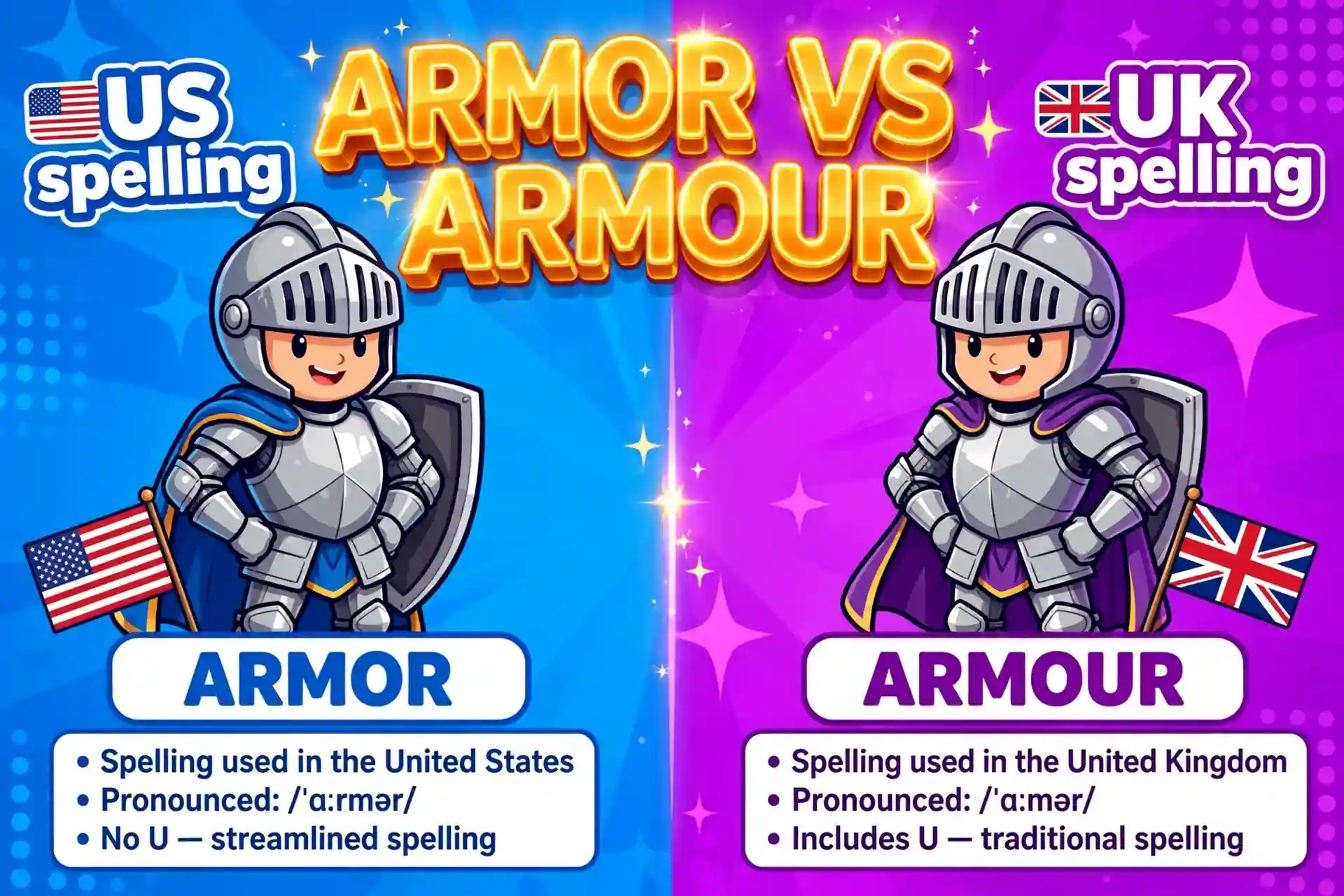
Quick Answer
| Word | Part of Speech | Main Meaning | Example |
|---|---|---|---|
| Armor | United States | The tank’s armor deflected the blast. | |
| Armour | United Kingdom, Canada, Australia | The tank’s armour deflected the blast. |
Simple rule: Writing for Americans? Use armor. Writing for British readers? Use armour.
What Does Armor Mean?
Armor is the standard American spelling for protective covering — the metal suits of medieval knights, the plating on military vehicles, and, figuratively, any defense. As a verb, to armor means to equip with such protection.
Examples:
- Medieval knights wore suits of armor into battle.
- The vehicle was fitted with extra armor plating.
- She faced criticism with emotional armor.
- The company armored its trucks for the desert route.
- Body armor has protected soldiers for centuries.
- The knight’s armor gleamed in the tournament sunlight.
American style guides consistently use armor, following the same simplified pattern as the -or/-our pattern in color vs colour.
What Does Armour Mean?
Armour is the standard British spelling, also used in Canada, Australia, New Zealand, and Ireland. It means exactly the same thing as armor — protective covering, literal or figurative.
Examples:
- Medieval knights wore suits of armour into battle.
- The vehicle was fitted with extra armour plating.
- She faced criticism with emotional armour.
- The company armoured its trucks for the desert route.
British publications, schools, and official documents use armour without exception.
For the dictionary entry, see armor on Cambridge Dictionary.
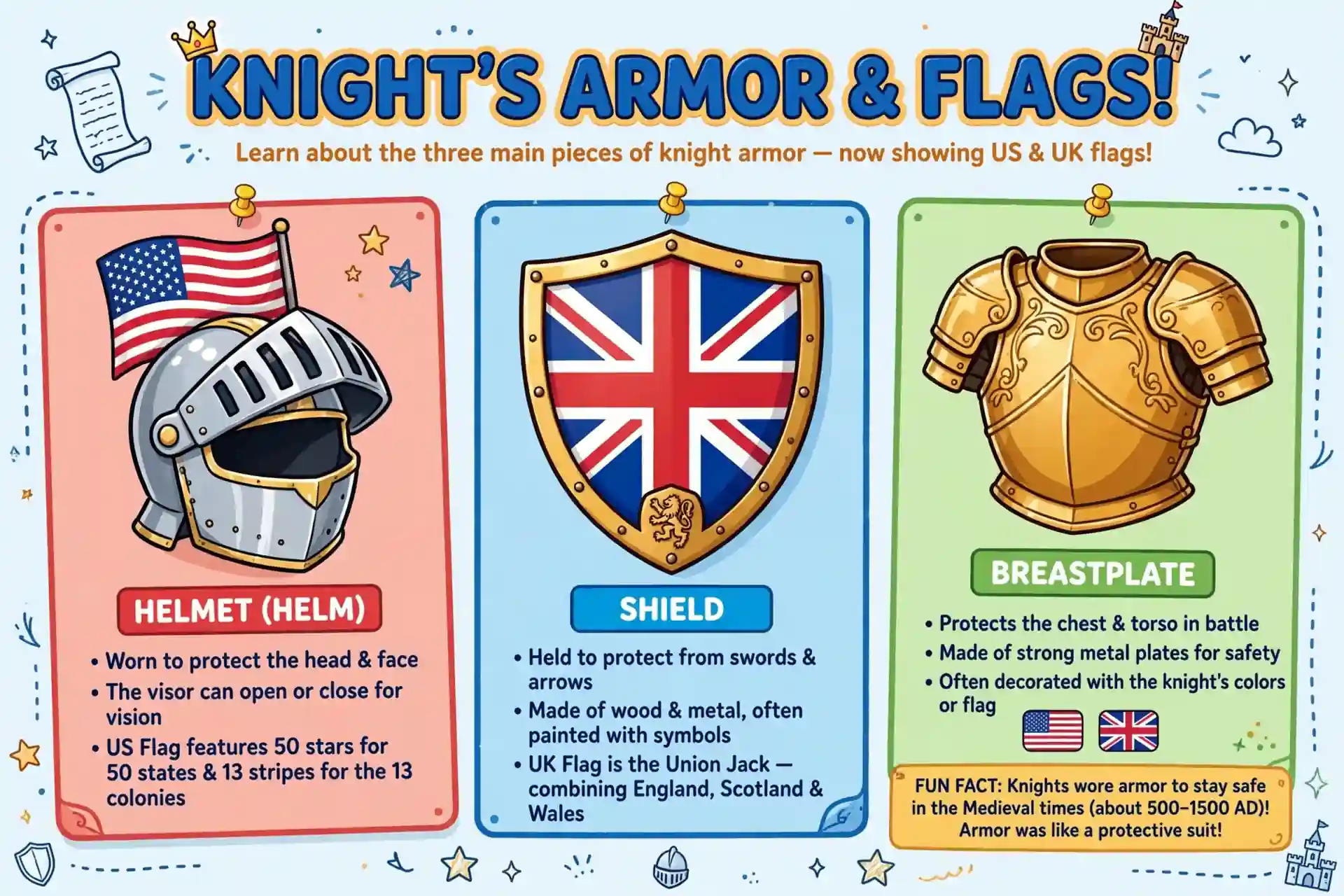
Armor vs. Armour: Key Differences
| Feature | Armor | Armour |
|---|---|---|
| Region | American English | British English |
| Meaning | Identical | Identical |
| Verb forms | Armored, armoring | Armoured, armouring |
| Related noun | Armorer | Armourer |
The -or vs. -our split runs through a whole family of words, and derived forms always follow the base spelling — armored with armor, armoured with armour.
Why Are There Two Spellings?
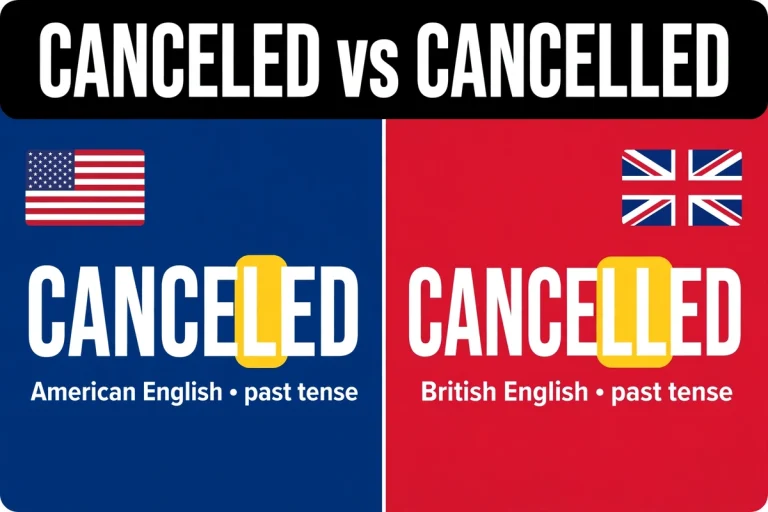
Both spellings descend from the Old French armure. British English kept the French-style -our ending, while Noah Webster’s American spelling reforms in the early 1800s stripped it to -or for simplicity — the same reform behind cancelled vs canceled.
Neither choice is more “correct.” They are simply the two regional standards, and each is wrong only when used for the wrong audience.
Related -or / -our Word Pairs
| American | British |
|---|---|
| Armor | Armour |
| Color | Colour |
| Flavor | Flavour |
| Honor | Honour |
| Labor | Labour |
| Humor | Humour |
Learn one pair and you have learned them all: American drops the u, British keeps it.
Common Mistakes With Armor and Armour
Mistake 1: Mixing Spellings in One Document
❌ The knight polished his armor, then donned his armour for battle.
✅ The knight polished his armor, then donned his armor for battle. (US)
✅ The knight polished his armour, then donned his armour for battle. (UK)
Why: Pick one regional standard and stay consistent throughout.
Mistake 2: Mismatching Derived Forms
❌ The armored knight wore shining armour. (mixed US/UK)
✅ The armored knight wore shining armor. (US)
✅ The armoured knight wore shining armour. (UK)
Why: Derived forms follow the base spelling — armored pairs with armor, armoured with armour.
Mistake 3: “Amour” for the Protective Gear
❌ The soldier wore steel amour.
✅ The soldier wore steel armour. (UK)
Why: Amour is a French word meaning love. The protective gear needs the r: armour.
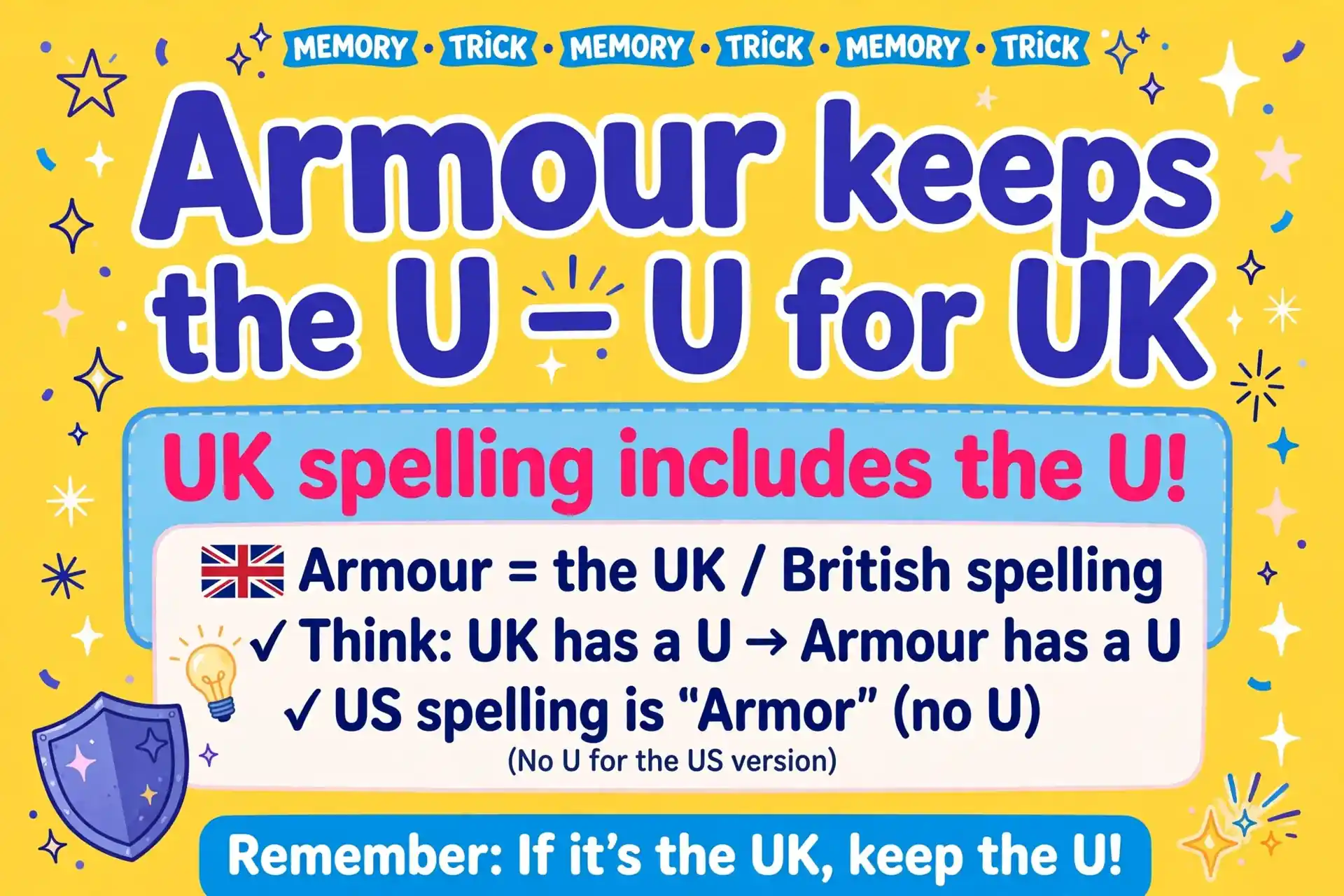
How to Remember the Difference
Memory trick: Armour keeps the u — think “u for UK.” American armor dropped it, so if your audience is American, drop the u too.
- Armor → American (no u, like color).
- Armour → British (keeps u, like colour).
Frequently Asked Questions
Which is correct: armor or armour?
Both are correct. Armor is American English; armour is British English (also used in Canada and Australia).
Is “armor” wrong in British English?
In formal British writing, armor reads as an Americanism. Use armour for UK audiences.
What is the verb form — “armor” or “armour”?
Both spellings work as verbs: American to armor (“they armored the vehicle”), British to armour (“they armoured the vehicle”).
Is it “armored” or “armoured”?
American: armored. British: armoured. The derived forms always match the base spelling.
What does “chink in one’s armor” mean?
It means a small weakness in someone’s defenses — figurative armor. The idiom works with either regional spelling.
Does the military use “armor” or “armour”?
Each follows its national standard: the US military writes armor (“body armor”), while the British Army writes armour (“body armour”). The gear is the same; only the u changes passports.
What is “body armour”?
Body armour (body armor in the US) is protective clothing worn by soldiers, police, and security personnel — vests, helmets, and plates designed to stop bullets and shrapnel. Like the base word, the spelling follows your region: body armor for American readers, body armour for British ones.
Conclusion
Armor is American and armour is British — same protection, different u. Choose the spelling your readers expect, keep it consistent, and apply the same -or/-our pattern to the whole word family.