Theatre or Theater: Which Spelling Is Correct?
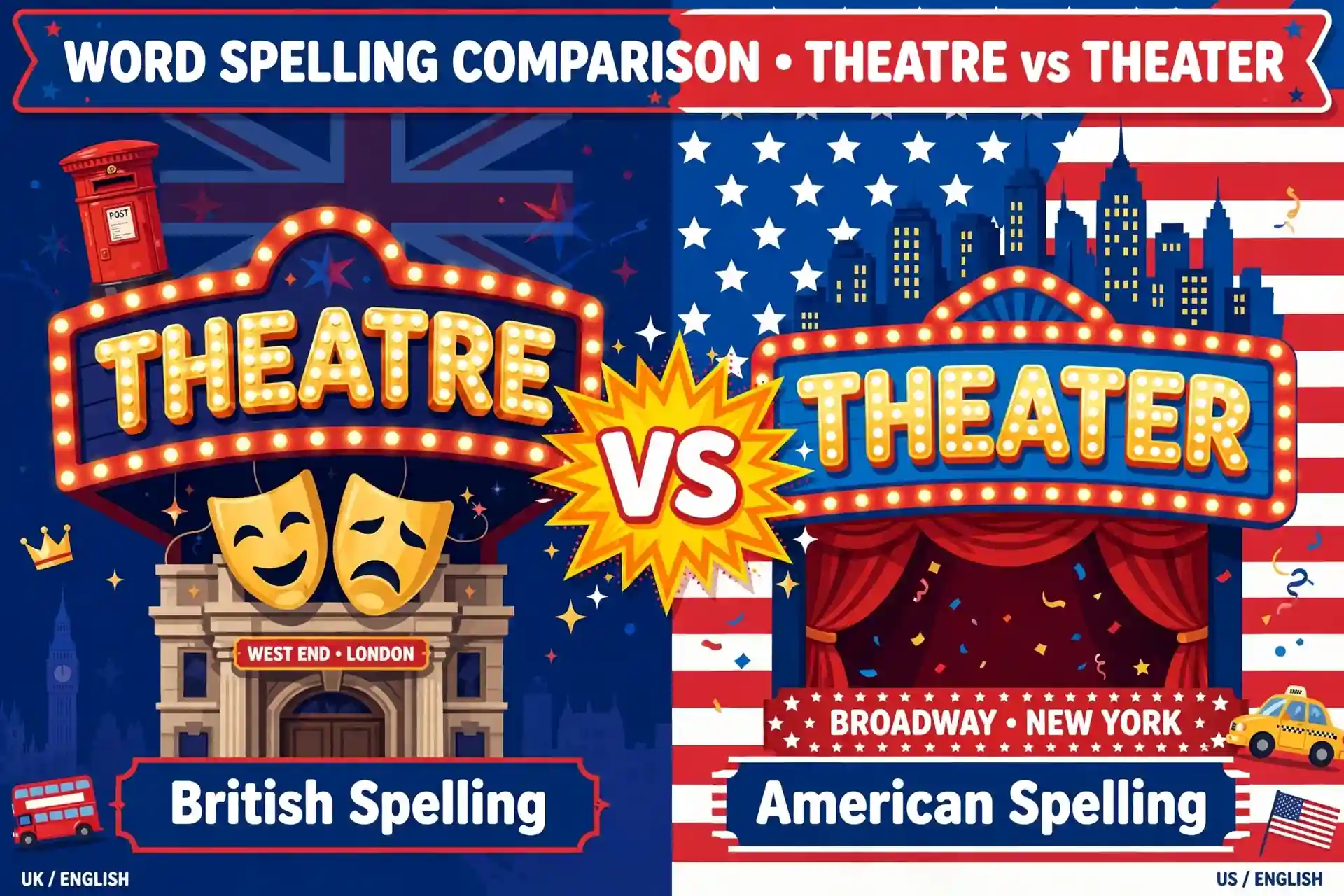
Theatre and theater are the same word with different regional spellings: theatre is the British English form, while theater is the American English form. Both refer to the building where plays are performed and to the art of live performance itself. A Londoner says she is going to the theatre; a New Yorker says she is going to the theater.
Quick Answer
| Word | Part of Speech | Main Meaning | Example |
|---|---|---|---|
| Theater | noun | US spelling: a building for plays or films, or the art form | “We watched the musical at a Broadway theater.” |
| Theatre | noun | UK spelling: exactly the same meaning as theater | “The new theatre on Drury Lane opens next month.” |
Simple rule: use theater in American English and theatre in British English — the meaning never changes, only the final two letters.
What Does Theater Mean?
Theater is the standard American spelling of the word. It names the building where plays, musicals, and films are shown, and it also names the art of live performance.
The Building
- “We watched the musical at a packed Broadway theater.”
- “The old theater downtown now shows classic films.”
- “That movie theater has the best popcorn in town.”
- “The school theater seats five hundred people.”
The Art Form
- “She studied theater at university and now directs plays.”
- “Live theater hits differently than streaming a show.”
What Does Theatre Mean?
Theatre is the standard British spelling, used across the UK, Ireland, Australia, and much of the Commonwealth. It carries the identical meanings: the building and the art form.
- “The National Theatre streams its plays online.”
- “They booked front-row seats at the West End theatre.”
- “He trained at a London theatre school.”
- “Our local theatre hosts a panto every Christmas.”
- “She works in theatre marketing for a touring company.”
Why Are There Two Spellings?
The split goes back to Noah Webster, whose 1828 American dictionary simplified many French-derived -re endings to -er: theatre became theater, centre became center, and metre became meter. British English kept the original French-style -re endings. Neither is a mistake; each is simply the local convention.
Other common -er / -re pairs that follow the same pattern:
| American (US) | British (UK) |
|---|---|
| theater | theatre |
| center | centre |
| meter | metre |
| fiber | fibre |
| liter | litre |
| caliber | calibre |
Theater vs. Theatre: Key Differences
| Feature | Theater | Theatre |
|---|---|---|
| Used in | United States, Canada (mixed) | UK, Ireland, Australia, Commonwealth |
| Ending | -er | -re |
| Meaning | Building for performances; the art form | Identical — no meaning difference at all |
| Pronunciation | /ˈθiːətər/ | /ˈθiːətər/ — same sound |
| Plural | theaters | theatres |
| Related adjective | theatrical (both spellings) | theatrical (both spellings) |
Everything else about the two words is identical — the difference begins and ends with the final two letters.

Theater and Theatre in Real Sentences
At Home
Theater: “We built a home theater in the basement for movie nights.”
Theatre: “Her flat is only a ten-minute walk from the local theatre.”
The first sentence suits an American household, the second a British one — same idea, different spelling.
At Work
Theater: “HR hired a theater group to run the team-building workshop.”
Theatre: “The London office booked the theatre for the awards night.”
Business writing should match the spelling of the office’s region.
In Conversation
Theater: “Do you prefer going to the theater or watching films at home?”
Theatre: “I haven’t been to the theatre in ages — fancy a play on Saturday?”
In speech the two are indistinguishable; only writing reveals the difference.
Common Mistakes
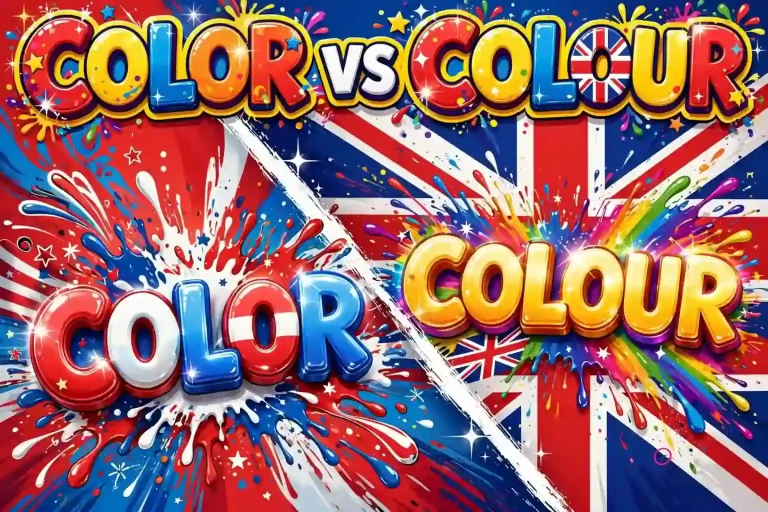
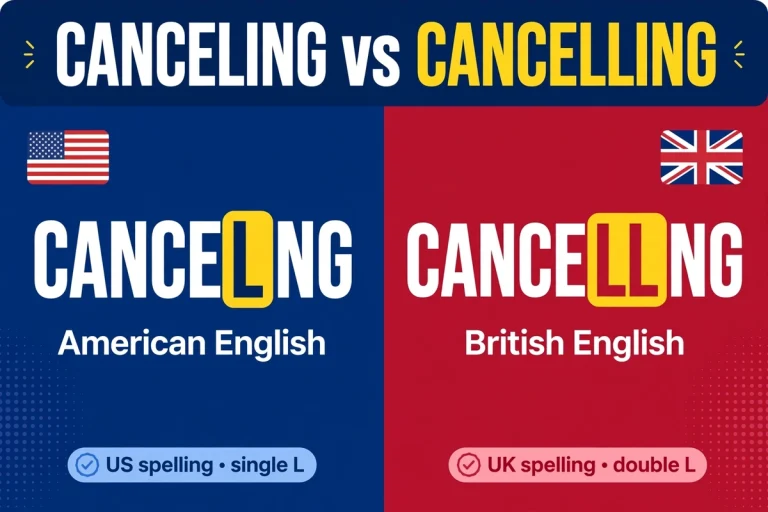
The biggest error is mixing the two spellings in the same piece of writing — much like the American/British spelling question in our guide to color or colour, or the doubled-consonant rule in cancelled or canceled. Pick one system and stick to it.
Mistake 1: Mixing Spellings in One Document
❌ “The new theater district includes the historic Globe Theatre.”
✅ “The new theater district includes the historic Globe Theater.” (US publication)
✅ “The new theatre district includes the historic Globe Theatre.” (UK publication)
Why: consistency matters more than which variant you choose — match your audience’s convention throughout.
Mistake 2: Spelling It “Teater”
❌ “The teater was sold out.”
✅ “The theater was sold out.” / “The theatre was sold out.”
Why: only the two established forms exist; dropping the h is always wrong.
Mistake 3: “Correcting” Proper Names
❌ “The National Theater of London” (its official name is the National Theatre)
✅ “The National Theatre of London”
Why: names of venues and companies keep their original spelling regardless of your region — the Cambridge Dictionary entry for theatre lists the word as standard British usage.
Mistake 4: Using “Theatre” for an Operating Room in the US
❌ US hospital report: “The patient was taken to the operating theatre.”
✅ US: “The patient was taken to the operating room.” / UK: “the operating theatre.”
Why: British English uses “operating theatre” for a surgical suite; Americans say “operating room.”
Pronunciation
Both spellings are pronounced identically: /ˈθiːətər/ (“THEE-uh-ter”). It rhymes with meter and heater. You will never hear the spelling difference — only see it.
How to Remember the Difference
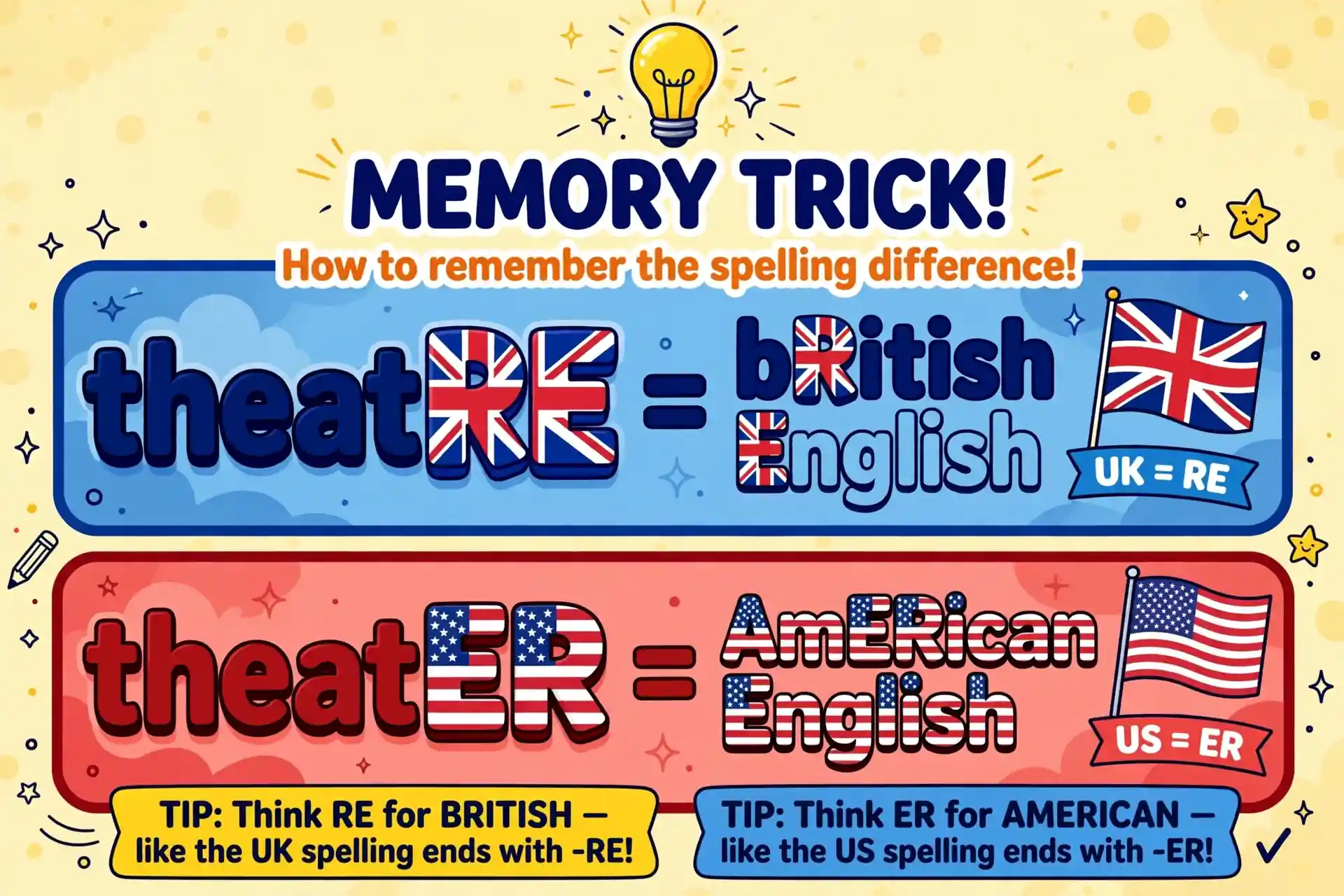
Think of the endings: theatRE = bRitish English, and theatER = AmERican English. The -re ending matches other British spellings like centre and metre.
- Theatre ends in -re → used in Britain.
- Theater ends in -er → used in America.
- The meaning, pronunciation, and plural pattern are the same for both.
Frequently Asked Questions
Is it theatre or theater?
Both are correct. Use theater in American English and theatre in British English.
Which spelling is correct?
It depends on your audience. American publications, schools, and style guides use theater; British, Irish, and Australian ones use theatre.
Do Americans ever use “theatre”?
Sometimes, for stylistic effect — some performing-arts venues use theatre to sound classical or prestigious, even in the US. For standard writing, though, theater is the safe American choice.
Is it “movie theater” or “movie theatre”?
Americans say “movie theater.” Brits rarely say either — they say “cinema.”
Is there any meaning difference between theater and theatre?
None at all. Building, art form, films, plays — every sense is shared.
How do you pronounce “theatre”?
/ˈθiːətər/ — “THEE-uh-ter,” exactly like theater.
Conclusion
Theater and theatre are regional twins of one word: American -er versus British -re, with zero difference in meaning or pronunciation. Choose the spelling your readers expect, stay consistent, and never “correct” a proper name.