Spicey or Spicy: Which Spelling Is Correct?
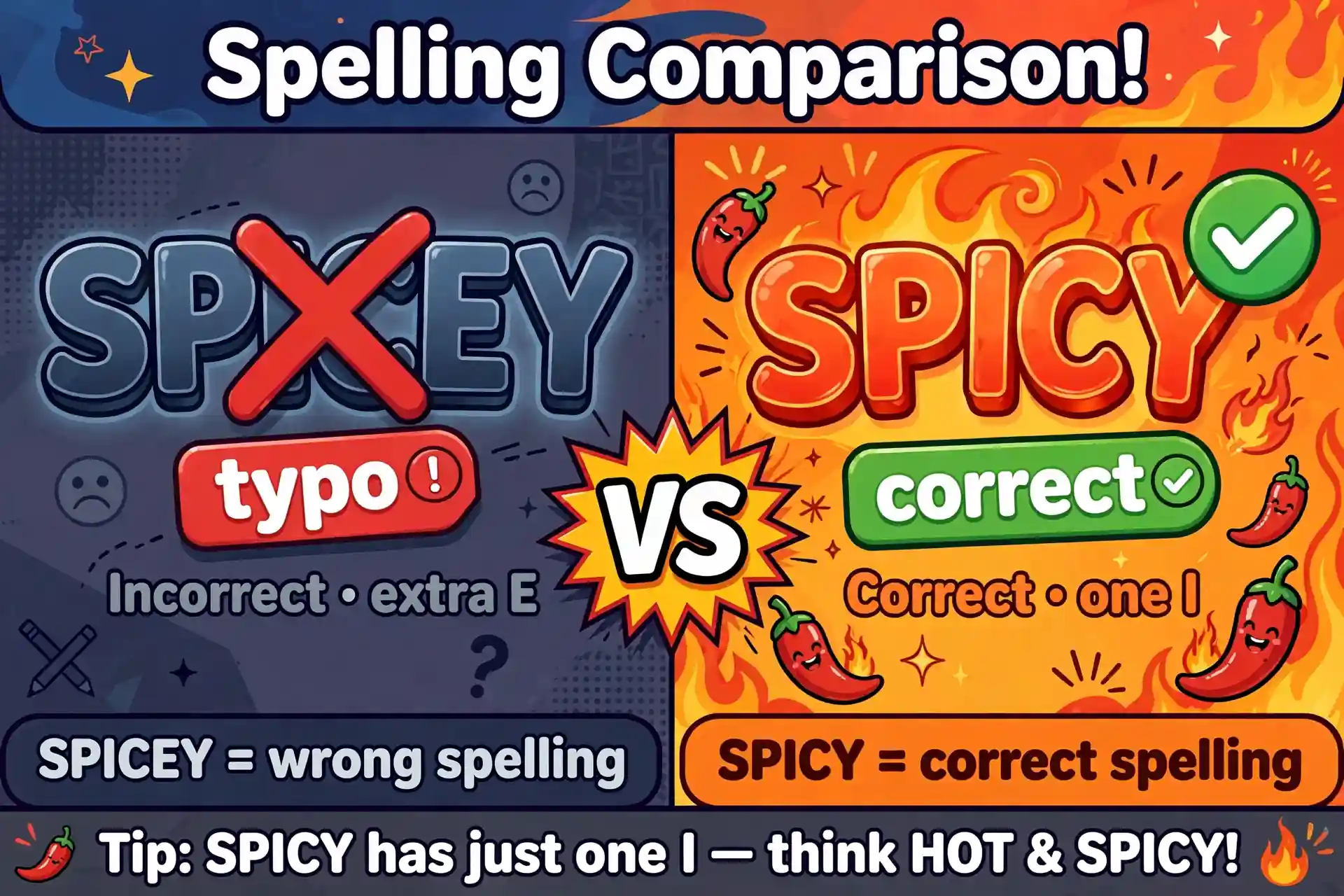
Spicy is the correct adjective for food seasoned with spices — and, in slang, for anything racy or provocative. Spicey is simply a misspelling: it looks plausible, but no dictionary lists it. The sauce was spicy enough to make me sweat.
Quick Answer
| Word | Part of Speech | Main Meaning | Example |
|---|---|---|---|
| Spicy | adjective | flavored with spices; hot or pungent | “This curry is too spicy for me.” |
| Spicy | adjective (slang) | racy, provocative, lively | “The novel had some spicy chapters.” |
| Spicey | — | common misspelling of “spicy” | ❌ “spicey food” → ✅ “spicy food” |
Simple rule: there is no “spicey” in the dictionary — the correct spelling always ends in -icy.
What Does Spicy Mean?
Spicy describes food flavored with spices, especially food that tastes hot or pungent from chilies, pepper, or mustard.
Examples:
- “The salsa was too spicy for the kids.”
- “I love spicy noodles with chili oil.”
- “Add some spicy mustard to the sandwich.”
- “Thai food is famous for its bold, spicy flavors.”
Spicy as Slang
Beyond food, spicy means lively, provocative, or a little scandalous.
- “The interview got spicy when salaries came up.”
- “She wrote a spicy memoir about her twenties.”
What Does Spicey Mean?
Spicey has no meaning — it is a misspelling of spicy. Spellcheckers flag it, dictionaries ignore it, and editors correct it. The error usually comes from adding -y to spice without dropping the final e.
- ❌ “This is a spicey dish.” → ✅ “This is a spicy dish.”
- ❌ “He likes his food spicey.” → ✅ “He likes his food spicy.”
- ❌ “That was a spicey take.” → ✅ “That was a spicy take.”
- ❌ “Spicey wings 2-for-1″ (menu typo) → ✅ “Spicy wings 2-for-1″
Spicey vs. Spicy: Key Differences
| Feature | Spicy | Spicey |
|---|---|---|
| Status | Correct standard spelling | Misspelling — not a real word |
| Meaning | Flavored with spices; slang: racy | None |
| Part of speech | Adjective | — |
| In dictionaries | Yes (Merriam-Webster lists “spicy” with both senses) | No |
| How it forms | spice + y, dropping the final e | Keeping the e by mistake |
| Spellcheck | Accepted | Flagged as an error |
The difference is simple: one is a word, the other is a typo.
Spicey and Spicy in Real Sentences
At Home
Spicy: “This soup needs to be spicier — pass the chili flakes.”
Spicey: ❌ “The tacos were too spicey.” → ✅ “The tacos were too spicy.”
At home the error is harmless, but any spellchecker will underline “spicey” in red.
At Work
Spicy: “Our new menu highlights spicy regional dishes.”
Spicey: ❌ A restaurant printing “spicey wings” on its menu — customers notice.
In professional writing, the misspelling reads as carelessness.
In Conversation
Spicy: “Things got spicy when they started talking politics.”
Spicey: ❌ Texting “that was a spicey take” — autocorrect will change it to spicy.
The slang sense works exactly like the food sense; only the spelling rule stays fixed.
Common Mistakes
Misspellings often come from false analogy — the same kind of pattern error behind loose or lose and the doubled-letter trap in dieing or dying. English spelling rules beat guesswork every time.
Mistake 1: Writing “Spicey” on Menus and Recipes
❌ “Add spicey peppers to the stew.”
✅ “Add spicy peppers to the stew.”
Why: when a noun ends in e, drop the e before adding -y: spice → spicy, ice → icy, noise → noisy.
Mistake 2: Misspelling the Comparative
❌ “This curry is spiceyer than the last one.”
✅ “This curry is spicier than the last one.”
Why: -y becomes -ier / -iest: spicy → spicier → spiciest.
Mistake 3: Confusing “Spicy” with “Spiced”
❌ “We drank spicy wine by the fire.” (meant mulled wine)
✅ “We drank spiced wine by the fire.”
Why: spiced means spices were added (mulled wine, spiced cake); spicy means it tastes hot. A mild cinnamon cake is spiced, not spicy.
Mistake 4: Copying “Dicey” as a Pattern
❌ “If dicey keeps its e, spicey must be fine.”
✅ “Dicey is the exception; spicy follows the normal drop-the-e rule.”
Why: English has a few oddballs like dicey, but spice → spicy is the standard pattern.
Pronunciation
Spicy is pronounced /ˈspaɪsi/ (“SPY-see”). It rhymes with icy and dicey — which is exactly why people are tempted to spell it like dicey. Resist the temptation.
How to Remember the Difference
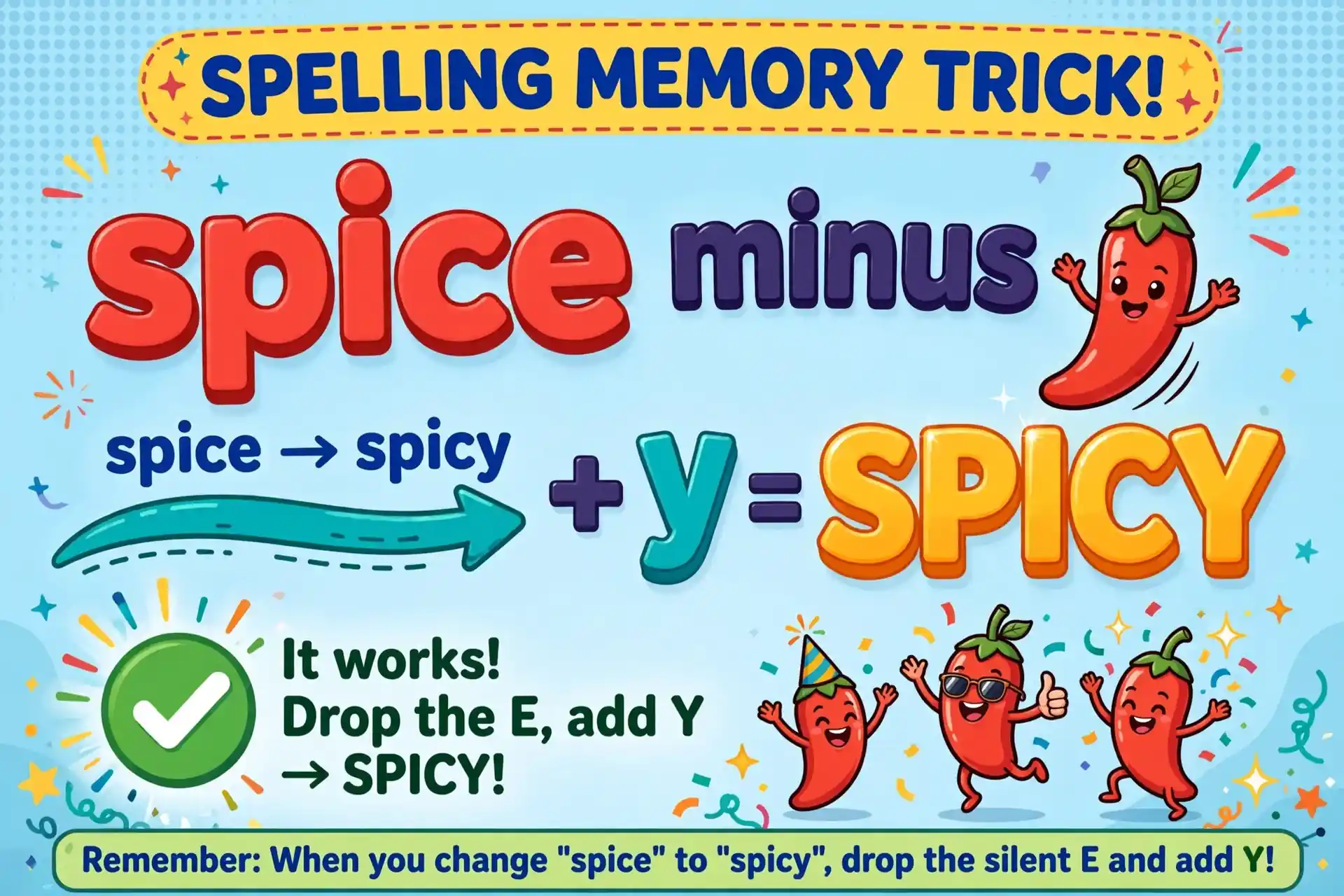
Picture the final e dropping off like a chili pepper falling from the plant: spice → spicy. The e is gone, and y takes its place. Or remember the rhyme: ice → icy, so spice → spicy.
- Spicy = spic + y (the e drops).
- Spicey = the e that should have dropped.
- When in doubt, spellcheck will always flag “spicey.”
Frequently Asked Questions
Is it spicey or spicy?
Spicy is correct. Spicey is a misspelling — it is not a word in standard English.
Why is it spelled “spicy” and not “spicey”?
English drops the final e when adding -y to make an adjective: spice → spicy, just like ice → icy and noise → noisy.
Is “spicey” ever correct?
No. Dictionaries do not list it, and spellcheckers flag it. Use spicy in every context.
What does “spicy” mean besides hot food?
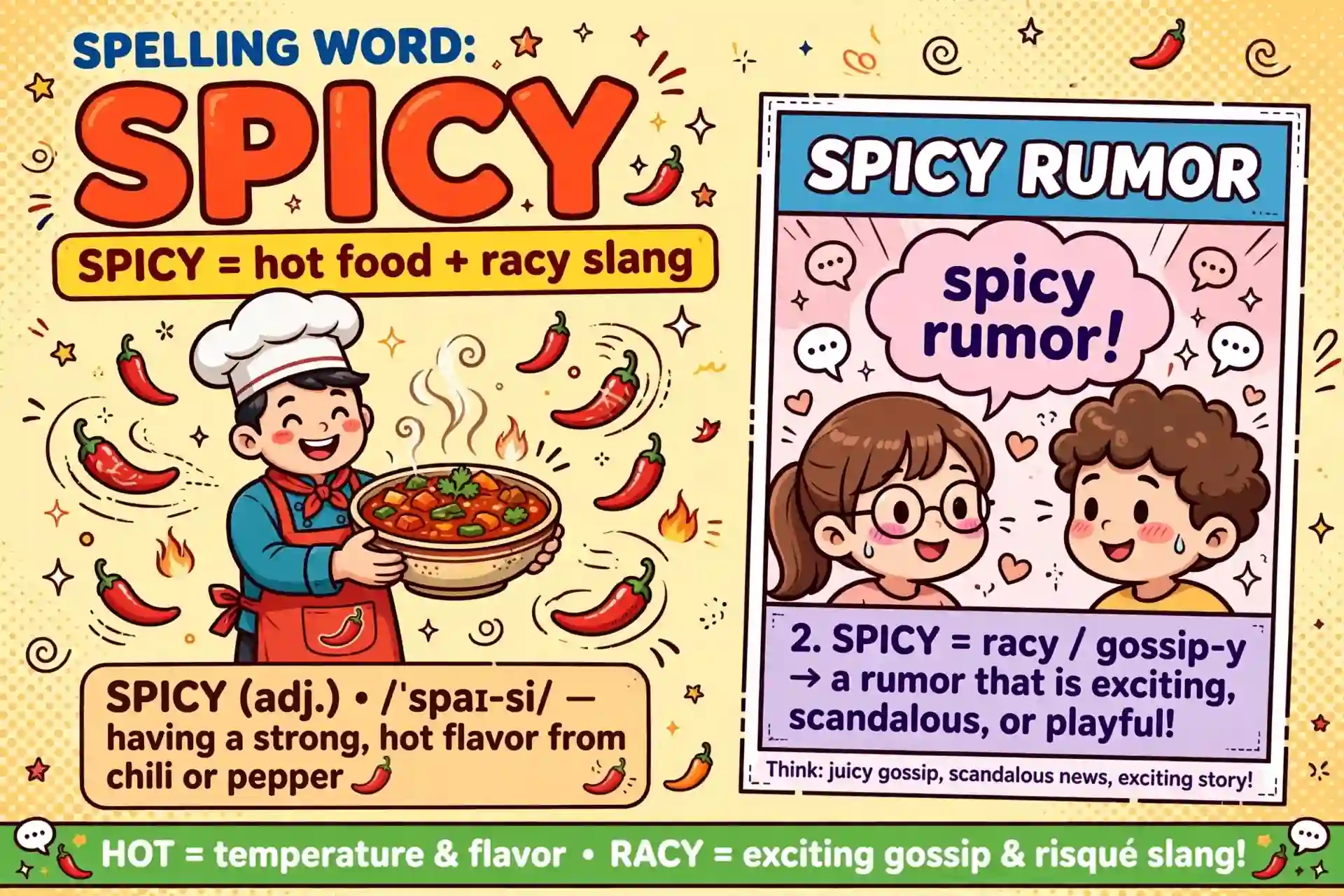
In slang it means racy, provocative, or lively — “a spicy debate,” “a spicy rumor.”
What are the comparative and superlative of “spicy”?
Spicier and spiciest — change the y to i and add -er / -est.
Is “spicy” an adjective or adverb?
An adjective: it describes nouns (“spicy food”). The adverb form is “spicily,” though it is rarely used.
Conclusion
Spicy is the only correct spelling, whether you mean chili-hot food or a racy rumor — and spicey is always a typo, because the final e drops when -y is added. Remember ice → icy and you will never write “spicey” again.