Intents and Purposes or Intensive Purposes: What’s the Difference?
For all intents and purposes is the correct phrase — it means “in every practical sense,” and it comes from centuries-old legal language. For all intensive purposes is not a real phrase at all; it is a mishearing that swaps in “intensive,” a word about concentrated effort that has no business here. The meeting was over for all intents and purposes; nobody’s purposes were ever “intensive.”
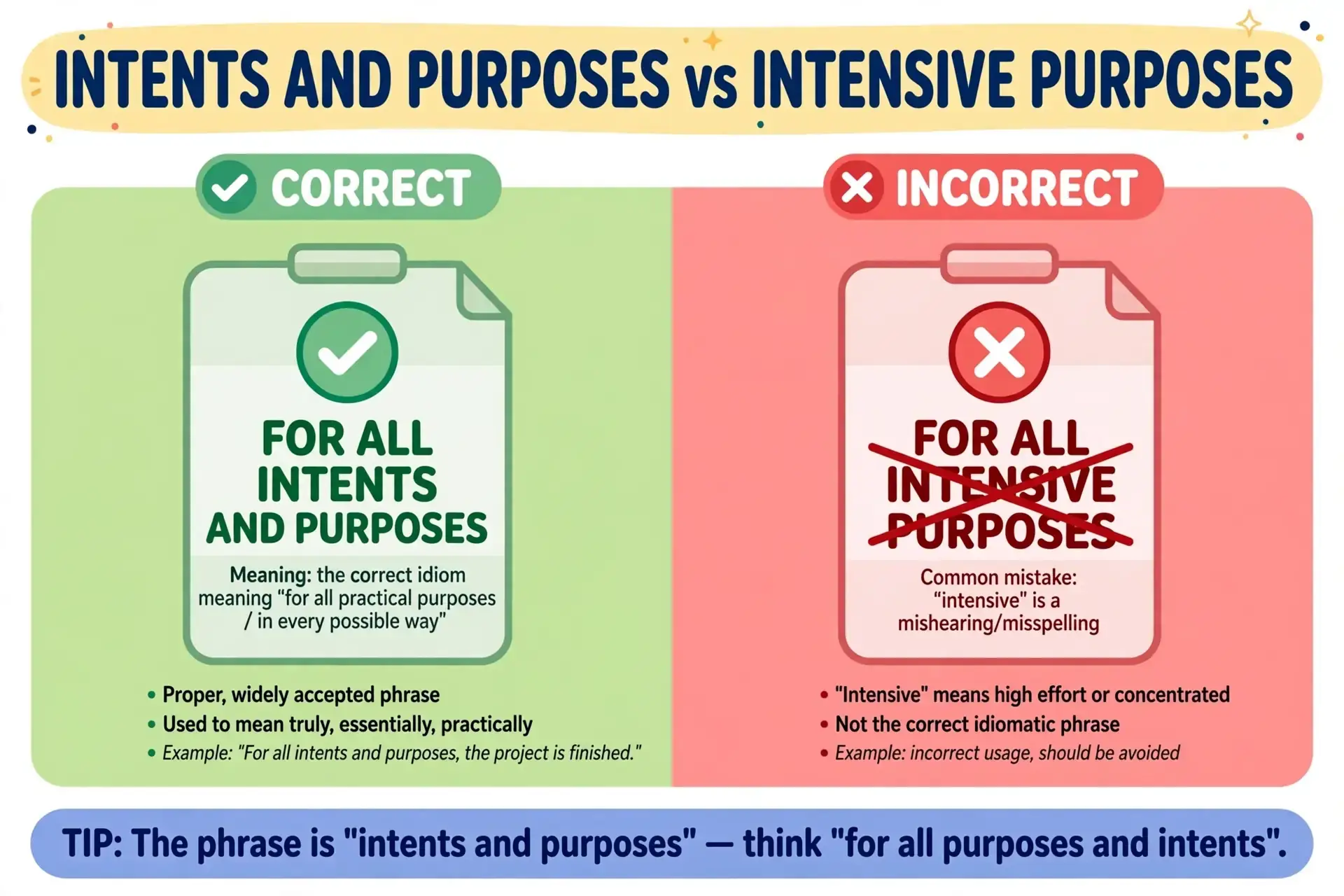
Table of Contents
- Quick Answer
- What Does “For All Intents and Purposes” Mean?
- What Does “For All Intensive Purposes” Mean?
- “For All Intents and Purposes” vs. “For All Intensive Purposes”: Key Differences
- “For All Intents and Purposes” and “For All Intensive Purposes” in Real Sentences
- Common Mistakes
- Pronunciation
- How to Remember the Difference
- Frequently Asked Questions
- Conclusion
Quick Answer
| Phrase | Status | Meaning | Example |
|---|---|---|---|
| “For all intents and purposes” | Correct, standard idiom | In every practical sense; essentially | ✅ “For all intents and purposes, the project is finished.” |
| “For all intensive purposes” | Common mishearing (eggcorn) | No accepted meaning | ❌ “For all intensive purposes, the project is finished.” (wrong) |
Simple rule: If you mean “practically speaking,” write intents and purposes — intentions plus purposes, two nouns, no “intensive” anywhere.
What Does “For All Intents and Purposes” Mean?
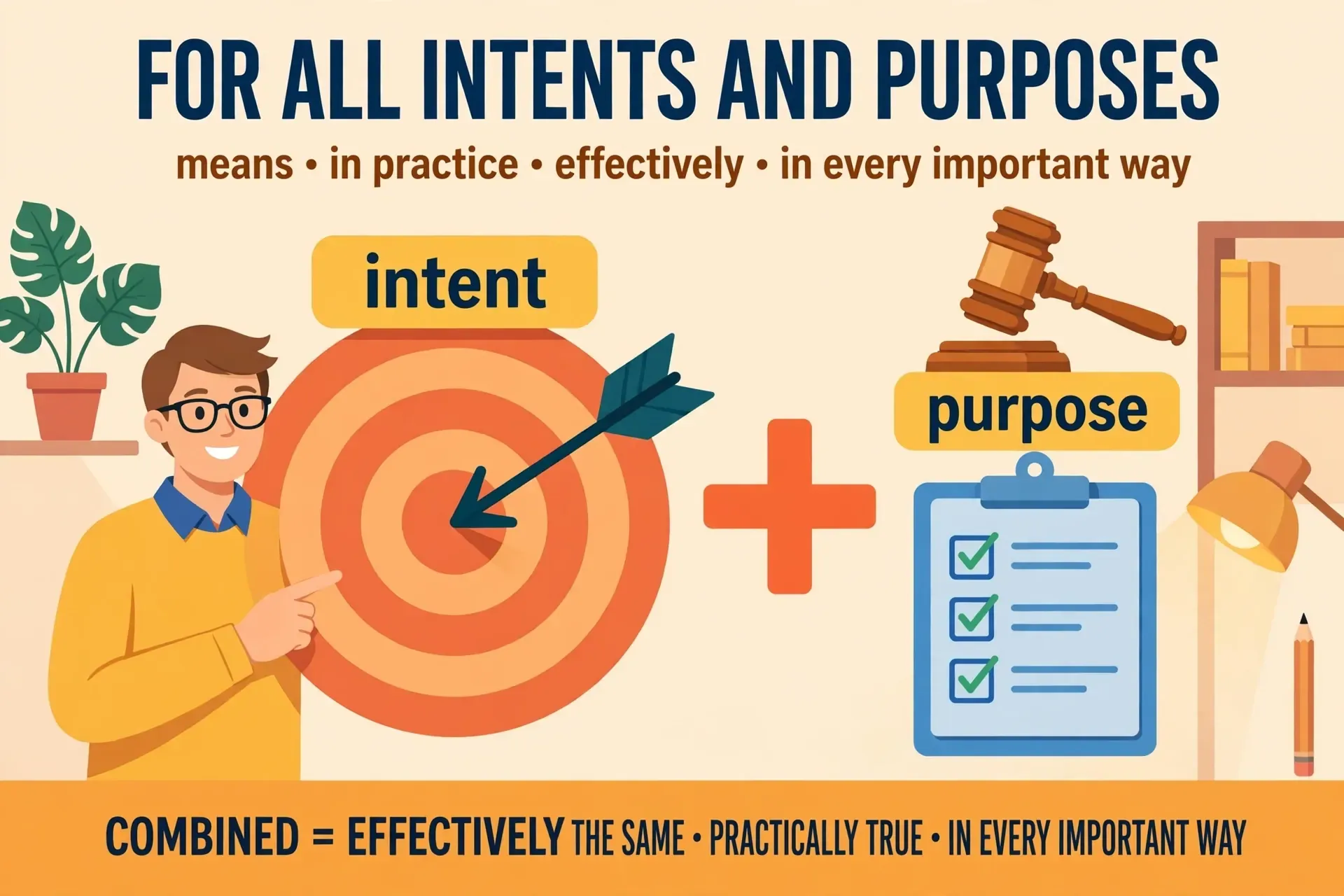
For all intents and purposes means “in every practical respect” — essentially, virtually, for practical purposes. It declares that something is true in every way that matters, even if some technical detail is still outstanding. The phrase comes from 16th-century English legal language (“to all intents, constructions, and purposes”), which is why it still carries a formal, conclusive tone. Merriam-Webster defines “intent” as a clearly formulated intention or plan — so the phrase literally covers every intention and every purpose a thing might serve.
Examples:
- “For all intents and purposes, the project is finished — we’re just waiting on signatures.”
- “She’s retired for all intents and purposes, though she still consults on Fridays.”
- “The two products are, for all intents and purposes, identical.”
- “For all intents and purposes, the deal is done.”
- “He’s the manager for all intents and purposes, even without the title.”
Use it when you want to close a discussion: the matter is settled in every way that counts, and the remaining details are footnotes.
What Does “For All Intensive Purposes” Mean?
For all intensive purposes has no standard meaning — it is an eggcorn born from fast speech. Intensive is a real adjective meaning concentrated, thorough, or demanding (intensive care, an intensive course, intensive farming), but “intensive purposes” would mean “concentrated purposes,” which is nonsense. Say “intents and” quickly and your mouth produces something very close to “intensive” — the ear does the rest, and the wrong version spreads from one confident speaker to the next. It appears in emails, essays, meeting notes, and occasionally even published articles.
Examples of the slip in the wild:
- ❌ “The report is finished for all intensive purposes.” (meant: intents and purposes)
- ❌ “For all intensive purposes, they run the company.” (meant: intents and purposes)
- “Spellcheck can’t help here — every single word is spelled correctly.”
- “The cover letter said ‘for all intensive purposes’ — the hiring manager noticed.”
- As a deliberate joke: “Our purposes aren’t just purposes. They’re INTENSIVE purposes.”
The giveaway is logic, not spelling: swap in the real meaning of “intensive” and the sentence collapses. Purposes are not “intensive” the way care or training can be.
“For All Intents and Purposes” vs. “For All Intensive Purposes”: Key Differences
| Feature | “For all intents and purposes” | “For all intensive purposes” |
|---|---|---|
| Status | Established idiom, in every dictionary | Mishearing (eggcorn), not standard English |
| Key word | “Intents” — intentions, aims | “Intensive” — concentrated, demanding |
| Meaning | In every practical sense | No coherent meaning |
| Origin | 16th-century English legal language | Modern mishearing of “intents and” |
| Grammar | Two nouns: intents + purposes | Adjective + noun that don’t belong together |
| Who uses it | Lawyers, writers, speakers everywhere | People who misheard it — with total confidence |
One phrase closes the debate; the other reveals you misheard it.
“For All Intents and Purposes” and “For All Intensive Purposes” in Real Sentences
At Home
✅ “For all intents and purposes, the kitchen is done — just the handles left.”
❌ “For all intensive purposes, the kitchen is done.”
The first sentence says the renovation is practically finished; the second says something about “intensive” handles that nobody can parse.
At Work
✅ “The merger is complete for all intents and purposes.”
❌ “The merger is complete for all intensive purposes.”
In a board report, “intensive” is a credibility ding — the kind of slip that makes readers doubt the numbers too.
In Conversation
✅ “He’s retired for all intents and purposes.”
❌ “He’s retired for all intensive purposes.”
Spoken aloud, almost nobody catches it — which is exactly how the mishearing keeps spreading. Written down, everyone does.
In Legal and Formal Writing
✅ “The contract is, for all intents and purposes, terminated.”
❌ “The contract is, for all intensive purposes, terminated.”
Lawyers still use this phrase closest to its 16th-century origin; “intensive” in a legal document would be a serious embarrassment.
Common Mistakes
Sound-alike slips fool even careful writers — the “apologize” vs “apologise” pair shows how one letter changes a word’s passport, and “chosing” vs “choosing” shows how a missing letter changes everything. The intents/intensive traps:
Mistake 1: Writing “intensive” in a formal document
❌ “The audit is complete for all intensive purposes.”
✅ “The audit is complete for all intents and purposes.”
Why: “Intensive” is a real word, so spellcheck waves it through. Only the meaning test — “concentrated purposes” makes no sense — exposes the error.
Mistake 2: Trusting the way it sounds
❌ Hearing “for all intensive purposes” in a meeting and adopting it.
✅ “For all intents and purposes.”
Why: “Intents and” slurs into “intensive” at conversational speed. Your ears heard correctly; your brain just filed it under the wrong spelling.
Mistake 3: “Fixing” the correct phrase
❌ Someone writes “intents and purposes” and a confident colleague “corrects” it to “intensive purposes.”
✅ Leave “intents and purposes” alone — it was right.
Why: This is how the mishearing spreads: confident people correcting correct people. The legal-origin phrase needs no fixing.
Mistake 4: Shortening it to “intents and purposes” alone
❌ “The policy serves intents and purposes.”
✅ “For all intents and purposes, the policy works.”
Why: The idiom needs its full form. On its own, “intents and purposes” is just two nouns looking for a sentence.
Pronunciation
“For all intents and purposes” is pronounced “for all in-TENTS and PUR-puh-siz,” while “intensive” is “in-TEN-siv.” Say “intents and” quickly and the sounds compress into something very close to “intensive” — that blur is the entire engine of this mistake. “Intents” rhymes with tents and rents; and if you ever hear someone say “for all intents and porpoises,” congratulations — you have met a comedian.

How to Remember the Difference
The correct phrase holds TWO nouns — intents (intentions) and purposes (aims). Both are things a person or plan can have. Intensive is an adjective meaning concentrated or demanding — you can have intensive training, but you cannot have “an intensive” standing in this slot. Two nouns, one idiom, zero adjectives.
- Intents = intentions: think “for all my intentions and purposes” — the meaning is right there in the words.
- “For ALL” needs plurals: “all” pairs with plural nouns (intents, purposes), not with an adjective like “intensive.”
- The logic test: substitute the real meaning — “for all concentrated purposes” is nonsense, so “intensive” can never be right.
Frequently Asked Questions
Is it “intents and purposes” or “intensive purposes”?
“Intents and purposes” is correct. “Intensive purposes” is a mishearing with no dictionary standing — no major dictionary lists it as an idiom.
Where does “for all intents and purposes” come from?
English law in the 1500s. The legal phrase “to all intents, constructions, and purposes” shortened over the centuries into the idiom we use today.
What does “intensive” actually mean?
Concentrated, thorough, or demanding — as in the intensive care unit, an intensive language course, or intensive farming. It describes effort, not intentions.
Can I just say “for all practical purposes” instead?
Absolutely — it means the same thing and carries zero risk of slipping into “intensive.” Many style-conscious writers prefer it for exactly that reason.
Is the phrase redundant — aren’t intents and purposes the same thing?
Nearly, but that is the point: the doubling is legal language being thorough, covering every possible angle. English is full of such pairs (“null and void,” “cease and desist”).
Why do so many smart people get this wrong?
Fast speech merges “intents and” into “intensive,” spellcheck can’t catch it, and confident people repeat the wrong version — so it sounds authoritative even when it isn’t.
Conclusion
For all intents and purposes means “in every practical sense” — intentions plus purposes, straight from old legal English. For all intensive purposes is a mishearing wearing a confident suit. Keep the two nouns, and the phrase stays bulletproof.