
Leaped or Leapt: Which Is Correct?
Leaped or leapt? Both are correct past tenses of the verb “leap,” which means to jump or spring forward. Leaped is the standard past tense in American English, as in “He leaped over the fence”, while leapt is the preferred form in British English, as in “He leapt over the fence”.
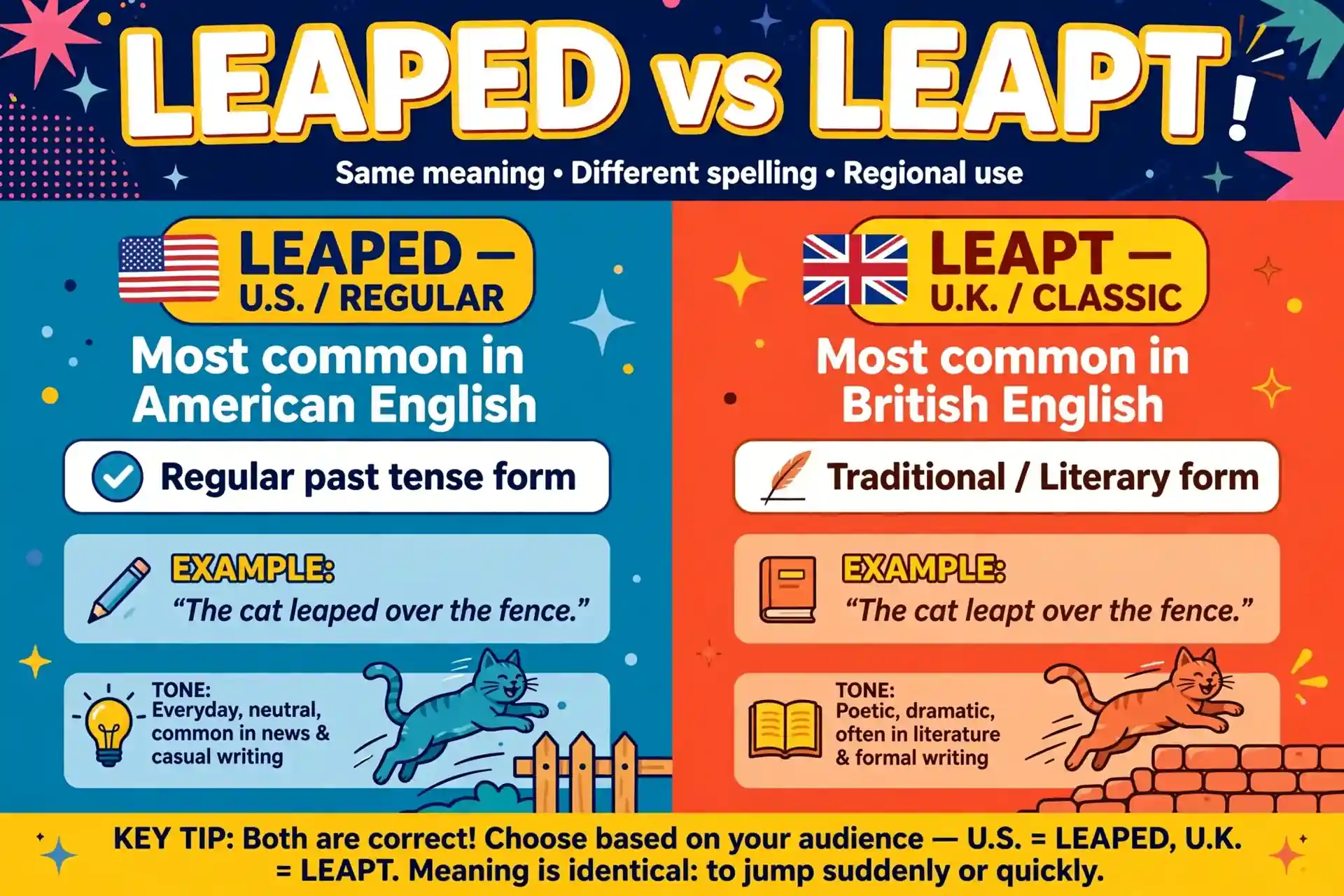
Table of Contents
Quick Answer
| Word | Part of Speech | Main Meaning | Example |
|---|---|---|---|
| Leaped | Verb (past tense / past participle) | Jumped or sprang forward (standard American form) | “She leaped across the stream.” |
| Leapt | Verb (past tense / past participle) | Jumped or sprang forward (standard British form) | “She leapt across the stream.” |
Simple rule: write leaped in American English and leapt in British English; both mean exactly the same thing.
What Does Leaped Mean?
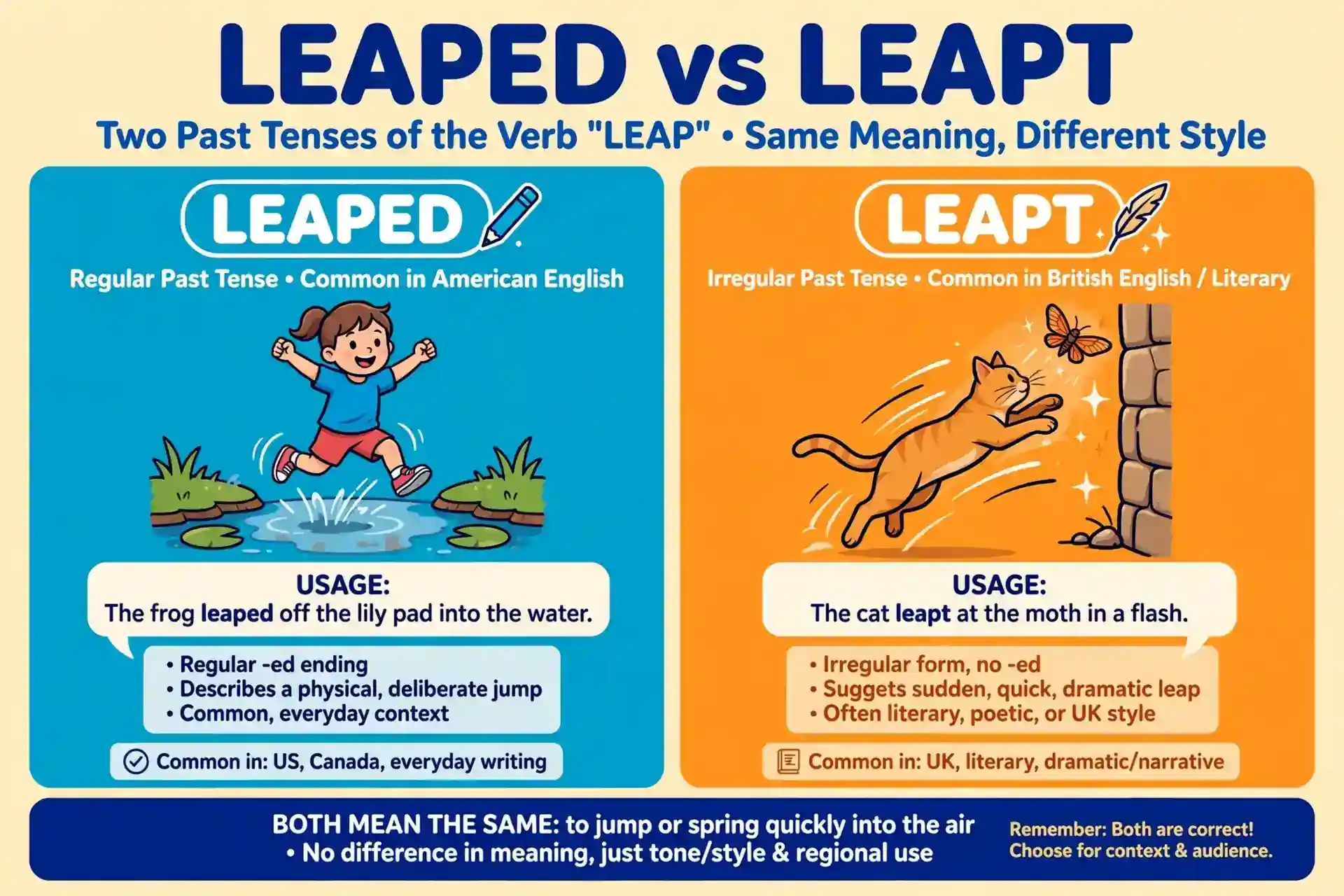
Leaped is the regular past tense and past participle of the verb leap, meaning to jump with force or to move suddenly. American dictionaries list it as the primary past-tense form, and it follows the standard rule of adding -ed to the base verb.
Examples:
- The cat leaped onto the kitchen counter when it heard the can opener.
- She leaped out of bed the moment the alarm rang.
- His eyes leaped to the headline before he had even poured his coffee.
- The company leaped ahead of its competitors with the new product.
- Gas prices have leaped by twenty percent since January.
What Does Leapt Mean?
Leapt is the irregular past tense and past participle of leap, preferred in British English and also widely understood in the US. It sits in the same family as other irregulars like dreamt/dreamed and burnt/burned — British English keeps the -t forms while American English often regularizes them.
Examples:
- The cat leapt onto the kitchen counter when it heard the can opener.
- She leapt out of bed the moment the alarm rang.
- His eyes leapt to the headline before he had even poured his coffee.
- The company leapt ahead of its competitors with the new product.
- Gas prices have leapt by twenty percent since January.
Leaped vs. Leapt: Key Differences
| Feature | Leaped | Leapt |
|---|---|---|
| Region | Standard in American English | Standard in British English |
| Verb type | Regular (-ed) past tense | Irregular (-t) past tense |
| Meaning | Same — jumped or sprang | Same — jumped or sprang |
| Correctness | Correct everywhere | Correct everywhere |
| Acceptance | Preferred by US style guides | Preferred by UK style guides |
| Example | “He leaped at the chance.” | “He leapt at the chance.” |
The key point: this is not a real meaning difference at all. Both leaped and leapt mean “jumped” — the only choice is which side of the Atlantic your spelling sits on.
Usage in Real Sentences
At Home
✅ “The dog leaped over the garden gate.” (US)
✅ “The dog leapt over the garden gate.” (UK)
Either form works at home; pick leaped if you write American English and leapt if you write British English.
At Work
✅ “Sales leaped after the holiday campaign.”
✅ “She leapt at the promotion opportunity.”
In business writing, match your audience: American clients see leaped in reports, British clients see leapt.
In Conversation
✅ “He leaped to his feet when the goal was scored.”
✅ “He leapt to his feet when the goal was scored.”
Nobody will misunderstand either form in conversation — they are pronounced almost the same and mean the same.
Common Mistakes
The real errors here come from mixing up past-tense forms, much like other verb-form confusions like dieing vs dying and spelling differences like canceled vs cancelled.
Mistake 1: Inventing “leapd” or “leapted”
❌ “He leapted over the wall.”
✅ “He leapt over the wall.”
Why: the irregular form is leapt — it never takes an extra -ed on top.
Mistake 2: Using “leap” as the past tense
❌ “Yesterday he leap over the puddle.”
✅ “Yesterday he leaped over the puddle.”
Why: past events need the past tense, either leaped or leapt, not the base form.
Mistake 3: Thinking leapt is a misspelling
❌ “Auto-correct flagged leapt — it must be wrong.”
✅ “Both leapt and leaped are correct.”
Why: leapt is the standard British past tense, not a typo — check leap on Merriam-Webster, which lists both forms.
Mistake 4: Mixing forms in one document
❌ “She leaped up, then leapt back down.”
✅ “She leaped up, then leaped back down.”
Why: consistency matters more than the choice — pick one form per document and stick with it.
Pronunciation
Leaped is pronounced “leept” — the -ed blends into the final p. Leapt is also pronounced “lept” in British English and “leept” in many American mouths, so they sound nearly identical. They rhyme with “kept” and “wept.”
How to Remember the Difference

Remember: “Leapt is the British t — British ends in T, and so does leapT.”
- Leaped with ED is the everyday American form — ED like “everyday.”
- Leapt with a T is the British form — T like “tea and Trafalgar.”
- Both mean the same thing, so when in doubt, pick the one your audience expects.
Frequently Asked Questions
Is it leaped or leapt?
Both are correct. Use leaped in American English and leapt in British English; they are simply regional past tenses of the verb “leap.”
Is leapt a word?
Yes. Leapt is the standard British past tense of leap, and it is listed in every major dictionary. It is pronounced “lept.”
What is the past tense of leap in American English?
Leaped. American style guides prefer the regular -ed form, though leapt will still be understood.
Can I use leapt and leaped interchangeably?
Meaning-wise, yes — they are interchangeable. Stylistically, stay consistent within one document so your writing looks deliberate.
Is “leapt” more formal than “leaped”?
Not exactly. Leapt can sound slightly literary to American ears, but in British English it is simply the normal, neutral form.
What is the past participle of leap?
The same regional split applies: leaped in American English, leapt in British English. So you would write “she has leaped over the hurdle” in the US and “she has leapt over the hurdle” in the UK. Both forms are fully correct after have/has/had — just match the participle to the past tense you chose and keep it consistent.
Conclusion
Leaped and leapt are the same verb’s past tense wearing two different coats: American and British. Choose leaped for US audiences, leapt for UK audiences, keep your choice consistent, and you can never go wrong.