Monkies or Monkeys: Which Spelling Is Correct?
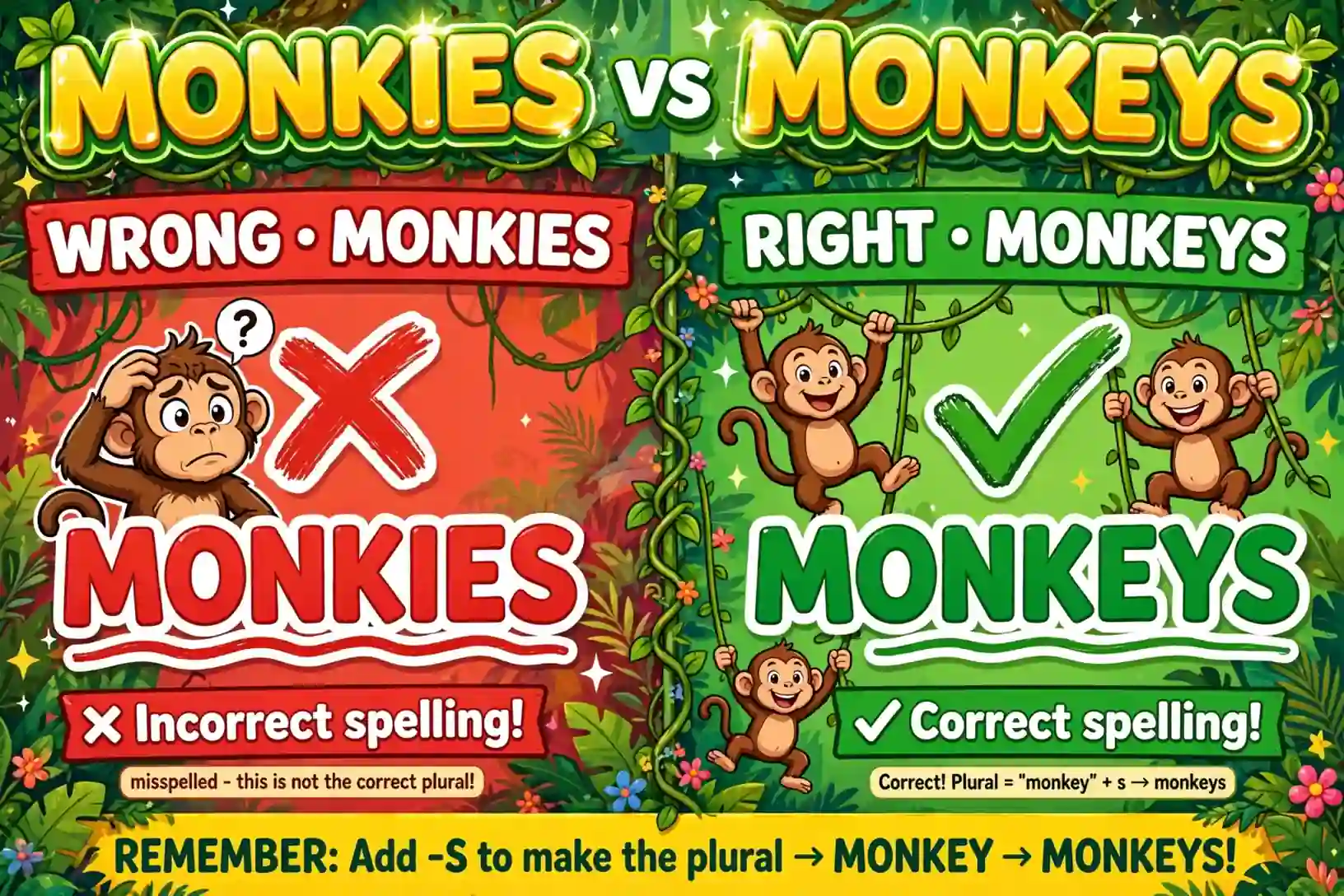
Monkeys is the correct plural of monkey. Monkies is a common misspelling — it is never correct in standard English. The rule is simple: words ending in a vowel + y just add -s.
For example, “The monkeys swung through the trees” is correct. “The monkies swung through the trees” is a spelling error, no matter how natural it looks.
Quick Answer
| Word | Part of Speech | Main Meaning | Example |
|---|---|---|---|
| Monkeys | Noun (plural) | More than one monkey | The monkeys are loud. |
| Monkies | — | Not a word (misspelling) | ❌ Never correct |
Simple rule: Vowel + y → just add s: monkey → monkeys.
What Does Monkeys Mean?
Monkeys is the plural of monkey — the primate animals known for climbing, swinging, and mischief. It is also used figuratively, as in “stop monkeying around.”
Examples:
- The monkeys chattered in the treetops.
- We saw three monkeys at the zoo.
- Sea monkeys are tiny brine shrimp, not real monkeys.
- The kids were acting like wild monkeys.
- Howler monkeys are the loudest land animals.
See monkey on Merriam-Webster for definitions and the correct plural form.
What Does Monkies Mean?
Monkies means nothing — it is a misspelling. Writers produce it by over-applying the consonant + y rule (baby → babies, city → cities) to a word where it does not apply.
The key: monkey ends in e + y — a vowel before the y. The y → ies change only happens after a consonant. Since e is a vowel, the y stays and you simply add s.
This is the same class of error as writing “heros” for heroes — applying the wrong plural pattern.

Monkeys vs. Monkies: Key Differences
| Feature | Monkeys | Monkies |
|---|---|---|
| Is it a word? | Yes | No |
| Plural rule | Vowel + y → add s | Wrongly applies consonant + y rule |
| Letter before y | e (vowel) — keep the y | — |
| Rhymes with | donkeys, keys, boys | — |
| Example | Five monkeys. | ❌ Never use |
The Vowel + Y Rule
| Word | Ends in | Plural |
|---|---|---|
| Monkey | Vowel + y (ey) | Monkeys |
| Donkey | Vowel + y (ey) | Donkeys |
| Boy | Vowel + y (oy) | Boys |
| Day | Vowel + y (ay) | Days |
| Baby | Consonant + y (by) | Babies |
| City | Consonant + y (ty) | Cities |
Check the letter before the y: vowel means add s; consonant means change y to ies. Note the contrast with words like potatoes, where a different rule (consonant + o) applies.
Examples in Real Sentences
At the Zoo
Monkeys: “The monkeys entertained the crowd for an hour.”
The correct plural keeps the y and adds s.
In a Story
Monkeys: “A barrel of monkeys tumbled down the hill.”
Even in playful phrases, the spelling stays monkeys.
In Conversation
Monkeys: “Stop monkeying around and help me!”
The verb form “monkeying” also keeps the y.
Common Mistakes
Mistake 1: Writing “Monkies”
❌ The monkies were swinging.
✅ The monkeys were swinging.
Why: Monkey ends in vowel + y, so just add s.
Mistake 2: “Donkies” and “Boies”
❌ The donkies carried the load. / The boies played ball.
✅ The donkeys carried the load. / The boys played ball.
Why: Same rule — vowel + y never becomes -ies.
Mistake 3: Overcorrecting “Babies” to “Babys”
❌ The babys were sleeping.
✅ The babies were sleeping.
Why: Baby ends in consonant + y, so y → ies is correct here.
Pronunciation
Monkeys is pronounced /ˈmʌŋkiz/ (MUNG-keez).
The misspelling monkies would be pronounced the same way, which is why the error slips past careless proofreading.

How to Remember the Difference
Memory trick: Look at the letter before the Y. A vowel is a keeper — it keeps the Y.
- monkey → the e is a vowel → keep Y → monkeys.
- Vowel = Very simple: just add S.
- Consonant = Change: Y becomes IES (baby → babies).
“Vowel keeps, consonant changes” — one sentence that fixes dozens of plurals.
Frequently Asked Questions
Is it monkies or monkeys?
Always monkeys. Monkies is a misspelling.
Why is it “monkeys” and not “monkies”?
Because monkey ends in a vowel + y (ey). The y → ies change only happens after a consonant.
Is “monkies” ever acceptable?
No. No dictionary lists monkies as a word.
What about “donkeys”?
Same rule: donkeys is correct, “donkies” is wrong.
Do children commonly misspell this?
Yes — it is one of the most common spelling-test errors, which is exactly why learning the vowel + y rule matters.
Conclusion
Monkeys is correct; monkies is not a word. Remember “vowel keeps, consonant changes,” and plurals like monkeys, donkeys, and boys will never trip you up.