Journeys or Journies: Which Is Correct?
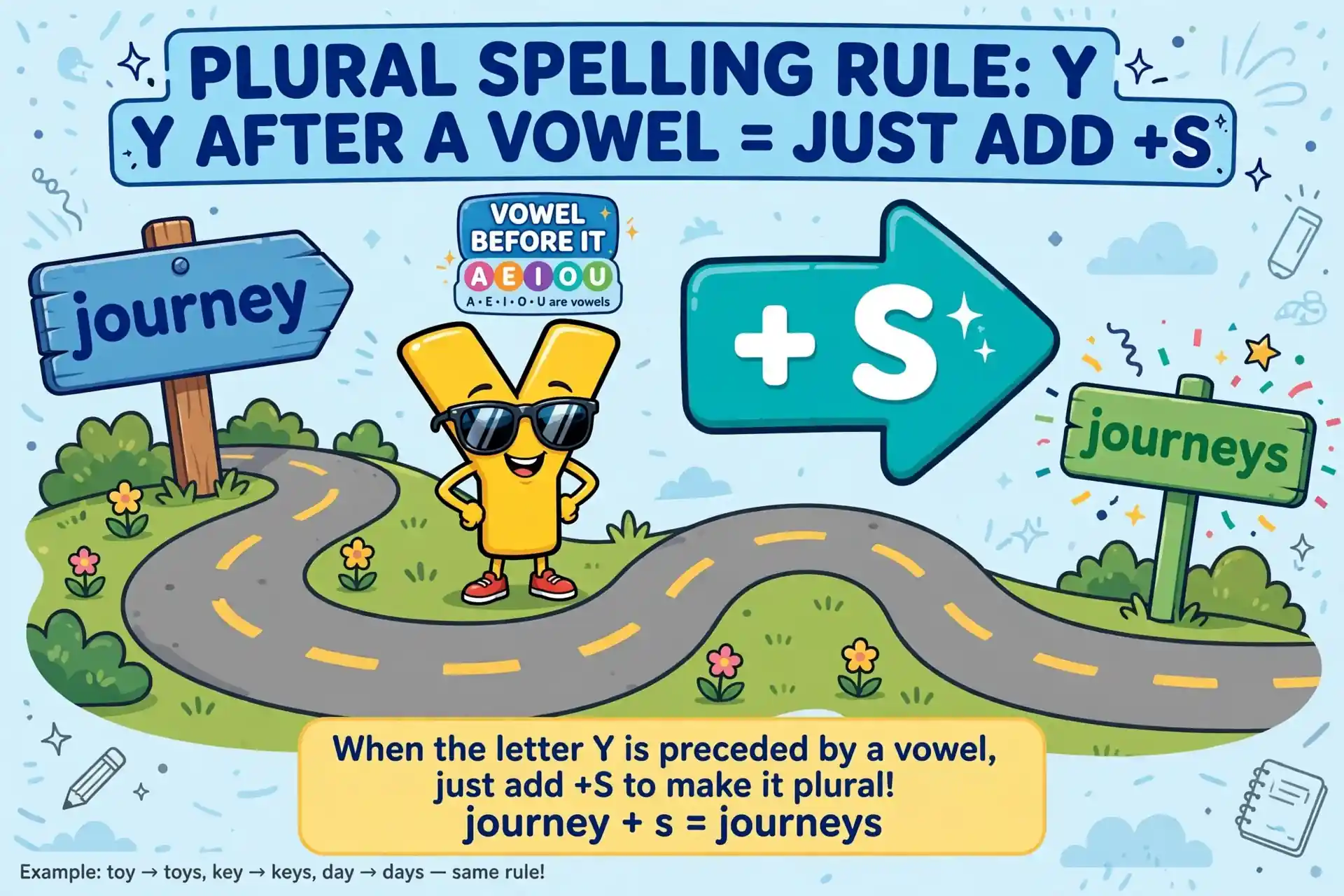
Journeys is the correct plural of journey, and journies is a misspelling. The confusion comes from the rule where consonant + y becomes -ies (family → families), but that rule does not apply here. Journeys follows the simple pattern: The journey was beautiful; they went on three journeys that year. Journies follows nothing: it is simply incorrect.
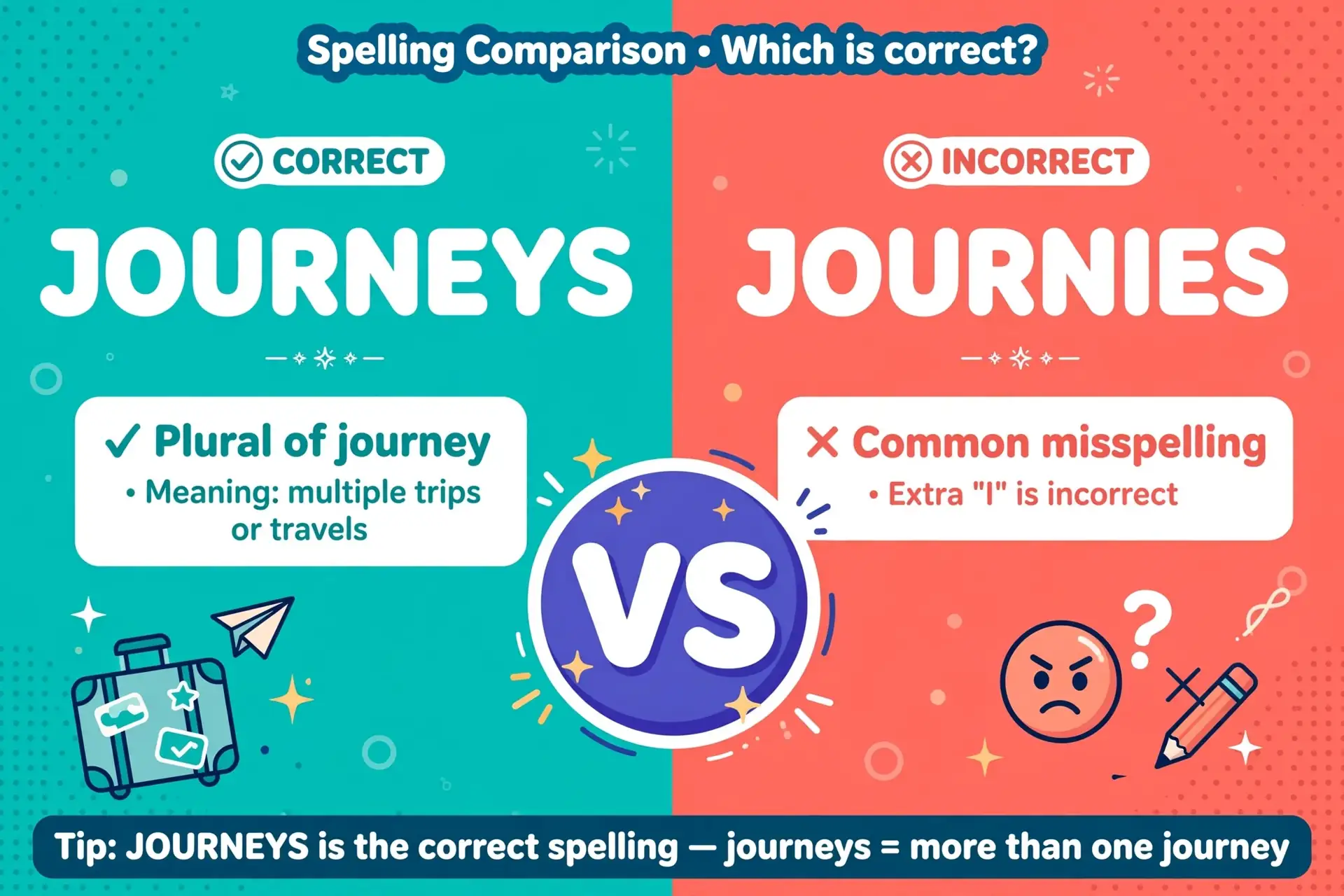
Table of Contents
Quick Answer
| Word | Part of Speech | Main Meaning | Example |
|---|---|---|---|
| Journeys | Noun (plural); also verb (3rd person singular) | More than one act of traveling from one place to another; also “travels” as a verb | They took two long journeys across the desert. |
| Journies | — | Not a word — a common misspelling of journeys | ❌ They took two long journies across the desert. |
Simple rule: when a noun ends in a vowel + y, just add -s — monkey → monkeys, day → days, journey → journeys.
What Does Journeys Mean?
Journeys is the plural of the noun journey: an act of traveling from one place to another, or a period of personal growth or experience. It is also the third-person singular of the verb journey (he journeys, she journeys).
Examples:
- Their three journeys through Europe changed how they saw the world.
- She journeys to work by train every morning.
- The novel follows two parallel journeys — one physical, one emotional.
- Long journeys by car are easier with good music and snacks.
- He journeys back to his hometown every winter.
What Does Journies Mean?
Journies has no meaning in English; it is simply a misspelling of journeys. The error comes from over-applying the consonant + y rule (family → families, city → cities) to a word where the y follows a vowel. Check any dictionary — journey on Merriam-Webster lists only journeys as the plural.
Examples of the mistake:
- ❌ We planned several journies for the summer.
- ❌ Her journies across Asia were unforgettable.
- ❌ He journies to the mountains each weekend. (❌ wrong verb form too — it should be “journeys”)
Journeys vs. Journies: Key Differences
| Feature | Journeys | Journies |
|---|---|---|
| Correctness | Correct standard spelling | Incorrect spelling |
| Part of speech | Plural noun; also verb (he/she journeys) | None — not a word |
| Spelling rule used | Vowel + y → add -s (ey → eys) | Misapplied consonant + y → -ies rule |
| Dictionary entry | Yes, in every dictionary | No entry anywhere |
| Acceptable in exams/essays | Yes | No — marked wrong |
| Rhymes with | monkeys, keys, days | — |
The only real difference is that one is a word and the other is a mistake — so the fix is to learn why the -ies pattern feels tempting but does not belong here.
Usage in Real Sentences
At Home
Labeled sentence: Journeys — “Our weekend journeys to the lake are the best part of summer.”
Contrast: nobody would say “our weekend journies” — the plural keeps its y because the letter before it is a vowel.
At Work
Labeled sentence: Journeys — “She journeys to three cities a month for client meetings.”
Contrast: the verb form gets the same treatment — add -s to the vowel + y, so “journeys,” never “journies.”
In Conversation
Labeled sentence: Journeys — “They talked about their journeys until midnight.”
Contrast: swapping in “journies” would be noticed instantly by a careful reader or listener.
Common Mistakes
Most spelling mistakes like this one come from half-remembered rules — the same plural-y rule as in monkies vs monkeys explains why the y stays, and similar false-pattern errors show up in verb-form confusions like dieing vs dying.
Mistake 1: Applying the -ies rule to vowel + y
❌ They documented all their journies.
✅ They documented all their journeys.
Why: the -ies rule applies only after a consonant (fly → flies). The y in journey follows the vowel e, so it keeps the y and just adds -s.
Mistake 2: Misspelling the verb form
❌ He journies alone through the hills.
✅ He journeys alone through the hills.
Why: verb endings follow the same vowel + y rule — he journeys, she plays, it stays.
Mistake 3: Overcorrecting in formal writing
❌ The report described three long journies.
✅ The report described three long journeys.
Why: in essays and exams, “journies” will be marked wrong no matter how consistent it looks — standard spelling has no variant here.
Mistake 4: Mixing it up with “families”-type words
❌ Like families, the plural of journey is journies.
✅ Like monkeys and keys, the plural of journey is journeys.
Why: family ends in consonant + y (ly), so it becomes families; journey ends in vowel + y (ey), so it becomes journeys.
Pronunciation
Journeys is pronounced /ˈdʒɜːrniz/ — say “JUR-neez,” rhyming with attorneys and monkeys. The y keeps its “eez” sound, so there is nothing in the pronunciation that hints at an -ies spelling.
How to Remember the Difference
Memory trick: journe-Y stays with its vowel frIEnd — the e stands right in front of the y, so the y never changes; you just add -s. Compare famil-y, where the y stands alone after a consonant and must change to -ies.
- journeys ✅ — vowel (e) + y → add -s
- journies ❌ — the y does not follow a consonant, so -ies never applies
- Same pattern: monkeys, keys, days, boys, plays
- Opposite pattern (consonant + y): families, cities, stories, babies

Frequently Asked Questions
Is it journeys or journies?
It is journeys. Journies is a misspelling and is never correct in standard English.
Why do people write “journies”?
Because they over-apply the consonant + y → -ies rule (family → families) to a word where the y follows the vowel e. Journey ends in -ey, a vowel + y, so the rule does not apply.
What is the plural of journey?
The plural of journey is journeys — for example, “their many journeys across Asia.”
Does the same rule apply to the verb “journey”?
Yes. The third-person singular is “he journeys,” following the same vowel + y → add -s pattern, just like “he plays” or “she stays.”
Are there any exceptions where “journies” is acceptable?
No. There is no regional spelling or informal variant — “journies” is always an error, in American, British, and every other variety of English.
Which words follow the same pattern as journeys?
Monkey → monkeys, key → keys, day → days, boy → boys, toy → toys — any noun ending in a vowel + y simply adds -s.
Conclusion
When you are choosing between journeys or journies, remember there is no choice: journeys is correct and journies is a misspelling. The y keeps its place because a vowel comes before it, so just add -s — the same way you would write monkeys, keys, or days. Nail that one pattern and this confusion disappears for good.