Embarrass or Embarass: What’s the Difference?
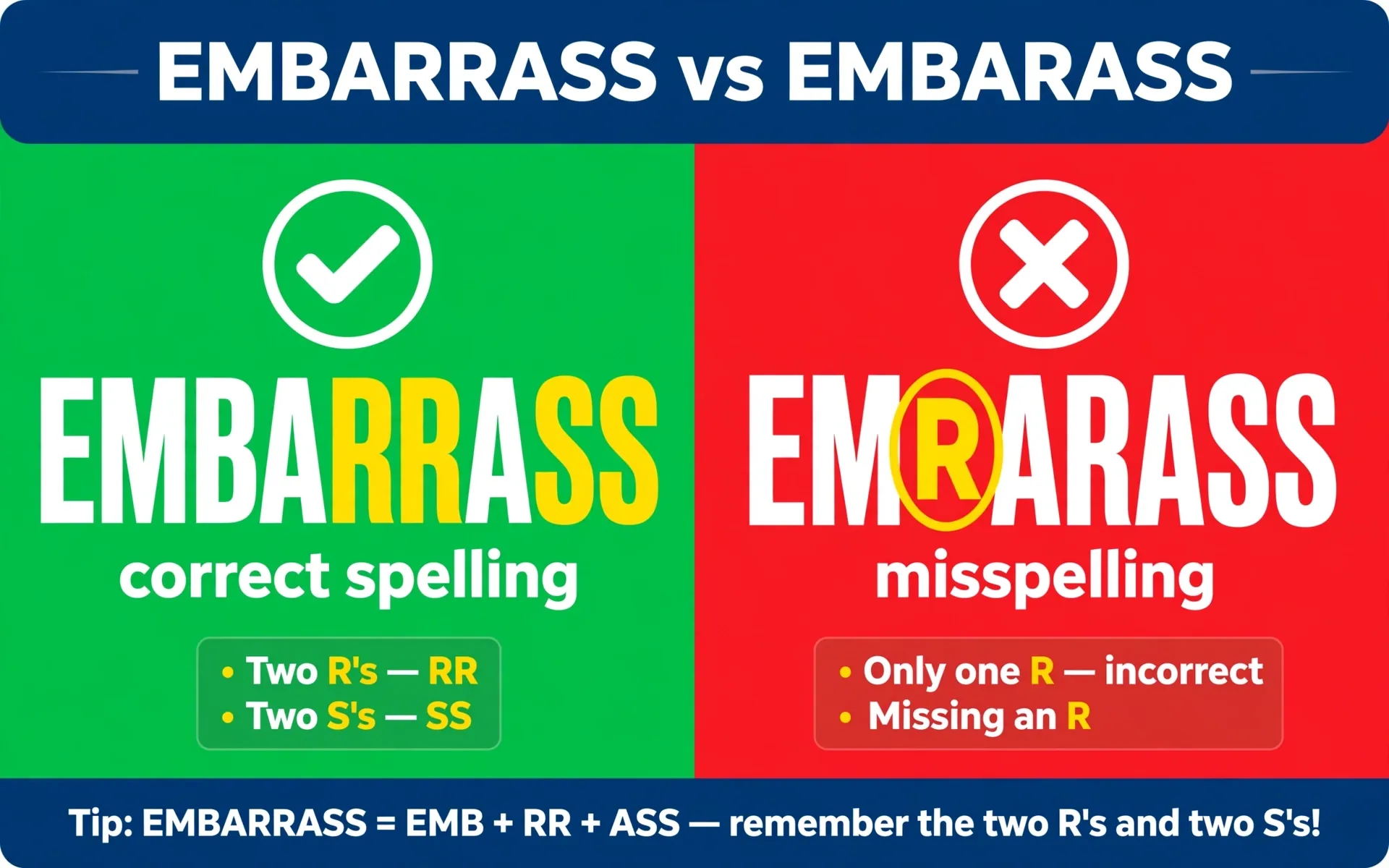
Embarrass is a verb meaning to make someone feel self-conscious or ashamed — and it carries a double R and a double S. Embarass, with a single R, is not a word at all: it is the common misspelling. The extra letters feel like one too many, so hurried fingers quietly drop them.
Quick Answer
| Word | Part of Speech | Main Meaning | Example |
|---|---|---|---|
| Embarrass | Verb | To make someone feel self-conscious or ashamed | ✅ “Don’t embarrass your brother in front of his friends.” |
| Embarass | Not a word | A common misspelling of “embarrass” | ❌ “Don’t embarass your brother in front of his friends.” |
Simple rule: Spell it embarrass — with a double R and a double S: it takes two Rs to turn Really Red and two S’s to feel So Silly.
What Does Embarrass Mean?
Embarrass is a verb meaning to cause someone to feel awkward, self-conscious, or ashamed — tripping on stage embarrasses you, and telling your friend’s secret embarrasses them. It comes from the French embarrasser (to block or encumber), which is where the doubled letters originate; the French kept its doubles, and English kept them too. Merriam-Webster’s entry for “embarrass” lists the “cause to feel self-conscious” sense first, with the older “hinder or impede” sense surviving in formal use.
Examples:
- “Please don’t embarrass me at the dinner party.”
- “He was embarrassed when the teacher read his essay aloud.”
- “Forgetting her lines embarrassed the young actress.”
- “The team’s defeat embarrassed the entire school.”
- “She felt embarrassed asking such a basic question.”
The adjective forms keep the doubles as well: embarrassed (past participle) and embarrassing (present participle) — every form of the word doubles both letters.
What Does Embarass Mean?
Embarass means nothing; it is a misspelling with no dictionary entry. It appears because the correct spelling asks for four repeated letters — RR and SS — and that feels excessive to a writer moving fast. The hand drops an R, drops an S, and produces “embaras,” “embarras,” or “embarass,” none of which are words.
Where you will see it:
- ❌ “I didn’t mean to embarass you.” (texts and apologies)
- ❌ “It was so embarassing.” (social media captions)
- ❌ “He was embarassed by the mistake.” (workplace emails)
- ❌ “Stop trying to embarass me!” (arguments)
- ❌ “What an embarasing moment.” (comments and reviews)
Every one of those should read embarrass, embarrassed, or embarrassing. The irony writes itself: misspelling “embarrass” is itself a little embarrassing.
Embarrass vs. Embarass: Key Differences
| Feature | Embarrass | Embarass |
|---|---|---|
| Status | A real English word | A misspelling — not a word |
| Part of speech | Verb | None |
| Consonant doubles | Double R + double S | One or both doubles missing |
| Origin | French embarrasser (kept its doubles) | No origin — a dropped letter |
| Related forms | Embarrassed, embarrassing, embarrassment | Do not exist |
| Spellcheck | Passes | Flagged everywhere |
Four letters do the heavy lifting: two Rs and two Ss. Lose any one of them and the word stops being a word.
Embarrass and Embarass in Real Sentences
At School
✅ “Nothing embarrasses a teenager like a parent’s joke.”
❌ “Nothing embarases a teenager like a parent’s joke.”
Classroom essays are where this spelling gets tested most — and marked wrong most.
At Work
✅ “The typo in the press release embarrassed the whole team.”
❌ “The typo in the press release embarassed the whole team.”
In professional writing, the misspelling lands harder than the mistake it describes — readers notice.
In Conversation
✅ “I didn’t mean to embarrass you — I’m sorry.”
❌ “I didn’t mean to embarass you — I’m sorry.”
Apologies typed in a hurry are the natural habitat of “embarass.” Slow down for the doubles.
With Family
✅ “Grandma’s stories never fail to embarrass us at reunions.”
❌ “Grandma’s stories never fail to embaras us at reunions.”
Speech forgives the missing letters entirely; only the written version betrays them.
Common Mistakes
Doubled consonants are a repeat offender across English spelling: the “adress” vs “address” double-letter trap shows how one missing letter breaks a word, and the “accidently” vs “accidentally” doubling rule shows how suffixes keep the doubles intact. The embarrass traps:
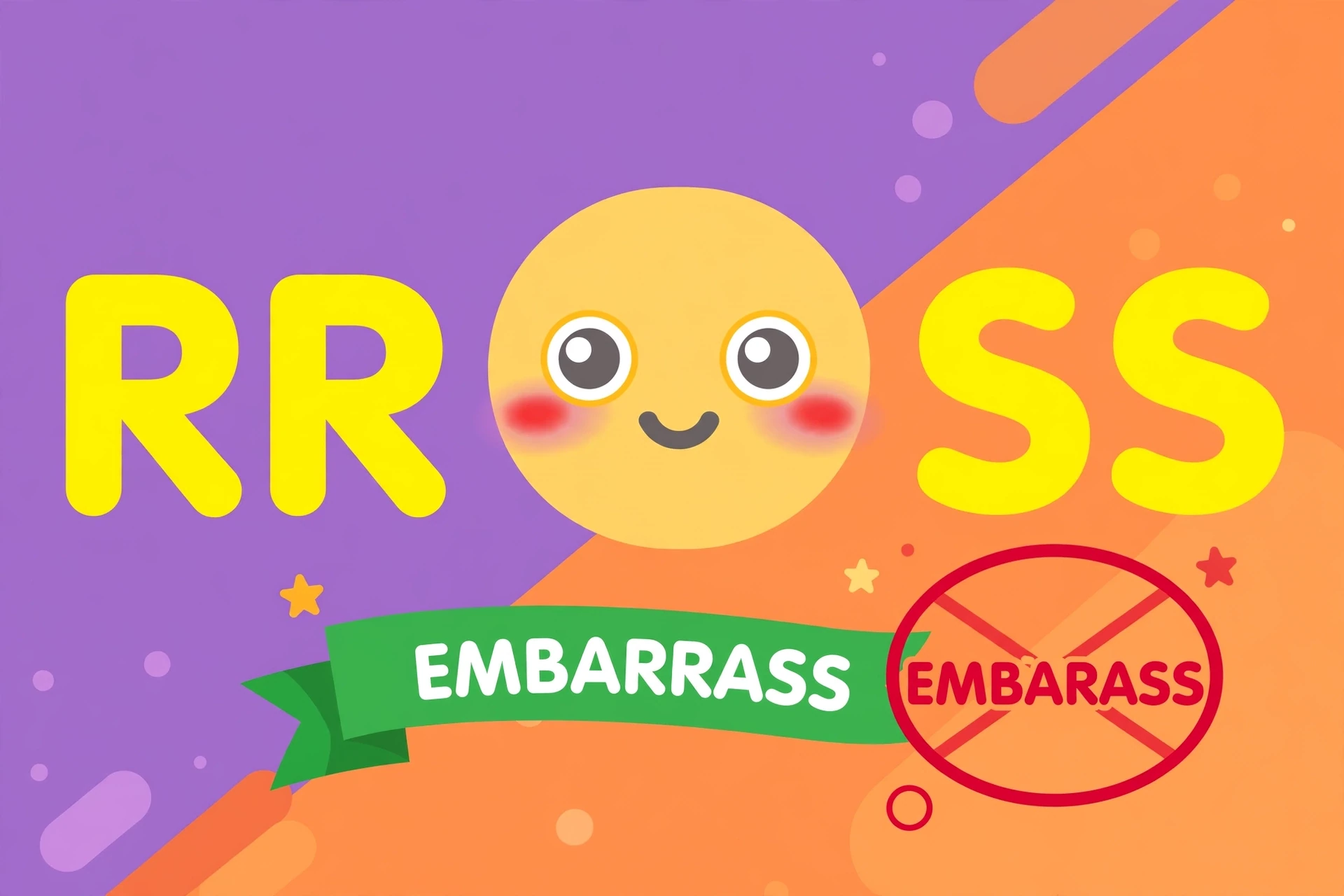
Mistake 1: Single R — “embaras” / “embarass”
❌ “Don’t embarass yourself.”
✅ “Don’t embarrass yourself.”
Why: The most common version of the error. The word needs RR (em-bar-) and SS (-rass): em-bar-rass.
Mistake 2: Dropping a letter in “embarrassing”
❌ “That was so embarasing.”
✅ “That was so embarrassing.”
Why: Adding “-ing” never removes letters. Keep both doubles from the base verb: embarrass → embarrassing.
Mistake 3: Dropping a letter in “embarrassed”
❌ “I felt so embarassed.”
✅ “I felt so embarrassed.”
Why: Same rule as above — the past tense keeps the full spelling: embarrass → embarrassed, doubles and all.
Mistake 4: Swapping the vowels — “embarras”
❌ “What an embarrasing typo.”
✅ “What an embarrassing typo.”
Why: The vowels are all As — em-barrass. No E sneaks in anywhere, unlike lookalike words such as “harass.”
Pronunciation
Embarrass is pronounced im-BAR-uhs, with the stress on the second syllable and the final syllable reduced to a quick “uhs.” It rhymes with “harass” (huh-RASS), which shares both the meaning neighborhood and the doubled letters. The pronunciation gives no hint of the doubles — the ear hears one R and one S, which is precisely why the hand keeps dropping them.

How to Remember the Difference
Picture the feeling itself: your face turns Really Red and you feel So Silly. Two Rs for “Really Red,” two S’s for “So Silly” — the embarrassment is doubled, so the letters are doubled too.
- Really Red test: two Rs, because blushing needs a pair — em-barr-ass.
- So Silly test: two S’s, because the shame is doubled — embarrass.
- French root test: the word comes from embarrasser, which kept its doubles — English kept them too.
Frequently Asked Questions
Is it embarrass or embarass?
Always “embarrass.” “Embarass” is a misspelling with no dictionary entry — it is never correct in any context.
Why does “embarrass” have double letters?
It comes from the French embarrasser, which doubles both the R and the S. English borrowed the word with its doubles intact, and every related form (embarrassed, embarrassing, embarrassment) keeps them.
What is the past tense of “embarrass”?
“Embarrassed” — add -ed to the full spelling, keeping both doubles. “I was embarrassed” is correct; “I was embarassed” is not.
Is “embarass” a British spelling?
No. British and American English agree completely here: “embarrass” is the only correct spelling in both.
What is the difference between “embarrassed” and “ashamed”?
“Embarrassed” is the lighter, more social feeling — awkwardness in front of others. “Ashamed” runs deeper, involving guilt over something wrong. You feel embarrassed tripping on stage; you feel ashamed lying about it.
Can “embarrass” mean anything besides shaming someone?
In formal or older writing, yes: “to embarrass” can mean to hinder or complicate, as in “embarrassed finances.” That sense is rare in everyday use but still appears in financial and legal contexts.
Conclusion
Embarrass is the only correct spelling — a verb meaning to make someone feel self-conscious, spelled with a double R and a double S inherited from French. Embarass is never right, in any dialect. Remember “Really Red, So Silly,” and the doubles will take care of themselves.