Purposely or Purposefully: Meaning, Difference, and Examples
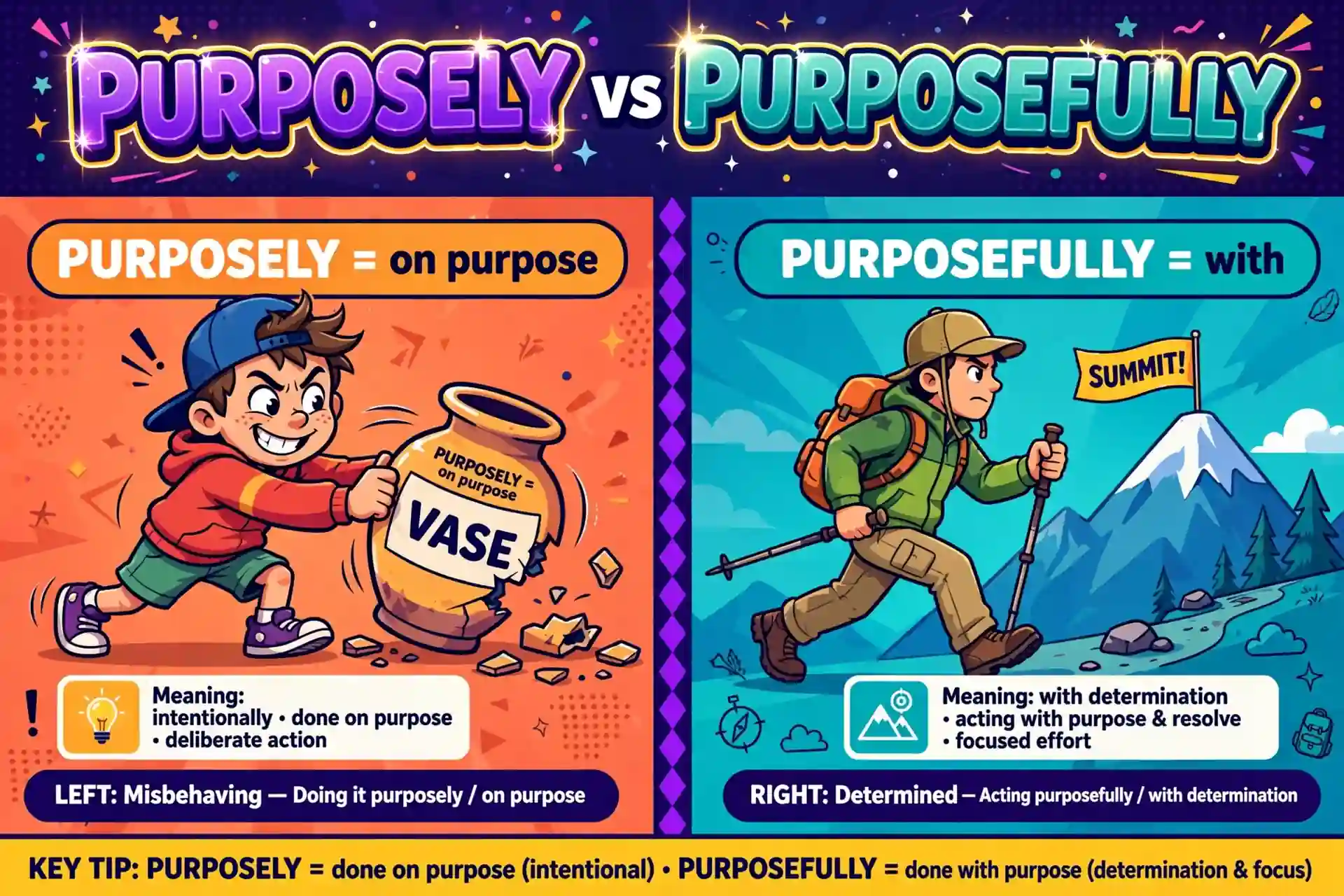
Purposely and purposefully look like twins, and many people use them interchangeably — but careful writers keep them apart. Purposely means intentionally, on purpose. Purposefully means in a determined way, showing clear purpose.
For example, “He purposely spilled the paint” means he did it deliberately. “She walked purposefully toward the door” means she walked with determination. One answers “was it deliberate?”; the other answers “was it done with resolve?”
Quick Answer
| Word | Part of Speech | Main Meaning | Example |
|---|---|---|---|
| Purposely | Adverb | Intentionally; on purpose | She purposely left the door open. |
| Purposefully | Adverb | With determination; showing purpose | He strode purposefully across the room. |
Simple rule: If you mean “on purpose, not by accident,” write purposely. If you mean “with strong determination,” write purposefully.
What Does Purposely Mean?
Purposely means deliberately or intentionally — done on purpose rather than by accident. It answers the question “was it meant?” If someone did something purposely, there was intent behind it.
Examples:
- He purposely arrived late to miss the speech.
- She purposely chose the window seat.
- The toddler purposely knocked over the tower.
- They purposely kept the guest list small.
- I didn’t do it purposely, I swear it was an accident.
Purposely is the plainer, more common word for “on purpose.” In most sentences about intent, it is the right choice.
See purposely on Merriam-Webster for the full dictionary entry.
What Does Purposefully Mean?
Purposefully means in a way that shows purpose, determination, or resolve. It describes how something is done — with focus and drive — rather than simply whether it was intended.
Examples:
- She walked purposefully toward the exit, ignoring the crowd.
- He spoke purposefully, choosing every word with care.
- The team worked purposefully through the night.
- She nodded purposefully and signed the contract.
Note: dictionaries also accept purposefully in the “intentionally” sense, so you will see overlap. But the traditional distinction — purposely for intent, purposefully for determination — is still what careful editors prefer.

Purposely vs. Purposefully: Key Differences
| Feature | Purposely | Purposefully |
|---|---|---|
| Core meaning | On purpose, deliberately | With determination |
| Answers | “Was it intended?” | “Was it done with resolve?” |
| Opposite | Accidentally | Aimlessly |
| Formality | Everyday | Slightly more formal |
| Example | He purposely ignored me. | She purposefully ignored the noise. |
The overlap in dictionaries does not erase the useful distinction: purposely is about intent, purposefully is about manner — a nuance worth keeping, just as with other near-synonyms that are not quite identical.
Examples of Purposely and Purposefully in Real Sentences
At Home
Purposely: “The cat purposely knocked the glass off the table.”
Purposefully: “She cleaned the whole house purposefully before the guests arrived.”
The cat acted with intent; she worked with determined focus.
At Work
Purposely: “He purposely left his phone on silent during the meeting.”
Purposefully: “The manager purposefully steered the discussion back on track.”
One describes a deliberate choice; the other describes a determined manner.
In a Story
Purposely: “The villain purposely spread the rumor.”
Purposefully: “The hero marched purposefully into the storm.”
Villains act purposely; heroes move purposefully.
Common Mistakes With Purposely and Purposefully
Because dictionaries allow some overlap, writers often grab whichever looks fancier — usually the longer one. Precision beats syllables, as with other pairs where the longer word is not always better.
Mistake 1: Using “Purposefully” for Simple Intent
❌ He purposefully broke the window.
✅ He purposely broke the window.
Why: The sentence is about intent (on purpose vs. by accident), so purposely is the precise word.
Mistake 2: Using “Purposely” for Determined Manner
❌ She walked purposely toward the stage.
✅ She walked purposefully toward the stage.
Why: The sentence describes a determined, focused walk — the manner of walking — so purposefully fits.
Mistake 3: Assuming They Are Always Interchangeable
❌ “They mean exactly the same thing, so it doesn’t matter.”
✅ They overlap, but “purposely” = on purpose and “purposefully” = with determination.
Why: In careful writing, the distinction carries meaning. Use it.
Pronunciation: Purposely vs. Purposefully
Purposely is pronounced “PUR-pus-lee” (/ˈpɜːrpəsli/). Purposefully is pronounced “PUR-pus-ful-lee” (/ˈpɜːrpəsfəli/) — one extra syllable, “full,” in the middle.
Hearing that extra “full” syllable is a handy check: if you would not say “full of purpose,” you probably want purposely.

How to Remember the Difference
Memory trick: Purposefully contains “full” — it is full of purpose, done with determination. Purposely is the shorter word for the simpler idea: on purpose.
- Purposefully = full of purpose = determined manner.
- Purposely = on purpose = deliberate intent.
- Opposites help: purposely ↔ accidentally; purposefully ↔ aimlessly.
Frequently Asked Questions
Is it purposely or purposefully for “on purpose”?
Purposely. “He did it purposely” means he did it on purpose, deliberately.
Can purposefully mean “intentionally”?
Dictionaries accept it, but careful writers reserve purposefully for “with determination” and use purposely for “intentionally.”
Which is more formal: purposely or purposefully?
Purposefully sounds slightly more formal and literary. Purposely is the everyday word for “on purpose.”
What is the opposite of purposely?
Accidentally or unintentionally. (“It wasn’t purposely” = “It was an accident.”)
What is the opposite of purposefully?
Aimlessly or half-heartedly. (“She wandered aimlessly” is the reverse of walking purposefully.)
Conclusion
Purposely means on purpose; purposefully means with determination. Keep “full of purpose” in mind for the longer word, and your intent — and your manner — will always be clear.