Caffeine or Caffiene: What’s the Difference?
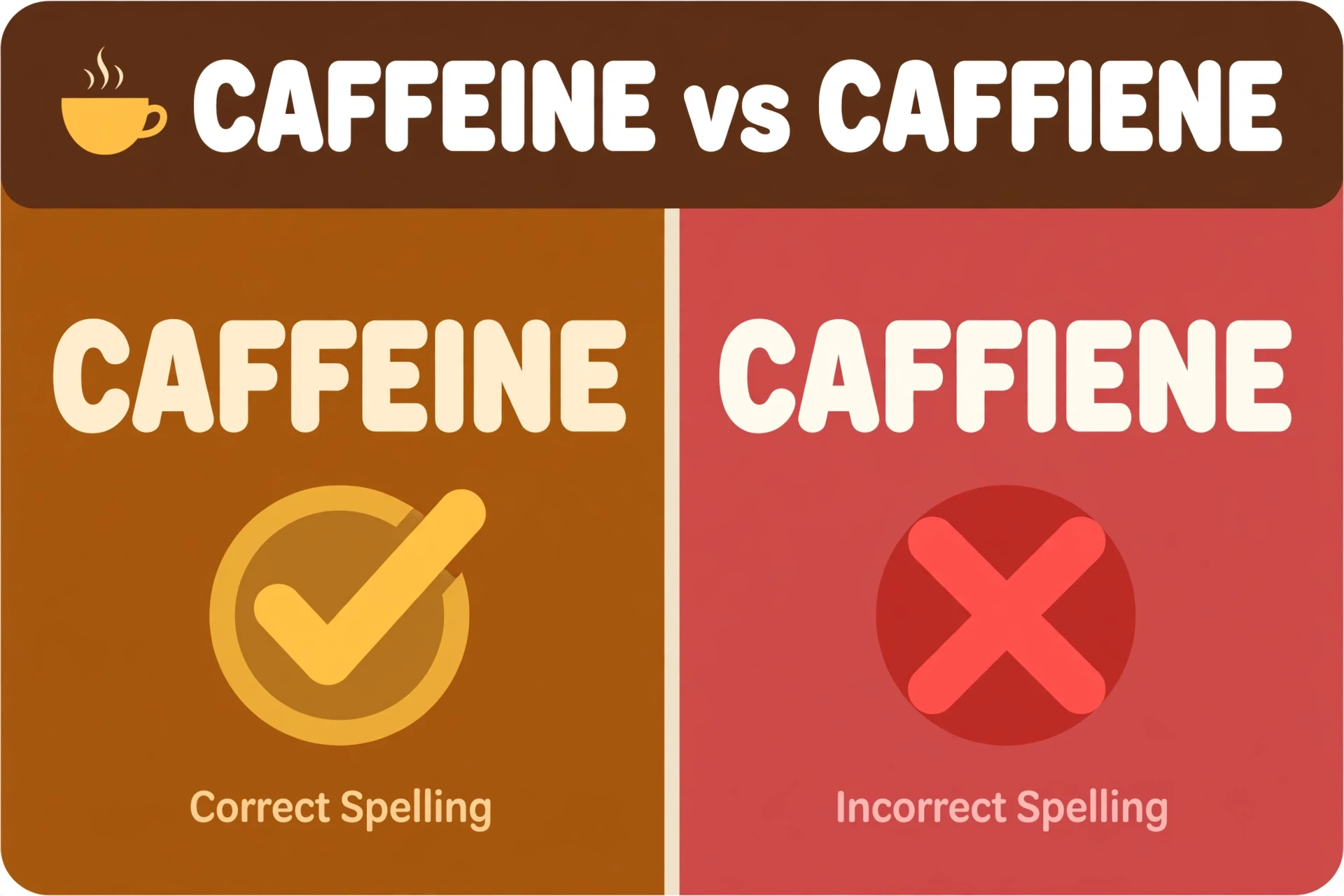
Caffeine is the correct spelling — caffiene with IE at the end is always a misspelling. The word has a double F in the middle and ends in E-I-N-E, a pattern that looks wrong to English eyes trained on “i before e.” “My morning caffeine keeps me going” is right; “caffiene” will get underlined everywhere it appears.
Quick Answer
| Word | Part of Speech | Main Meaning | Example |
|---|---|---|---|
| caffeine | Noun | The stimulant in coffee, tea, and chocolate | ✅ “Too much caffeine keeps me awake.” |
| caffiene | — (misspelling) | Not a standard English word | ❌ “Too much caffiene keeps me awake.” |
Simple rule: Caffeine has a double F and ends E-I-N-E. Caffiene flips the ending to I-E-N-E and is never correct.
What Does Caffeine Mean?
Caffeine is the bitter stimulant found in coffee beans, tea leaves, cacao, and many soft drinks and energy drinks. It blocks sleepiness signals in the brain, which is why the world’s mornings run on it. Merriam-Webster’s entry for “caffeine” defines it as “a bitter alkaloid found especially in coffee, tea, and kola nuts.”
Examples:
- “I try to avoid caffeine after 2 p.m.”
- “This tea has less caffeine than coffee.”
- “Caffeine is the world’s most popular drug.”
- “She switched to decaf to cut her caffeine intake.”
- “Chocolate contains small amounts of caffeine.”
The double F comes from the word’s history — it entered English through German “Kaffein,” from “Kaffee” (coffee) — and the unusual ending is just how chemistry words often look.
What Does Caffiene Mean?
Nothing in standard English. Caffiene is a misspelling of “caffeine,” produced by writers applying the “i before e” rule to the word’s ending. The E-I-N-E finish looks like a rule violation, so careful spellers “fix” it to I-E-N-E — and create a word that appears in no dictionary. Spellcheckers flag it instantly, but it floods informal writing.
Examples of the misspelling (all incorrect):
- ❌ “I need my morning caffiene.”
- ❌ “This drink is loaded with caffiene.”
- ❌ “Caffiene makes me jittery.”
- ❌ “How much caffiene is in green tea?”
Like many misspellings, it looks plausible — which is exactly why it survives in texts, comments, and hasty emails.
Caffeine vs. Caffiene: Key Differences
| Feature | Caffeine | Caffiene |
|---|---|---|
| Spelling status | Correct standard spelling | Misspelling — not a real word |
| Middle | Double F (“caff-“) | Double F (usually kept) |
| Ending | E-I-N-E (“-eine”) | I-E-N-E (“-iene”) — wrong |
| The rule | Breaks “i before e” (like “protein”) | What the rule would predict |
| Example | ✅ “caffeine-free” | ❌ “caffiene-free” |
Two quirks define the word — the double F and the E-I-N-E ending — and caffiene “corrects” the second one into an error.
Caffeine and Caffiene in Real Sentences
At Home
✅ “The decaf still has a little caffeine.”
❌ “The decaf still has a little caffiene.”
Kitchen-table talk about coffee deserves the right spelling — the word shows up on the very labels in your cupboard.
At Work
✅ “Our office runs on caffeine and deadlines.”
❌ “Our office runs on caffiene and deadlines.”
Wellness newsletters and HR emails about “cutting back on caffiene” undermine their own advice with the typo.
In Conversation
✅ “I’m too sensitive to caffeine for espresso.”
❌ “I’m too sensitive to caffiene for espresso.”
Said aloud, nobody can tell — the double F and the ending are purely written features.
Common Mistakes
Double letters and odd endings trip everyone — the “worshipped” vs “worshiped” double consonants show how doubling works, and the “transferred” vs “transfered” double letters show the same instinct at work. With caffeine:
Mistake 1: Writing “caffiene” by rule
❌ “No more caffiene for me.”
✅ “No more caffeine for me.”
Why: “I before E” would demand IENE — but “caffeine” is a chemistry word, and chemistry words routinely end in -eine (protein, codeine). The rule doesn’t govern them.
Mistake 2: Writing “cafeine” with one F
❌ “One cafeine pill, please.”
✅ “One caffeine pill, please.”
Why: The double F comes from German “Kaffee.” Single-F looks like “café” with extra letters — wrong root, wrong word.
Mistake 3: Writing “caffine” (double F, no E)
❌ “This has too much caffine.”
✅ “This has too much caffeine.”
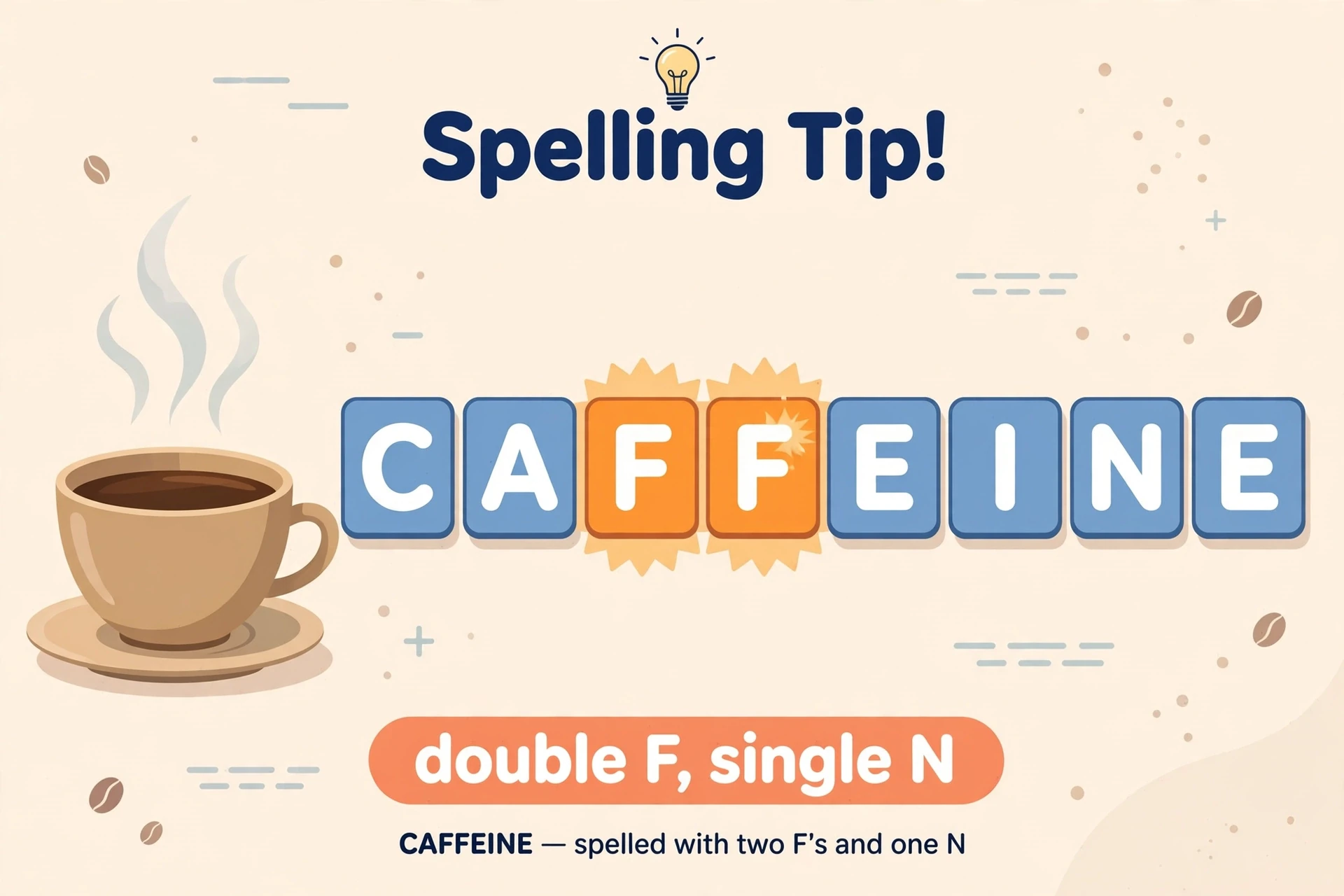
Why: Dropping the E after the F collapses the ending. The full sequence is C-A-F-F-E-I-N-E — all eight letters, every time.
Mistake 4: Capitalizing it mid-sentence
❌ “I love Caffeine.”
✅ “I love caffeine.”
Why: It is a common noun, not a brand name — lowercase, like “sugar” or “water.”
Pronunciation
Caffeine is pronounced ka-FEEN, stress on the second syllable, rhyming with “hygiene” and “unseen.” The misspelling “caffiene” would be pronounced identically — the double F and the ending are silent partners in the sound, loud only on the page.
How to Remember the Difference
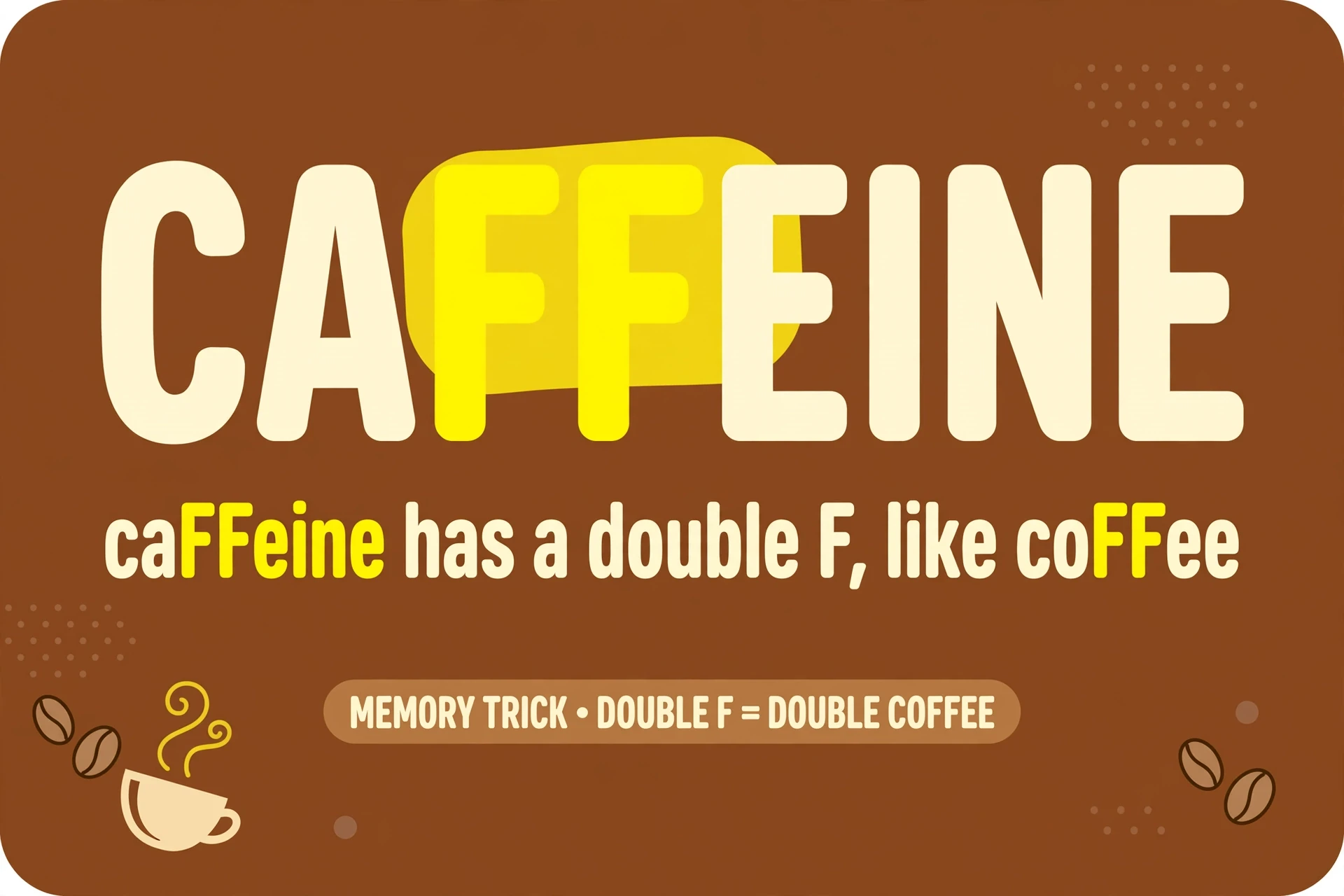
CaFFeine has a double F — just like coFFee, the drink it comes in. And the ending? Think of its chemical cousins: protein, codein — science words love that -eine finish.
- Coffee link: caFFeine ← coFFee. Double F in the drink, double F in the drug.
- Chemistry ending: protein, codeine, caffeine — the -eine club. “I before E” doesn’t get a vote here.
- Letter count: C-A-F-F-E-I-N-E — eight letters, two Fs, one E before the I.
Frequently Asked Questions
Is it caffeine or caffiene?
Caffeine. “Caffiene” is a misspelling and is never correct in standard English.
Why does “caffeine” end in EINE instead of IENE?
It follows chemistry-word convention (protein, codeine), not the “i before e” rule. Scientific vocabulary plays by its own spelling rules.
Why the double F?
It comes from German “Kaffee” (coffee), which doubles the F. English kept the doubling when it borrowed the word.
Is caffeine a drug?
Technically yes — it is a stimulant alkaloid, and the world’s most widely consumed psychoactive substance. The spelling doesn’t change its chemistry.
How much caffeine is in coffee?
About 95mg per 8-ounce cup of brewed coffee — but the question is about chemistry, not spelling, so we’ll leave it there.
What’s “decaffeinated”?
Coffee with most caffeine removed — and yes, it keeps the double F and the -eine ending: decaffeinated.
Conclusion
Caffeine doubles its F like coffee and ends like its chemical cousins — E-I-N-E, rule or no rule. Write caffiene and you’ve let “i before e” overrule chemistry; keep the double F and the -eine, and the word is yours.