Seize or Sieze: What’s the Difference?
Seize is the correct spelling — sieze with I before E is always a misspelling, and it is a delicious irony: “seize” is one of the famous exceptions to the “i before e” rule, so the rule-following version is the wrong one. “Seize the day” is right; “sieze the day” will get corrected by anyone who knows the word’s history.
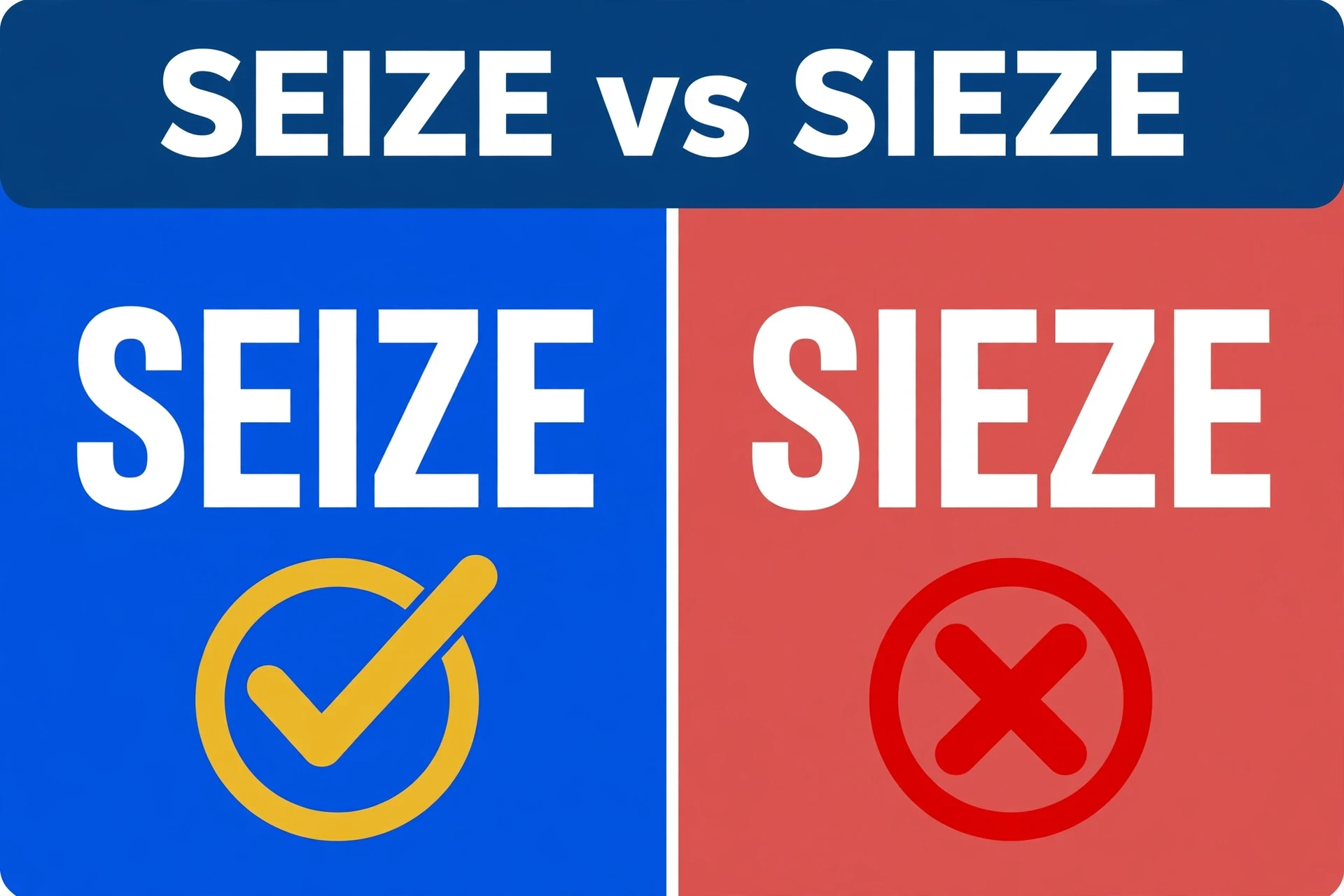
Quick Answer
| Word | Part of Speech | Main Meaning | Example |
|---|---|---|---|
| seize | Verb | To grab suddenly; to take hold of | ✅ “Seize the opportunity.” |
| sieze | — (misspelling) | Not a standard English word | ❌ “Sieze the opportunity.” |
Simple rule: Seize breaks “i before e” — it is E-I despite having no C before it. Sieze “fixes” it and is never correct.
What Does Seize Mean?
Seize means to take hold of something suddenly and firmly — opportunities, moments, power, or physical objects. It also covers the body turning against itself (“he had a seizure”) and machinery locking up (“the engine seized”). Merriam-Webster’s entry for “seize” gives “to take or lay hold suddenly or forcibly” as the core sense, with the extended meanings branching from there.
Examples:
- “Seize the day — it won’t come back.”
- “Customs seized the illegal shipment.”
- “Panic seized the crowd.”
- “She seized his hand before he fell.”
- “The rebels seized control of the radio station.”
The noun seizure keeps the same EI order — medical, legal, and mechanical senses all trace back to that sudden grabbing.
What Does Sieze Mean?
Nothing in standard English. Sieze is a misspelling of “seize,” and it is the “i before e” rule’s most successful trap. Writers who learned “i before e except after c” look at S-E-I-Z-E, see no C, and “correct” it to S-I-E-Z-E — exactly backwards. The rule has famous exceptions (weird, seize, leisure), and this word is one of them.
Examples of the misspelling (all incorrect):
- ❌ “Sieze every chance you get.”
- ❌ “The army siezed the bridge at dawn.”
- ❌ “Don’t let fear sieze you.”
- ❌ “She siezed the moment.”
The cruel twist: the more faithfully someone applies the classroom rule, the more confidently they produce the wrong spelling.
Seize vs. Sieze: Key Differences
| Feature | Seize | Sieze |
|---|---|---|
| Spelling status | Correct standard spelling | Misspelling — not a real word |
| Middle letters | EI (breaks “i before e”) | IE (follows the rule — wrongly) |
| The rule | Famous exception | What the rule would predict |
| Related forms | seizure, seizing, seized | None |
| Example | ✅ “Seize it!” | ❌ “Sieze it!” |
Here the rule is the enemy: seize is correct because it breaks “i before e,” while sieze obeys the rule and fails.
Seize and Sieze in Real Sentences
At Home
✅ “Seize the remote before the kids do.”
❌ “Sieze the remote before the kids do.”
Everyday grabbing is the verb’s home turf — spelled with EI, rule or no rule.
At Work
✅ “We must seize this market opening.”
❌ “We must sieze this market opening.”
In a strategy memo, “sieze” signals a writer who learned the rule but not its exceptions.
In Conversation
✅ “He seized up during the presentation.”
❌ “He siezed up during the presentation.”
Spoken, the two are identical — the trap is purely a writing problem.

Common Mistakes
The IE/EI battlefield is full of casualties — the “thier” vs “their” ie/ei spelling shows the rule working normally, while the “recieve” vs “receive” ie/ei spelling rule shows the famous “after c” half. “Seize” is the ambush:
Mistake 1: “Fixing” seize to sieze
❌ “Sieze the day.”
✅ “Seize the day.”
Why: “I before E except after C” would demand IE here — but “seize” is a classic exception, like “weird.” Memorize the exceptions, don’t derive them.
Mistake 2: Writing “seizure” as “sie zure”
❌ “He suffered a siezure.”
✅ “He suffered a seizure.”
Why: The noun keeps the verb’s EI. Fix “seize” and the whole family — seizing, seized, seizure — falls into line.
Mistake 3: Confusing with “size”
❌ “What sieze shoe do you wear?” (meant: size)
✅ “What size shoe do you wear?”
Why: “Sieze” looks like it could be related to “size,” but it isn’t a word at all. “Size” and “seize” are separate words that happen to sound alike.
Mistake 4: Over-applying the rule everywhere
❌ “The weird neighbor siezed the package.”
✅ “The weird neighbor seized the package.”
Why: “Weird” and “seize” are both exceptions — a sentence can contain two rule-breakers. Rules describe tendencies, not laws.
Pronunciation
Seize is pronounced seez, rhyming with “squeeze” and “freeze” — one clean syllable. The misspelling “sieze” would sound exactly the same, which is why the error is invisible in speech and only a writing problem.
How to Remember the Difference
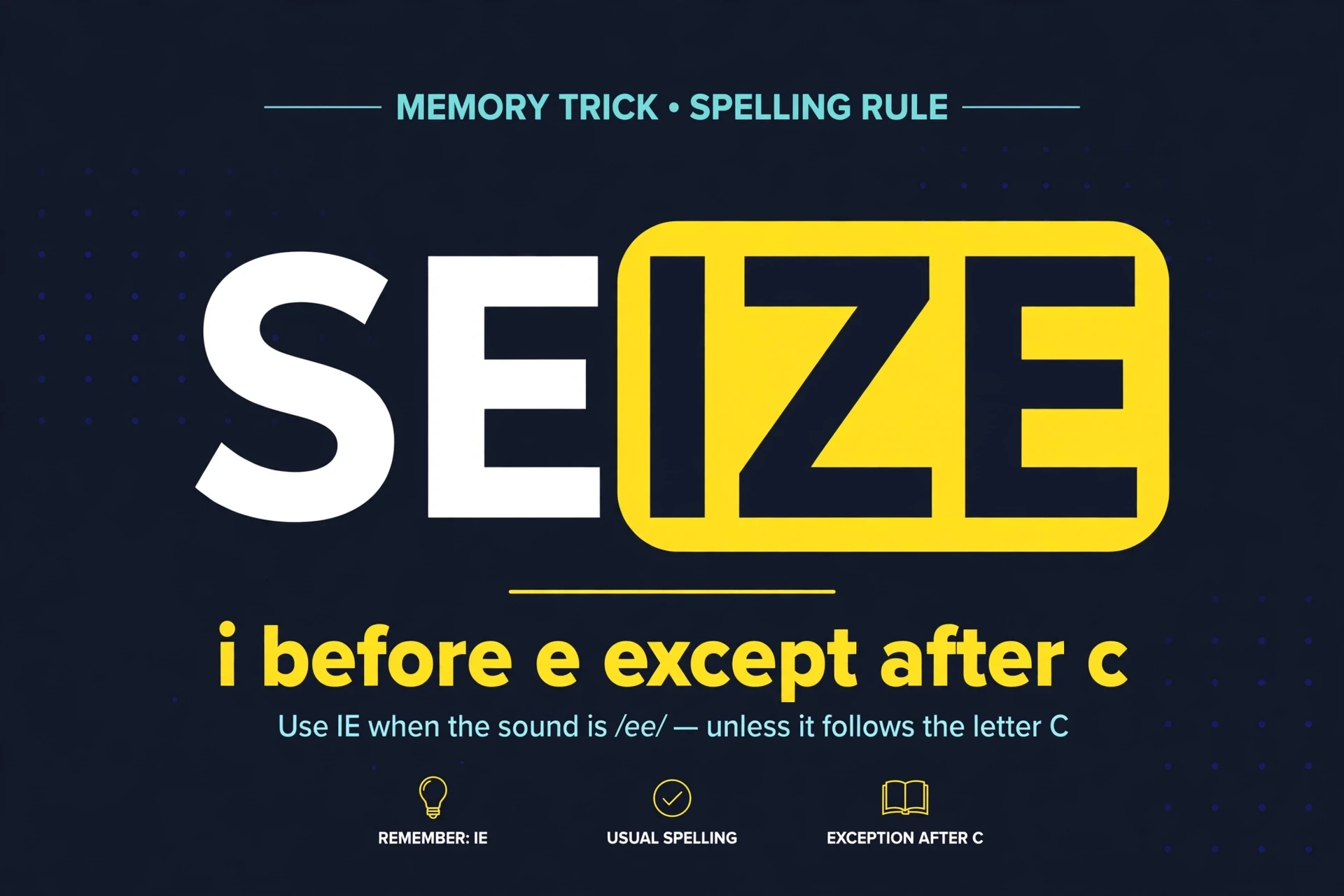
Seize is the rebel that proves the rule has exceptions — and rebels don’t follow rules. When you write it, picture the E elbowing past the I: the “wrong” order is the right spelling.
- Rebel list: memorize the trio — weird, seize, leisure. All break “i before e,” all are correct.
- Seizure anchor: you already know “seizure” has EI — the verb matches its noun.
- Size trap: “sieze” isn’t “size” either — if IE looks tempting, check whether you meant “size.”
Frequently Asked Questions
Is it seize or sieze?
Seize. “Sieze” is a misspelling and is never correct in standard English.
Doesn’t “i before e” mean it should be “sieze”?
The full rule is “i before e except after c” — and even then, “seize” is a recognized exception, like “weird.” Exceptions are memorized, not derived.
What does “seize the day” mean?
It translates the Latin “carpe diem” — make the most of the present moment instead of waiting.
Is “seizure” spelled with EI too?
Yes — seizure, seizing, and seized all keep the verb’s EI order.
What’s the difference between “seize” and “cease”?
“Seize” means to grab; “cease” means to stop. They sound similar but share nothing else.
Can “seize” mean something medical?
Yes — a “seizure” is also a sudden attack of illness, like an epileptic seizure, from the same “sudden taking hold” sense.
Conclusion
Seize breaks the “i before e” rule on purpose — it is the exception that proves the classroom rhyme incomplete. Write sieze and you’ve applied the rule too well; write seize and you’ve spelled it like someone who knows the exceptions.