Separate or Seperate: What’s the Difference?
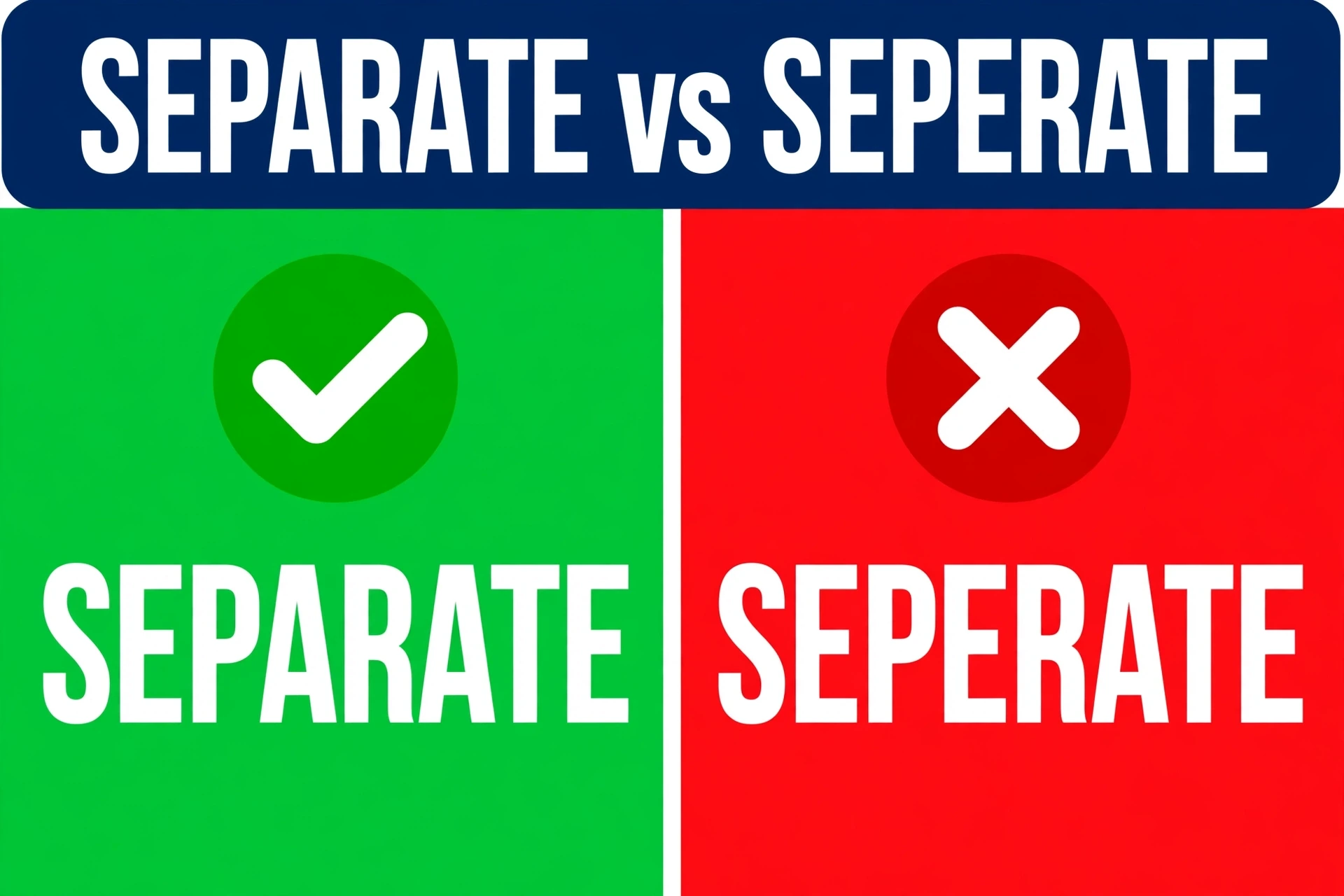
Separate is the correct spelling — the verb and adjective meaning to divide, set apart, or keep distinct. Seperate with an E in the middle is not a word; it is one of the most persistent misspellings in English, born from the way the unstressed middle syllable sounds like “per.” The middle vowel is an A, and this guide will make sure you never swap it again.
Quick Answer
| Word | Part of Speech | Main Meaning | Example |
|---|---|---|---|
| separate | Verb / adjective | To divide or set apart; kept distinct, not joined | ✅ “Please separate the recyclables.” |
| seperate | — | Not a word — the E-for-A misspelling of “separate” | ❌ “Please seperate the recyclables.” |
Simple rule: The middle vowel is A, not E — separate (sep-A-rate) is correct; seperate is always wrong.
What Does Separate Mean?
Separate works as both a verb and an adjective. As a verb it means to divide into parts, to set apart, or to move away from something — you separate laundry, separate egg whites, or separate from a crowd. As an adjective it means kept apart or distinct — separate rooms, separate accounts, separate ways. Merriam-Webster’s entry for “separate” covers both roles, from physically dividing things to the adjective sense of “not shared with another.”
Examples:
- “Please separate the dark clothes from the light ones.”
- “They decided to go their separate ways.”
- “The twins sleep in separate bedrooms.”
- “We need to separate fact from rumor.”
- “She keeps her work and personal life completely separate.”
The noun separation and the adverb separately keep the same middle A — fix the base word and the whole family follows.
What Does Seperate Mean?
Seperate means nothing — it is absent from every standard dictionary. The error comes straight from pronunciation: the middle syllable of “separate” is unstressed, so it collapses in speech to something sounding like “per” (SEP-rit), and the hand writes what the ear hears. It is the single most common A/E swap in English spelling, appearing in student essays, business emails, and product packaging alike.
Where the misspelling appears — and the fix:
- ❌ “Please seperate your trash.” → ✅ “Please separate your trash.”
- ❌ “We sat at seperate tables.” → ✅ “We sat at separate tables.”
- ❌ “Keep the receipts seperately.” → ✅ “Keep the receipts separately.”
- ❌ “They live in seperate apartments.” → ✅ “They live in separate apartments.”
- ❌ “Seperate the yolks from the whites.” → ✅ “Separate the yolks from the whites.”
In every case the meaning was perfectly clear — only the middle vowel was wrong. That is what makes this error so sneaky: it never breaks the sentence, so it slips past careless proofreading.
Separate vs. Seperate: Key Differences
| Feature | separate | seperate |
|---|---|---|
| Dictionary status | Correct, standard spelling | Misspelling — not in dictionaries |
| Middle vowel | A: sep-A-rate | E: the error |
| Part of speech | Verb and adjective | None — it has no meaning or function |
| Why it happens | — | The unstressed syllable sounds like “per” |
| Spellchecker reaction | Accepted everywhere | Red underline in most editors |
| Example | ✅ “In separate containers.” | ❌ “In seperate containers.” |
One vowel carries the whole distinction: A in the middle means the word is right; E in the middle means it isn’t a word.
Separate and Seperate in Real Sentences
At Home
✅ “We keep the cleaning supplies in a separate cabinet.”
❌ “We keep the cleaning supplies in a seperate cabinet.”
Household labels and chore lists are prime territory for the E-swap — worth a second look.
At Work
✅ “Please send the invoices as separate attachments.”
❌ “Please send the invoices as seperate attachments.”
This sentence appears in offices daily, and the misspelling rides along in an alarming share of them.
While Cooking
✅ “Separate the eggs before you start whisking.”
❌ “Seperate the eggs before you start whisking.”
Recipes move fast and proofreading moves slow — the exact conditions where “seperate” thrives.
In Conversation
✅ “Let’s keep business and friendship separate.”
❌ “Let’s keep business and friendship seperate.”
Spoken advice never reveals the spelling, which is why the error survives for years in otherwise strong writers.

Common Mistakes
Vowel swaps and doubled-letter slips share one root cause — writing what the ear hears instead of what the dictionary says. The “recieve” vs “receive” spelling mistake and the “adress” vs “address” spelling mistake both come from the same sound-over-sight habit. With separate, the traps are:
Mistake 1: Writing E for the middle A
❌ “seperate”
✅ “separate”
Why: The unstressed middle syllable sounds like “per.” English spelling doesn’t care how it sounds — the vowel is A, always.
Mistake 2: Carrying the error into “separately”
❌ “Please file these seperately.”
✅ “Please file these separately.”
Why: The adverb inherits the base spelling. If the root has an E, every derived form is wrong too.
Mistake 3: “Fixing” it by doubling letters
❌ “sepperate” / “seperrate”
✅ “separate”
Why: Adding extra consonants never helps — there are no doubled letters in this word at all. The fix is the vowel, not the consonants.
Mistake 4: Assuming spellcheck caught it
❌ Skimming past the red underline in a rushed draft
✅ Proofreading slowly, middle vowel first
Why: “Seperate” looks close enough to pass a quick scan. Train your eye to check the middle of the word specifically.
Pronunciation
As a verb, separate is pronounced SEP-uh-rayt (stress on the first syllable, long A at the end). As an adjective, it shifts slightly to SEP-rit — and that swallowed middle syllable is exactly what births the “seperate” spelling. Either way, the spelling keeps its A regardless of how the syllable sounds.
How to Remember the Difference
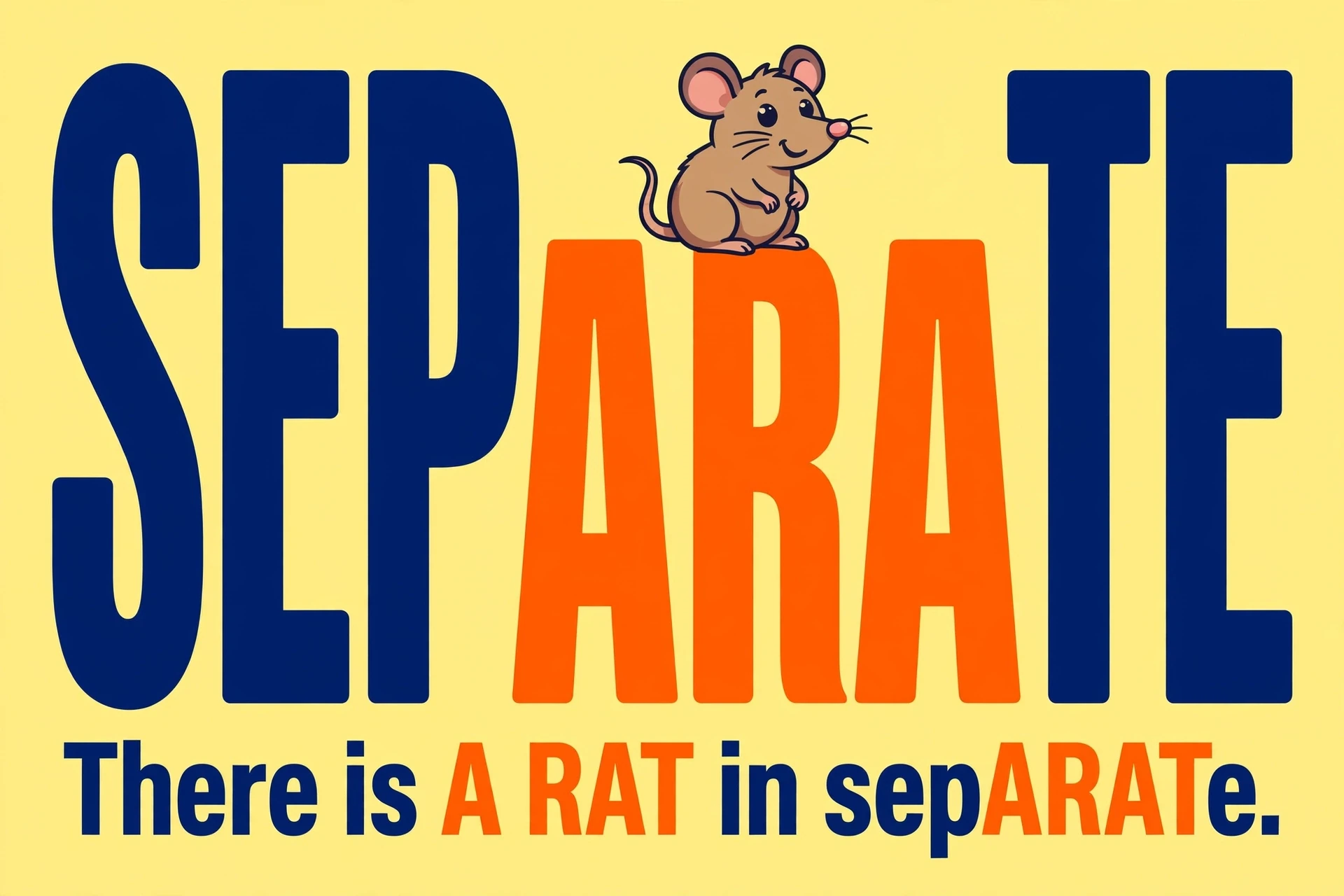
There is A RAT in sepA RATe. Picture a rat scurrying between two halves of something you’ve split apart — the rat separates them, and its name spells the middle of the word. You will never write “seperate” again once you’ve seen the rat.
- The rat test: can you find A-R-A-T in the middle? Then the A is in place — separate.
- The parade test: “separate the parade” — the A’s march together in the middle.
- The family test: separation, separately, separable all keep the A — one root, one spelling.
- The sound test (in reverse): if it sounds like “SEP-rit,” distrust your ears and check for the A.
Frequently Asked Questions
Is it separate or seperate?
It is separate, with an A in the middle. “Seperate” with an E is a misspelling and is never correct.
Why do so many people write “seperate”?
The middle syllable is unstressed, so in speech it sounds like “per” — and writers spell what they hear. The dictionary spelling keeps the A regardless of pronunciation.
Is “seperate” acceptable anywhere?
No — not in British, American, or any standard English. It appears in no dictionary as an accepted variant.
How do you spell “separately”?
With the same middle A: s-e-p-a-r-a-t-e-l-y. It inherits the base spelling exactly.
Is “separate” a verb or an adjective?
Both. As a verb it means to divide (“separate the laundry”); as an adjective it means kept apart (“separate rooms”). The spelling is identical either way.
What’s the easiest trick to remember it?
There’s a rat in separate. Find the rat, find the A, and the spelling is settled.
Conclusion
Separate — with an A in the middle — is the only correct spelling; seperate is a sound-driven misspelling that no dictionary accepts. Look for the rat in sepARATe, and the middle vowel will never fool you again.