Benefitted or Benefited: Which Spelling Is Correct?
Benefited, with one t, is the standard and preferred spelling in American English. Benefitted, with two ts, is an accepted variant that appears more often in British writing. Neither is a misspelling, but benefited is the safer choice in formal writing.
For example, “The community benefited from the new park” follows the preferred American style, while “The community benefitted from the new park” is the variant you will more often see in British publications.

Quick Answer
| Spelling | Part of Speech | Status | Example |
|---|---|---|---|
| Benefited | Verb (past of benefit) | Standard, preferred (especially US) | She benefited from the training. |
| Benefitted | Verb (past of benefit) | Accepted variant (more common in UK) | She benefitted from the training. |
Simple rule: When in doubt, write benefited with one t. It is correct everywhere and preferred by most style guides.
What Does “Benefited” Mean?
Benefited is the standard past tense and past participle of the verb benefit, meaning to receive an advantage or to give one. Major American dictionaries list it first, and style guides like AP and Chicago prefer it.
Examples:
- Local shops benefited from the festival crowds.
- He has benefited greatly from his mentor’s advice.
- The new policy benefited thousands of families.
- Students benefited from smaller class sizes.
- Regular exercise has benefited her health.
- The scholarship benefited students from rural areas.
- Everyone benefited when the library extended its hours.
Because benefit ends in an unstressed syllable, American English does not double the t — the same logic behind labeled with one l.
What Does “Benefitted” Mean?
Benefitted means exactly the same thing as benefited. It is the doubled-consonant variant, formed by analogy with verbs like admit → admitted. It is fully listed in dictionaries, not a typo.
Examples:
- The charity benefitted from generous donations. (variant)
- Farmers have benefitted from the recent rains. (variant)
- She benefitted more than anyone from the exchange program. (variant)
You will meet benefitted most often in British publications, where consonant doubling is the broader habit — compare cancelled vs canceled.
For the full dictionary entry, see benefited on Merriam-Webster, which lists both forms.

Benefitted vs. Benefited: Key Differences
| Feature | Benefited | Benefitted |
|---|---|---|
| Spelling | One t | Two ts |
| Status | Standard, preferred | Accepted variant |
| Most common in | American English | British English |
| Style guides | AP, Chicago prefer it | Allowed, less preferred |
| Meaning | Identical | Identical |
The meaning never changes; only the spelling convention does. Pick one form and use it consistently through a document.
Examples in Real Sentences
In a News Report (US Style)
Benefited: “Small businesses benefited from the tax cut, officials said.”
American newsrooms overwhelmingly choose the single-t form.
In a British Article
Benefitted: “Schools across the county benefitted from the funding boost.”
British writers double the consonant more freely, so benefitted looks natural there.
In Everyday Conversation
Benefited: “I really benefited from that workshop.”
In speech the difference vanishes entirely — only writing reveals it.
Common Mistakes With Benefitted and Benefited
Mistake 1: Assuming “Benefitted” Is Always Wrong
❌ “Benefitted” is a misspelling.
✅ “Benefitted” is an accepted variant, though “benefited” is preferred.
Why: Dictionaries list both. Calling the double-t form a typo is the real error.
Mistake 2: Tripling the T
❌ They benefittted from the advice.
✅ They benefited from the advice.
Why: Three ts is never correct in any variety of English.
Mistake 3: Mixing Both Spellings in One Document
❌ The team benefited early on, but later they benefitted even more.
✅ The team benefited early on, and later they benefited even more.
Why: Consistency matters more than which variant you choose. Pick one per document.
How to Remember the Difference
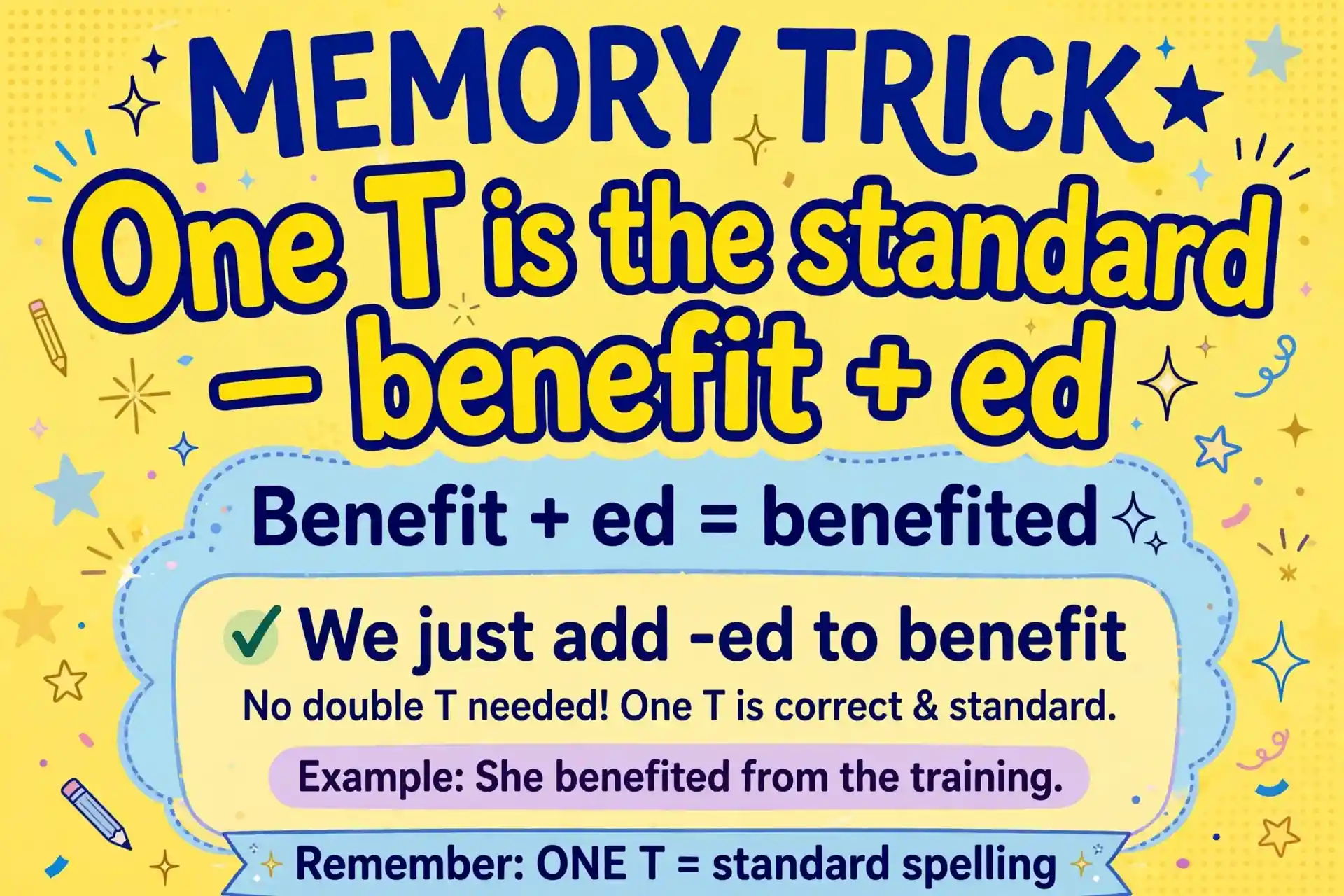
Memory trick: The base verb benefit has one T at the end — just add -ed and keep it that way: benefited.
- Benefit + ed = benefited (standard).
- Double t only if you are deliberately following British doubling habits.
When a teacher, editor, or style guide is watching, the single t never gets marked wrong.
Frequently Asked Questions
Is it benefitted or benefited?
Both exist, but benefited (one t) is the standard and preferred spelling, especially in American English. Use it unless you have a reason to follow British doubling conventions.
Is “benefitted” a misspelling?
No. Benefitted is listed in major dictionaries as a variant. It is less preferred in the US but fully acceptable, particularly in British writing.
Which spelling do style guides prefer?
AP and Chicago both prefer benefited. If you write for an American publication, the single t is the safe choice.
Why do some people double the T?
English often doubles a final consonant before -ed (admit → admitted), so benefitted follows a real pattern. But because the stress falls on the first syllable of benefit, American style skips the doubling.
Is “benefitted” more British?
It appears more often in British English, where doubled consonants are the broader habit (travelled, cancelled). Even there, benefited is also used.
Can I use “benefitted” in American English?
You can — dictionaries list it as a variant. But benefited is what AP and Chicago prefer, so the single t is the safer choice in US writing.
Conclusion
Benefited with one t is the standard spelling and the safest choice everywhere; benefitted with two is an accepted variant seen more in British writing. The meaning is identical either way — just stay consistent within a document. When an editor is watching, the single-t benefited is the choice that never gets questioned.