Cacoon or Cocoon: What’s the Difference? (With Examples)
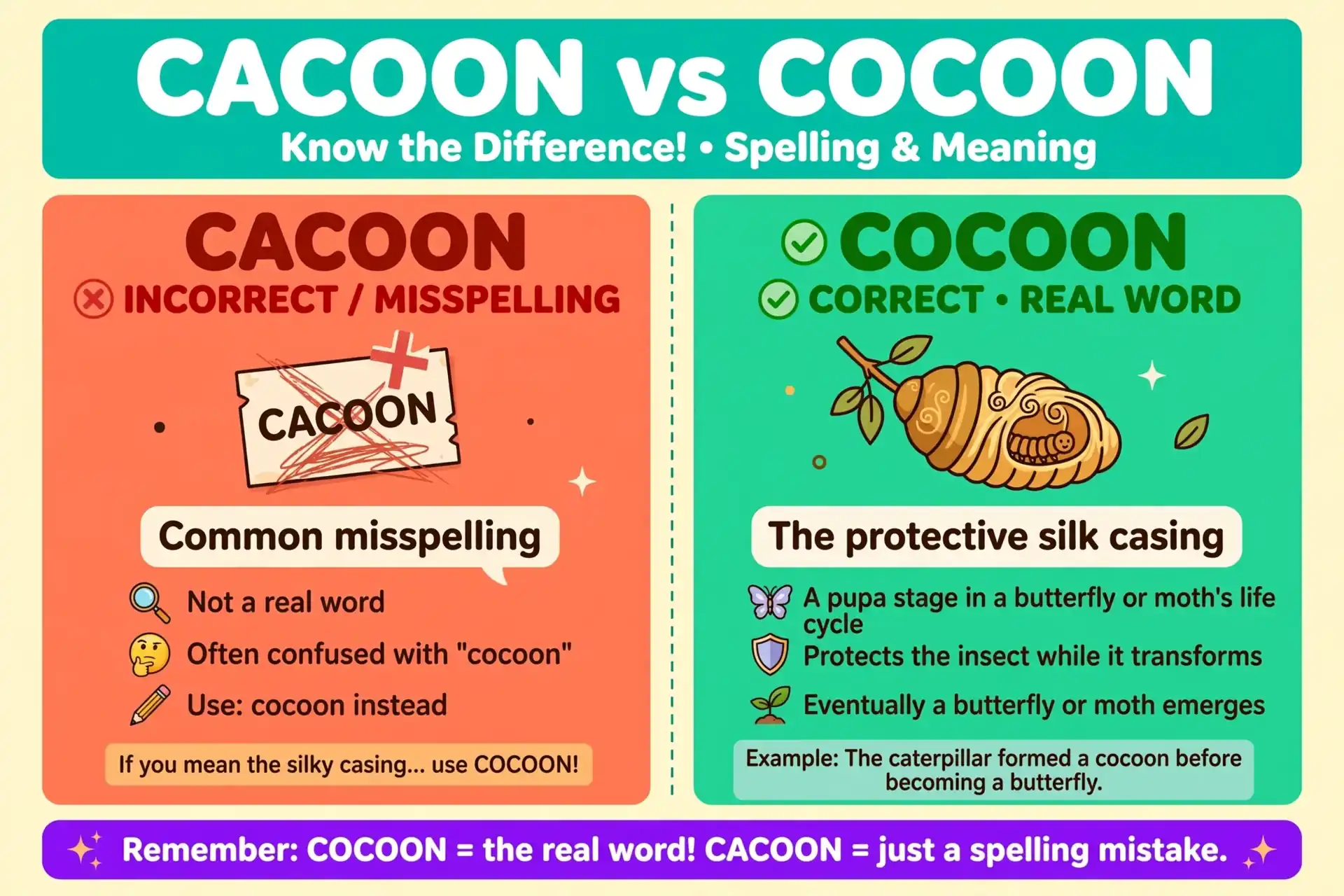
Only one of these spellings is correct. Cocoon is the silky protective case spun by caterpillars and other insect larvae, and it is the only standard spelling in English. Cacoon is a common misspelling.
Table of Contents
Quick Answer
| Word | Part of Speech | Main Meaning | Example |
|---|---|---|---|
| Cocoon | Noun (also a verb) | A silky case spun by insect larvae; also, to wrap snugly | “The caterpillar spun a cocoon.” |
| Cacoon | — (misspelling) | Not a standard English word | “I typed ‘cacoon’ by mistake.” |
Simple rule: if you mean the silky case, write cocoon with two O’s — like the two halves of the shell.
What Does Cacoon Mean?
Cacoon has no accepted meaning in English. It is simply what happens when people mishear or mistype “cocoon,” swapping the first O for an A. You will see it in unedited comments, forum posts, and hastily written texts — never in a dictionary.
Examples:
- The blog post said “butterfly cacoon” — it should have said “cocoon.”
- She searched for “cacoon” and Google asked, “Did you mean: cocoon?”
- His text read, “The moth came out of its cacoon,” and everyone knew what he meant.
- The student’s essay lost marks for writing “cacoon” instead of “cocoon.”
What Does Cocoon Mean?
Cocoon is a standard English word with a literal meaning and a few figurative ones.
Cocoon as a Noun
The protective silky covering spun by the larvae of moths, butterflies, and some other insects before they transform into adults. Figuratively, it can mean any warm, insulated, sheltered place or state.
Examples:
- The cocoon hung from the branch, swaying gently in the breeze.
- After two weeks, a moth pushed its way out of the cocoon.
- She wrapped herself in a blanket, happy in her cozy cocoon on the sofa.
- The kids built a cocoon of pillows and called it their fort.
- Silkworm cocoons have been harvested for fabric for thousands of years.
- A single cocoon can yield nearly a kilometer of silk thread.
Cocoon as a Verb
To wrap or envelop someone or something snugly, as if inside a cocoon. Check Merriam-Webster’s full entry for cocoon for all its senses.
Examples:
- He cocooned the baby in a soft blanket.
- Noise-canceling headphones cocooned her from the office chatter.
- They cocooned the pipes in insulation before winter arrived.
Cacoon vs. Cocoon: Key Differences
| Feature | Cacoon | Cocoon |
|---|---|---|
| Spelling | C-A-C-O-O-N | C-O-C-O-O-N |
| Status | Misspelling | Correct, standard word |
| In dictionaries? | No | Yes |
| Meaning | None | Silky insect case; to wrap snugly |
| Plural | — | Cocoons |
| Safe to use | No — looks like an error | Yes |
The difference is simple: one letter changes a real word into a mistake. Cacoon is what you type; cocoon is what you meant.
Cacoon vs. Cocoon in Real Sentences
In Nature
Cocoon: “A monarch caterpillar forms its cocoon in late summer.”
Cacoon: “The nature documentary’s subtitles misspelled it as ‘cacoon.'”
Use “cocoon” for the real thing; “cacoon” is only ever the typo.
At Home
Cocoon: “On rainy Sundays, I cocoon myself in blankets with a book.”
Cacoon: “Her shopping list said ‘cacoon cardigan’ — she meant the cozy kind.”
Even the figurative “cozy” sense keeps the double-O spelling.
In Conversation
Cocoon: “She came out of her cocoon after the breakup and started dating again.”
Cacoon: “He pronounced it ‘kuh-KOON’ but spelled it ‘cacoon’ in the chat.”
Say it with an O sound at the start, and spell it that way too.
Common Mistakes
English spelling is full of traps like dieing or dying and cancelled or canceled, and this pair catches people who spell words the way they sound.
Mistake 1: Writing “cacoon” in schoolwork
❌ “The butterfly’s cacoon is made of silk.”
✅ “The butterfly’s cocoon is made of silk.”
Why: only “cocoon” is a real word — “cacoon” will be marked wrong.
Mistake 2: Typing “cacoon” in a search
❌ Searching “how long does a cacoon take to hatch”
✅ Searching “how long does a cocoon take to hatch”
Why: search engines may correct you, but the right spelling gets better results.
Mistake 3: Using “cacoon” for the cozy sense
❌ “I love my bed — it’s my little cacoon.”
✅ “I love my bed — it’s my little cocoon.”
Why: the figurative meaning keeps the same standard spelling.
Mistake 4: Assuming “cacoon” is an alternative spelling
❌ “Cacoon is the American spelling of cocoon.”
✅ “Cocoon is spelled the same in American and British English.”
Why: unlike some word pairs, this one has no regional variant — “cacoon” is wrong everywhere.
Pronunciation
Cocoon is pronounced “kuh-KOON” — the stress falls on the second syllable. It rhymes with moon, soon, spoon, and balloon. Notice the first syllable sounds like “kuh” with an O sound, which is exactly why people wrongly write an A there — trust the double O, not your ear.
How to Remember the Difference
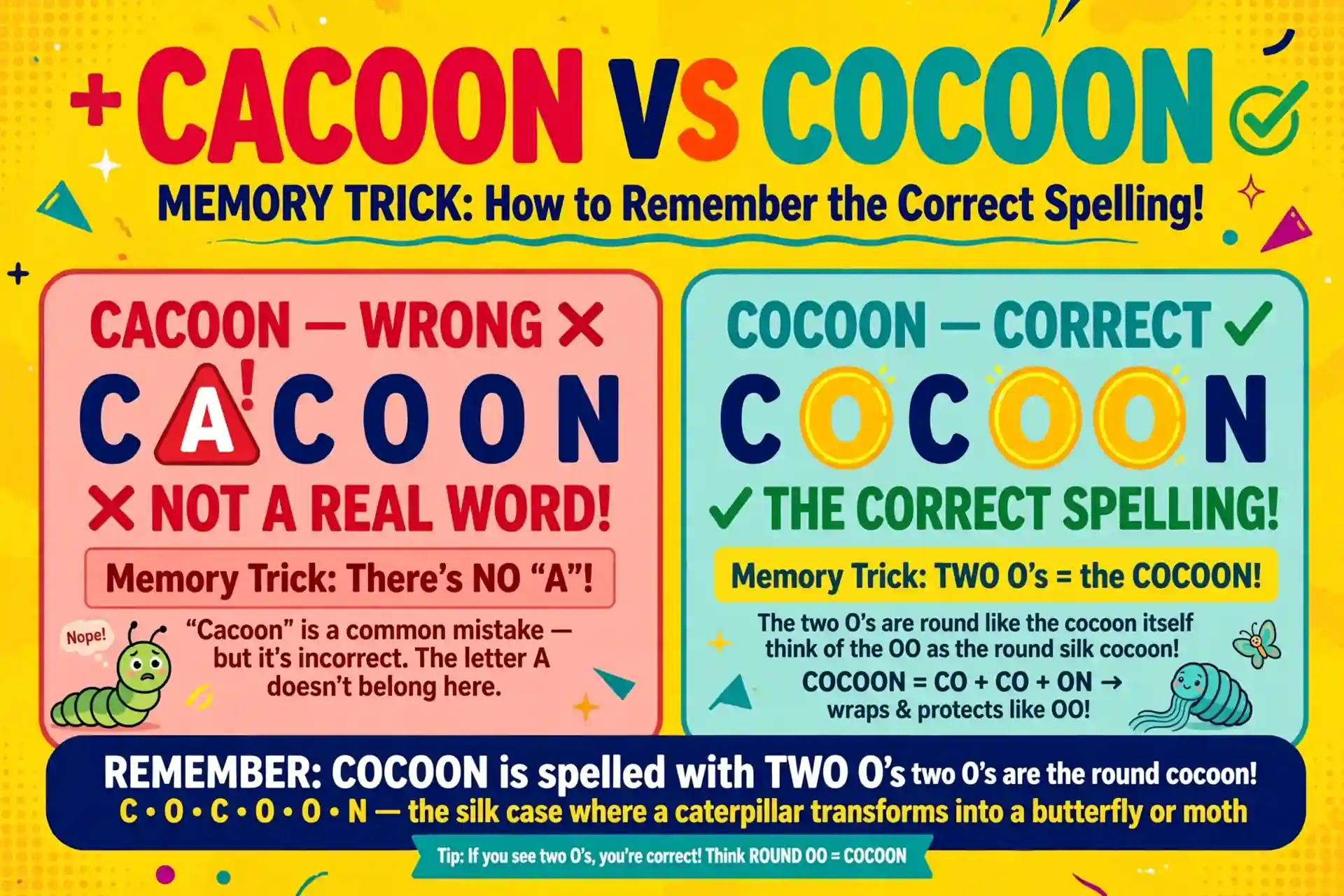
Think of the word as CO + COON: the caterpillar covers itself completely, then becomes a cocoon-dweller. Or picture the two O’s as a pair of eyes peeking out of the silky case — the word “cocoon” literally has two pairs of O’s, just like the two halves of the shell.
- Cocoon = C-O-C-O-O-N, the real word (double O, twice).
- Cacoon = the typo with an A — if you see an A, it’s an error.
- Rhymes with “balloon” — and “balloon” has double O too.
Frequently Asked Questions
Is it cacoon or cocoon?
It is cocoon. “Cacoon” is a misspelling and is not recognized as a standard English word.
What is the plural of cocoon?
The plural is cocoons — just add an S, as in “The tree was covered in cocoons.”
Why do so many people spell it “cacoon”?
The first syllable sounds like “kuh,” so writers guess at an A. English vowels are unreliable guides — the correct spelling uses O in both syllables.
Can “cocoon” be used as a verb?
Yes. To “cocoon” someone means to wrap them snugly, as in “She cocooned the baby in blankets.”
Is “cacoon” ever correct in any context?
No. It is not an accepted variant, regional spelling, or archaic form — always use “cocoon.”
What is the difference between a cocoon and a chrysalis?
A cocoon is the silky outer case spun by moth caterpillars (and some other larvae), while a chrysalis is the hardened body of a butterfly pupa itself — butterflies don’t spin cocoons. Both are spelled with double O’s in “cocoon.”
Can “cocoon” describe a person?
Figuratively, yes — someone “in a cocoon” is sheltered or withdrawn from the world, as in “After the scandal, he retreated into a cocoon.” The verb works too: “She cocooned herself from criticism.”
Conclusion
Cocoon is the correct spelling for the silky case spun by insect larvae — and for anything wrapped up snugly. Cacoon is simply a misspelling with no place in standard English. Remember the double O’s, and you will never get this pair wrong.