Requestor or Requester: What’s the Difference? (With Examples)
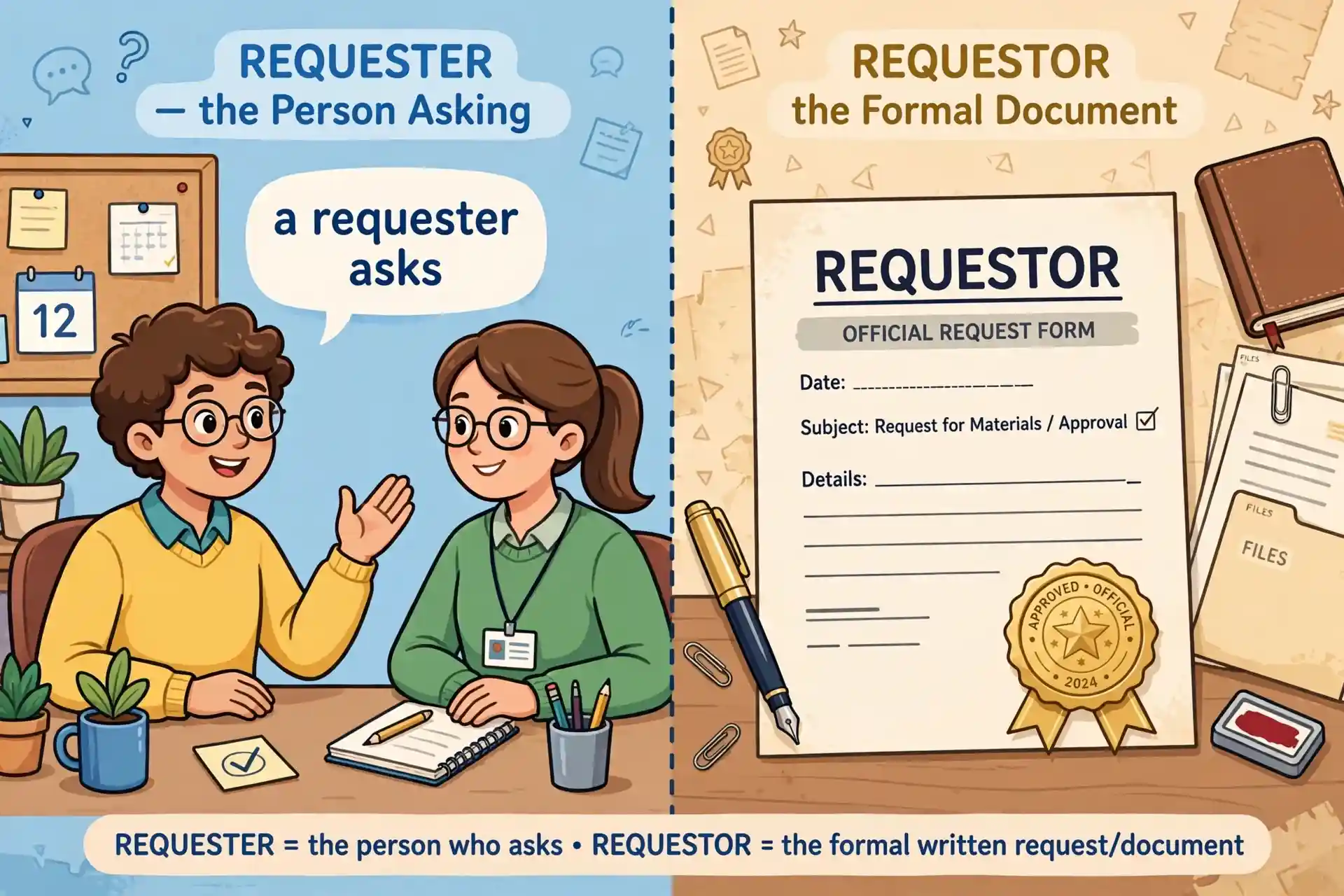
Both requester and requestor are real English words that describe a person who asks for something. The difference is mostly about register and habit: requester is the standard, everyday choice, while requestor shows up mainly in formal, legal, and technical writing. You might write, “The requester asked for a faster delivery,” but see “the requestor named in the filing” in a court document.

Quick Answer
| Word | Part of Speech | Main Meaning | Example |
|---|---|---|---|
| Requester | Noun | A person who requests something (standard, everyday form) | The requester asked for a detailed receipt. |
| Requestor | Noun | A person who requests something (formal/legal variant) | The requestor named in the FOIA filing was a journalist. |
Simple rule: default to requester in almost everything you write; use requestor only when a legal, government, or technical document already uses it.
What Does Requester Mean?
A requester is simply a person who makes a request — someone who asks for something to be done, given, or provided. It is the regular agent noun formed from the verb “request,” and it is by far the more common of the two spellings in books, news, and everyday writing.
- The requester asked the library to hold the book for three days.
- Each requester will receive a confirmation email within 24 hours.
- The company thanked the original requester for the idea.
- As the requester of the quote, she had to approve the final price.
- Support tickets are closed automatically once the requester confirms the fix.
What Does Requestor Mean?
A requestor means exactly the same thing as requester — a person who makes a request. The spelling is an accepted variant, but it is much less common and mostly survives in specialized contexts: legal filings, Freedom of Information Act (FOIA) paperwork, insurance claims, and some software systems that label the user who opened a ticket the “requestor.”
- The requestor named in the FOIA filing was a local journalist.
- Insurance forms ask the requestor to sign and date the application.
- The requestor must submit the paperwork before Friday.
- In the ticketing system, the requestor receives status updates by email.
Why does the -or form exist at all? English agent nouns that come from Latin past participles often end in -or (actor, vendor, sponsor), so some writers extend the pattern to “request” by analogy. But “request” entered English through Old French requeste, not Latin, which is why the natural, standard spelling is requester. Merriam-Webster lists both spellings, so neither is a typo — one is simply far more widely used. (See the dictionary entry for requester for confirmation.)
Requester vs. Requestor: Key Differences
| Feature | Requester | Requestor |
|---|---|---|
| Meaning | Person who makes a request | Person who makes a request (identical meaning) |
| Frequency | Overwhelmingly common | Much rarer |
| Register | Neutral — works everywhere | Formal, legal, or technical |
| Typical contexts | Emails, customer service, everyday writing | FOIA requests, court filings, insurance forms, some ticketing software |
| Suffix origin | Regular English -er agent noun | -or by analogy with Latin-derived words |
| Safe default? | Yes — always acceptable | Acceptable, but marked and formal |
The distinction is not regional, like US vs UK spelling, and it is not a difference in meaning. It is a difference in formality and convention — closer to a wardrobe choice than a definition.
At Work
Requester: “The requester wants the invoice by Thursday.”
Requestor: “The compliance team asked who the requestor of the document was.”
Use requester in ordinary workplace emails and chats; switch to requestor only when your company or industry paperwork already uses that spelling.
In Legal Documents
Requester: “The original requester may appeal the decision.”
Requestor: “The requestor shall provide written authorization.”
Legal drafting favors requestor alongside other -or forms like grantor and vendor. If you are editing a legal text, match whatever spelling the document already uses rather than mixing the two.
In Everyday Speech
Requester: “I’m the requester — I asked for the window seat.”
Requestor: (rare in conversation; would sound oddly stiff)
In normal conversation and casual writing, requester is the only natural choice. Nobody says “requestor” at a coffee shop.
Common Mistakes
The trickiest thing about this pair is that there is no wrong answer — only an unusual one. Still, a few patterns trip writers up, much like confusing vendor vs vender or mixing up etc vs ect.
Mistake 1: Assuming requestor is a typo
❌ “Your form says requestor — that’s spelled wrong.”
✅ “Requestor is a less common but accepted variant.”
Why: requestor appears in major dictionaries and real legal documents, so flagging it as a spelling error is itself a mistake.
Mistake 2: Using requestor in casual writing
❌ “The requestor of the pizza was me.”
✅ “The requester of the pizza was me.”
Why: requestor carries a formal, bureaucratic flavor that feels out of place in everyday sentences. requester fits naturally everywhere.
Mistake 3: Mixing both spellings in one document
❌ “The requester submits the form, and the requestor receives the reply.”
✅ “The requester submits the form, and the requester receives the reply.”
Why: Consistency matters. Pick one spelling per document and stick with it — requester unless the house style says otherwise.
Mistake 4: Writing “requestor” when you mean something else
❌ “The requestor approved the budget.” (when you mean the person who authorized it)
✅ “The approver approved the budget.”
Why: The requester is the person who asked — not necessarily the person who decided or approved. Check that the role actually matches the word.
Pronunciation
Both spellings are pronounced exactly the same: rih-KWES-ter (/rɪˈkwɛstər/). It rhymes with “gesture” and “jester” — the stress falls on the second syllable, and the final sound is an unstressed “ter,” no matter which way you spell it.

How to Remember the Difference
Think: the ER in requestER stands for Everyday Routine — the ordinary word for ordinary situations. The OR in requestOR stands for Official Records — the formal spelling for paperwork.
- RequestER = Everyday Routine (standard, always safe).
- RequestOR = Official Records (legal, FOIA, formal documents).
- Same pronunciation, same meaning — only the setting changes.
- When in doubt, write requester.
Frequently Asked Questions
Is it requestor or requester?
Both are correct, but requester is the standard spelling you should use in nearly all writing. Requestor is a less common variant found mostly in legal, government, and technical documents.
Is requestor a word?
Yes. Requestor is a real word listed in major dictionaries, meaning the same as requester. It is not a misspelling.
Why do legal documents use requestor?
Legal English favors Latin-style -or agent nouns (vendor, grantor, actor), so requestor fits the pattern of formal drafting even though “request” itself comes from Old French.
Can I use requester in a legal document?
Yes — requester is correct everywhere, including legal writing. The only reason to prefer requestor is to match a document or system that already uses that spelling.
Which spelling does my spell-checker prefer?
Most spell-checkers accept both, though some grammar tools flag requestor as less common. Writing requester keeps you safe with every tool.
Are requester and requestor pronounced differently?
No. They are pronounced identically — “rih-KWES-ter” — because the difference is purely in the final vowel letter, which is unstressed.
Conclusion
Requester and requestor both name the person who asks for something, but requester is the everyday standard while requestor belongs to legal, government, and technical paperwork. Unless a document already uses the -or form, requester is the spelling to reach for — it is correct, natural, and never out of place.