Etc. or Ect.: Which Spelling Is Correct?
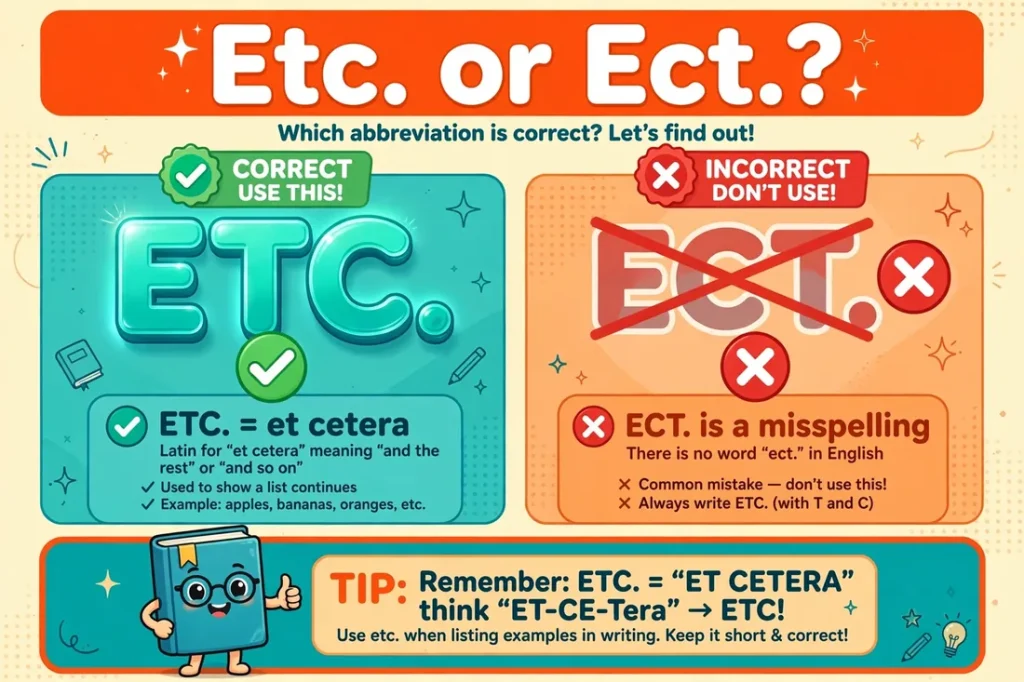
Etc. is the correct abbreviation for et cetera, which means “and other things” or “and so on.” Ect. is a common misspelling. Use etc. when listing additional items that belong to the same category. For example: “Bring pens, notebooks, folders, etc.”
Quick Answer
Quick Facts: Etc. vs. Ect.
|
Feature |
Etc. |
Ect. |
|
Correct spelling |
Yes |
No, when meaning et cetera |
|
Full phrase |
Et cetera |
No standard expansion |
|
Meaning |
And other things |
No intended meaning in this context |
|
Abbreviation |
Misspelling | |
|
Example |
We bought fruit, bread, milk, etc. |
We bought fruit, bread, milk, ect. |
|
Standard form |
Etc. |
Etc. |
What Does Etc. Mean?
Etc. is an abbreviation of the Latin phrase et cetera. It means “and other things” or “and so on.”
Writers use it when they list some examples but do not want to name every item. The unlisted items should be clear from the context.
For example:
In each sentence, etc. tells readers that the list continues with similar items.
What Does Et Cetera Literally Mean?
The Latin phrase et cetera means “and the rest” or “and other things.”
The abbreviation keeps the first letters of the two words and includes a period: etc.
What Does Ect. Mean?
Ect. is not the correct abbreviation for et cetera. It is usually a spelling error caused by switching the letters in etc.
For example:
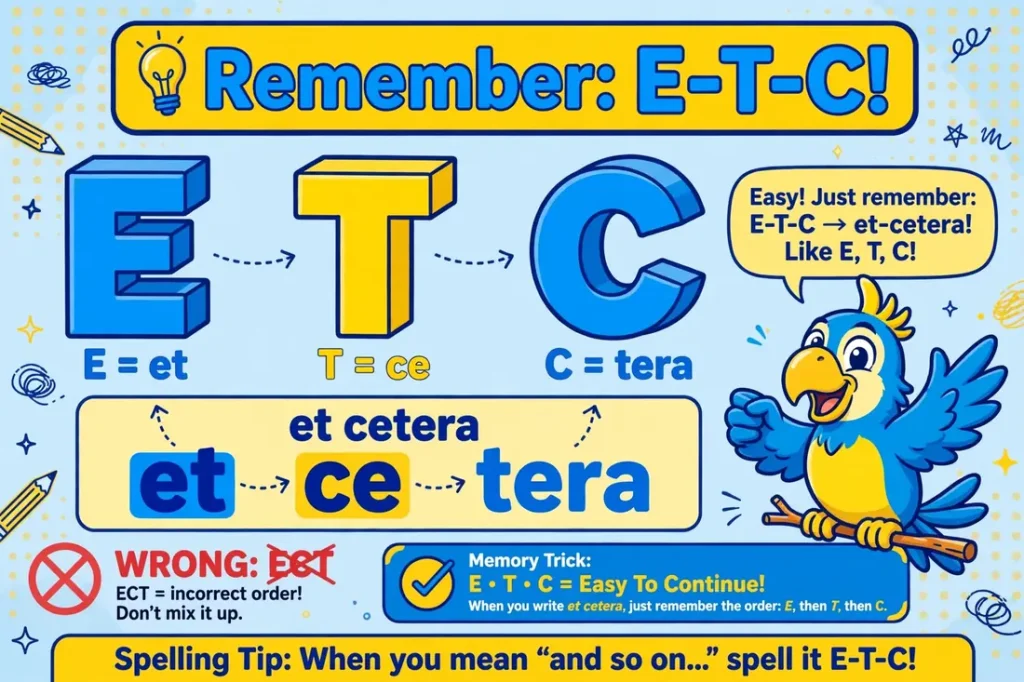
The correct abbreviation follows the order of the letters in et cetera: E-T-C.
Why Do People Write Ect.?
People may write ect. because they remember the sound of the word but not its spelling.
The pronunciation can make the letter order less obvious. Since the spoken word does not clearly reveal the written abbreviation, writers sometimes reverse the final letters.
The solution is simple: remember that etc. comes from the first letters of et cetera.
Key Differences Between Etc. and Ect.
The difference is spelling and correctness. Etc. is the standard abbreviation. Ect. is not an accepted alternative spelling for this phrase.
|
Comparison |
Etc. |
Ect. |
|
Standard abbreviation |
Yes |
No |
|
Comes from et cetera |
Yes |
No |
|
Used in formal writing |
Yes, when appropriate |
No |
|
Used to continue a list |
Yes |
No |
|
Recommended spelling |
Yes |
No |
When Should You Use Etc.?
Use etc. when you have listed examples and want to show that other similar items are included.
It works best when the category is already clear.
1. When Listing Similar Objects
Use etc. after examples of objects that belong to the same group.
Examples:
The reader can understand that the list includes other related objects.
2. When Listing Activities
You can also use it after a list of activities or tasks.
Examples:
3. In Informal Writing
Etc. often appears in emails, notes, messages, and everyday writing.
Examples:
In formal writing, consider whether the reader needs a complete list. If the missing items matter, name them instead.
How to Use Etc. Correctly in a Sentence
The abbreviation usually appears at the end of a list. It should follow examples that share a clear category.
Use Etc. After a List
Correct:
Incorrect:
Do Not Use Etc. When the List Is Unclear
Readers should be able to understand what the omitted items might include.
Unclear:
– She likes apples, history, blue, etc.
The items do not form an obvious category. The sentence gives readers no clear idea of what else belongs in the list.
Clearer:
– She likes apples, oranges, bananas, etc.
The examples all belong to the fruit category.
Avoid Using Etc. With an Incomplete Thought
The abbreviation should not replace information that readers need.
Weak:
– The company offers several services, etc.
Better:
– The company offers plumbing, electrical repairs, painting, and other home services.
The second sentence gives readers useful information instead of leaving the list vague.
Should You Write Etc. or Etc?
In standard writing, etc. includes a period.
The period marks the abbreviation. It is part of the standard written form.
Examples:
When etc. appears at the end of a sentence, you do not need to add another period.
Correct:
– The store sells pens, folders, notebooks, etc.
Incorrect:
– The store sells pens, folders, notebooks, etc..
The abbreviation already ends with a period.
Should You Put a Comma Before Etc.?
Usually, yes. When etc. follows a list of three or more items, place a comma before it.
Examples:
The comma separates the final listed example from the abbreviation.
However, punctuation can depend on sentence structure and the style guide being followed. In ordinary lists, a comma before etc. is the common choice.
Is It Correct to Say “And Etc.”?
No. Avoid writing “and etc.” because et cetera already means “and other things.”
The word et means “and.” Adding another and creates unnecessary repetition.
Incorrect:
– We bought bread, milk, eggs, and etc.
Correct:
– We bought bread, milk, eggs, etc.
You can also write:
– We bought bread, milk, eggs, and other groceries.
Choose either etc. or a phrase such as and other items. Do not combine them unnecessarily.
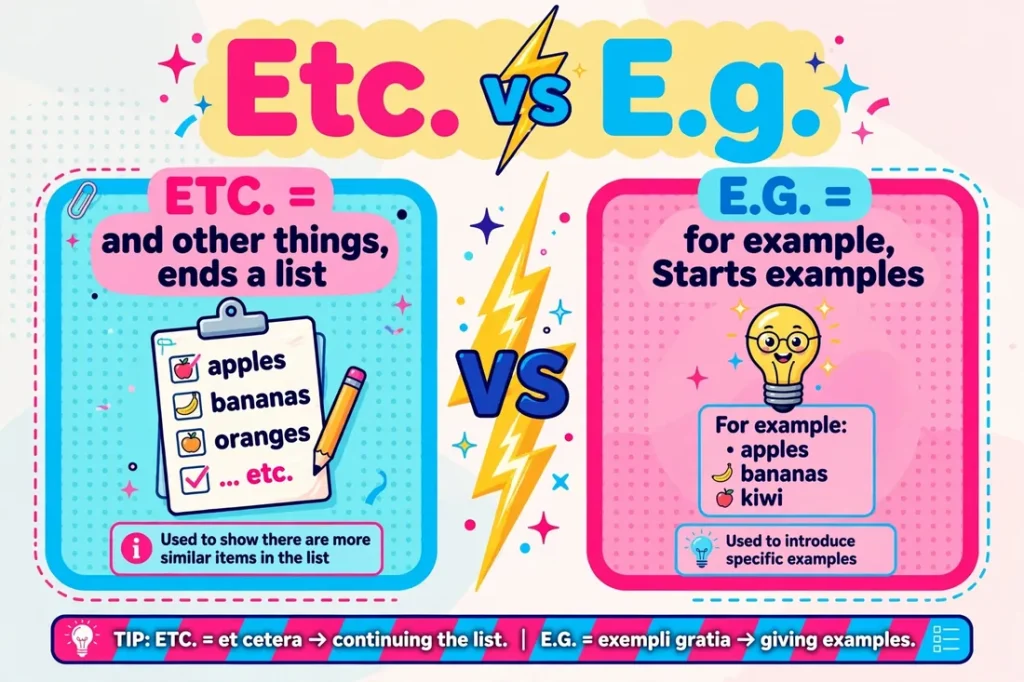
Etc. vs. E.g.: What Is the Difference?
Etc. and e.g. are both abbreviations, but they serve different purposes.
Etc. means “and other things.” It indicates that a list continues.
E.g. means “for example.” It introduces one or more examples.
|
Abbreviation |
Full form |
Meaning |
Example |
|
Etc. |
Et cetera |
And other things |
Bring pens, paper, folders, etc. |
|
E.g. |
Exempli gratia |
For example |
Bring writing supplies, e.g., pens and paper. |
When to Use E.g.
Use e.g. when you want to provide examples of a broader category.
Example:
– Some writing tools, e.g., pens, pencils, and markers, are available.
This sentence gives examples of writing tools.
When to Use Etc.
Use etc. when you have already listed examples and want to indicate that more similar items exist.
Example:
– The shop sells pens, pencils, markers, etc.
This sentence suggests that the shop sells additional writing supplies.
Etc. vs. Et Cetera: Which Should You Use?
Both forms are correct, but they serve slightly different writing needs.
Use etc. when you want a concise list. Use et cetera when you prefer the full expression, although the abbreviation is more common in everyday writing.
Examples:
Both sentences are understandable. The abbreviated form is usually more practical.
Common Mistakes When Using Etc.
Mistake 1: Writing Ect. Instead of Etc.
Incorrect: The office needs paper, clips, folders, ect.
Correct: The office needs paper, clips, folders, etc.
Remember the letter order: E-T-C.
Mistake 2: Writing And Etc.
Incorrect: We discussed costs, deadlines, and etc.
Correct: We discussed costs, deadlines, etc.
The abbreviation already includes the meaning of “and.”
Mistake 3: Using Etc. for Unrelated Items
Incorrect: The box contains a jacket, a sandwich, history, etc.
Better: The box contains a jacket, a shirt, a sweater, etc.
Use etc. when the listed items belong to a recognizable category.
Mistake 4: Using Etc. When the Full List Matters
In instructions, contracts, reports, and technical documents, vague lists can create confusion.
Instead of:
– Submit your documents, etc.
Write:
– Submit your application, identification, proof of address, and payment receipt.
A complete list is more useful when readers must follow specific requirements.
Mistake 5: Adding Two Periods
Incorrect: We need paper, pens, folders, etc..
Correct: We need paper, pens, folders, etc.
The abbreviation already contains its final period.
How to Remember the Correct Spelling
Use this simple memory tip:
Etc. comes from E-T-C in et cetera.
The first two letters represent et. The next letter begins cetera.
You can also remember the phrase:
When writing a list, check that the letters appear in the correct order before finishing the sentence.
Frequently Asked Questions
Is Etc. or Ect. Correct?
Etc. is correct when you mean et cetera. Ect. is a common misspelling and should not be used for this meaning.
What Does Etc. Stand For?
Etc. stands for the Latin phrase et cetera. It means “and other things,” “and so on,” or “and the rest.”
Is Ect. Ever Correct?
Ect. is not a standard abbreviation for et cetera. If you intend to show that a list continues, write etc.
Do You Put a Period After Etc.?
Yes. The standard abbreviation includes a period. If it appears at the end of a sentence, that period also ends the sentence.
Is It Correct to Write And Etc.?
No. Avoid and etc. because et cetera already includes the meaning “and other things.” Write etc. or and other items instead.
Can You Use Etc. in Formal Writing?
Yes, but use it carefully. In formal reports or instructions, provide a complete list when the missing items could affect meaning or action.
Conclusion
Etc. is the correct abbreviation of et cetera, meaning “and other things” or “and so on.” Ect. is a common spelling mistake, not an accepted alternative. Use etc. after a clear list when additional similar items are understood. Remember the correct letter order: E-T-C.