Worse or Worst: What Is the Difference?
Worse and worst are both correct words, but they have different grammatical uses. Worse compares two things and means “more bad” or “less good.” Worst describes the lowest level among three or more things, or the most negative possible degree.
Use worse for a comparison between two things. Use worst when identifying the most negative option in a group or situation.
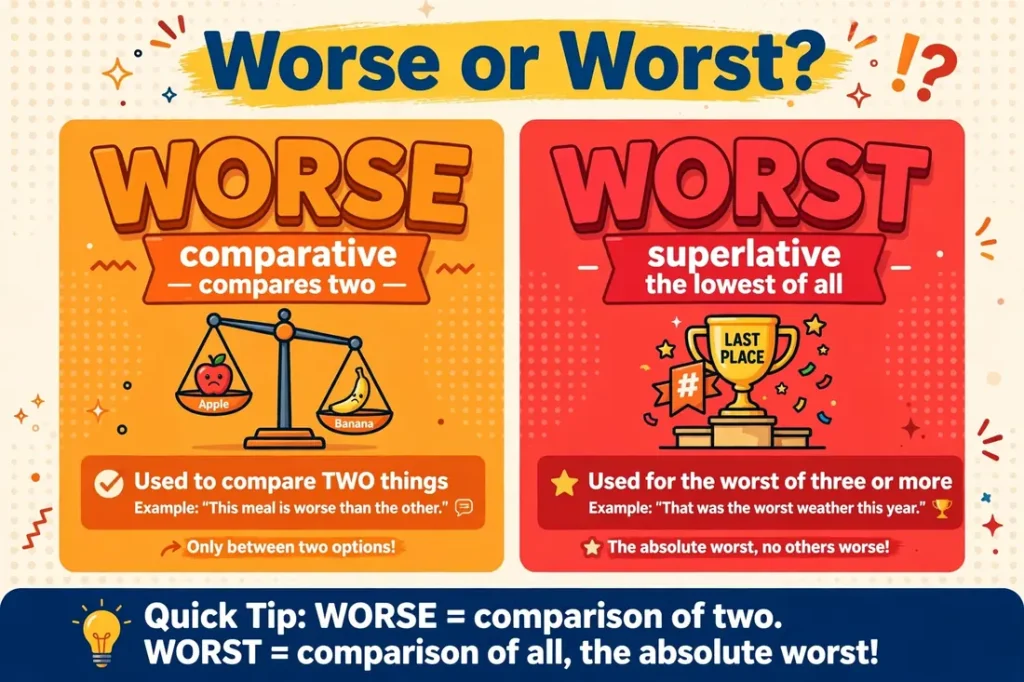
Quick Answer: Worse or Worst?
Examples:
Both words are correct. The right choice depends on what you are comparing.
Quick Facts About Worse and Worst
|
Feature |
Worse |
Worst |
|
Grammatical form |
Comparative |
Superlative |
|
Meaning |
More bad; less good |
Most bad; least good |
|
Main use |
Compares two things |
Identifies the lowest level in a group |
|
Related adjective |
Bad |
Bad |
|
Related adverb |
Badly |
Badly |
|
Example |
The weather is worse today. |
This is the worst weather this week. |
|
Common phrase |
Worse than |
The worst of all |
What Does Worse Mean?
Worse is the comparative form of bad and badly. It describes something that is less good, more unpleasant, or more serious than another thing.
Use it when comparing two people, objects, conditions, experiences, or situations.
Worse as an Adjective
As an adjective, worse describes a noun. It shows that one thing has a lower quality or condition than another.
Examples:
Worse as an Adverb
Worse can also work as the comparative form of the adverb badly. It describes how an action is performed.
Examples:
Here, worse describes an action or performance rather than a noun.
Worse as a Noun
In some expressions, worse can function as a noun. It refers to something more unpleasant or serious.
Examples:
The phrase “from bad to worse” describes a situation that continues to deteriorate.
What Does Worst Mean?
Worst is the superlative form of bad and badly. It describes the least desirable, least successful, or most unpleasant option in a group.
Use it when identifying the lowest level among three or more things. It can also describe an extreme situation.
Worst as an Adjective
As an adjective, worst describes a noun. It identifies the least favorable member of a group.
Examples:
Each sentence identifies one thing as the lowest or most negative option.
Worst as an Adverb
Worst can also function as the superlative form of badly. It describes the lowest level of performance or action.
Examples:
Worst as a Noun
Worst can also refer to the most unpleasant part or possible outcome of a situation.
Examples:
In these sentences, worst means the most difficult or negative possibility.
Worse vs. Worst: Key Differences
The main difference is the degree of comparison. Worse compares two things, while worst identifies the lowest level in a group.
|
Point |
Worse |
Worst |
|
Degree |
Comparative |
Superlative |
|
Basic meaning |
More negative than another |
Most negative in a group |
|
Typical comparison |
Two items or situations |
Three or more items or an entire range |
|
Common structure |
Worse than |
The worst |
|
Example |
This route is worse than that one. |
This is the worst route in the city. |
Compare Two Things With Worse
Use worse when one thing is less good than another.
The comparison may be explicit or understood from context.
For example:
“My condition is getting worse.”
This sentence compares the current condition with an earlier one. The second item does not need to appear in the sentence.
Identify the Lowest Level With Worst
Use worst when something ranks at the bottom of a group or represents an extreme.
The group may be stated directly or understood from the situation.
When to Use Worse or Worst
Choosing between these words becomes easier when you identify the type of comparison.
Use Worse for a Comparison
Choose worse when comparing one thing with another.
Common sentence patterns include:
Examples:
Use Worst for the Lowest Degree
Choose worst when describing the most negative option or extreme.
Common sentence patterns include:
Examples:
Why Do We Say “Worse Than” but “The Worst”?
The word than commonly introduces a comparison. That is why it often follows worse.
Correct: This exam was worse than the last one.
The word the often appears before a superlative adjective. It identifies one item as the highest or lowest within a group.
Correct: This was the worst exam of the year.
However, the is not required in every sentence with worst. For example:
The sentence structure determines whether an article is needed.
Sentence Examples: Worse vs. Worst
Examples Using Worse
Examples Using Worst
Common Mistakes With Worse and Worst
Both words are common, but people sometimes use them in the wrong form.
Mistake 1: Using Worst for a Two-Item Comparison
Incorrect: This phone is worst than my old phone.
Correct: This phone is worse than my old phone.
Use worse than to compare two phones.
Mistake 2: Using Worse to Identify the Lowest Option
Incorrect: This is the worse restaurant in town.
Correct: This is the worst restaurant in town.
The sentence identifies one restaurant as the lowest option in a larger group.
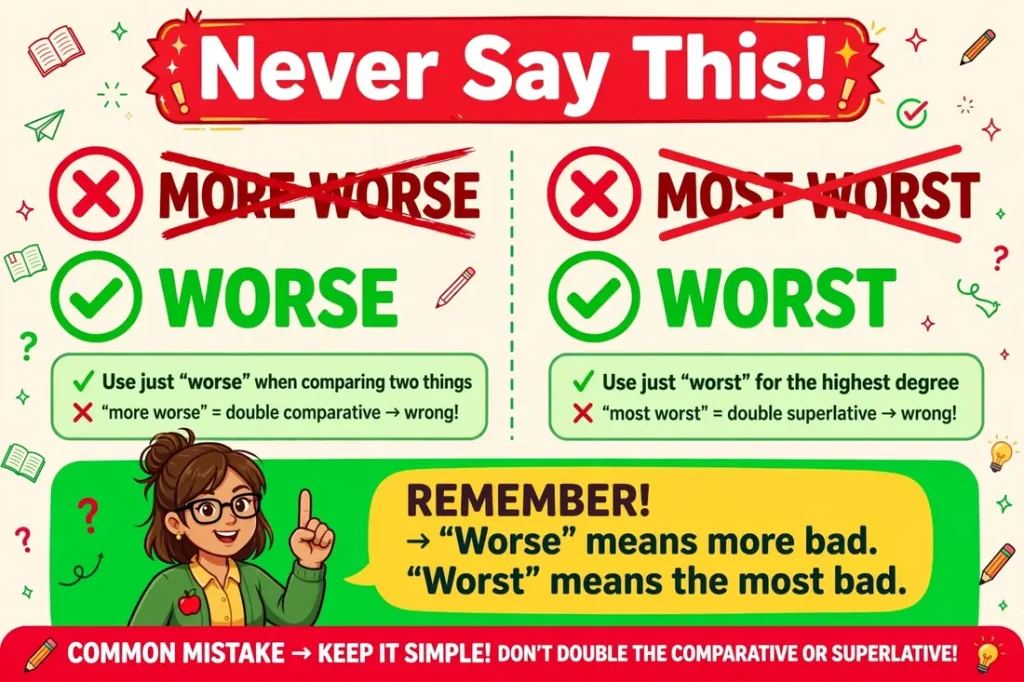
Mistake 3: Writing “More Worse”
Incorrect: The situation is more worse today.
Correct: The situation is worse today.
Worse already expresses a comparative meaning. Adding more is usually unnecessary and incorrect in standard English.
Mistake 4: Writing “Most Worst”
Incorrect: That was the most worst experience of my life.
Correct: That was the worst experience of my life.
Worst already expresses the superlative degree. Do not add most before it in standard usage.
Mistake 5: Confusing Worse With Worst in Fixed Expressions
Some expressions use one form consistently.
|
Expression |
Correct use |
Meaning |
|
From bad to worse |
Worse |
A situation becomes less favorable |
|
The worst is over |
Worst |
The most difficult part has passed |
|
Worse than expected |
Worse |
Less favorable than anticipated |
|
At worst |
Worst |
In the most negative possible case |
|
For better or worse |
Worse |
Regardless of whether the result is good or bad |
Worse and Worst in Different Contexts
The distinction applies to many subjects, not just quality or personal experiences.
Health and Conditions
Use worse to describe a condition that has declined compared with an earlier point.
Use worst to identify the most serious point or experience.
Work and Performance
Use worse when comparing performance across two tasks or periods.
Use worst when identifying the lowest performance in a group.
Weather and Travel
Use worse when conditions become less favorable or compare unfavorably.
Use worst for the most severe conditions in a period or group.
Decisions and Outcomes
Use worse to compare two possible outcomes.
Use worst to describe the most negative possible outcome.
How to Remember the Difference
Use this simple rule:
You can also connect the words to their base form:
|
Base word |
Comparative |
Superlative |
|
Bad |
Worse |
Worst |
|
Badly |
Worse |
Worst |
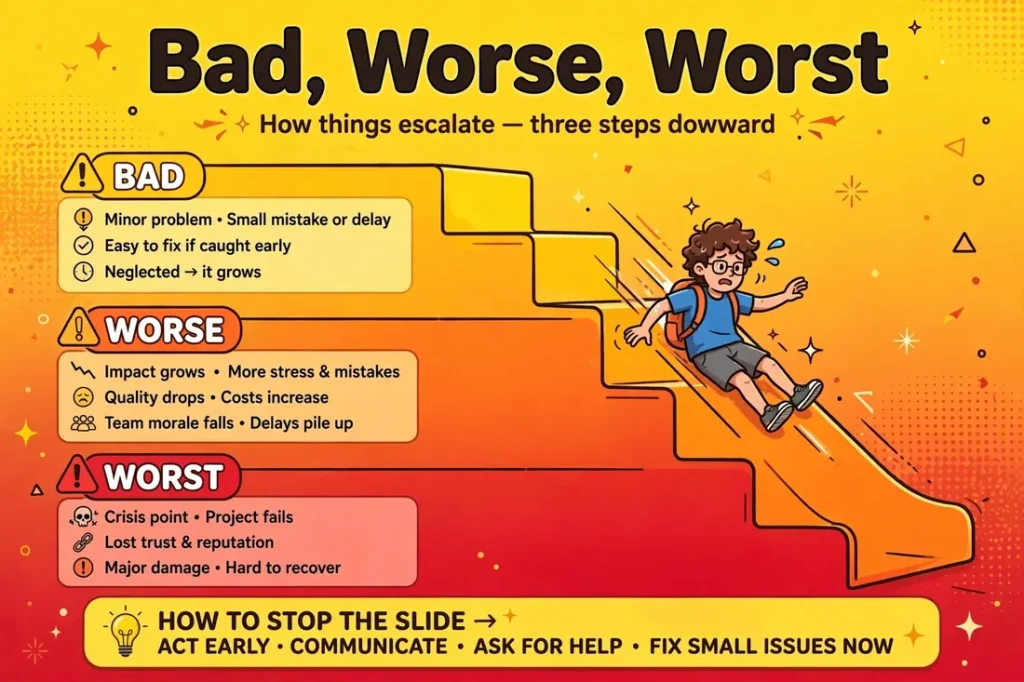
Think of the three forms as a sequence:
Remember that worse does not always need an explicit second item. “The weather is getting
worse” compares the current weather with an earlier condition.
Frequently Asked Questions
Is worse or worst grammatically correct?
Both are grammatically correct. Worse is the comparative form of bad or badly. Worst is the superlative form. The correct choice depends on the sentence.
Is worse than or worst than correct?
Worse than is correct when comparing two things. Worst than is not standard English. For example, write “This result is worse than the previous one.”
Is it getting worse or getting worst?
“Getting worse” is the standard expression. It means a situation is becoming less favorable or more serious. “Getting worst” is generally incorrect in this context.
Do you say the worse or the worst?
Both phrases can be correct, but they have different uses. “The worst” identifies the lowest or most negative option. “The worse” can refer to the less favorable of two choices, as in “Choose the worse of the two options.”
Is worse the opposite of better?
Yes. Worse is the comparative opposite of better. For example, “This option is worse than the other one” means it is less favorable.
What is the difference between worse, worst, and bad?
Bad describes a negative quality. Worse compares two things. Worst identifies the most negative option in a group or situation.
Conclusion
Worse and worst are both correct, but they serve different purposes. Use worse when comparing two things or describing a decline. Use worst when identifying the lowest level or most negative option.
Remember the simple rule: worse than for comparisons, and the worst for the lowest degree.