Lets or Let’s: Which One Is Correct?
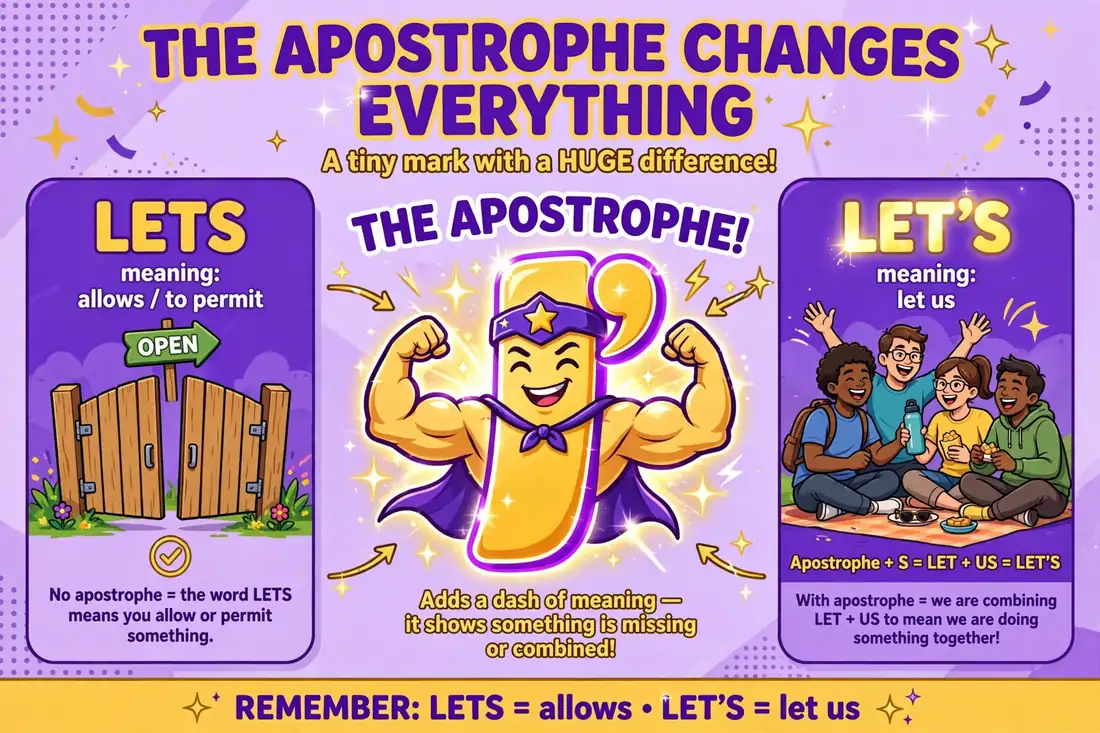
Lets and let’s are both correct words, but they have different meanings and grammatical uses. Let’s is a contraction of let us, commonly used to make suggestions or invite someone to do something. Lets is the third-person singular form of the verb let, meaning allows or permits. The apostrophe changes the meaning, so choosing the correct form matters.

Quick Answer
- Let’s: Short for let us. Use it for suggestions, invitations, or shared actions.
- Lets: A verb meaning allows or permits.
- Example with let’s: Let’s go for a walk.
- Example with lets: My mother lets me use her laptop.
- Main difference: The apostrophe in let’s replaces the letter in us.
Quick Facts: Lets vs. Let’s
| Feature | Lets | Let’s |
| Correct spelling | Yes | Yes |
| Part of speech | Verb | Contraction |
| Full form | Lets | Let us |
| Main meaning | Allows or permits | Suggests a shared action |
| Apostrophe | No | Yes |
| Example | He lets the dog outside. | Let’s take the dog outside. |
What Does Let’s Mean?
Let’s is a contraction of let us. It usually introduces a suggestion, invitation, or proposal involving the speaker and another person.
For example:
- Let’s watch a movie tonight.
- Let’s finish this work before lunch.
- Let’s take a short break.
- Let’s discuss the plan tomorrow.
Each sentence suggests that the speaker and someone else should do something together.
Let’s as a Suggestion
Use let’s when recommending an action.
Examples:
- Let’s try a different approach.
- Let’s order dinner instead of cooking.
- Let’s meet near the library.
- Let’s check the answers again.
The speaker is usually including themselves in the proposed action.
Let’s as an Invitation
You can also use let’s to invite someone to join an activity.
Examples:
- Let’s go shopping this weekend.
- Let’s have coffee after work.
- Let’s visit our grandparents.
- Let’s celebrate your birthday together.
The phrase makes the invitation sound direct and friendly.
Let’s in Instructions
Let’s can introduce a shared step or action during a lesson, discussion, or demonstration.
Examples:
- Let’s begin with the first question.
- Let’s look at the main problem.
- Let’s read the next paragraph.
- Let’s review the results.
This use is common in teaching, presentations, and conversations.
What Does Lets Mean?
Lets is the third-person singular form of the verb let. It means allows, permits, or gives someone permission to do something.
Use lets with singular subjects such as he, she, it, or a singular noun.
Examples:
- She lets her children play outside.
- My teacher lets us use calculators.
- The hotel lets guests check in early.
- He lets his dog sleep indoors.
In each sentence, lets describes what someone allows.
Lets in Everyday Sentences
The verb let often appears when discussing permission or freedom.
Examples:
- My father lets me drive his car.
- This app lets users edit their photos.
- The school lets students leave early on Fridays.
- Our manager lets the team work remotely.
- The landlord lets us keep a small pet.
In these examples, lets means allows.
Key Differences Between Lets and Let’s
The main difference is grammatical function.
Lets is a verb form. Let’s is a contraction that usually suggests an action.
| Comparison | Lets | Let’s |
| Meaning | Allows or permits | Let us |
| Grammar | Verb | Contraction |
| Subject | Usually he, she, it, or a singular noun | Includes the speaker |
| Typical use | Describing permission | Making suggestions |
| Example | She lets me borrow her car. | Let’s borrow a car. |
When to Use Lets
Use lets when a person, group, organization, or thing allows someone to do something.
1. When Someone Gives Permission
Examples:
- My sister lets me borrow her books.
- The coach lets players take breaks.
- My parents let us travel alone.
Notice that the last example uses let, not lets, because the subject parents is plural.
2. When a Person Allows an Action
Examples:
- The manager lets employees choose their schedules.
- He lets his children watch television after dinner.
- She lets her guests choose the music.
3. When a Thing Makes an Action Possible
The verb let can also describe something that allows an action.
Examples:
- This feature lets you save your work.
- The wide entrance lets visitors enter easily.
- The new system lets staff track orders.
Here, lets means makes it possible or allows.
When to Use Let’s
Use let’s when you mean let us.
1. To Suggest Doing Something Together
Examples:
- Let’s clean the kitchen.
- Let’s prepare for the exam.
- Let’s walk to the station.
- Let’s start the meeting.
2. To Make a Friendly Proposal
Examples:
- Let’s try the new restaurant.
- Let’s spend the afternoon outdoors.
- Let’s watch the final episode.
- Let’s plan a trip for next month.
3. To Move a Conversation Forward
Examples:
- Let’s focus on the main issue.
- Let’s consider another option.
- Let’s return to the original question.
- Let’s move on to the next topic.
4. To Encourage a Group
Examples:
- Let’s work together to solve this problem.
- Let’s give everyone a chance to speak.
- Let’s make this project successful.
- Let’s do our best.
How to Remember the Difference
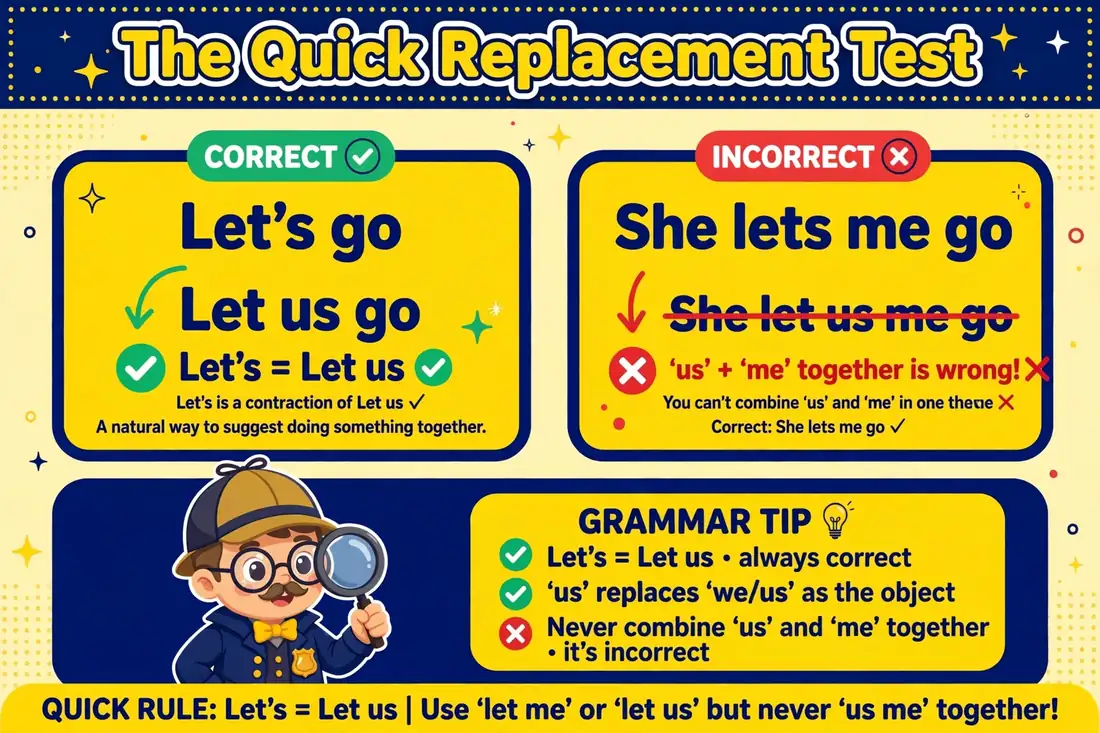
A simple way to choose the correct form is to replace let’s with let us.
If the sentence still makes sense, use let’s.
Example:
- Let’s go outside.
- Let us go outside.
Both sentences make sense, so let’s is correct.
Now consider:
- She lets me go outside.
- She let us me go outside.
The second sentence does not make sense. The correct form is lets because it means allows.
The Quick Replacement Test
| Sentence | Replacement test | Correct form |
| ___ go home. | Let us go home. | Let’s |
| He ___ me use his phone. | He allows me to use his phone. | Lets |
| ___ start the lesson. | Let us start the lesson. | Let’s |
| My teacher ___ us ask questions. | My teacher allows us to ask questions. | Lets |
Can You Use Lets and Let’s in the Same Sentence?
Yes. Both forms can appear in one sentence when each has a different grammatical role.
Example:
– My brother lets me choose the movie, so let’s watch a comedy.
In this sentence:
- Lets means allows.
- Let’s means let us.
Another example:
– The teacher lets us work in pairs, so let’s finish the exercise together.
The first form describes permission. The second introduces a suggestion.
Common Mistakes With Lets and Let’s
Mistake 1: Using Lets for a Suggestion
Incorrect: Lets go to the park.
Correct: Let’s go to the park.
The sentence means let us go to the park, so it needs an apostrophe.
Mistake 2: Using Let’s to Describe Permission
Incorrect: My mother let’s me stay up late.
Correct: My mother lets me stay up late.
The sentence means that the mother allows something. It does not mean let us.
Mistake 3: Adding an Apostrophe to Every Verb Ending in S
An apostrophe does not make a verb plural or indicate third-person singular agreement.
Incorrect: She cook’s dinner every night.
Correct: She cooks dinner every night.
Similarly:
- Correct: He lets me drive.
- Incorrect: He let’s me drive.
Mistake 4: Confusing Lets With Let
Use lets with a singular third-person subject. Use let with plural subjects and with I, you, and we.
Examples:
- She lets me borrow her notes.
- They let me borrow their notes.
- I let him use my computer.
- You let us know the answer.
The verb changes according to the subject.
Mistake 5: Using Let’s When You Mean Let Us in a Formal Quote
In ordinary writing, let’s is a standard contraction. However, some formal contexts may prefer the full form let us.
For example:
- Everyday: Let’s begin the presentation.
- More formal: Let us begin the presentation.
Both are grammatically correct. The choice depends on tone and style.
Lets vs. Let’s vs. Let: What Is the Difference?
These three forms come from the same verb, but they serve different purposes.
| Form | Meaning | Example |
| Let | Allow or permit | Please let me explain. |
| Lets | Allows or permits | She lets me explain. |
| Let’s | Let us | Let’s explain the problem. |
Let
Use let with subjects such as I, you, we, and they. It also follows modal verbs such as can, should, and will.
Examples:
- They let us enter early.
- Please let me finish.
- You should let her decide.
- We can let the team choose.
Lets
Use lets with a singular third-person subject.
Examples:
- He lets me use his desk.
- The app lets you change the settings.
- My school lets students bring lunch.
Let’s
Use let’s as a contraction of let us.
Examples:
- Let’s leave now.
- Let’s ask for help.
- Let’s make a decision.
Is Let’s Always a Contraction of Let Us?
In standard modern English, let’s is the contraction of let us. It usually makes a suggestion or proposes a shared action.
In some expressions, the phrase may function more like an instruction or a way to guide attention.
Examples:
- Let’s see what happens next.
- Let’s say you receive an unexpected offer.
- Let’s be honest about the results.
These examples still use let’s in the sense of let us, though the speaker may not be asking for literal permission.
Frequently Asked Questions
Is It Lets or Let’s?
Both are correct, but they have different meanings. Lets means allows or permits. Let’s is short for let us and introduces a suggestion or shared action.
Is Let’s Short for Let Us?
Yes. Let’s is the contraction of let us. For example, “Let’s leave” means “Let us leave.”
Does Lets Need an Apostrophe?
No. Use lets without an apostrophe when it means allows or permits. For example, “She lets me borrow her car.”
Is “Let’s Go” or “Lets Go” Correct?
Let’s go is correct when inviting or suggesting that people leave together. It means “Let us go.”
Is “He Lets Me” or “He Let’s Me” Correct?
He lets me is correct. Here, lets means allows. The apostrophe is unnecessary and incorrect.
What Is the Difference Between Let, Lets, and Let’s?
Let is the base verb, lets is its third-person singular form, and let’s means let us. Their correct use depends on the sentence’s meaning and subject.
Conclusion
Lets and let’s are both correct, but they are not interchangeable. Use lets when someone allows or permits an action. Use let’s when suggesting something or inviting others to join you. To check your choice, replace let’s with let us. If the sentence still makes sense, the apostrophe belongs there.