Quite or Quiet: What Is the Difference?
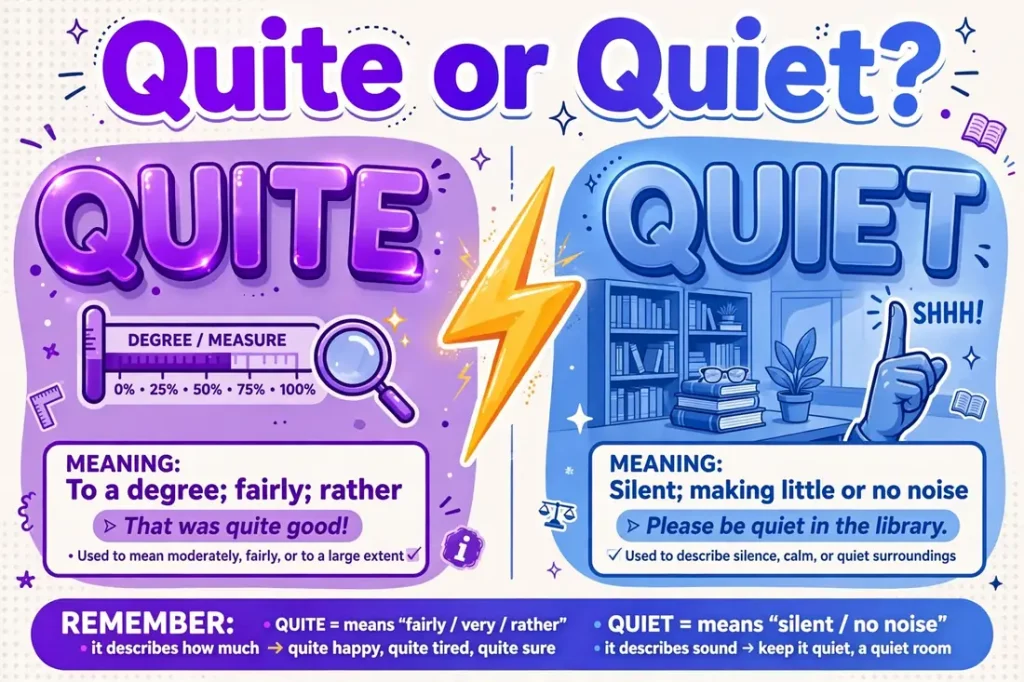
Quite and quiet are both correct English words, but they have different meanings and grammatical roles. Quite is an adverb that means “fairly,” “completely,” or “to a certain degree,” depending on context. Quiet is an adjective that means “making little or no noise” or “calm.”
Use quite to describe the degree of something. Use quiet to describe a person, place, or situation with little noise or activity.
Quick Answer: Quite or Quiet?
Examples:
The words look and sound similar, but they are not interchangeable.
Quick Facts About Quite and Quiet
|
Feature |
Quite |
Quiet |
|
Part of speech |
Adverb |
Usually an adjective |
|
Main meaning |
Fairly, rather, completely, or entirely |
Making little noise; calm |
|
Describes |
Degree or extent |
A person, place, sound, or situation |
|
Example |
The room is quite large. |
The room is quiet. |
|
Related word |
Quite often |
Quietly |
|
Common phrase |
Quite good |
Keep quiet |
What Does Quite Mean?
Quite is an adverb that changes the meaning of an adjective, another adverb, or sometimes a verb. It can express different degrees of intensity.
Its meaning depends on the sentence and the variety of English being used.
Quite Means Fairly or Rather
In many contexts, quite means “fairly,” “rather,” or “moderately.” It shows that something has a particular quality to a noticeable degree.
Examples:
In these sentences, quite softens or measures the adjective. The restaurant is expensive, but the speaker may not mean extremely expensive.
Quite Means Completely or Entirely
In other contexts, quite means “completely,” “entirely,” or “fully.” It gives an adjective a stronger meaning.
Examples:
Here, quite can express a complete or strong degree.
Quite Can Express Agreement or Emphasis
People also use quite in conversation to show agreement or emphasize a point.
Examples:
The meaning depends on the structure and tone. In British English, “Quite!” can express strong agreement.
What Does Quiet Mean?
Quiet is usually an adjective. It describes someone or something that makes little noise, has little activity, or feels peaceful.
It can also function as a noun or verb in certain contexts.
Quiet as an Adjective
As an adjective, quiet describes a person, place, sound, or situation.
Examples:
In each sentence, quiet describes a noun or subject.
Quiet as a Noun
As a noun, quiet refers to a state of calm or silence.
Examples:
In these examples, quiet names a condition rather than describing one.
Quiet as a Verb
Quiet can also function as a verb. It means to make someone or something quieter or less noisy.
Examples:
The verb form is less common than the adjective, but it is standard English.
Quite vs. Quiet: Key Differences
The main difference is grammatical. Quite modifies the degree of a quality, while quiet describes a lack of noise or activity.
|
Point |
Quite |
Quiet |
|
Word type |
Adverb |
Usually adjective |
|
Meaning |
Fairly, rather, or completely |
Silent, peaceful, or not noisy |
|
Main purpose |
Changes the degree of a description |
Describes a condition or quality |
|
Example |
The room is quite clean. |
The room is quiet. |
|
Related form |
Quite clearly |
Quietly |
|
Opposite idea |
Depends on context |
Noisy or loud |
Compare These Sentences
The room is quite clean.
Here, quite modifies the adjective clean. It tells us how clean the room is.
The room is quiet.
Here, quiet describes the room. It tells us that the room has little noise.
The two words can appear in the same sentence:
“The room is quite quiet.”
In this example, quite modifies quiet. The sentence means the room is fairly or very quiet, depending on context.
When to Use Quite
Use quite when you want to express the degree or extent of a quality.
It commonly appears before adjectives and adverbs.
Before an Adjective
Examples:
Before an Adverb
Examples:
With “A” and a Noun
Quite can appear before an article and adjective, followed by a singular countable noun.
Examples:
This structure is common in both British and American English.
When to Use Quiet
Use quiet when describing a lack of noise, disturbance, or activity.
To Describe a Place
Examples:
To Describe a Person
Examples:
A quiet person may speak less than others. It does not necessarily mean the person is shy.
To Describe a Situation
Examples:
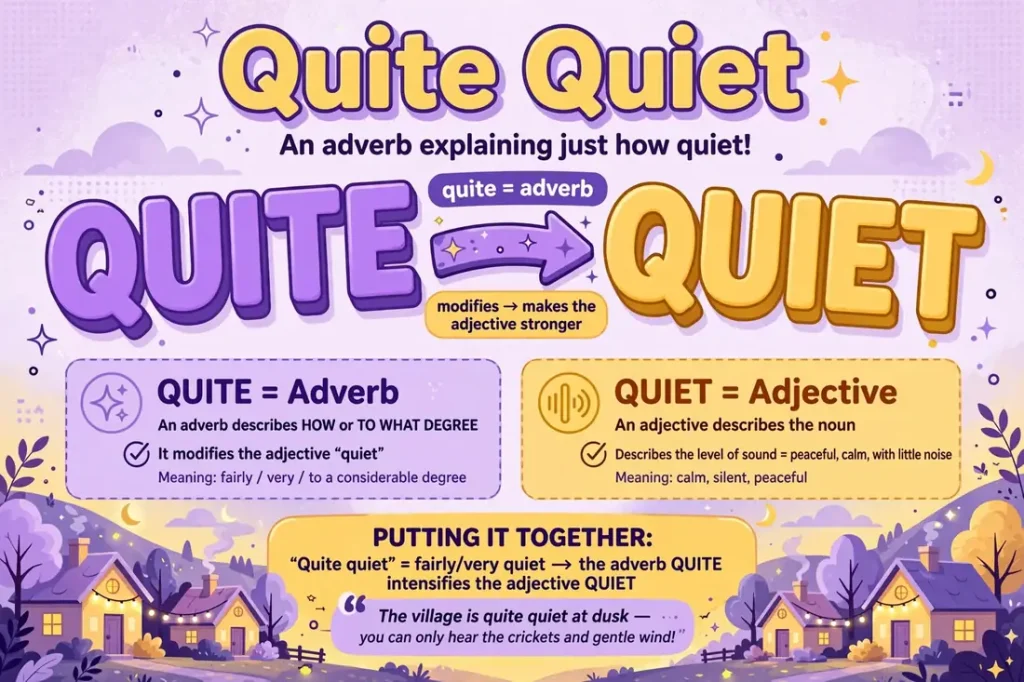
Quite Quiet: Can You Use Both Words Together?
Yes. Quite quiet is grammatically correct.
In this phrase, quite is an adverb that modifies quiet, an adjective. It describes the degree of silence or calm.
Examples:
The phrase may mean “fairly quiet” or “very quiet,” depending on context and regional usage.
Do not confuse quite quiet with quiet quite. The standard word order places the adverb before the adjective.
Quite and Quiet in American and British English
Both words are used in American and British English. Their spelling does not change between these varieties.
However, the meaning of quite can vary by context and regional convention.
Quite in British English
In British English, quite can mean either “fairly” or “completely.” Context helps determine the intended meaning.
For example:
Quite in American English
American English also uses quite to mean “fairly,” “rather,” or “completely.” In everyday speech, Americans may prefer words such as pretty or very in some informal contexts.
Examples:
Quiet in Both Varieties
Quiet has the same spelling and basic meaning in American and British English.
Examples:
The difference between the words is grammatical and semantic, not regional.
Examples in Sentences: Quite vs. Quiet
These examples show how each word works in everyday situations.
Examples Using Quite
Examples Using Quiet
Common Mistakes With Quite and Quiet
These words are often confused because their spellings differ by only one letter. Their meanings and grammatical roles are not the same.
Mistake 1: Using Quiet Instead of Quite
Incorrect: The movie was quiet interesting.
Correct: The movie was quite interesting.
Use quite because it modifies the adjective interesting.
Mistake 2: Using Quite Instead of Quiet
Incorrect: Please be quite during the presentation.
Correct: Please be quiet during the presentation.
Use quiet because the sentence asks people to make little or no noise.
Mistake 3: Writing “Quite Place”
Incorrect: We found a quite place to study.
Correct: We found a quiet place to study.
The sentence needs an adjective describing the place.
Mistake 4: Writing “Quiet Good”
Incorrect: The food was quiet good.
Correct: The food was quite good.
The word quite modifies the adjective good.
Mistake 5: Confusing “Quite” With “Quietly”
Quietly is an adverb formed from quiet. It describes how an action happens.
By contrast, quite expresses degree:
– The room is quite quiet.
Quite, Quiet, and Quietly: What Is the Difference?
These three words are related in appearance, but they perform different jobs.
|
Word |
Part of speech |
Meaning |
Example |
|
Quite |
Adverb |
Fairly, rather, or completely |
The task is quite difficult. |
|
Quiet |
Usually adjective |
Making little noise; calm |
The room is quiet. |
|
Quietly |
Adverb |
In a quiet manner |
She spoke quietly. |
Remember that quite does not mean “in a quiet way.” That meaning belongs to quietly.
Compare:
– He spoke quite softly. Quite describes the degree of softness.
– He spoke quietly. Quietly describes how he spoke.
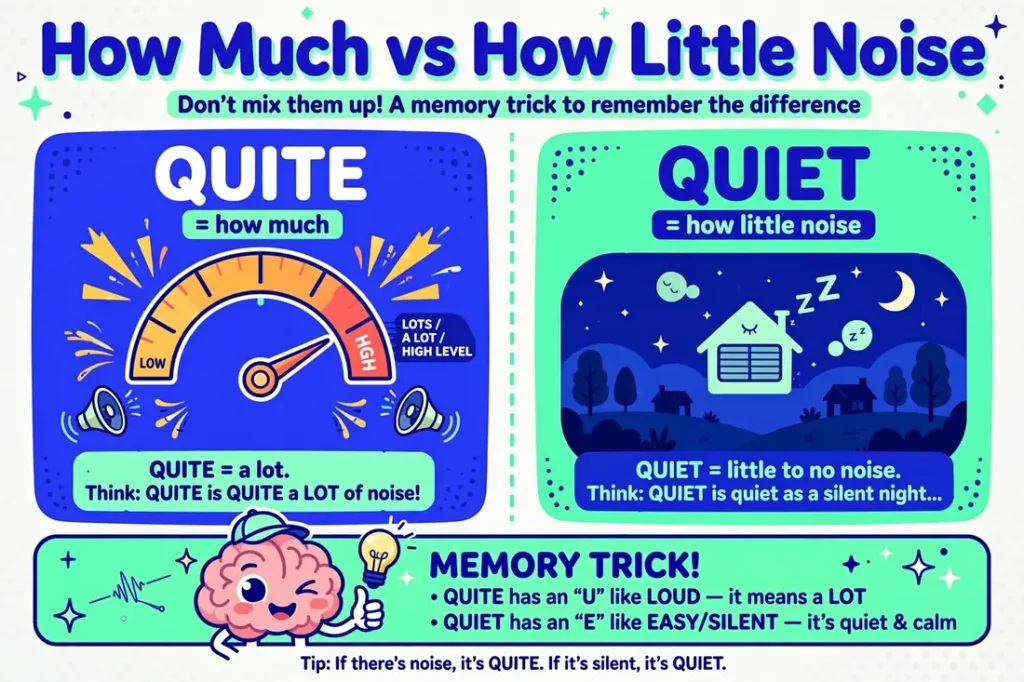
How to Remember the Difference
A simple memory trick can help you choose the correct word.
You can also use a quick substitution test.
If you can replace the word with fairly, rather, or completely, use quite.
If you can replace it with silent, peaceful, or not noisy, use quiet.
Frequently Asked Questions
Is quite or quiet correct?
Both words are correct, but they have different meanings. Quite expresses degree, while quiet describes something with little noise or activity.
Is it quite good or quiet good?
Quite good is correct. Quite modifies the adjective good. The phrase quiet good is incorrect in standard English.
Does quite mean very?
Sometimes. Quite can mean “very” or “completely,” but it can also mean “fairly” or “rather.” The exact meaning depends on context and regional usage.
Is quiet an adjective or an adverb?
Quiet is usually an adjective, as in “a quiet room.” It can also function as a noun or verb. The adverb form is quietly.
What does quite quiet mean?
“Quite quiet” means fairly or very quiet. Quite modifies quiet and expresses the degree of silence or calm.
How do you spell quiet and quite?
Both spellings are correct. Quiet means silent or calm. Quite means fairly, rather, or completely. The letters are arranged differently, so check the meaning before choosing.
Conclusion
Quite and quiet are not interchangeable. Use quite to describe the degree of a quality, such as “quite interesting.” Use quiet to describe a calm or silent person, place, or situation.
Remember: quite means how much, while quiet means how little noise.