Blond or Blonde: Which Spelling Is Correct?
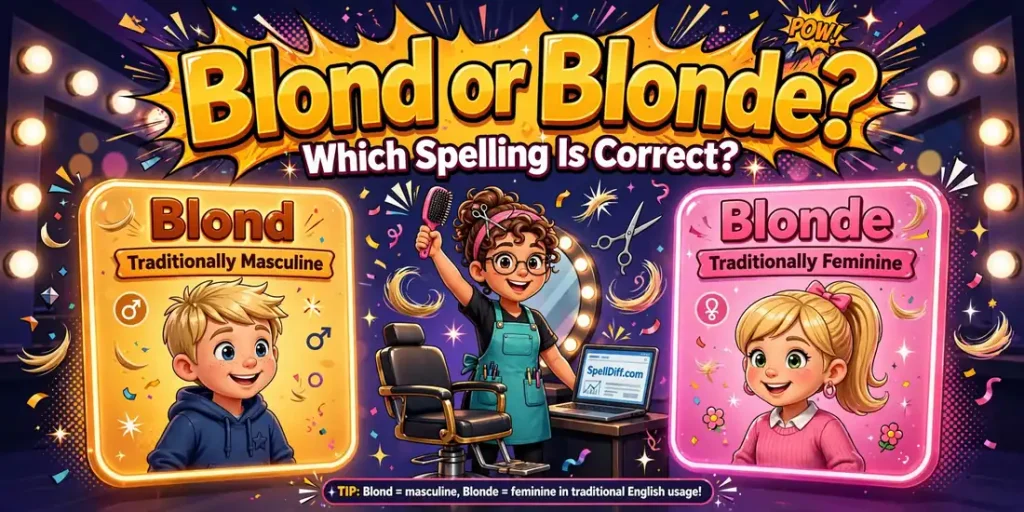
Blond and blonde are both correct spellings. They describe light-colored hair or someone who has that hair color. Traditionally, blond refers to men and blonde refers to women. However, modern English does not always follow this distinction. In American English, blond is often used for any gender, while blonde remains common when describing women.
The best choice depends on the sentence, your audience, and the style you follow.
Quick Answer
Examples:
Blond vs. Blonde: Quick Facts
|
Feature |
Blond |
Blonde |
|
Correct spelling |
Yes |
Yes |
|
Main meaning |
Light-colored or fair |
Light-colored or fair |
|
Traditional use |
Men and boys |
Women and girls |
|
Gender-neutral use |
Common, especially in American English |
Less common |
|
Part of speech |
Adjective and noun |
Adjective and noun |
|
Pronunciation |
Same as blonde |
Same as blond |
|
Describes hair |
Yes |
Yes |
|
Describes wood or other objects |
Common |
Used in some established terms |
|
Example |
He is blond. |
She is blonde. |
What Does Blond Mean?
Blond describes hair that is light in color, usually pale yellow, golden, or light brown. It can also describe a person with that hair color.
The word functions as both an adjective and a noun.
Blond as an Adjective
An adjective describes a person, object, or quality. Use blond before a noun or after a linking verb to describe light-colored hair.
Examples:
In American English, blond is often used as the adjective for any gender.
For example, both of these are acceptable:
The first uses a gender-neutral spelling. The second follows the traditional feminine form.
Blond as a Noun
Blond can also refer to a person with light-colored hair. Traditionally, it refers to a man or boy.
Examples:
However, describing someone by hair color alone may sound impersonal. In many contexts, it is more respectful and natural to say a man with blond hair or a person with blond hair.
What Does Blonde Mean?
Blonde has the same basic meaning as blond. It describes light-colored hair or a person with that hair color.
Traditionally, it is the feminine form. It is commonly used for women and girls.
Like blond, blonde can function as an adjective or a noun.
Blonde as an Adjective
Use blonde to describe a woman’s or girl’s light-colored hair when following the traditional distinction.
Examples:
The spelling blonde is widely accepted in these sentences. You may also see blond used for women, especially in American English.
Blonde as a Noun
Blonde can refer to a woman or girl with light-colored hair.
Examples:
Although this noun is established, it can sound reductive. It identifies a woman by her appearance rather than her name or role.
For a more neutral sentence, write:
The woman with blonde hair is waiting near the entrance.
This wording focuses on the person rather than treating hair color as her identity.
What Is the Difference Between Blond and Blonde?
The main difference is the traditional gender distinction. Blond is traditionally masculine, while blonde is traditionally feminine.
However, English usage varies. Many American writers use blond as a gender-neutral adjective. Other writers preserve the traditional distinction.
|
Usage |
Blond |
Blonde |
|
Describing a man’s hair |
Traditional choice |
Also used |
|
Describing a woman’s hair |
Accepted, especially in American English |
Traditional and common choice |
|
Describing a boy’s hair |
Traditional choice |
Also used in some contexts |
|
Describing a girl’s hair |
Accepted, especially in American English |
Traditional and common choice |
|
Describing a person’s hair without specifying gender |
Common choice |
Possible, but less neutral |
|
Describing light-colored wood |
Common |
Less usual |
|
Referring to a person as a noun |
Traditionally masculine or gender-neutral |
Traditionally feminine |
The difference is not always strict. Modern English allows variation, especially when blond describes hair rather than a person.
Should You Write Blond Hair or Blonde Hair?
Both blond hair and blonde hair are correct. The choice depends on your preferred style and the person being described.
Traditionally:
In American English, blond hair is often used regardless of gender.
Examples:
If you want to follow a gender-neutral style, blond hair works for anyone. If you prefer the traditional distinction, use blonde hair for women and girls.
The most important point is consistency. Choose a style that fits your publication and apply it throughout your writing.
Blond or Blonde in American English
American English often uses blond as a gender-neutral spelling. This means you may see it describing men, women, and children.
Examples:
The spelling blonde remains common for women, particularly when used as a noun.
For example:
She is a natural blonde.
American writers may also choose blond in that sentence:
She is a natural blond.
Both forms are used, although blonde is a familiar traditional choice for a woman.
Blond or Blonde in British English
British English has traditionally maintained the distinction between blond and blonde more clearly.
Examples:
However, British usage is not completely fixed. Both spellings may appear in broader contexts, and blonde can sometimes be used for men or boys.
Therefore, it is better to describe the distinction as a traditional preference rather than an absolute grammar rule.
Is Blond or Blonde Used for Objects?
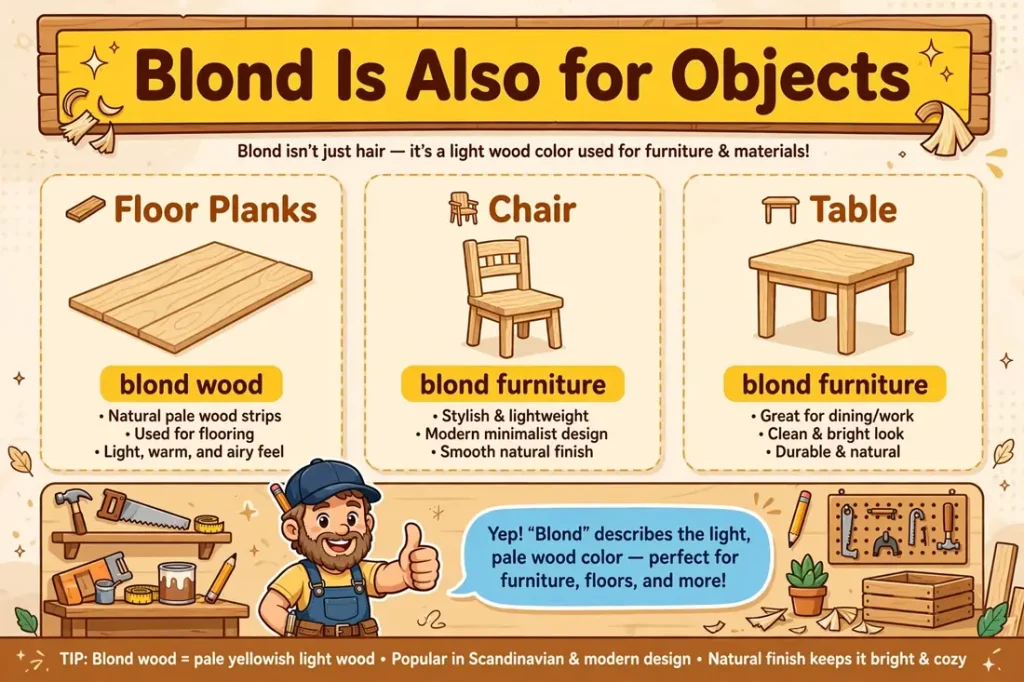
When describing objects, blond is generally the preferred spelling. It can refer to a light color in wood, furniture, or other materials.
Examples:
However, blonde appears in some established names and expressions.
Examples include:
These uses do not follow a strict rule about the gender of a person. They are conventional terms for particular products, styles, or colors.
For ordinary descriptions of wood or furniture, blond is the clearer choice.
Blond and Blonde in Different Hair Colors
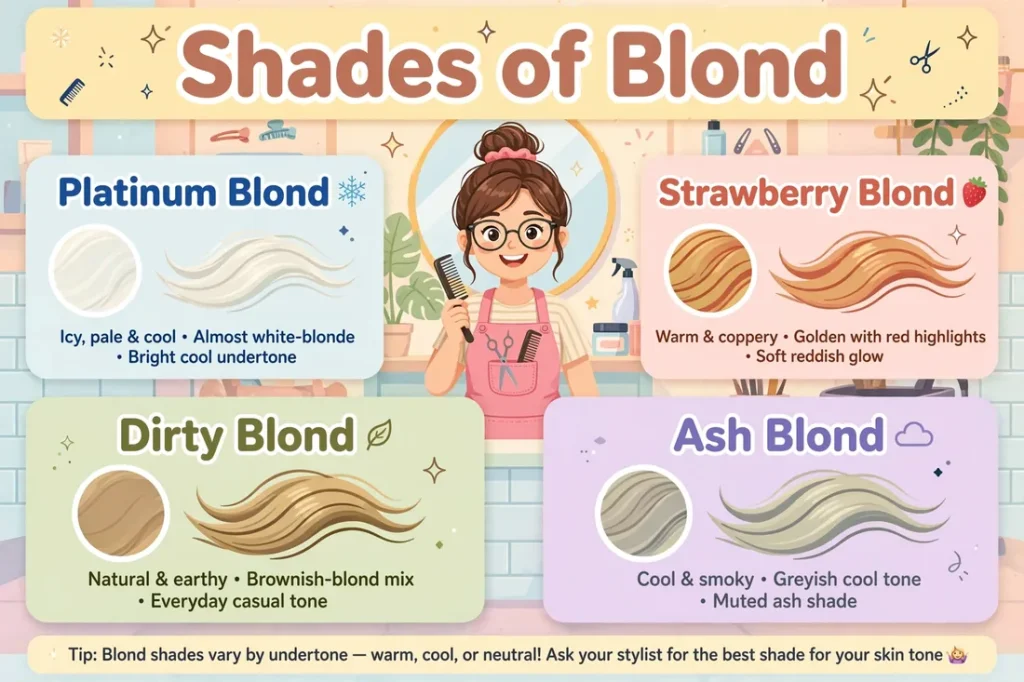
The words blond and blonde can describe several shades. They do not refer to only one exact color.
Hair described as blond or blonde may range from pale yellow to darker golden shades.
Platinum Blond or Platinum Blonde
Platinum hair is extremely light, often close to white or silver.
Examples:
Both spellings are used.
Strawberry Blond or Strawberry Blonde
Strawberry blond describes a light hair color with reddish or copper tones.
Examples:
The spelling may follow the traditional gender distinction or a publication’s style.
Dirty Blond or Dirty Blonde
Dirty blond describes a darker shade of blond, often with brown or muted tones.
Examples:
Both forms are used in modern English.
Ash Blond or Ash Blonde
Ash blond describes a cooler, muted shade without strong golden or red tones.
Examples:
Again, both spellings can appear.
Examples of Blond and Blonde in Sentences
These examples show how each spelling works in everyday writing.
Examples With Blond
Examples With Blonde
Examples Where Both Forms Are Acceptable
The preferred form may depend on the region, style guide, or writer’s preference. The meaning remains the same.
Common Mistakes With Blond and Blonde
1. Assuming Blonde Is Always Wrong for Men
Some writers follow the traditional distinction and reserve blonde for women. However, modern English does not always maintain this rule.
You may see blonde hair used for a man, especially in informal writing or publications that use the spelling broadly.
For consistency, follow your chosen style guide.
2. Assuming Blond Can Only Describe Men
This is also incorrect. Blond is commonly used as a gender-neutral adjective, especially in American English.
For example:
The woman has blond hair.
This sentence is correct.
3. Using Blonde for Every Light-Colored Object
When describing wood or furniture, blond is generally preferred.
Less usual: The room has blonde wood floors.
Common: The room has blond wood floors.
Some product names use blonde, but ordinary descriptions usually use blond.
4. Treating the Words as Different Hair Colors
Blond and blonde do not describe separate shades. The final e does not make the hair lighter, darker, or more golden.
Both can describe pale yellow, golden, or light brown hair.
5. Using Blonde as a Label When It Is Unnecessary
Calling someone “a blonde” is grammatically possible. However, it may reduce the person to their appearance.
Instead of:
A blonde is waiting outside.
You could write:
A woman with blonde hair is waiting outside.
The second sentence is more specific and person-focused.
How to Remember Blond or Blonde
Use the traditional distinction as a memory aid:
For modern American English, remember that blond is also widely used as a neutral spelling.
When describing objects, blond is usually the better choice:
When describing a woman, blonde is a familiar traditional choice:
If you are writing for a particular publication, follow its style guide. Consistency is more important than applying a gender distinction that English does not always maintain.
Frequently Asked Questions
Is Blond or Blonde Correct?
Both are correct. Traditionally, blond refers to men and boys, while blonde refers to women and girls. Modern English often uses blond as a gender-neutral adjective, especially in American English.
Is Blonde Only for Females?
No. Blonde is traditionally feminine, but English usage is not completely strict. Some writers use it for men and boys too. The spelling blond is often preferred when a gender-neutral form is needed.
Should I Write Blonde Hair or Blond Hair?
Both are correct. Blonde hair traditionally describes a woman’s or girl’s hair. Blond hair is common for men and can also be used for any gender, particularly in American English.
Is It Blond or Blonde in American English?
American English often prefers blond as a gender-neutral spelling. However, blonde remains common when describing women or referring to a woman as a noun.
Is Blond or Blonde Used for Wood?
Use blond for light-colored wood in ordinary descriptions. For example, “The table is made from blond oak.” Some established product names may use blonde, but blond wood is the usual form.
Do Blond and Blonde Have the Same Pronunciation?
Yes. Both are pronounced the same way. The final e in blonde does not create an extra sound or syllable.
Conclusion
Blond and blonde are both correct spellings for light-colored hair. The traditional distinction uses blond for men and blonde for women. However, modern English often uses blond for any gender, especially in American writing. Use blond for neutral descriptions and objects such as wood. Choose blonde when following the traditional feminine form or an established expression. Most importantly, keep your spelling consistent.