Valentines or Valentine’s: Correct Spelling? (Examples)
Put valentines and valentine’s next to each other and they look almost identical, yet they do completely different jobs. Valentines is a plural noun — it means more than one Valentine card or greeting. Valentine’s is the possessive form — it shows something belongs to or is connected with a valentine, most famously in the holiday’s name: Valentine’s Day.
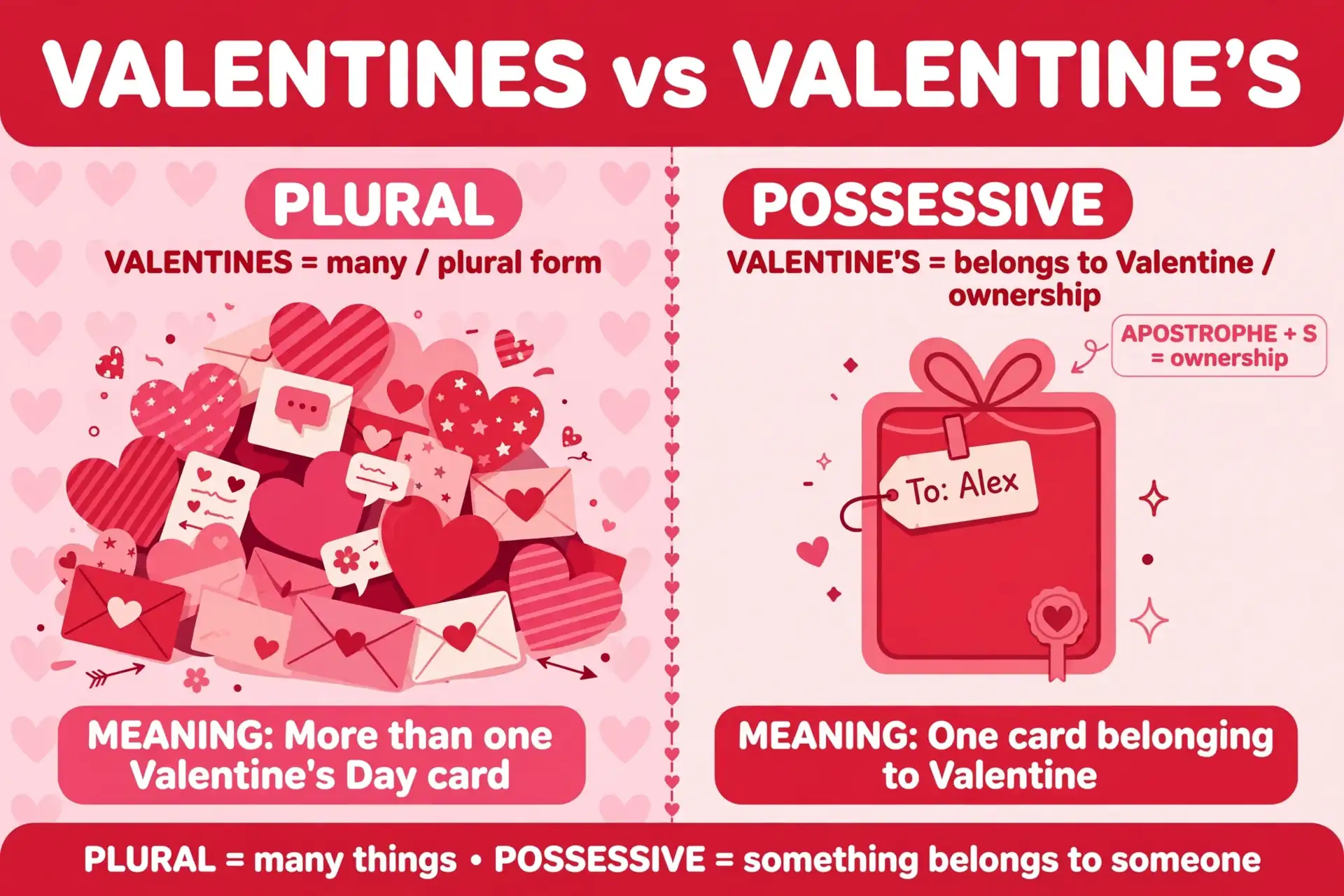
Table of Contents
Quick Answer
| Word | Part of Speech | Main Meaning | Example |
|---|---|---|---|
| valentines | plural noun | more than one Valentine card or sweetheart | She gave valentines to everyone in class. |
| valentine’s | possessive form | belonging to or associated with a valentine | We stayed home on Valentine’s Day. |
Simple rule: if you mean more than one card, write valentines with no apostrophe; if you could say “of the valentine” or you are naming the holiday, write valentine’s with the apostrophe.
What Does Valentines Mean?
Valentines is simply the plural of valentine — a card, note, or small gift exchanged on February 14th. A valentine can also mean a sweetheart or a person chosen as one’s valentine, so valentines can mean several sweethearts too. No apostrophe is ever needed to make this plural; the -s ending does all the work.
One capitalization note: as the plural of the proper noun Valentine — the saint and the card tradition named for him — valentines usually keeps its capital V in edited writing, though the lowercase form is common in casual messages and texts.
Examples:
- The children decorated a shoebox to collect their valentines at school.
- He buys handmade valentines from the craft fair every February.
- Her desk was covered in valentines from secret admirers.
- They first met as each other’s valentines at a college dance.
- Grandma still keeps the valentines her late husband sent her.
What Does Valentine’s Mean?
Valentine’s is the possessive form of valentine — it points to something belonging to or linked with a valentine. In practice, you will meet it almost exclusively inside the holiday’s name, Valentine’s Day, which is short for “the day of Saint Valentine.” Merriam-Webster defines valentine as a sweetheart chosen on Valentine’s Day, and the apostrophe simply turns that noun into its possessive.
Examples:
- Restaurants are fully booked on Valentine’s Day.
- She wore a red dress to the Valentine’s dinner party.
- Valentine’s week is the busiest time of year for florists.
- He forgot his valentine’s gift and had to improvise.
- The store’s Valentine’s display went up in mid-January.
Valentines vs. Valentine’s: Key Differences
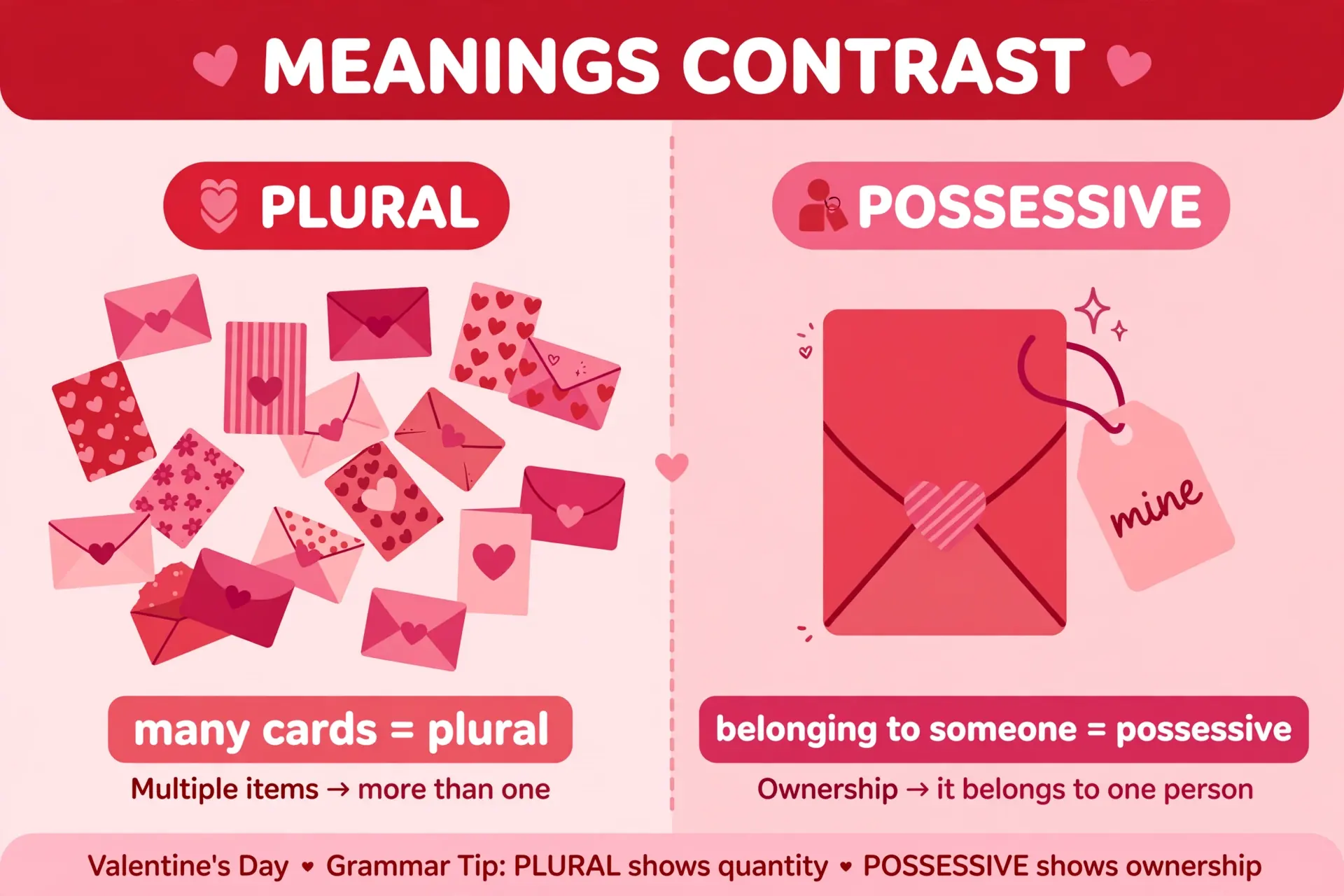
| Feature | valentines | valentine’s |
|---|---|---|
| Job in the sentence | names more than one thing | shows ownership or association |
| Apostrophe | never takes one | always has one |
| Meaning | multiple cards or sweethearts | of / belonging to a valentine |
| Most common use | classroom card exchanges | the holiday name, Valentine’s Day |
| Can be singular? | no — it is plural by definition | yes — it modifies a singular noun |
| Pronunciation | identical to valentine’s | identical to valentines |
The two are homophones, so your ear cannot help you — only the spelling tells the reader whether you mean many cards or something belonging to a valentine.
Usage in Real Sentences
At Home
Valentines: “Mom helped the kids sign all their valentines before bedtime.”
Valentine’s: “Dad planned a quiet Valentine’s breakfast with pancakes.”
The first counts physical cards; the second names the holiday morning.
At Work
Valentines: “Our team sent valentines to every client on the list.”
Valentine’s: “The Valentine’s marketing campaign doubled last year’s sales.”
One describes items mailed out, the other describes a campaign tied to the holiday.
In Conversation
Valentines: “Did you get many valentines this year?”
Valentine’s: “Are you doing anything special for Valentine’s?”
The question about “many” needs the plural; the question about the occasion needs the possessive.
While Shopping
Valentines: “The store put all its leftover valentines on clearance on February 15th.”
Valentine’s: “Valentine’s sales account for a huge share of February revenue.”
The discounted cards on the shelf are plural; the sales event belongs to the holiday itself.
Common Mistakes
Apostrophe errors are among the most stubborn in English — the same confusion trips people up with pairs like loose or lose and whose or who’s. Here is how it plays out with these two words.
Mistake 1: Adding an apostrophe to the plural
❌ “The teacher collected the student’s valentine’s.”
✅ “The teacher collected the students’ valentines.”
Why: plurals never take an apostrophe on their own — the -s ending is enough.
Mistake 2: Dropping the apostrophe from the holiday
❌ “Happy Valentines Day!”
✅ “Happy Valentine’s Day!”
Why: the holiday is “the day of Saint Valentine,” so the possessive apostrophe belongs there.
Mistake 3: Using the possessive for multiple cards
❌ “She received three valentine’s from admirers.”
✅ “She received three valentines from admirers.”
Why: three of something calls for the plain plural, not the possessive.
Mistake 4: Lowercasing the holiday
❌ “We met on valentine’s day.”
✅ “We met on Valentine’s Day.”
Why: as a proper holiday name it takes a capital V either way you spell the occasion.
Pronunciation
Both words sound exactly the same: VAL-un-tynz. The apostrophe is completely silent, which is why this mix-up is a spelling problem rather than a speaking one. They rhyme with wines, entwines, and defines.
How to Remember the Difference
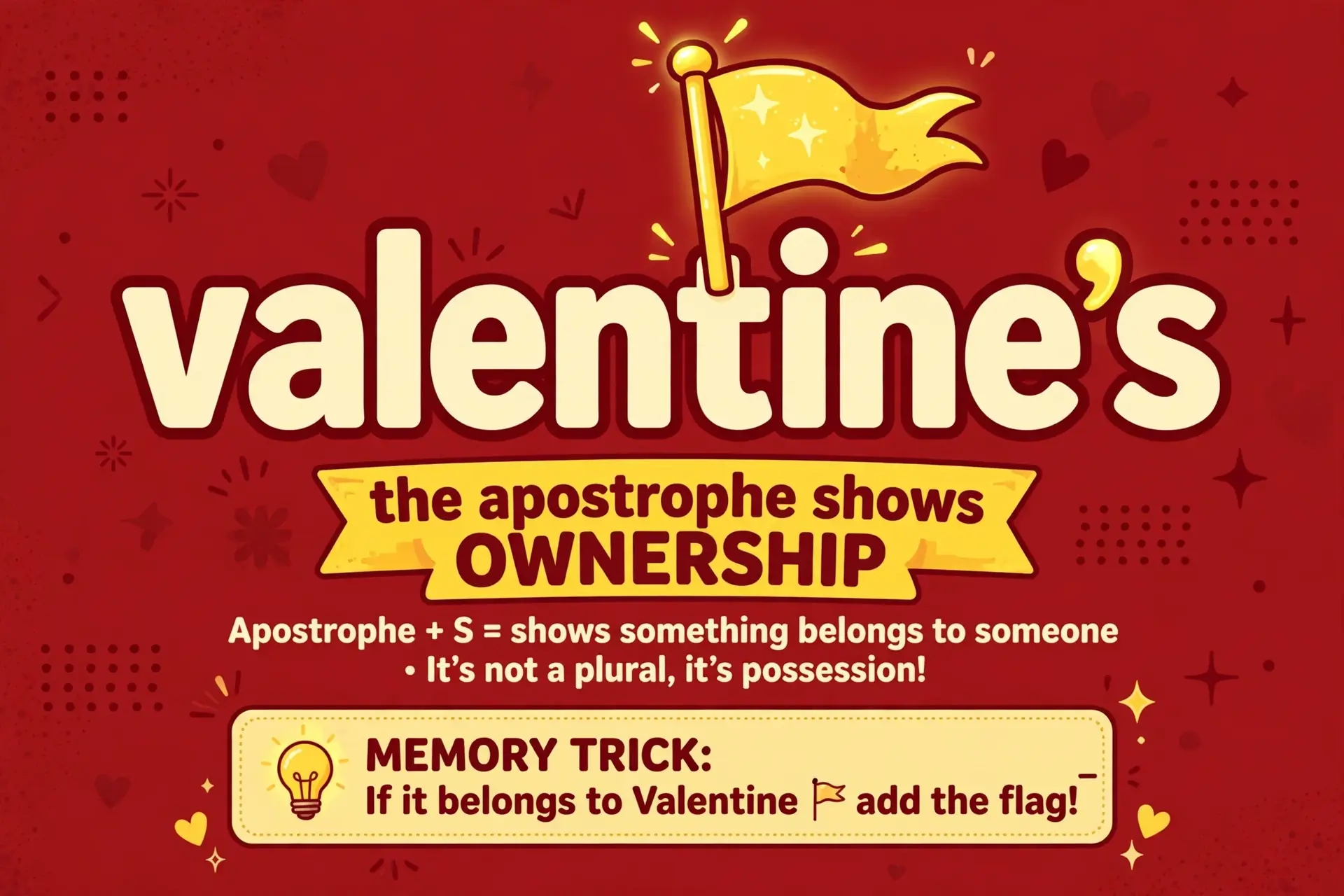
Picture the apostrophe as a tiny hand holding something — valentine’s is holding the Day, the gift, or the dinner that belongs to it. No hand, no holding: valentines is just a plain pile of cards. Or shorter: apostrophe = ownership.
- valentines — many cards, no apostrophe, ends in plain -s
- valentine’s — the holiday or something belonging to a valentine, apostrophe before the s
- If you can say “of the valentine,” use the apostrophe; if you can count them, don’t
FAQ
Is it Valentines Day or Valentine’s Day?
It is Valentine’s Day, with the apostrophe — the day belongs to Saint Valentine, and every major style guide agrees on the possessive. “Valentines Day” without the apostrophe is one of the most common February errors in print.
Is it valentines or valentine’s when I mean several cards?
Use valentines. Multiple cards take the plain plural with no apostrophe — the -s ending already does the pluralizing work, and adding an apostrophe turns a simple plural into a possessive that makes no sense.
Can valentine’s ever refer to more than one card?
No. Valentine’s is possessive, never plural — it always points to something belonging to or connected with a valentine, like the Day, a gift, or a dinner. If you can count the items, you need the plural valentines instead.
Why is the holiday called Valentine’s Day?
The name honors Saint Valentine, so the possessive marks it as his day — literally “the day of Saint Valentine.” Over the centuries it became the fixed name of the February 14th holiday, which is why the apostrophe survives even though most people no longer think of the saint.
Is “valentines” ever used for people?
Yes — a valentine can mean a sweetheart or the person chosen as one’s valentine, so valentines can mean several sweethearts (“they were childhood valentines”). The card meaning is far more common in everyday use, though.
Conclusion
Remember the tiny hand: valentine’s holds something that belongs to it, most often the Day itself, while valentines is simply a stack of cards with no apostrophe in sight. Get that distinction right and your February writing will never look sloppy again.