Momma or Mama: What’s the Difference? (With Examples)
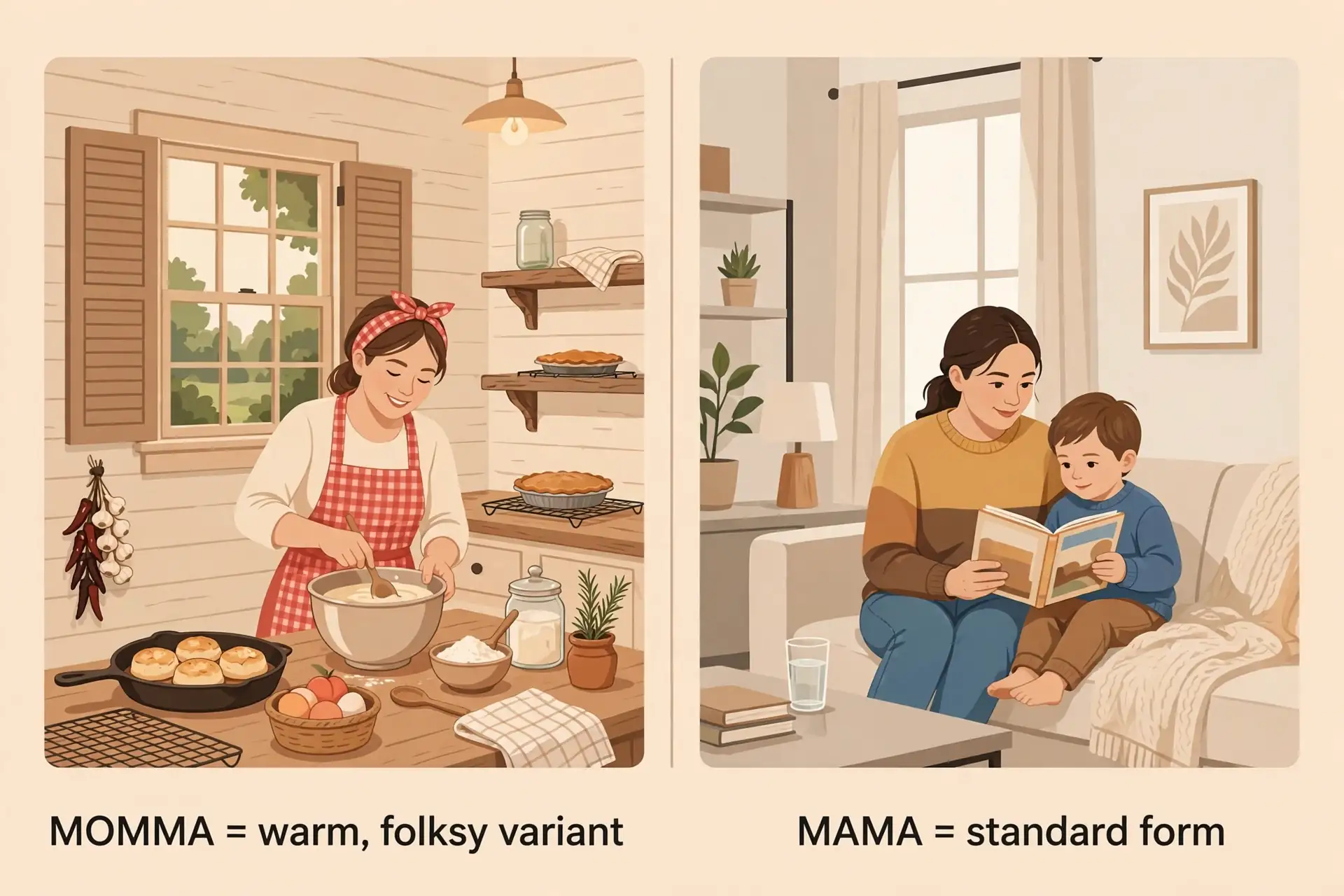
Both momma and mama are correct, affectionate ways to say “mother” — neither is a misspelling. Mama is the more standard, widely used form, while momma is a warmer, folksier variant especially common in the American South. You might hear “Mama said dinner is ready” in one house and “Momma made her famous pie” in another.
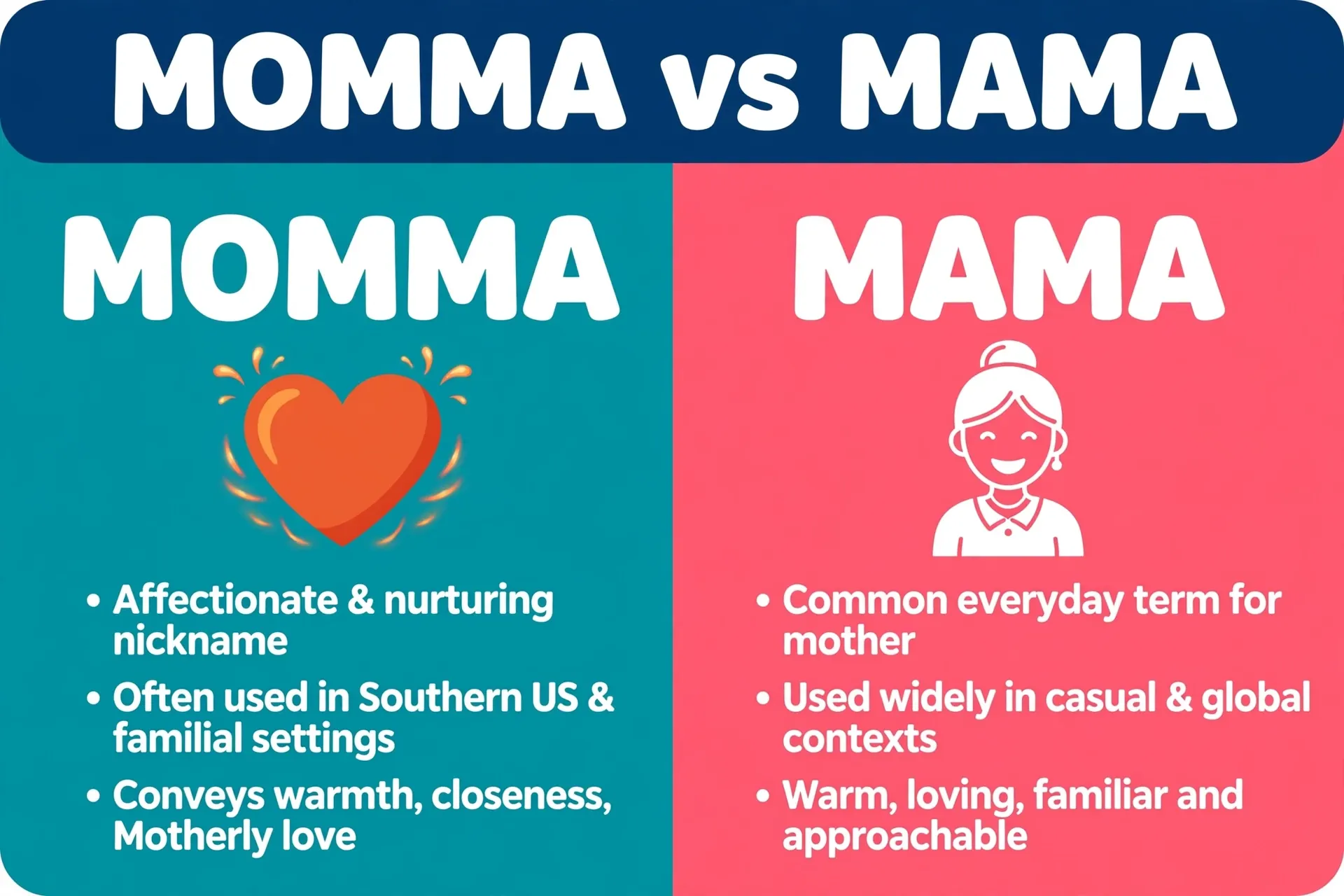
Table of Contents
Quick Answer
| Word | Part of Speech | Main Meaning | Example |
|---|---|---|---|
| Mama | Noun (informal) | Mother; the standard informal form | “Mama packed my lunch this morning.” |
| Momma | Noun (informal) | Mother; a warm, regional variant | “Momma always knows when I am upset.” |
Simple rule: mama works everywhere; momma adds extra warmth and a folksy, Southern flavor.
What Does “Mama” Mean?
Mama is the standard informal word for “mother,” used by children and adults alike across the English-speaking world. It appears in everyday speech, songs, and writing, and it is the spelling most dictionaries list first. See Merriam-Webster’s definition of mama for the standard entry.
Examples:
- Mama packed my lunch this morning.
- The baby said “mama” for the first time yesterday.
- I called Mama to wish her a happy birthday.
- Mama’s lasagna is the best thing I have ever tasted.
- She ran to her mama after scoring the goal.
What Does “Momma” Mean?
Momma means exactly the same thing as “mama” — it is simply a warmer, more folksy spelling of “mother,” strongly associated with the American South and with close, affectionate family talk. Writers often choose it to give dialogue a homespun, tender voice.
Examples:
- Momma always knows when I am upset.
- We spent Sunday afternoon at Momma’s house.
- “Momma, can you help me with my homework?”
- Momma’s fried chicken drew the whole family to the table.
- He still calls his grandmother Momma out of love.
Momma vs. Mama: Key Differences
| Feature | Mama | Momma |
|---|---|---|
| Correctness | Fully standard | Fully correct, informal |
| Tone | Warm and familiar | Extra warm, folksy, tender |
| Regional feel | Used everywhere | Strong American South association |
| Formality | Acceptable in most informal writing | Best for dialogue and personal writing |
| Dictionary status | Listed as the main entry | Listed as a variant |
| Common mix-up | None — the safe default | Mistaken for a misspelling |
The meaning is identical; the difference is purely flavor. Mama is the plain white T-shirt, momma is the same shirt with a warm hug stitched in.
Momma and Mama in Real Sentences
At Home
Mama: “Mama asked us to set the table before dinner.”
Momma: “Momma tucked the blanket around me and kissed my forehead.”
Both work at home; momma just leans into the tenderness of the moment.
In Conversation
Mama: “I told Mama about the promotion, and she cried happy tears.”
Momma: “My momma would say, ‘Baby, you did your best, and that is enough.'”
In quoted speech, momma signals a specific voice and upbringing, while mama sounds neutral and universal.
In Texts and Letters
Mama: “Texted Mama the photos from the trip.”
Momma: “Wrote Momma a long letter for Mother’s Day.”
Personal writing favors whichever spelling the family actually uses — consistency with your own family matters more than any rule.
In Music and Pop Culture
Mama: “The song ‘Mama’ by the Spice Girls became a Mother’s Day anthem.”
Momma: “Countless country songs open with ‘Momma’ to set a Southern, homespun scene.”
Songwriters pick momma when they want that down-home warmth and mama when they want broad, universal appeal.
Common Mistakes with Momma and Mama
Since both spellings are correct, the mistakes here are about judgment, not spelling — the same kind of careful choice needed for other tricky pairs like “whose or who’s” and “desert or dessert”.
Mistake 1: “Correcting” momma to mama
❌ Crossing out “momma” in someone’s writing as a typo.
✅ Leaving “momma” alone — it is a recognized variant.
Why: momma is a legitimate spelling, not an error; “fixing” it changes the writer’s intended tone.
Mistake 2: Using momma in formal writing
❌ “The momma of the patient signed the consent form.”
✅ “The mother of the patient signed the consent form.”
Why: formal documents call for “mother”; both momma and mama are too casual for legal or medical paperwork.
Mistake 3: Lowercasing it as a name
❌ “I asked momma for advice.” (when Momma is used as her name)
✅ “I asked Momma for advice.”
Why: when Momma or Mama replaces her name directly, capitalize it, just like you would with “Dad” or “Grandma.”
Mistake 4: Mixing spellings in one piece
❌ “Mama called this morning. Momma sounded tired.”
✅ “Mama called this morning. Mama sounded tired.”
Why: pick one spelling per piece of writing and stick with it, the way you would with any stylistic choice.
Pronunciation
Mama and momma are usually pronounced the same way: “MAH-muh.” Mama rhymes with “drama” and “llama”; momma rhymes with “comma” and “drama.” In most accents you cannot hear any difference between them at all.

How to Remember the Difference
MAMA is the plAin, stAndard spelling — A’s all the way through. MOMMA swaps in an O like hOme: the warmer, homier variant.
- Mama = stAndard, safe everywhere
- Momma = hOme-style warmth, Southern flavor
- Same meaning, same pronunciation — only the feeling changes
Frequently Asked Questions
Is it momma or mama?
Both are correct. Mama is the standard spelling used everywhere; momma is a warm, informal variant.
Is momma a misspelling of mama?
No. Momma is a recognized variant spelling of “mother,” especially common in Southern American English.
Which is more common?
Mama is far more common in print and worldwide usage. Momma appears mostly in dialogue, song lyrics, and personal writing.
Can adults say momma?
Absolutely. Plenty of adults call their mothers Momma or Mama — it is a term of affection, not an age marker.
Should I capitalize Momma?
Capitalize it when it stands in for her name (“Ask Momma”), and use lowercase when it follows “my” or “the” (“my momma called”).
What is the plural?
The plurals follow the same pattern: mamas and mommas, as in “The mamas at the park chatted while the kids played.”
Conclusion
Mama and momma say the same loving thing in slightly different voices. Reach for mama as the safe, standard default, and save momma for moments — and families — where the extra warmth belongs.