Calendar or Calender: What’s the Difference?
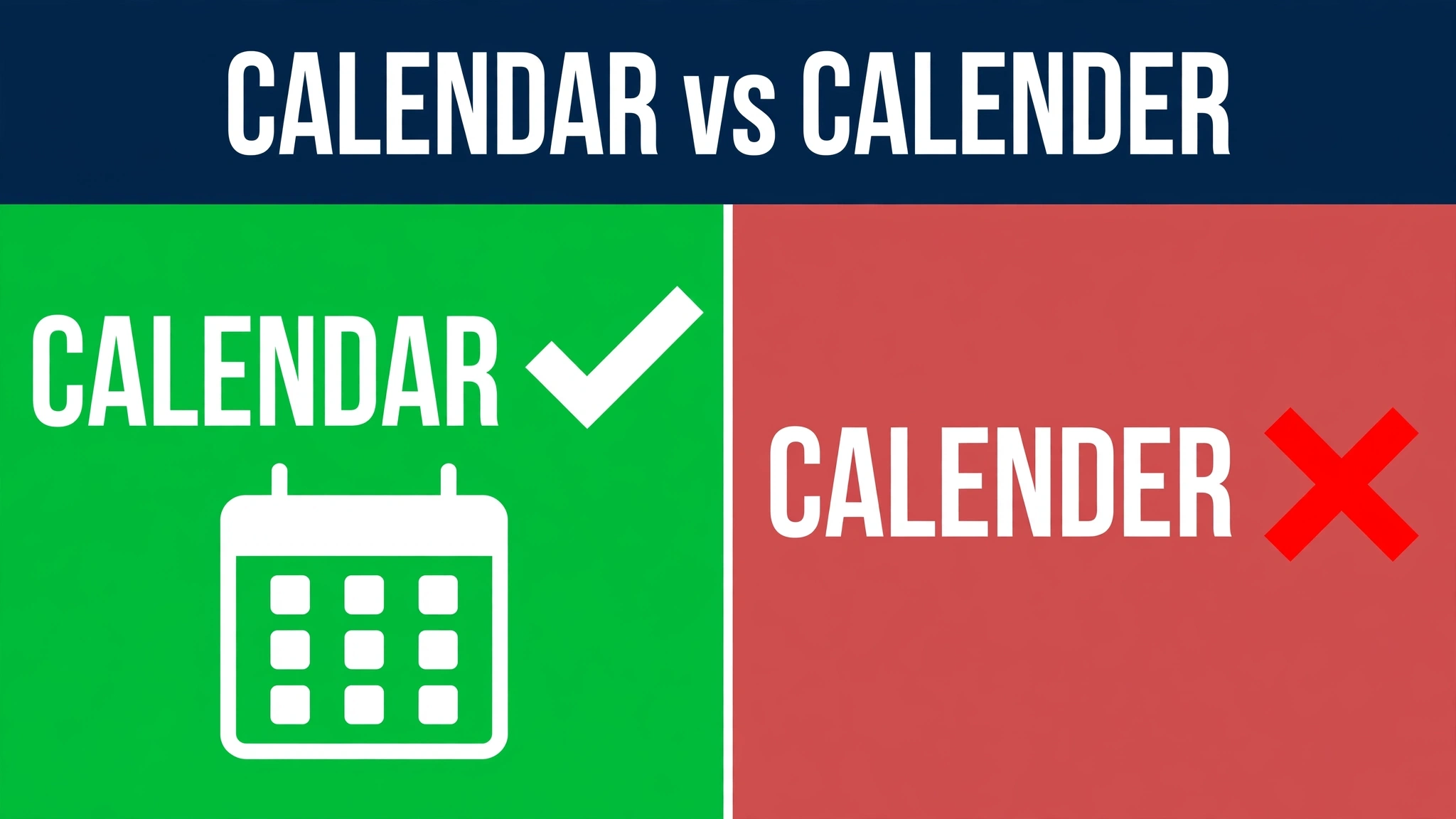
Calendar with an -ar ending is the chart of days and months you hang on the wall or check on your phone. Calender with an -er ending is almost always a misspelling — though it does exist as a rare word for an industrial pressing machine. For dates, appointments, and schedules, “calendar” is the only correct choice.
Quick Answer
| Word | Part of Speech | Main Meaning | Example |
|---|---|---|---|
| calendar | Noun (also verb) | A chart or system of days, weeks, and months; to schedule | ✅ “She marked the deadline on her calendar.” |
| calender | Noun (rare) | A machine that presses paper or cloth smooth with rollers | ✅ “The paper mill’s calender polished the sheets.” (but ❌ “Check the calender” for dates) |
Simple rule: If it involves dates, write calendar — the machine with an -er is a word you’ll likely never need.
What Does Calendar Mean?
Calendar is a noun meaning a chart showing the days, weeks, and months of a year — or the system behind it, like the Gregorian calendar the world runs on. It also covers your personal schedule: the calendar on your phone, a shared team calendar, an editorial calendar. As a verb, it means to schedule or enter into that system: “Let’s calendar a meeting for Thursday.”
Merriam-Webster’s entry for calendar lists the chart-of-days sense first, which matches how nearly everyone uses the word. Examples:
- “She marked the deadline on her wall calendar in red ink.”
- “The school calendar runs from September to June.”
- “Check the shared calendar before booking the conference room.”
- “Their wedding is on my calendar for next spring.”
- “The ancient Mayan calendar tracked cycles of hundreds of years.”
Calendar as a system
A calendar isn’t only the thing on your wall — it’s any system for organizing time. The Gregorian calendar replaced the Julian one in 1582, the lunar calendar sets the dates of Ramadan and Chinese New Year, and a fiscal calendar decides when a company’s year begins. The spelling never changes across these uses: always -ar.
Calendar as a verb
In offices, calendar works as a verb meaning to put something on the schedule. “I’ll calendar it” is shorthand for “I’ll add it to the calendar.” Like the noun, the verb is always spelled with -ar — “calender it” would send your invite to a paper-pressing machine.
What Does Calender Mean?
Calender is a real word, but a rare and technical one: a machine fitted with rollers that presses paper, cloth, or plastic smooth and glossy. Paper mills and textile factories use calenders; almost nobody else does. It comes from a different root than “calendar” and has nothing to do with dates.
Here’s the catch that confuses writers: in roughly 99% of everyday writing, “calender” appears as a misspelling of “calendar.” If your sentence is about appointments, holidays, or schedules, the -er spelling is wrong — full stop. Reserve “calender” for the factory floor.
Calendar vs. Calender: Key Differences
| Feature | calendar | calender |
|---|---|---|
| Ending | -ar | -er |
| Main meaning | Chart/system of days and months | Industrial pressing machine |
| Part of speech | Noun and verb | Noun only |
| How common | Everyday word | Rare, technical term |
| For dates | Always correct | Always a misspelling |
| Example | “Sync your calendar.” | “The calender smoothed the paper.” |
The spelling you need depends on the meaning you want: dates take -ar, factory rollers take -er — and since most writing is about dates, -ar wins almost every time.
Calendar and Calender in Real Sentences
At Home
✅ “The new calendar goes up on the fridge every January.”
Writing “calender” here would describe a pressing machine on your fridge — the -ar spelling is the one that hangs on walls.
At Work
✅ “She blocked two hours on her calendar for deep work.”
This is the most common real-world context, and it’s always “calendar”: schedules, invites, and deadlines never take the -er spelling.
In Conversation
✅ “‘Let me check my calendar and get back to you,’ he said.”
The spoken sentence sounds identical either way — the difference only shows up in writing, which is exactly why it trips people up.
At the Factory (the rare exception)
✅ “The mill’s calender gave the paper its glossy finish.”
This is the one context where -er is right: heavy rollers pressing material smooth. If your sentence isn’t about machinery, you don’t want this word.

Common Mistakes
The -ar/-er mix-up is one of English’s greatest hits — it drives the “loose” vs “lose” spelling confusion and the “desert” vs “dessert” spelling debate too. With calendar, the errors cluster around the unstressed final syllable, which sounds like “er” no matter how it’s spelled.
Mistake 1: Using -er for dates
❌ “Check the calender for Friday’s meeting.”
✅ “Check the calendar for Friday’s meeting.”
Why: Dates, appointments, and schedules always take calendar with -ar. The -er spelling names a machine, not a schedule.
Mistake 2: Trusting the sound
❌ “I’ll calender the dentist appointment.”
✅ “I’ll calendar the dentist appointment.”
Why: The final syllable sounds like “er” when spoken quickly, but the verb — like the noun — is spelled with -ar. Sound is a bad guide here.
Mistake 3: “Correcting” the right spelling
❌ “My calender app synced overnight.” (written by someone who “fixed” calendar)
✅ “My calendar app synced overnight.”
Why: Some writers assume -er because so many English words end that way. “Calendar” belongs to the smaller -ar family (grammar, dollar, popular) — memorize it as a group.
Mistake 4: Using “calendar” for the machine
❌ “The factory’s new calendar presses cotton smooth.”
✅ “The factory’s new calender presses cotton smooth.”
Why: This one runs the other direction: the pressing machine really is spelled calender with -er. Rare, but real.
Pronunciation
Calendar is pronounced “KAL-un-der” (/ˈkæl.ən.dər/) — stress on the first syllable, and the final syllable collapses to a quick “der” no matter how it’s spelled. That collapsed ending is precisely why people write “calender”: the ear hears -er, but the standard spelling is -ar. Calender (the machine) is pronounced the same way, which is no help at all — only the meaning tells them apart in speech, and only the spelling tells them apart in writing.
How to Remember the Difference
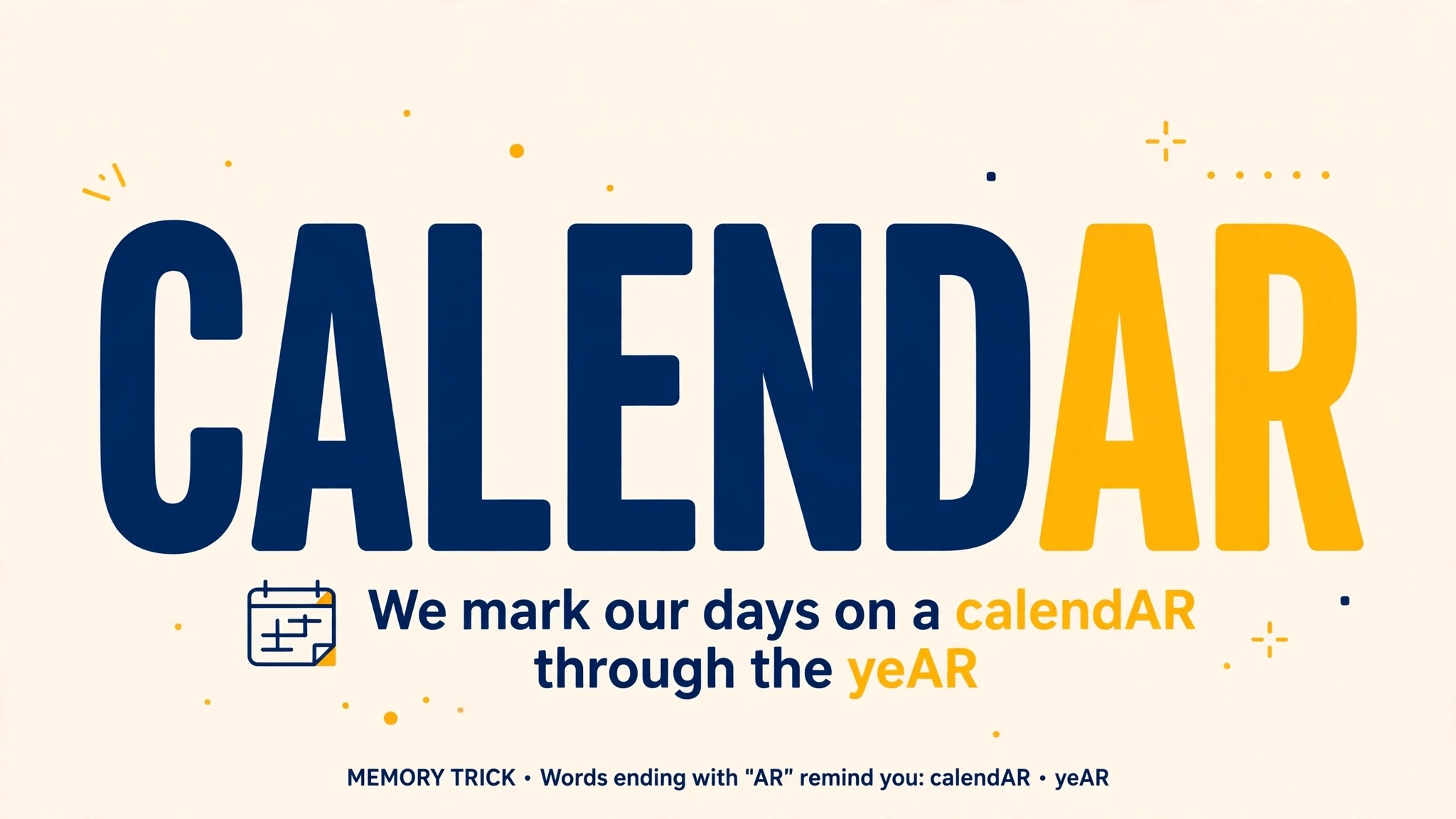
Think: we mark our days on a calendAR through the yeAR. The -AR ending echoes “year,” and a calendar is all about the year. The machine keeps the -ER.
- Dates = -AR: calendar, like year — appointments, holidays, schedules.
- Machine = -ER: calender, like roller — it literally contains rollers.
- -ar family: group it with grammar, dollar, and popular — common words that also end in -ar despite sounding like -er.
- Ask the meaning: if the sentence could swap in “schedule,” write “calendar”; if it could swap in “pressing machine,” write “calender.”
Frequently Asked Questions
Is it calendar or calender?
For dates and schedules, it’s calendar with -ar — always. “Calender” with -er is a misspelling in that context.
Is “calender” ever a real word?
Yes, but rarely: a calender is an industrial machine with rollers that presses paper or fabric smooth. Unless you’re writing about mills or factories, you don’t need it.
What is the plural of calendar?
Calendars — just add S. “She keeps separate calendars for work and family.”
How do you pronounce calendar?
“KAL-un-der,” with the stress on the first syllable. The ending sounds like “-der,” which is why the -er misspelling is so tempting.
Why do so many people write “calender”?
Two reasons: the unstressed final syllable genuinely sounds like “er,” and -er is a far more common English ending than -ar. The ear votes -er; the dictionary votes -ar, and the dictionary wins.
Conclusion
For anything involving dates, calendar with -ar is the only correct spelling. Calender with -er belongs to factory machinery — remember “a calendAR through the yeAR,” and the right ending will come naturally.