Referred or Refered: What’s the Difference?
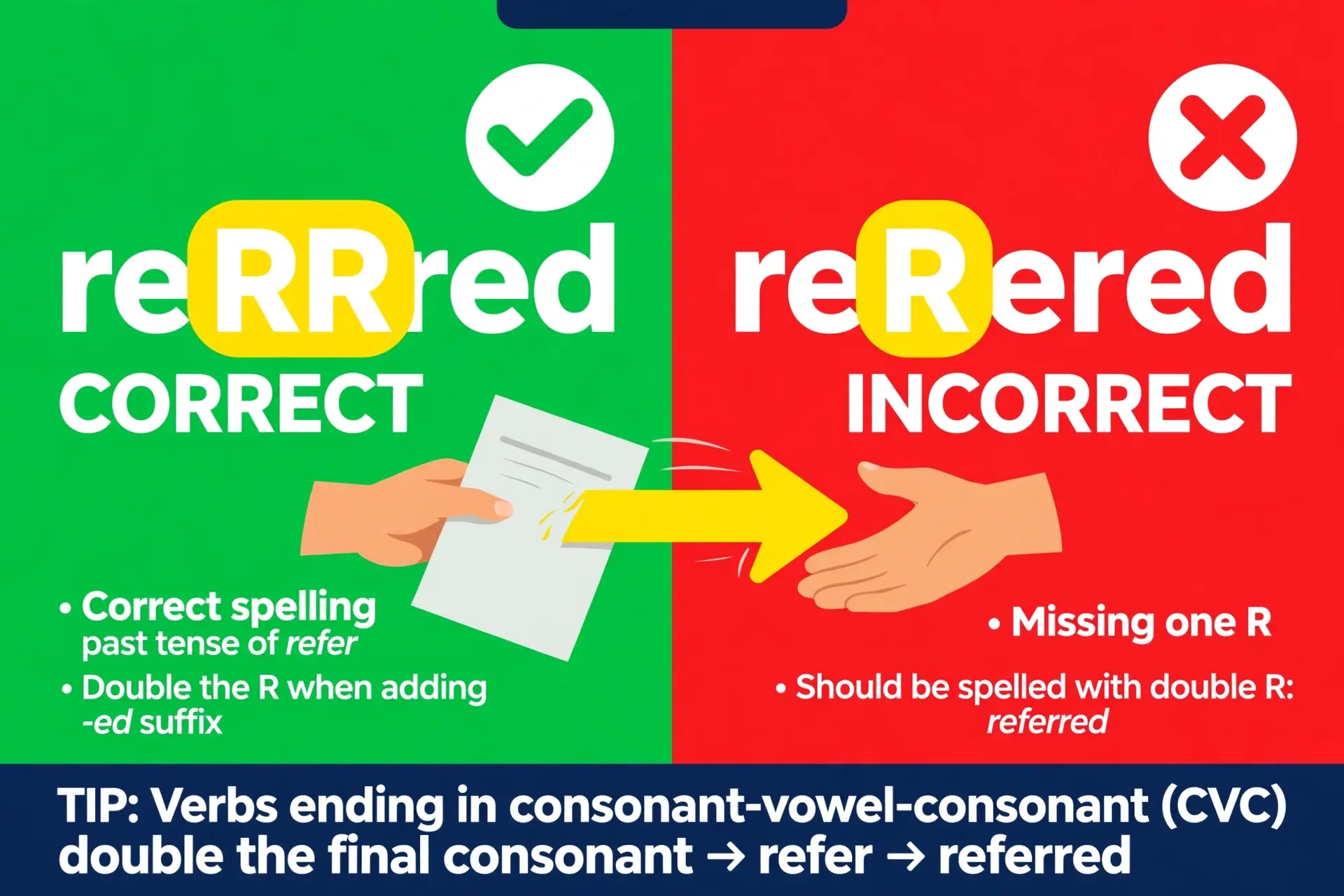
Referred with a double R is the past tense of “refer” — to send someone onward, mention, or direct attention. Refered with a single R is a misspelling, though one of the most common in English. “She referred me to a specialist” is correct; “she refered me” is the version spellcheckers quietly fix a million times a day.
Quick Answer
| Word | Part of Speech | Main Meaning | Example |
|---|---|---|---|
| referred | Verb (past tense / past participle) | Sent onward, mentioned, or directed to a source | ✅ “He referred the case to a senior lawyer.” |
| refered | — (misspelling) | Not a standard English word | ❌ “He refered the case to a senior lawyer.” |
Simple rule: When a verb ends in a single vowel plus a consonant and the stress falls on the final syllable (re-FER), double the consonant before -ed — referred, with two R’s.
What Does Referred Mean?
Referred is the past tense and past participle of “refer.” It covers several everyday jobs: sending a person to someone else (“referred me to a doctor”), mentioning or alluding to something (“she referred to the report”), and directing someone to a source of information (“the sign referred visitors to the front desk”). Merriam-Webster’s entry for “refer” lists these senses, from medical referrals to literary references.
Examples:
- “My dentist referred me to an orthodontist.”
- “He referred to her comments in his reply.”
- “The manual referred users to page 42 for troubleshooting.”
- “She was referred to the program by her teacher.”
- “The article referred back to an earlier study.”
The noun “referral” and the adjective “referred” both keep the double R, so learning the doubling once pays off across the whole word family: refer, refers, referring, referred, referral.
What Does Refered Mean?
Refered with one R is a misspelling — it appears in no dictionary and survives no spellchecker. It persists for two reasons: first, the base verb “refer” itself has only one R, so writers assume the past tense adds just -ed; second, plenty of similar verbs genuinely do not double (“offer → offered,” “visit → visited”), which makes the single-R version look plausible. Plausible is not correct, though, and “refered” on a job application or medical form reads as a basic error.
Examples of where the error shows up:
- ❌ “I was refered by a friend.” (meant: referred)
- ❌ “She refered to the instructions.” (meant: referred)
- ❌ “The patient was refered to a specialist.” (meant: referred)
- ❌ “He refered me to this website.” (meant: referred)
- ❌ “As refered to above…” (meant: referred)
The fix is always the same: give the R a twin. There is no context — formal, informal, American, British — where “refered” is the right choice.
Referred vs. Refered: Key Differences
| Feature | referred | refered |
|---|---|---|
| Status | Correct standard spelling | Misspelling — not a word |
| Verb base | refer (stress on final syllable → double the R) | — (no verb produces this form) |
| Letter count | Double R (…rred) | Single R (…red) — incorrect |
| Part of speech | Verb (past tense / participle) | None |
| Accepted in dictionaries | Yes | No |
| Example | ✅ “They referred us onward.” | ❌ “They refered us onward.” |
One R or two is the entire dispute: stress on the final syllable of “refer” demands the double, and “refered” ignores it.
Referred and Refered in Real Sentences
At Home
✅ “Mom referred me to Dad for permission.”
❌ “Mom refered me to Dad for permission.”
The family chain of command works either way, but only the double R is spelled right.
At Work
✅ “HR referred the complaint to management.”
❌ “HR refered the complaint to management.”
Workplace writing is judged closely, and a single R here undermines an otherwise professional sentence.
In Conversation
✅ “He kept referring to the good old days.”
❌ “He kept refered to the good old days.”
Note the present participle too — “referring” doubles the R just like “referred” does.
At the Doctor’s Office
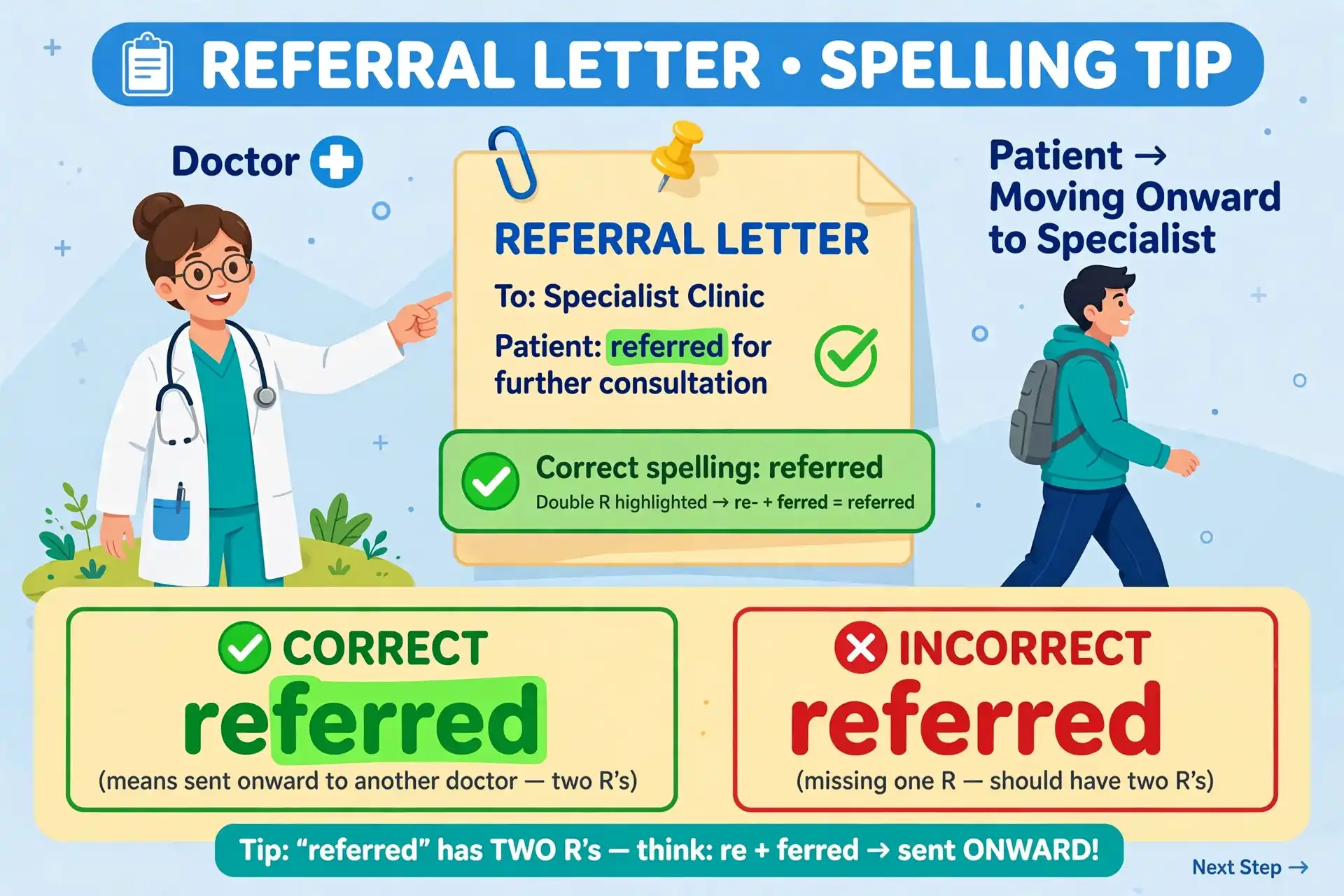
✅ “You will be referred to a specialist.”
❌ “You will be refered to a specialist.”
Medical paperwork is full of this word, which is why the correct spelling matters for clarity and trust.
Common Mistakes
Doubling rules trip up whole word families — the “cancelled” vs “canceled” doubling rule shows how the same logic splits across regions, and the “labelled” vs “labeled” spelling shows doubling in another common verb. The referred traps:
Mistake 1: Adding -ed without doubling (“refered”)
❌ “She refered him to the careers office.”
✅ “She referred him to the careers office.”
Why: The rule: one vowel + one final consonant + stress on the last syllable (re-FER) = double the consonant. “Refer” meets all three conditions, so the R must double.
Mistake 2: Overcorrecting to “reffered”
❌ “I was reffered by my colleague.”
✅ “I was referred by my colleague.”
Why: Only the final R doubles — the R in the middle of “refer” stays single. Doubling both is the mirror-image error of doubling neither.
Mistake 3: Copying the “offer → offered” pattern
❌ “Just like ‘offered,’ it must be ‘refered.'” (faulty logic)
✅ “‘Offered’ has one F because the stress is on OF-fer; ‘referred’ has two R’s because the stress is on re-FER.”
Why: Stress decides. Verbs stressed on the first syllable (offer, visit, happen) never double; verbs stressed on the last (refer, prefer, admit) always do: preferred, admitted, referred.
Mistake 4: Dropping the R in “referral”
❌ “Ask your doctor for a referal.”
✅ “Ask your doctor for a referral.”
Why: The noun keeps the double R from “referred.” The whole family — refer, refers, referring, referred, referral — doubles together, so learn it once and apply it everywhere.
Pronunciation
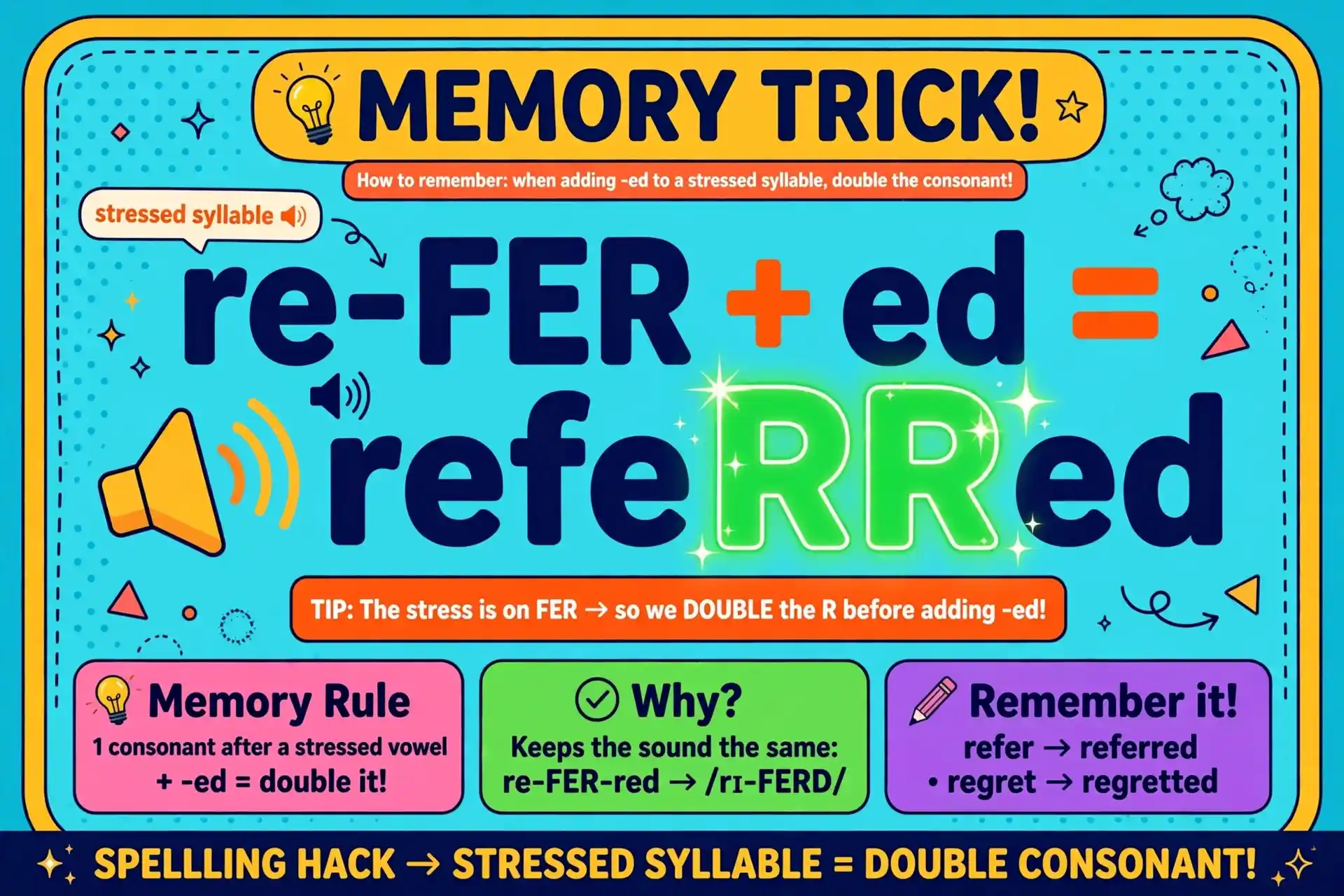
Referred is pronounced ri-FURD, with the stress on the second syllable — rhyming with “preferred” and “deferred.” Hearing that stressed “FER” is the practical key: the stressed final syllable is exactly what forces the R to double in spelling.
How to Remember the Difference
Stress is the boss: say re-FER out loud and punch that second syllable — a stressed ending is strong enough to carry two R’s, so “referred” gets RR. Compare OF-fer, where the stress sits up front and the lonely F manages fine alone. If the beat lands at the end, double the letter.
- Stress test: re-FER → stressed ending → double R → referred.
- Family check: prefer → preferred, admit → admitted, occur → occurred — same stress, same doubling.
- Opposite check: OF-fer → offered, VIS-it → visited, HAP-pen → happened — stress up front, no doubling.
Frequently Asked Questions
Is it referred or refered?
It is referred with two R’s. “Refered” with one R is a misspelling that no dictionary recognizes.
Why does “referred” have a double R?
English doubles the final consonant when a verb ends in one vowel plus one consonant and the stress falls on the final syllable. “Refer” (re-FER) meets all three conditions, so the R doubles before -ed and -ing.
Why is it “offered” with one F but “referred” with two R’s?
Stress placement. “Offer” is stressed on the first syllable (OF-fer), so nothing doubles. “Refer” is stressed on the last (re-FER), so the R doubles. The rule is consistent once you listen for the stress.
How do you spell the -ing form of “refer”?
“Referring” — the same doubling applies: re-FER + ing → referring, with two R’s.
Is “referral” spelled with a double R?
Yes. The noun “referral” keeps the double R from the verb family: refer, referred, referring, referral.
Is “refered” ever acceptable in any dialect?
No. Both American and British English spell it “referred.” (British English does double the L in words like “cancelled,” but that is a separate pattern — “referred” is doubled everywhere.)
Conclusion
Referred doubles its R because the stress lands on the final syllable of re-FER — a rule it shares with “preferred” and “admitted.” Listen for the stressed ending, double the consonant, and “refered” will never slip through again.