Writing or Writting: What’s the Difference?
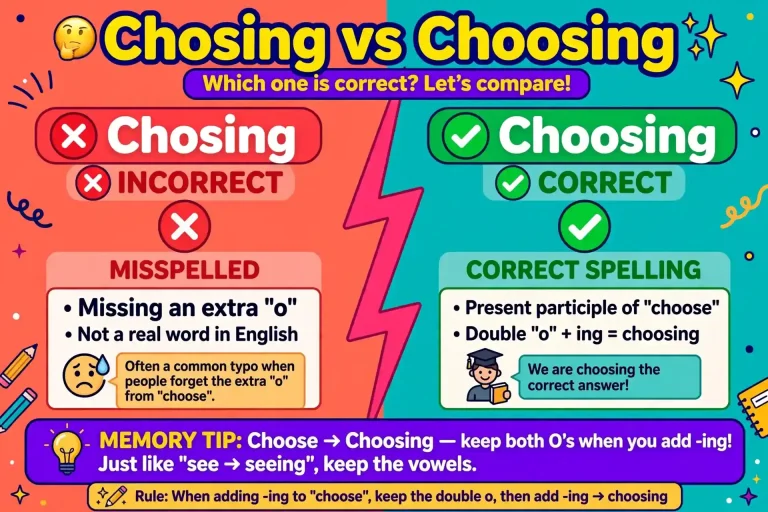
Writing with one T is the present participle of “write” — putting words on paper or screen, and also the craft of composing text itself. Writting with two T’s is not a word at all; it is simply a misspelling, though a very understandable one. “She is writing a novel” is correct; “she is writting a novel” will get a red underline in every spellchecker ever made.
Quick Answer
| Word | Part of Speech | Main Meaning | Example |
|---|---|---|---|
| writing | Verb (present participle) / noun | The act of forming letters and words; the craft of composing text | ✅ “She is writing her thesis.” |
| writting | — (misspelling) | Not a standard English word | ❌ “She is writting her thesis.” |
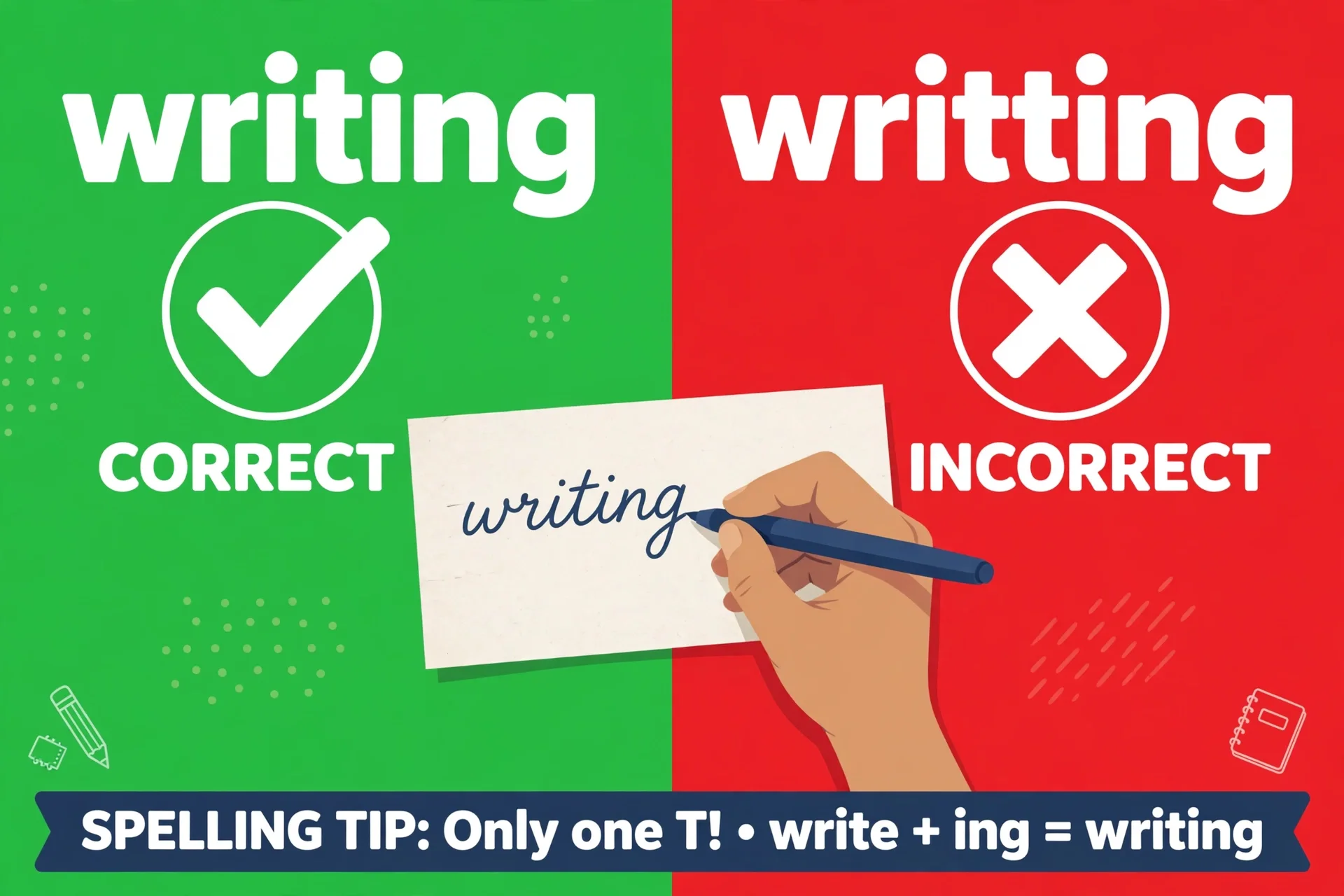
Simple rule: Drop the silent E from “write” and add -ing with a single T — writing. English only doubles the final consonant after a short stressed vowel (run → running), and the long I in “write” means the T stays single.
What Does Writing Mean?
Writing is the present participle of the verb “write”: the act of forming letters, words, and sentences with a pen, pencil, keyboard, or fingertip. As a noun, it names the craft and the product — the writing in a novel, someone’s handwriting, a career in writing. Merriam-Webster’s entry for “writing” covers both the verb form and the noun senses, from the physical act to the art of authorship.
Examples:
- “He is writing a letter to his grandmother.”
- “Writing every morning has made her faster and clearer.”
- “The writing on the wall was barely legible.”
- “She earns her living by writing travel guides.”
- “They spent the afternoon writing thank-you notes.”
Whether participle, gerund, or noun, one spelling — one T — serves every job.
What Does Writting Mean?
Writting means nothing, because it is not an English word. It is the most common misspelling of “writing,” and it survives because it looks like it should be right: English doubles final consonants all the time — running, sitting, swimming, stopping — so the hand reaches for a second T out of habit. Spellcheckers flag it instantly, teachers circle it, and editors fix it without a second thought.
Examples of where the error shows up:
- ❌ “I enjoy writting short stories.” (meant: writing)
- ❌ “She is writting up the meeting notes.” (meant: writing)
- ❌ “His writting has improved a lot.” (meant: writing)
- ❌ “Writting a will requires care.” (meant: Writing)
- ❌ “Thank you for writting back so quickly.” (meant: writing)
Every one of these is fixed the same way: delete one T. There is no sentence, dialect, or style guide in which “writting” is the preferred form.
Writing vs. Writting: Key Differences
| Feature | writing | writting |
|---|---|---|
| Status | Correct standard spelling | Misspelling — not a word |
| Verb base | write (drop the silent E, add -ing) | — (no verb produces this form) |
| Final consonant | Single T (long vowel before it) | Double T (incorrect doubling) |
| Part of speech | Verb form and noun | None |
| Accepted in dictionaries | Yes | No |
| Example | ✅ “Writing takes practice.” | ❌ “Writting takes practice.” |
The whole difference is one letter: “writing” keeps the single T that “write” had, while “writting” adds a T that English spelling rules never asked for.
Writing and Writting in Real Sentences
At Home
✅ “The kids are writing birthday cards for their dad.”
❌ “The kids are writting birthday cards for their dad.”
One T or two, the cards get written — but only the first version survives a teacher’s red pen.
At Work
✅ “She is writing the quarterly report this week.”
❌ “She is writting the quarterly report this week.”
Professional documents are exactly where a doubled T does the most damage to your credibility.
In Conversation
✅ “I’ve been writing to him for years.”
❌ “I’ve been writting to him for years.”
Speech hides the error — both sound identical — which is why the mistake lives on in text messages and emails.
Common Mistakes
Spelling slips travel in families — the “dieing” or “dying” spelling rule shows how silent-E verbs change before -ing, and the “loose” vs “lose” spelling confusion shows how one letter can flip a word’s identity. The writing traps:
Mistake 1: Doubling the T by analogy with “running”
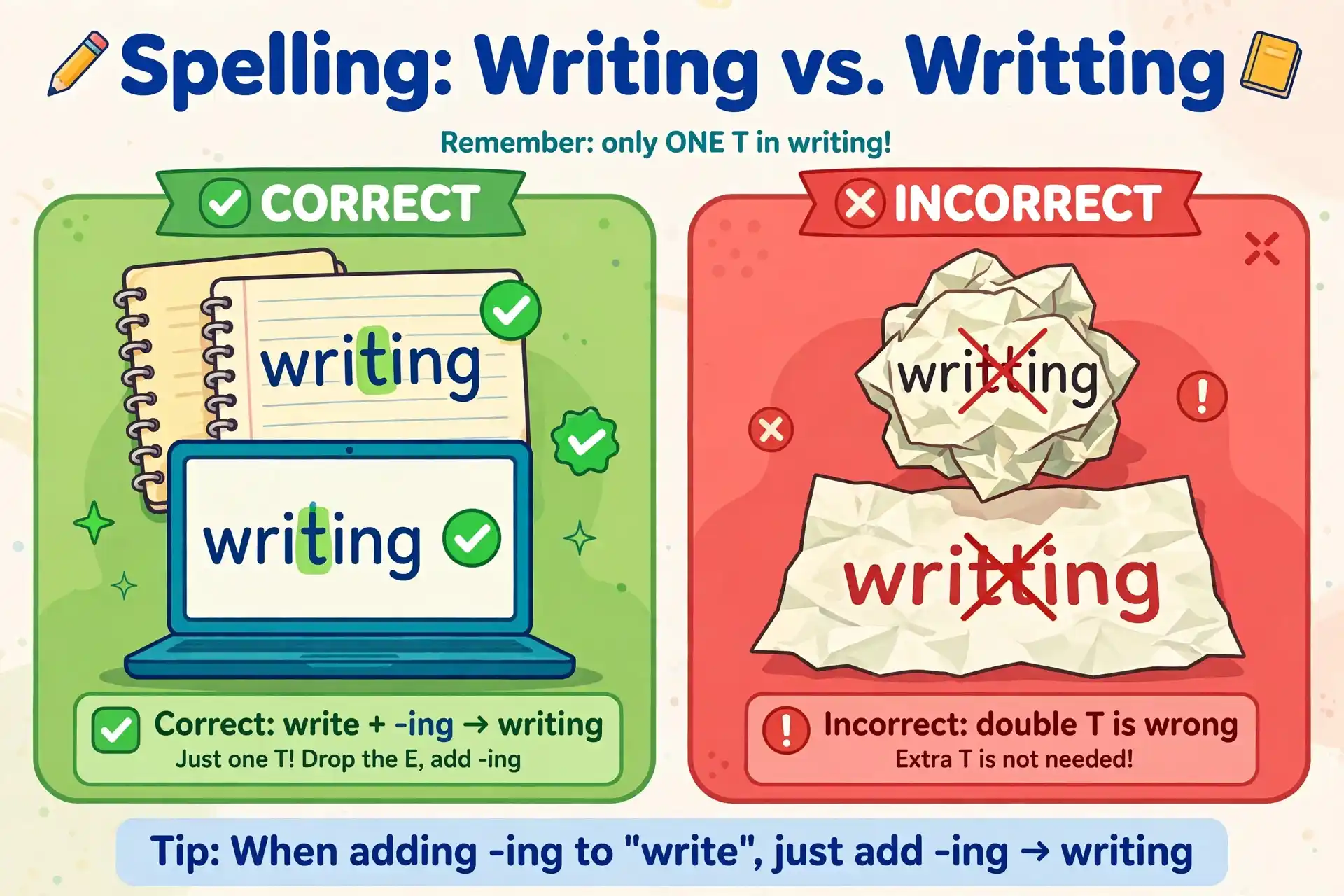
❌ “He enjoys writting poetry.”
✅ “He enjoys writing poetry.”
Why: Doubling happens after a short stressed vowel — run, sit, swim. “Write” has a long I (thanks to the silent E), so the rule that creates “running” simply does not apply here.
Mistake 2: Keeping the silent E — “writeing”
❌ “She is writeing a novel.”
✅ “She is writing a novel.”
Why: Verbs ending in silent E drop it before -ing: write → writing, like make → making and take → taking. Keeping the E is the opposite error from doubling the T, but it is just as wrong.
Mistake 3: Confusing the participle with the past forms
❌ “He was writting when I called — I mean, he written it yesterday.”
✅ “He was writing when I called — he wrote it yesterday.”
Why: The forms are write (base), wrote (past), written (past participle), writing (present participle). “Writting” is none of these; when the tenses pile up in one sentence, anchor each verb to this four-form set.
Mistake 4: Letting the error stand in formal writing
❌ A résumé line: “Responsible for writting client proposals.”
✅ “Responsible for writing client proposals.”
Why: Recruiters and clients read spelling as a signal. “Writting” on a job application advertises the exact skill it misspells — always proofread the words that describe your abilities.
Pronunciation
Writing is pronounced RY-ting, rhyming with “lighting,” “fighting,” and “biting.” The misspelling “writting” would theoretically be pronounced the same way — the extra T adds no sound — which is exactly why the error is invisible in speech and so common in writing.
How to Remember the Difference
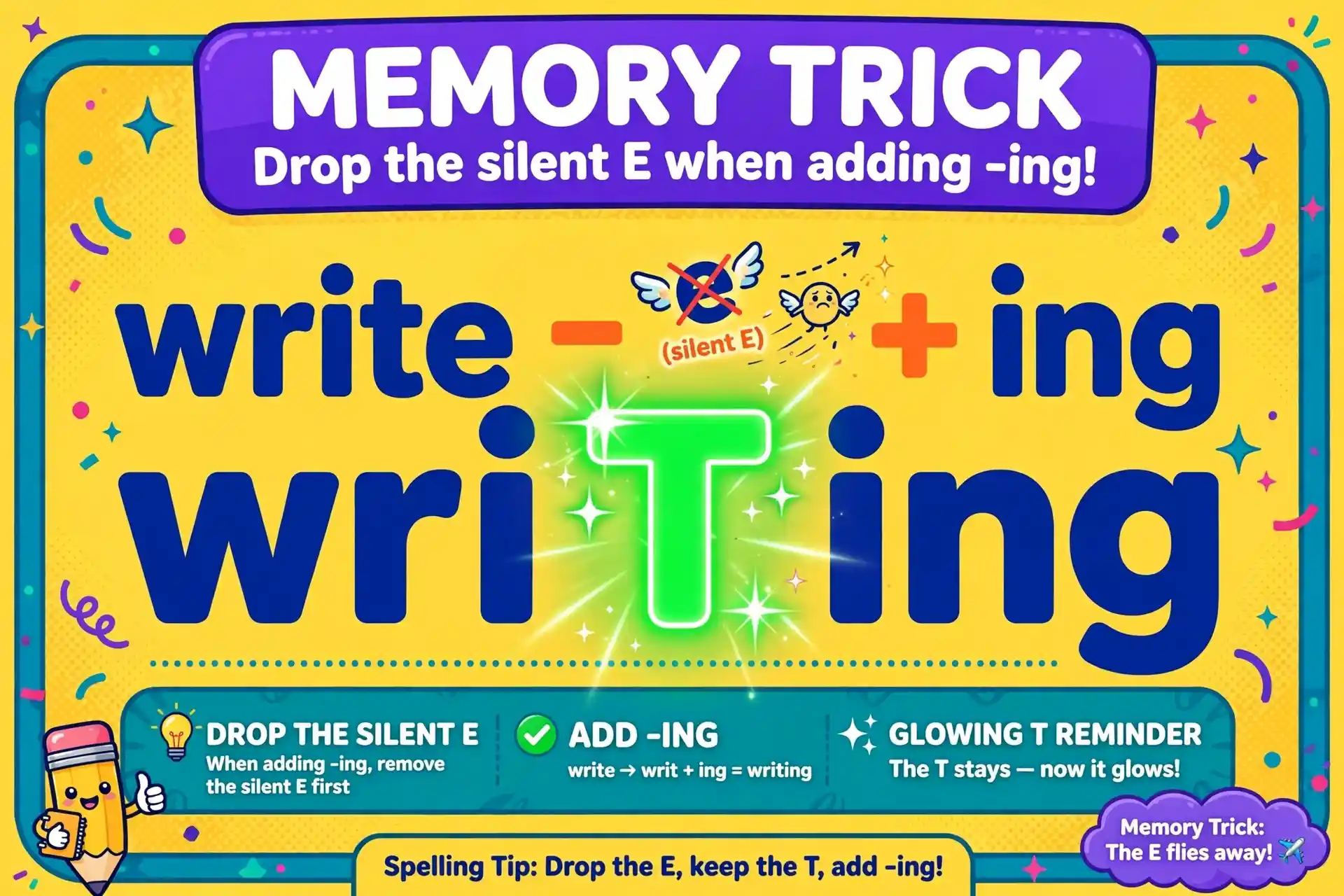
Think of the silent E as a worker that already did its job: in “write,” the E’s whole purpose was to make the I long, so when the E leaves to make room for -ing, the I stays long and the T stays single — writing. One vowel sound, one T; the E’s work is done, and no extra letter is needed to replace it.
- Silent-E club: write → writing, bite → biting, ride → riding, hide → hiding. Every one drops the E and keeps a single consonant.
- Short-vowel club: run → running, sit → sitting, swim → swimming. Doubling only happens here, after a short stressed vowel.
- Sound test: say “write” slowly — the long “rye” sound means no doubling, ever.
Frequently Asked Questions
Is it writing or writting?
It is writing with one T. “Writting” with two T’s is a misspelling and is not recognized as a word in any standard dictionary.
Why do so many people spell it “writting”?
Because English doubles final consonants in words like “running,” “sitting,” and “swimming.” The habit carries over, but the doubling rule only applies after a short stressed vowel — “write” has a long vowel, so the T stays single.
What is the past tense of “write”?
“Wrote” is the simple past (“she wrote a poem”), and “written” is the past participle (“she has written three poems”). “Writing” is the present participle used for ongoing action.
Is “writeing” ever correct?
No. Verbs ending in a silent E drop it before -ing: write → writing, make → making, take → taking. The only common exceptions are to keep pronunciation clear, like “dyeing” (to dye) versus “dying.”
Can “writing” be a noun?
Yes — it names both the activity (“writing relaxes me”) and the written product (“the writing in this book is beautiful”). It is also the name of the skill and profession.
Conclusion
Writing has one T because the long vowel in “write” needs no doubling — the silent E already did the lengthening work before it left. Drop the E, add -ing, keep the single T, and “writting” will never slip past you again.