Chosing or Choosing: What’s the Difference?
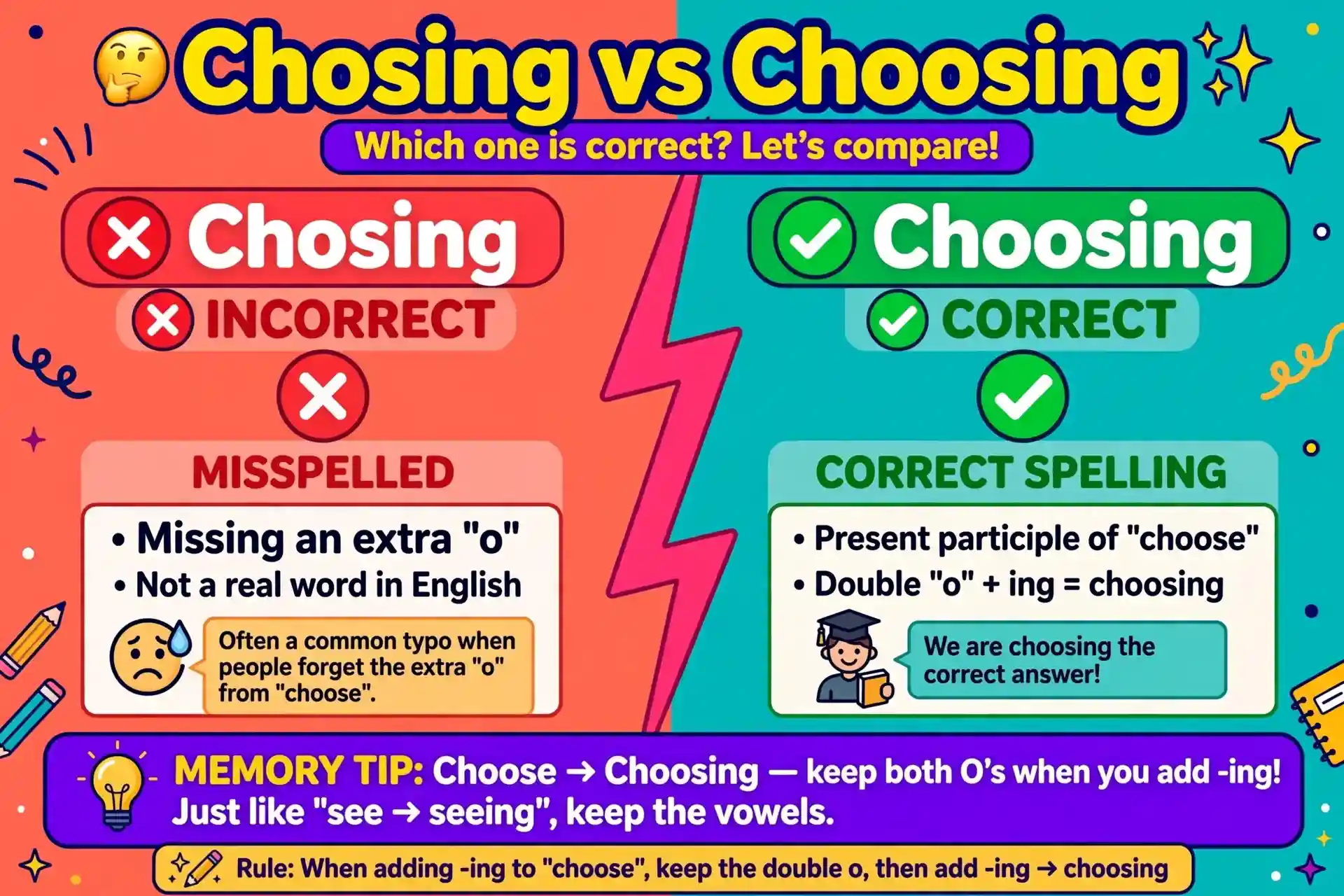
Chosing drops a letter it has no right to drop. The correct spelling is choosing — with two Os — the present participle of “choose.” “She is choosing a dress for the party” is right; “chosing” with one O is always a misspelling.
Quick Answer
| Word | Part of Speech | Main Meaning | Example |
|---|---|---|---|
| chosing | — (misspelling) | Not a standard English word | ❌ “He is chosing his words carefully.” |
| choosing | Verb (present participle) | In the act of picking or selecting | ✅ “He is choosing his words carefully.” |
Simple rule: Keep both Os from choose when you add -ing: choosing. Chosing with one O is never correct.
What Does Chosing Mean?
Nothing in standard English. Chosing is a misspelling of choosing, and it comes from a half-remembered spelling rule. Many learners know that verbs ending in E drop the E before -ing (“make” → “making”), so they apply the same logic to “choose” and drop an O instead. But “choose” doesn’t end in E — it ends in a double O — and there is no rule that drops a vowel from a double pair.
Examples of how this misspelling appears (all incorrect):
- ❌ “We are chosing a name for the baby.”
- ❌ “She spent an hour chosing the right filter.”
- ❌ “Chosing a career is never easy.”
- ❌ “He is chosing between two job offers.”
The sentences all make sense, which is why the error survives proofreading — the reader’s brain auto-corrects it. The spelling, though, is simply wrong.
What Does Choosing Mean?
Choosing is the present participle of the verb choose, meaning to pick or select from options. It appears in continuous tenses (“is choosing”), as a gerund (“choosing wisely matters”), and as an adjective-like modifier (“the choosing committee”). Merriam-Webster’s entry for “choose” covers the verb and its forms, including the participle choosing.
Examples:
- “She is choosing a dress for the wedding.”
- “Choosing the right school took months of research.”
- “They are choosing between pizza and burgers for dinner.”
- “He regretted choosing speed over safety.”
- “We spent the evening choosing photos for the album.”
Chosing vs. Choosing: Key Differences
| Feature | Chosing | Choosing |
|---|---|---|
| Spelling status | Misspelling — not a real word | Correct standard spelling |
| Vowel pattern | Single O | Double O (kept from “choose”) |
| Formed from | Faulty E-dropping analogy | choose + -ing (no letters dropped) |
| Dictionary entry | No entry | Listed as a form of “choose” |
| Pronunciation | — | CHOO-zing |
| Example | ❌ “chosing sides” | ✅ “choosing sides” |
The difference is one O: choosing keeps the double O from choose, while chosing wrongly drops one. The E-dropping rule applies to words ending in E — and “choose” ends in O.
Chosing and Choosing in Real Sentences
At Home
❌ “The kids are chosing a movie for tonight.”
✅ “The kids are choosing a movie for tonight.”
Family decisions are the everyday home of this word — and the double O should survive every one of them.
At Work
❌ “We are chosing a new supplier this quarter.”
✅ “We are choosing a new supplier this quarter.”
In professional writing, “chosing” is especially visible because “choosing” is such a common business verb.
In Conversation
❌ “I’m chosing my words carefully here.”
✅ “I’m choosing my words carefully here.”
Ironically, people write this sentence while trying to sound careful — the misspelling undercuts the whole point.
Common Mistakes
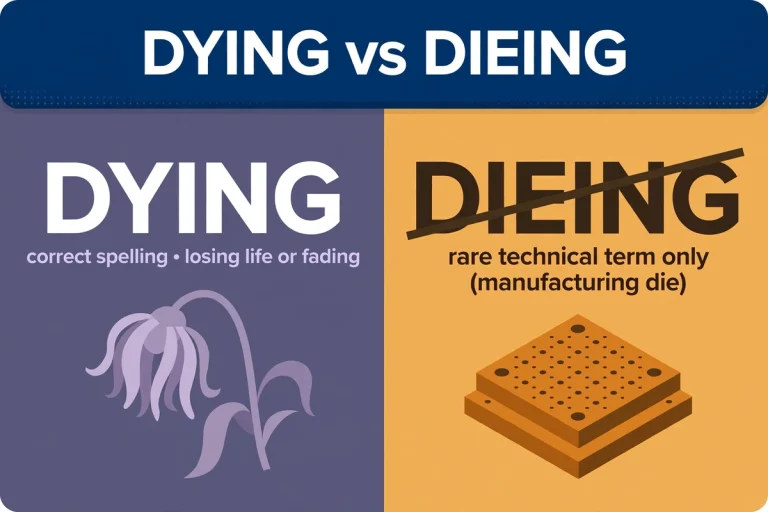
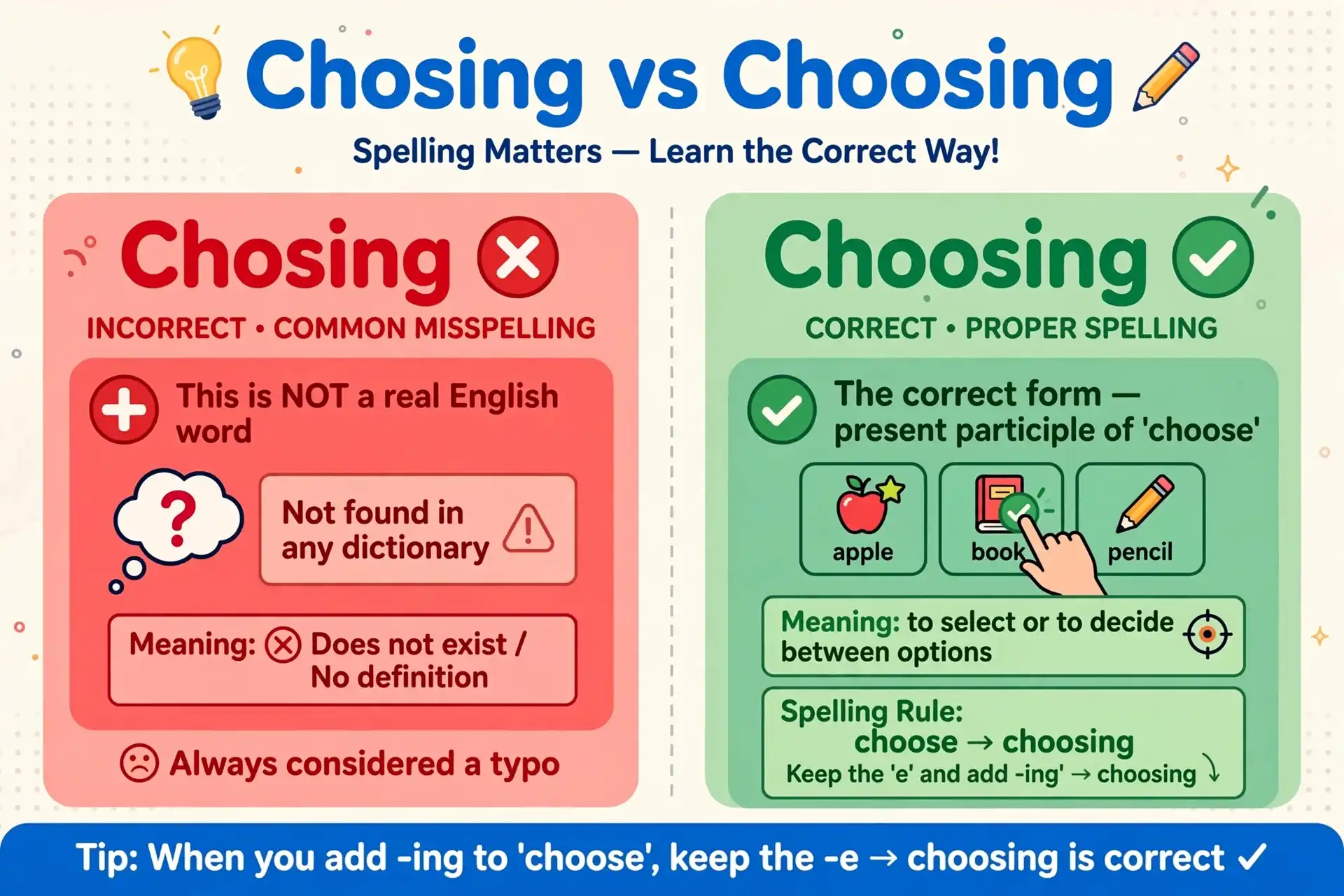
Vowel-dropping errors follow familiar patterns — the “dieing” or “dying” spelling rule is the classic case of knowing half a rule, and the “loose” vs “lose” spelling confusion shows how one vowel changes a word completely. Here are the traps with choosing:
Mistake 1: Applying the drop-the-E rule to “choose”
❌ “choose” − “e” + “ing” = “chosing”
✅ “choose” + “ing” = “choosing” (nothing is dropped)
Why: The drop-the-E rule only fires when the word actually ends in E. “Choose” ends in a double O, so both Os stay.
Mistake 2: Confusing “choosing” with “chasing”
❌ “He is chosing the bus.” (meant: running after it)
✅ “He is chasing the bus.”
Why: “Chosing” looks like it could belong to a verb “chose” — but no such verb exists. “Chase” becomes “chasing”; “choose” becomes “choosing.”
Mistake 3: Mixing up “choose,” “chose,” and “chosen”
❌ “Yesterday she choosing the red one.”
✅ “Yesterday she chose the red one.”
Why: “Chose” (pronounced chohz) is the simple past; “choosing” is for ongoing action. Keep the timeline straight: choose (now), chose (past), choosing (in progress).
Mistake 4: Writing “chooseing” with the E kept
❌ “They are chooseing their seats.”
✅ “They are choosing their seats.”
Why: The opposite overcorrection — some writers keep a phantom E. There is no E in “choose” to begin with; the word ends in double O.
Pronunciation
Choosing is pronounced CHOO-zing, rhyming with “oozing” and “losing.” The double O makes the long “oo” sound, exactly as in “choose” — another reason the spelling keeps both letters. “Chose,” the past tense, is pronounced differently: chohz, rhyming with “nose.”
How to Remember the Difference
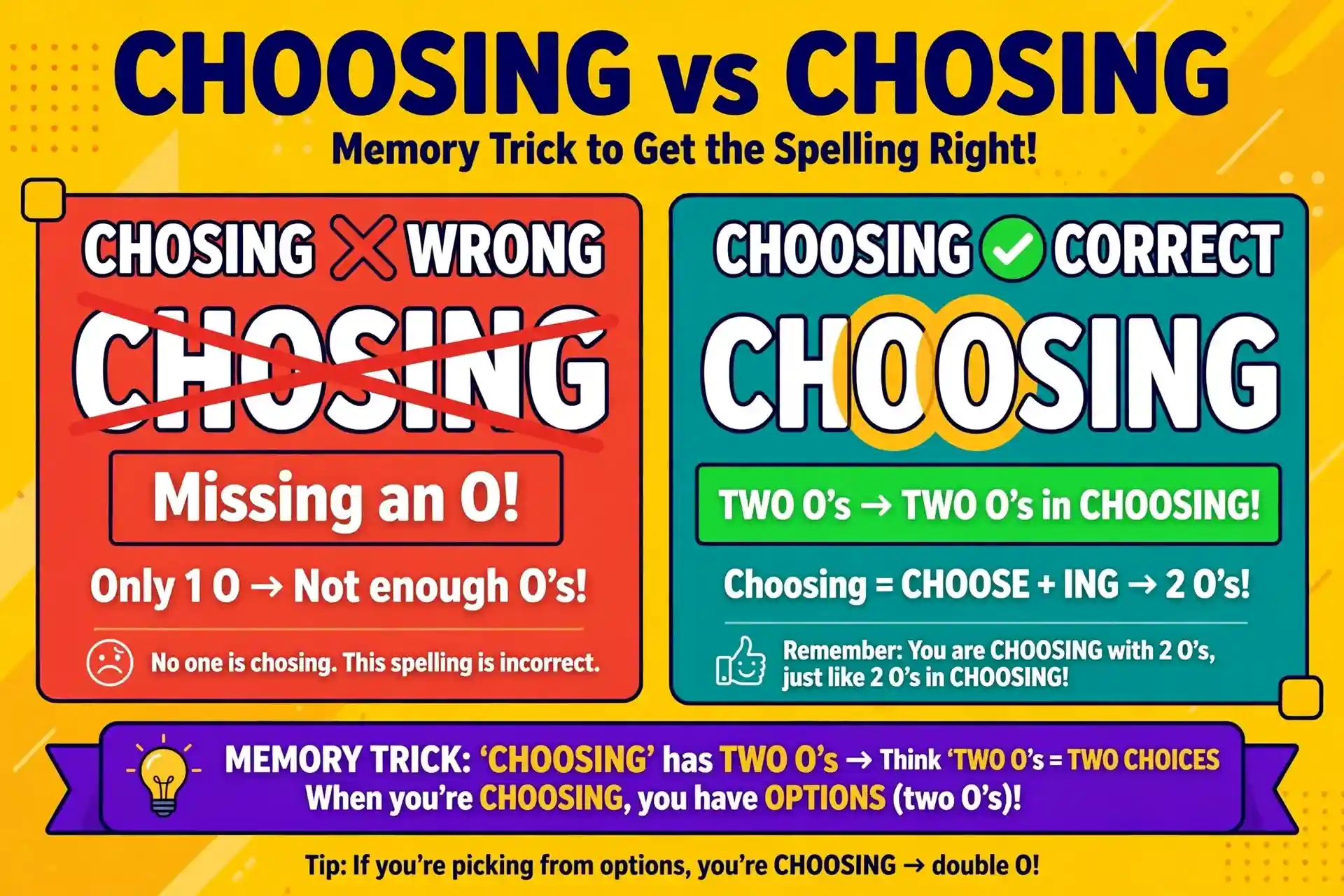
Choose never loses an O — the double O is the heart of the word, and choosing carries both of them along. Think of the two Os as a pair of eyes: choosing means looking at your options, and you need both eyes open.
- Keep the pair: choose → choosing. Nothing drops, nothing changes — just add -ing.
- Eyes trick: the “oo” looks like two eyes scanning the options. One O means one eye closed — wrong.
- Test sentence: “I choose, I chose, I am choosing” — all three keep the double O.
Frequently Asked Questions
Is it chosing or choosing?
Choosing. Chosing is a misspelling and is never correct in standard English.
Is “chosing” ever acceptable?
No. No major dictionary lists it, and it is not recognized as a variant in any register.
Why do people write “chosing”?
They over-apply the drop-the-E rule from words like “make → making.” But “choose” ends in a double O, not an E, so nothing gets dropped.
What is the past tense of “choose”?
Chose (pronounced “chohz”): “She chose the blue dress yesterday.” The past participle is chosen: “They have chosen a winner.”
Can “choosing” be a noun?
Yes, as a gerund: “Choosing wisely takes practice” — here choosing acts as the subject of the sentence.
How is “choosing” different from “selecting”?
They are near-synonyms, but “choosing” feels more personal and everyday, while “selecting” sounds slightly more formal or official.
Conclusion
Choosing is the only correct spelling — it keeps the double O from choose and simply adds -ing, while chosing drops a letter the word never agreed to lose. Keep both eyes (both Os) open, and the spelling stays correct.