Manuel or Manual: Which Is Correct?
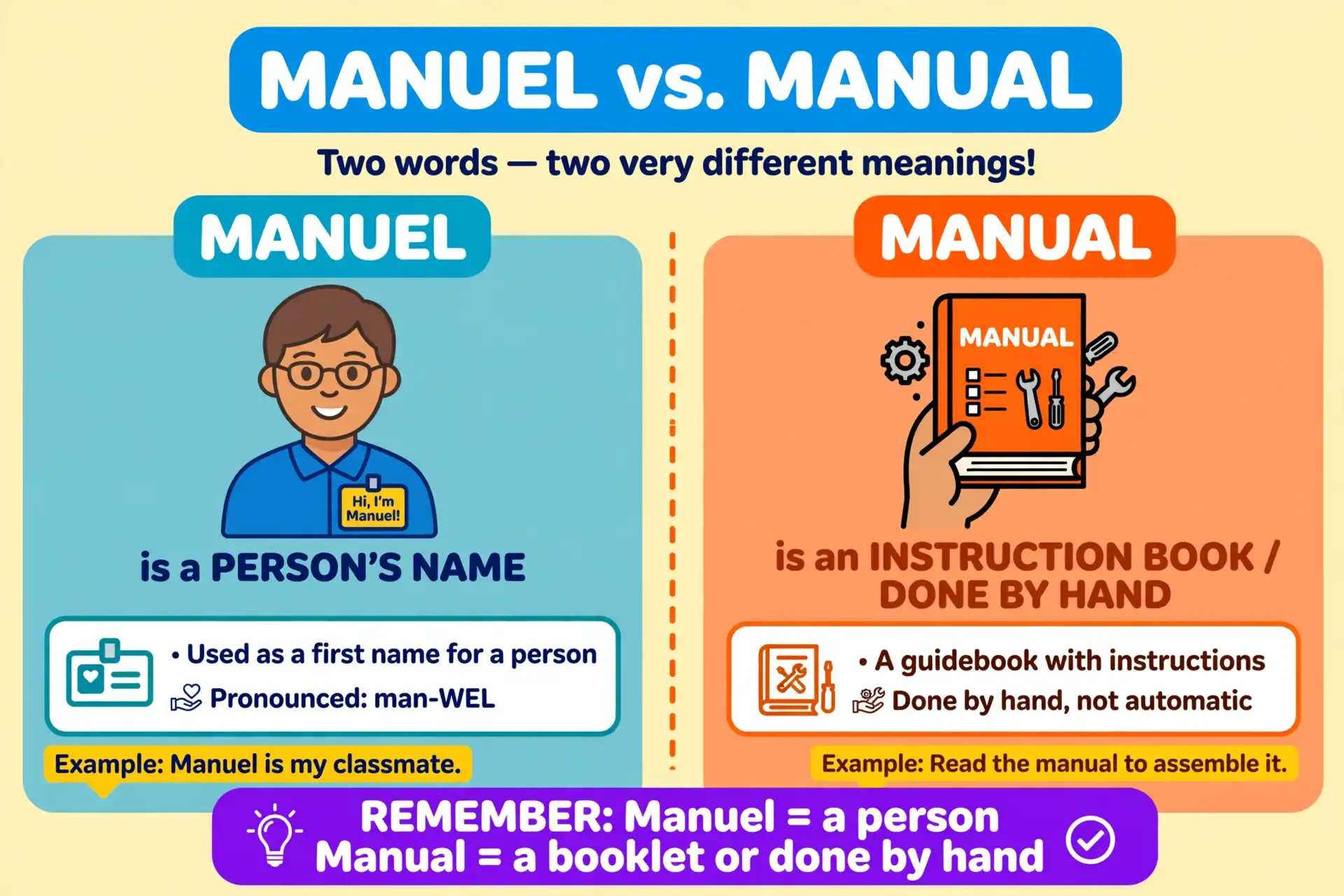
Manuel or manual? They look almost identical but could not be more different. Manual is the everyday word meaning done by hand or a book of instructions, as in “She shifted into manual gear”. Manuel is a person’s name — the Spanish and Portuguese form of Emmanuel, as in “Manuel joined our team last week”.
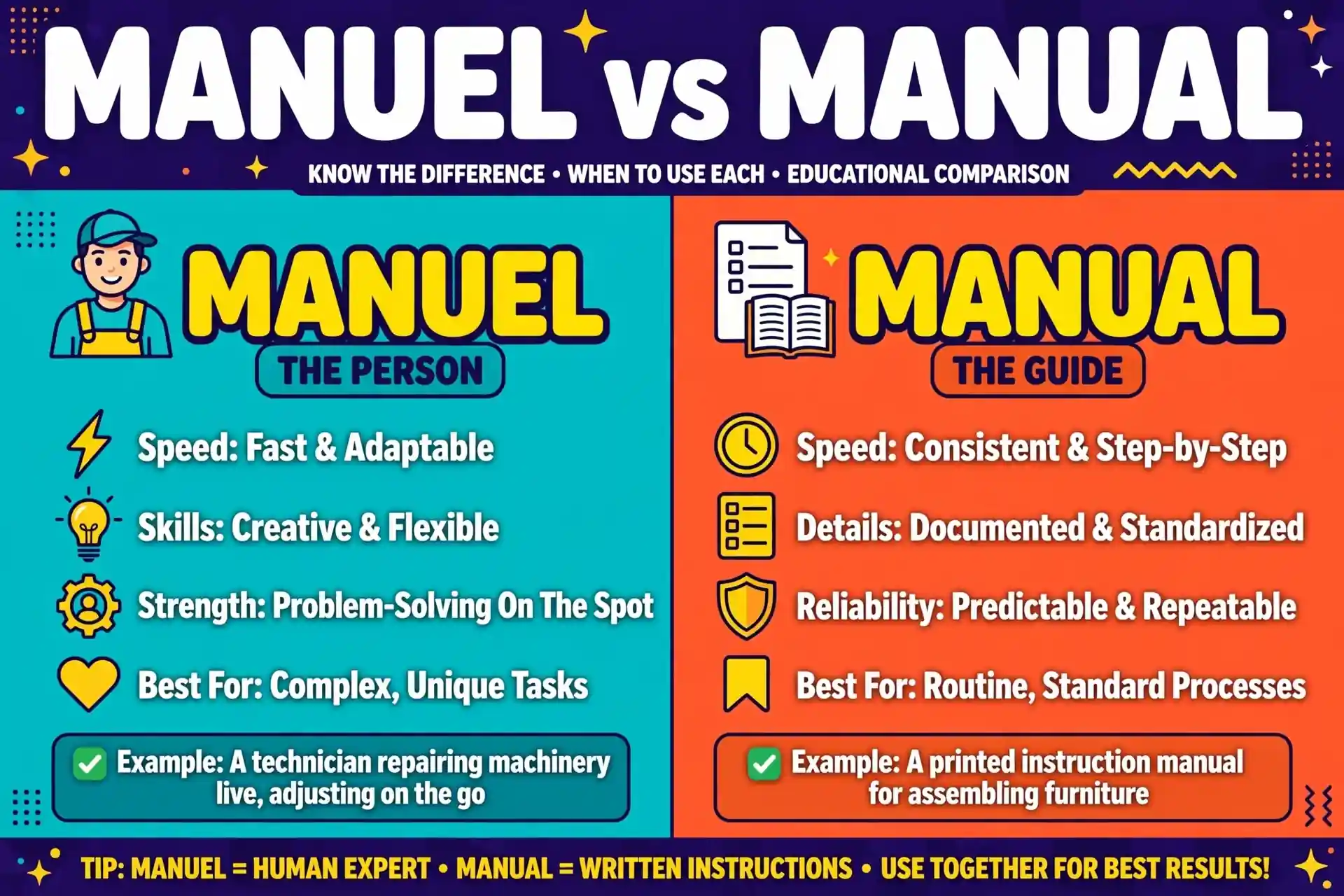
Table of Contents
Quick Answer
| Word | Part of Speech | Main Meaning | Example |
|---|---|---|---|
| Manual | Adjective / noun | Done by hand; an instruction book | “Read the manual before assembling the desk.” |
| Manuel | Proper noun | A person’s given name (Spanish/Portuguese for Emmanuel) | “Manuel fixed the engine himself.” |
Simple rule: if it starts with a capital M and refers to a person, it is Manuel; if it means “by hand” or a guidebook, it is manual.
What Does Manual Mean?
Manual is a common English word with two main uses. As an adjective it describes work done with the hands rather than by machine, and as a noun it means a handbook that explains how to operate or repair something.
Manual as an adjective: done by hand
- He prefers manual labor to sitting at a desk all day.
- The car has a manual transmission, so you need to shift gears yourself.
- She keeps a manual backup of all her important files.
- Manual typewriters are popular again among vintage collectors.
Manual as a noun: an instruction book
- Read the manual before you plug in the new dishwasher.
- The employee manual explains the company’s holiday policy.
- He lost the manual, so he watched a tutorial instead.
- The training manual is available as a free PDF.
What Does Manuel Mean?
Manuel is a proper noun — a popular given name in Spanish- and Portuguese-speaking countries, derived from Emmanuel, meaning “God is with us.” It is always capitalized and never used as an adjective or a common noun.
Examples:
- Manuel García was the first to arrive at the office.
- Our new neighbor, Manuel, speaks three languages.
- Chef Manuel won the regional cooking competition.
- Manuel’s grandfather emigrated from Seville in the 1960s.
- Fans cheered when Manuel scored the winning goal.
Manuel vs. Manual: Key Differences
| Feature | Manuel | Manual |
|---|---|---|
| Word type | Proper noun (a name) | Adjective or common noun |
| Capitalized? | Always (Manuel) | Only at sentence start |
| Meaning | A person | By hand / instruction book |
| Plural | No plural (names don’t pluralize) | manuals |
| Used for things | Never | Yes |
| Example | “Manuel called earlier.” | “Check the manual first.” |
Think of it this way: manual describes how something is done or read, while Manuel is who someone is.
Usage in Real Sentences
At Home
✅ “Where is the manual for this washing machine?”
✅ “Manuel said the repair takes about an hour.”
One is a book of instructions; the other is the person who might read it for you.
At Work
✅ “Please update the employee manual by Friday.”
✅ “Manuel in accounting approved the invoice.”
Use manual for the document and Manuel for the colleague — mixing them up in an email would be embarrassing.
In Conversation
✅ “I like the manual focus on this camera.”
✅ “Have you met Manuel? He’s the new photographer.”
Context makes the spoken difference obvious: one describes a feature, the other introduces a friend.
Common Mistakes
This is one of those typos that slips past spellcheckers — both spellings are valid words, like other homophone mix-ups like isle vs aisle and spelling errors like recieve vs receive.
Mistake 1: Writing “manuel” for the instruction book
❌ “The manuel says to call a technician.”
✅ “The manual says to call a technician.”
Why: an instruction book is always manual with a lowercase m and a “u-a” spelling.
Mistake 2: Writing “manual” for the name
❌ “Nice to meet you, manual!”
✅ “Nice to meet you, Manuel!”
Why: names are capitalized and Manuel is spelled with “u-e-l” at the end — see manual on Merriam-Webster to confirm the word for “by hand.”
Mistake 3: Lowercasing the name in writing
❌ “I asked manuel for help.”
✅ “I asked Manuel for help.”
Why: proper nouns take a capital letter — manuel in lowercase looks like a typo for manual.
Mistake 4: Autocorrect changing the name
❌ “Thanks, Manual Rodriguez.”
✅ “Thanks, Manuel Rodriguez.”
Why: spellcheckers “correct” Manuel to manual because the word is more common — always proofread names by hand.
Pronunciation
Manual is pronounced “MAN-yoo-uhl,” with the stress on the first syllable. Manuel is usually pronounced “man-WELL” in Spanish or “man-yoo-EL” in English, with stress toward the end. In conversation they sound noticeably different, but on the page they differ by just one vowel.
How to Remember the Difference
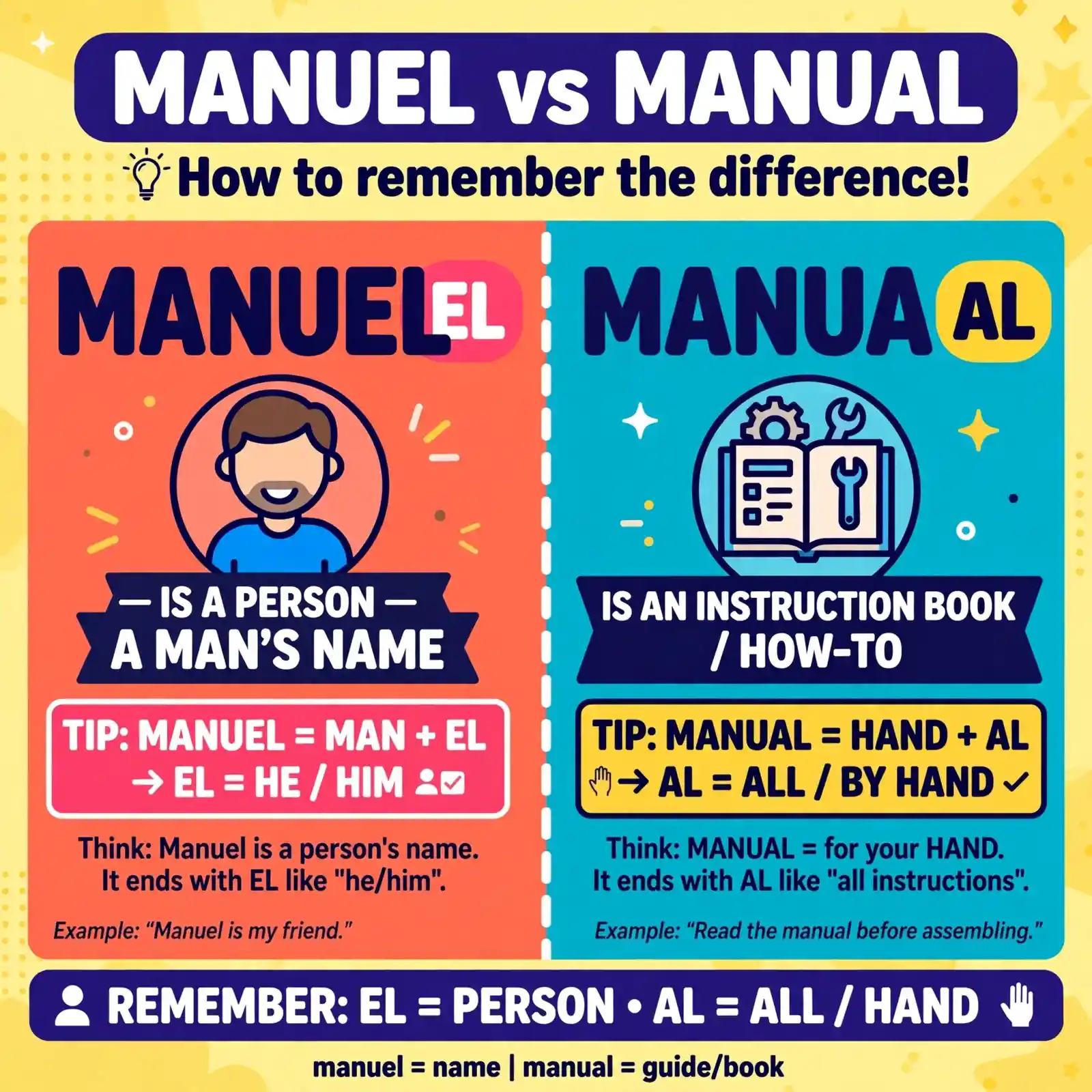
Remember: “ManUally turned pages — the book is manUal. ManuEL is a fELlow.”
- Manual has a U — think of “use your hands” for things done manually.
- Manuel ends in EL like “fellow” — it is a person’s name.
- If it needs a capital letter and refers to someone, it is Manuel, always.
Frequently Asked Questions
Is it Manuel or manual?
Both are correct words. Use manual for things done by hand or instruction books, and Manuel (capitalized) as a person’s name.
Is Manuel a word or just a name?
It is just a proper noun — a given name. Unlike manual, it has no dictionary meaning beyond identifying a person.
Why does my spellchecker change Manuel to manual?
Because manual is the far more common word, and many spellcheckers are not context-aware about names. Add Manuel to your dictionary to stop it.
What does the name Manuel mean?
Manuel is the Spanish and Portuguese form of Emmanuel, which means “God is with us” in Hebrew.
Is it “manual labour” or “manuel labour”?
Always manual labour (or “manual labor” in American English) — it means work done by hand.
Can “manual” be a noun?
Yes — and this is one of its most common uses. A manual is an instruction book (“check the owner’s manual“), and in everyday speech “a manual” also means a car with a stick shift, as in “she drives a manual.” Neither of these has anything to do with the name Manuel, which is always capitalized and always refers to a person.
Conclusion
Manual is the versatile word for things done by hand or the book that tells you how — while Manuel, with a capital M, is simply a man’s name. One letter apart, worlds apart in meaning: keep the name capitalized and the guidebook lowercase, and you will never confuse them.