Lifes or Lives: What’s the Difference? (With Examples)
Lifes is a misspelling; lives is the correct plural of “life” — and it also works as the third-person singular of “live” (“she lives”). The trap is that most plurals just add -s, but “life” changes its f to a v. For example: “Their lives changed forever” is correct, while “Their lifes changed forever” is wrong.

Table of Contents
Quick Answer
| Word | Part of Speech | Main Meaning | Example |
|---|---|---|---|
| lifes | — | Not an English word (misspelling) | “Many lifes were lost.” (wrong) |
| lives | Plural noun | More than one life | “Many lives were lost.” |
| lives | Verb | Third-person singular of “live” | “She lives in Lahore.” |
Simple rule: The plural of life is lives — the f turns into a v before adding -es.
What Does Lifes Mean?
Lifes is not a word in standard English. It shows up when people pluralize “life” the regular way, simply tacking on an -s.
Examples:
- The student typed “lifes” three times in the essay before noticing.
- The sign read “we value all lifes here,” which made customers laugh.
- Her message said “our lifes are so different now” — autocorrect did not save her.
- A commenter asked whether “lifes” was an American spelling. It is not.
- The flyer promised to “change lifes,” and the typo undercut the message.
What Does Lives Mean?
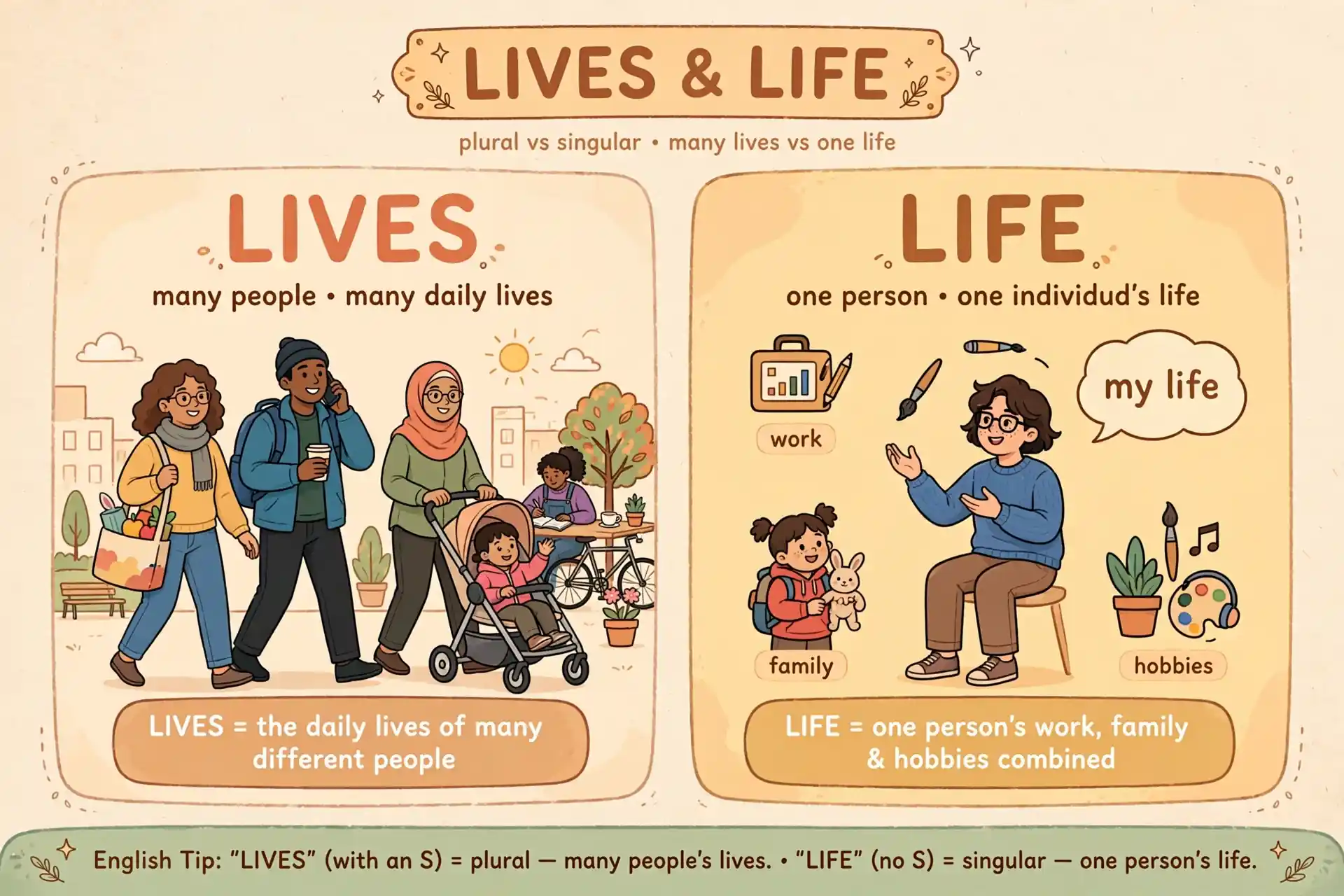
Lives does double duty in English, and the two jobs sound different. As a plural noun (pronounced “lyves”), it means more than one life — human existences, or the way people spend their days: “the storm destroyed hundreds of lives.” As a verb (pronounced “livz”), it is the third-person singular present of “live” — what he, she, or it does: “she lives downtown,” “the legend lives on.” The Merriam-Webster entry for “life” lists “lives” as the plural — never “lifes.”
Examples:
- Firefighters saved dozens of lives that night.
- Our lives are busier than our parents’ were.
- She lives two streets away from me.
- He lives for the weekend football matches.
- The cat has nine lives, or so they say.
- The documentary follows the lives of three fishermen.
- My grandmother lives to tell stories about her youth.
Lifes vs. Lives: Key Differences
| Feature | Lifes | Lives |
|---|---|---|
| Status | Misspelling | Correct English |
| Plural of “life” | Never | Yes (pronounced “lyves”) |
| Verb form of “live” | Never | Yes — “she lives” (pronounced “livz”) |
| Meaning | None | Multiple existences; resides |
| Use in writing | Do not write it | Everyday writing |
The rule is simple: when “life” goes plural, the f softens into a v — lifes skips that step and lands in error.
Usage in Real Sentences
At Home
Lifes: ❌ “Our lifes would be easier with a dishwasher.”
Lives: “Our lives would be easier with a dishwasher.”
Same thought — only “lives” survives a spellcheck.
At Work
Lifes: ❌ “The policy protects the lifes of all employees.”
Lives: “The policy protects the lives of all employees.”
Formal documents are the worst place for a typo.
In Conversation
Lifes: ❌ “They lead such different lifes now.”
Lives: “She lives alone; he lives with his parents.”
Here “lives” is the verb — “lifes” cannot do that job either.
In a Story
Lifes: ❌ “The hero saved countless lifes.”
Lives: “The hero saved countless lives.”
Big claims need correct spelling.
Lifes: ❌ “Their lifes crossed again after ten years.”
Lives: “Their lives crossed again after ten years.”
Novelists pluralize “life” constantly — and always with a v.
In Class
Lifes: ❌ “The chapter was titled ‘The Lifes of Insects.'”
Lives: “The chapter was titled ‘The Lives of Insects.'”
Printed mistakes teach the wrong spelling to everyone who reads them.
Lifes: ❌ “The teacher asked about the lifes of famous scientists.”
Lives: “The teacher asked about the lives of famous scientists.”
Biographies are about “lives,” plural — spelled with a v every time.
Common Mistakes
This is the same kind of slip as loose or lose and whose or whos — one letter off, whole word wrong.
Mistake 1: Adding -s the Regular Way
❌ “Two lifes were changed by the program.”
✅ “Two lives were changed by the program.”
Why: “Life” is irregular: the f becomes a v, then add -es. Most nouns take a plain -s, so the habit is strong — but “life” belongs to the small f-to-v family, and treating it like a regular noun produces a non-word.
Mistake 2: Using “Lifes” as a Verb
❌ “She lifes alone in the city.”
✅ “She lives alone in the city.”
Why: The third-person singular of “live” is also “lives” — “lifes” never works as a verb either. If the sentence needs “he/she/it” + a verb, “lives” is the only option.
Mistake 3: Breaking a Familiar Phrase
❌ “All lifes matter in this debate.”
✅ “All lives matter in this debate.”
Why: Set phrases use “lives” — swapping in “lifes” breaks a phrase everyone knows.
Mistake 4: Typing Too Fast
❌ “Our lifes changed after the move.”
✅ “Our lives changed after the move.”
Why: Speed typing skips the f-to-v change; slow down on irregular plurals.
Pronunciation
Lives is pronounced two different ways depending on its job. As the plural noun it sounds like “lyves” (/laɪvz/), rhyming with “hives” and “drives.” As the verb in “she lives,” it sounds like “livz” (/lɪvz/), rhyming with “gives.” Lifes has no standard pronunciation because it is not a word.
How to Remember the Difference
Life gives its F up and takes a V — think f → v, then add es. It belongs to the same family as knife → knives and wife → wives.
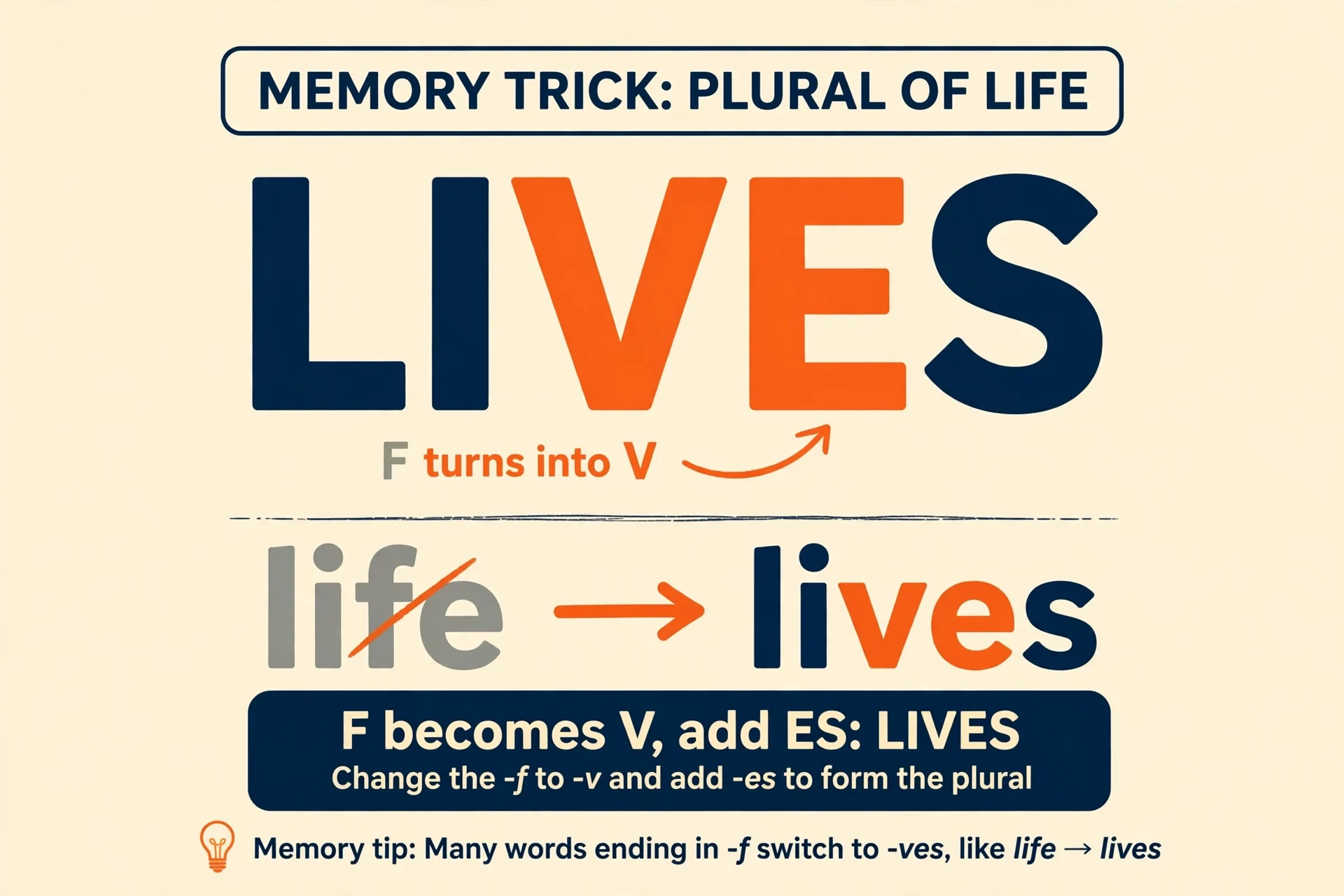
- The F changes to a V before the ending.
- Add -es, never just -s.
- “Lifes” skips the f-to-v step — that skipped step is the mistake.
Frequently Asked Questions
Is it lifes or lives?
It is lives. “Lifes” is a misspelling that appears when people add -s to “life” without changing the f to a v.
What is the plural of life?
Lives — as in “many lives were touched.” The f becomes a v and the ending becomes -es, just like knife/knives and wife/wives.
Is “lifes” ever correct?
No. It is not listed in any dictionary, in any variety of English. There is no context where “lifes” is the right choice.
How do you pronounce “lives”?
It depends on the job. As a noun (“their lives”), say “lyves,” rhyming with “hives.” As a verb (“she lives”), say “livz,” rhyming with “gives.” Different sounds, same spelling.
Why is it “lives” and not “lifes”?
English changes f to v in some plurals — life/lives, knife/knives, wife/wives, leaf/leaves. The pattern is old and irregular, so it simply has to be memorized.
Is “lifes” an American spelling?
No — it is wrong in every variety of English. American, British, and all other standards agree: the plural is “lives.”
Conclusion
Lives is the only correct plural of “life” (and the verb form of “live”); lifes is always an error. Remember the f-to-v switch, and the spelling takes care of itself.