Scarves or Scarfs: What’s the Difference? (With Examples)
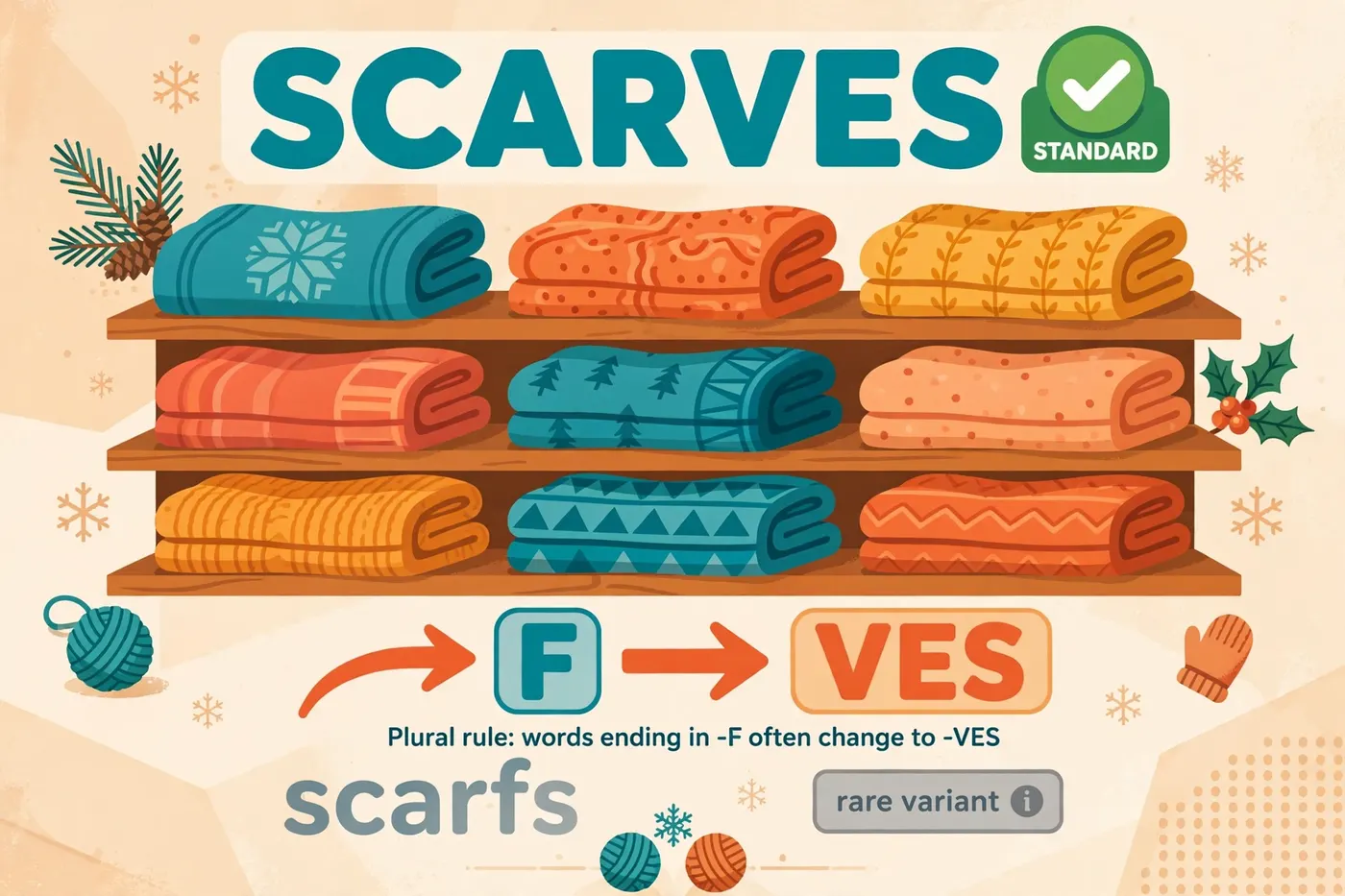
Scarves is the standard plural of scarf: “She folded her scarves.” Scarfs is also a recognized plural, but it is far less common in modern writing.
For example, “The gift shop sells silk scarves” reads naturally to almost every reader. “The gift shop sells silk scarfs” is not wrong, yet it looks odd to many editors. When in doubt, choose scarves.
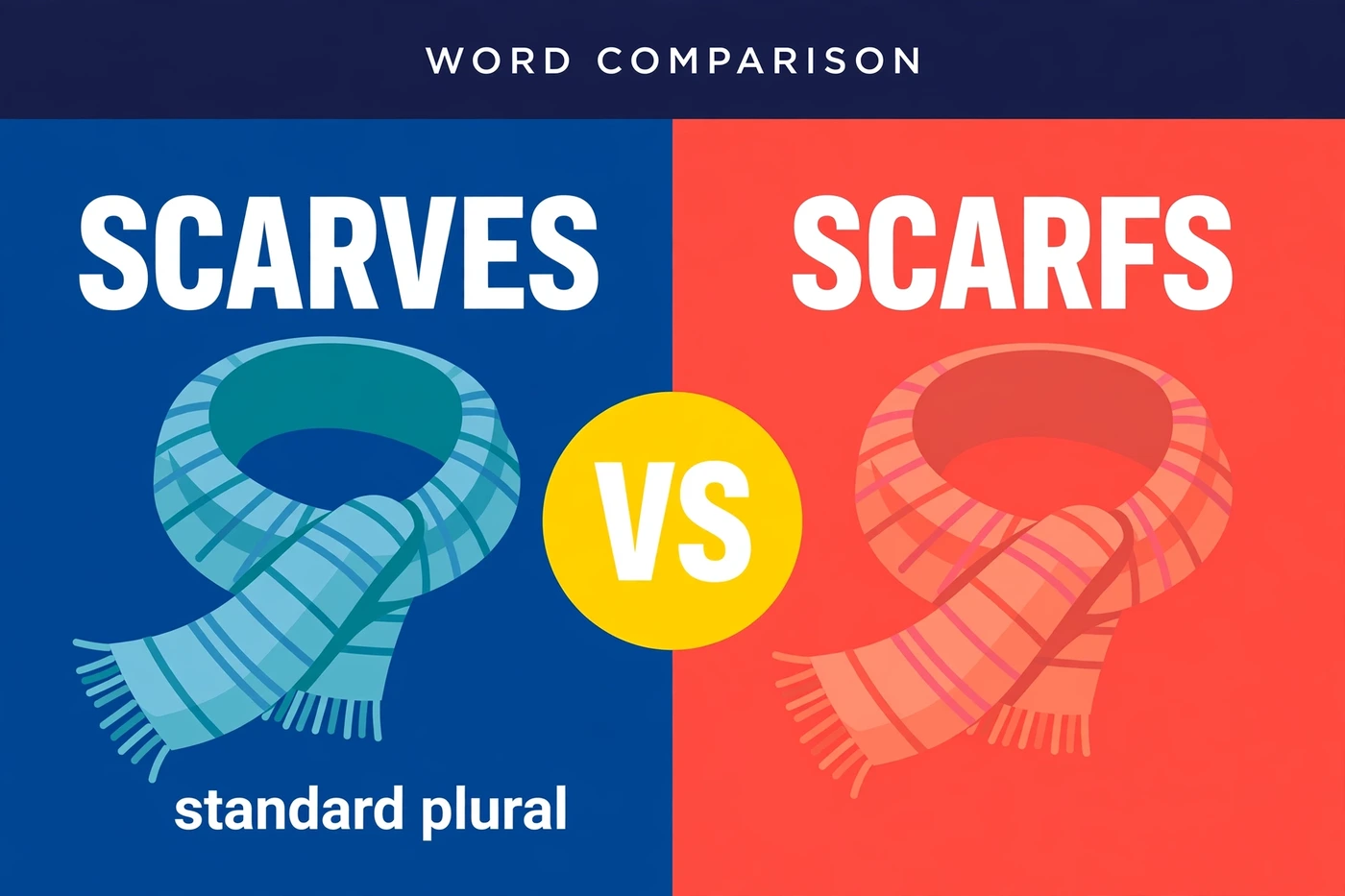
Table of Contents
Quick Answer
| Word | Part of Speech | Main Meaning | Example |
|---|---|---|---|
| Scarves | Noun (plural of scarf) | The standard, preferred plural | She owns a dozen scarves. |
| Scarfs | Noun (plural of scarf) | A rare but acceptable plural | The scarfs hung behind the door. |
Simple rule: Write scarves unless a house style specifically asks for scarfs. You will never be corrected for choosing scarves.
What Does Scarves Mean?
Scarves is the plural of scarf — more than one band of cloth worn around the neck, head, or shoulders. It follows the same pattern as leaf → leaves and half → halves, where the final f changes to ves. Dictionaries list it as the preferred plural, and it dominates printed English by a wide margin.
Examples:
- My grandmother knitted warm scarves for the whole family.
- The store displays its most colorful scarves by the window.
- She packed three scarves for the cold trip to Chicago.
- Football scarves covered the railing of the stadium stand.
- I bought two scarves at the winter market yesterday.
- Cashmere scarves make the most popular gifts in December.
Common collocations include silk scarves, wool scarves, and head scarves. The word never takes a different spelling in the singular — both plurals come from the same scarf.
What Does Scarfs Mean?
Scarfs is an alternative plural of scarf, formed by the regular rule of adding s. Merriam-Webster lists scarfs as an accepted variant plural of scarf, so it is not a misspelling. It appears mainly in older texts and occasional modern usage, but editors today almost always normalize it to scarves.
Examples:
- The museum catalog described several wool scarfs from the 1800s.
- Among the items listed were two silk scarfs.
- He draped the scarfs over the back of the chair.
- The trunk contained old gloves, hats, and scarfs.
Scarves vs. Scarfs: Key Differences
| Feature | Scarves | Scarfs |
|---|---|---|
| Correctness | Fully standard | Accepted but rare |
| Frequency in print | Overwhelmingly common | Very uncommon |
| Spelling pattern | Irregular (f → ves) | Regular (+ s) |
| Reader impression | Natural, professional | Slightly unusual to some |
| Dictionary status | Primary plural entry | Variant plural entry |
Scarves is the safer pick in every register, from academic papers to product listings.
Usage in Real Sentences
At Home
“Your scarves are in the closet.” / “Your scarfs are in the closet.” The second sentence is technically acceptable, but the first sounds right to native ears.
At Work
“We need to photograph the new scarves for the catalog.” Retail copy always uses scarves; a copyeditor would change scarfs on sight.
In Conversation
“Do you sell winter scarves?” Spoken English makes no distinction between the two spellings, which is why the confusion only appears in writing.
Online Shopping
“The listing said ‘silk scarves,’ but the package contained ‘scarfs.'” Product titles from different sellers mix both forms, so searching with scarves returns more results — sellers who know the standard spelling tend to be the established ones.
Common Mistakes
This plural trips people up the same way other f-to-ves words do — compare hero plural patterns like heros vs heroes and irregular plural spellings like tomatos vs tomatoes.
Mistake 1: Treating scarfs as a typo
❌ “You misspelled scarves.”
✅ “Scarfs is a valid variant plural, though scarves is preferred.”
Why: Dictionaries accept both; the issue is style, not correctness.
Mistake 2: Mixing both spellings in one document
❌ “The scarves are new. Those scarfs are on sale.”
✅ “The scarves are new. Those scarves are on sale.”
Why: Pick one form and use it consistently throughout a text.
Mistake 3: Over-applying the -ves rule to other words
❌ “He collects old scarfs and hoofes of horses.”
✅ “He collects old scarves and hoofs of horses.”
Why: Some f-ending words take -ves (scarves, leaves), while others just take -s (hoofs, roofs). Each word has its own convention.
Mistake 4: Writing “scarves’s”
❌ “I borrowed my scarves’s favorite pin.”
✅ “I borrowed my scarf’s favorite pin.” / “I borrowed my scarves’ favorite pin.”
Why: Use the singular possessive for one scarf, the plural possessive for many.
Pronunciation
Both words are pronounced identically: SKAHRVZ (rhymes with “starves” and “carves”). Since the pronunciation is the same, the choice between them is purely a spelling convention.
How to Remember the Difference
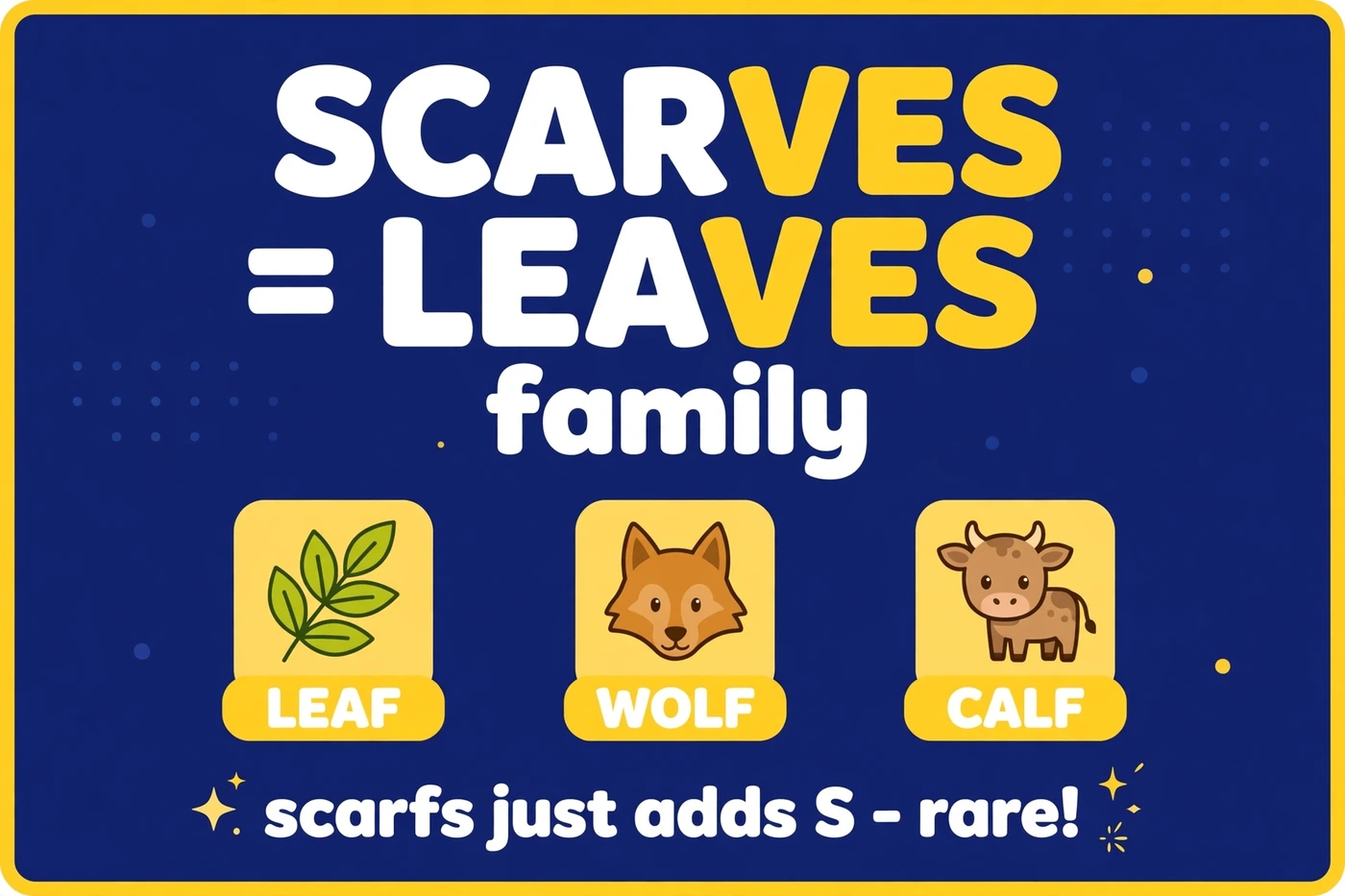
Think of scarves alongside leaves, wolves, and calves — the ves family of plurals. The pattern is old, common, and expected by readers.
- Scarves = standard; ends in ves like leaves.
- Scarfs = rare variant; simply adds an s.
- When you see the word pluralized in print, it is almost always scarves.
Frequently Asked Questions
Is it scarves or scarfs?
Use scarves. It is the standard plural and the form readers expect. Scarfs is an accepted variant but is rarely used today.
Is “scarfs” a misspelling?
No. Major dictionaries list scarfs as a legitimate plural of scarf. It is not an error — just an uncommon choice that may attract an editor’s correction.
Why do so many f-words become -ves in the plural?
It comes from an old English sound change: the voiceless f became a voiced v between vowels. Words like leaf, half, and scarf kept that pattern, while later words like roof and hoof never adopted it. The spelling simply froze the old pronunciation in place.
Should I ever use “scarfs” on purpose?
Only if you are quoting an older source that uses it, or writing historical dialogue where the variant feels authentic. In your own modern voice, scarves is always the better choice — it keeps readers focused on your meaning instead of your spelling.
What is the plural of scarf in British English?
Scarves in both American and British English. The variation here is about style, not region.
Can “scarfs” be used as a verb?
Not exactly. The verb scarf means to eat quickly (“he scarfed his lunch”), and its third-person singular is scarfs — “He scarfs his lunch.” That verb form is unrelated to the plural question.
Conclusion
Scarves is the standard plural of scarf, and scarfs is a rare but legitimate variant. Stick with scarves in your writing and you will match reader expectations every time.