Jewelry or Jewellery: US vs UK Spelling Explained
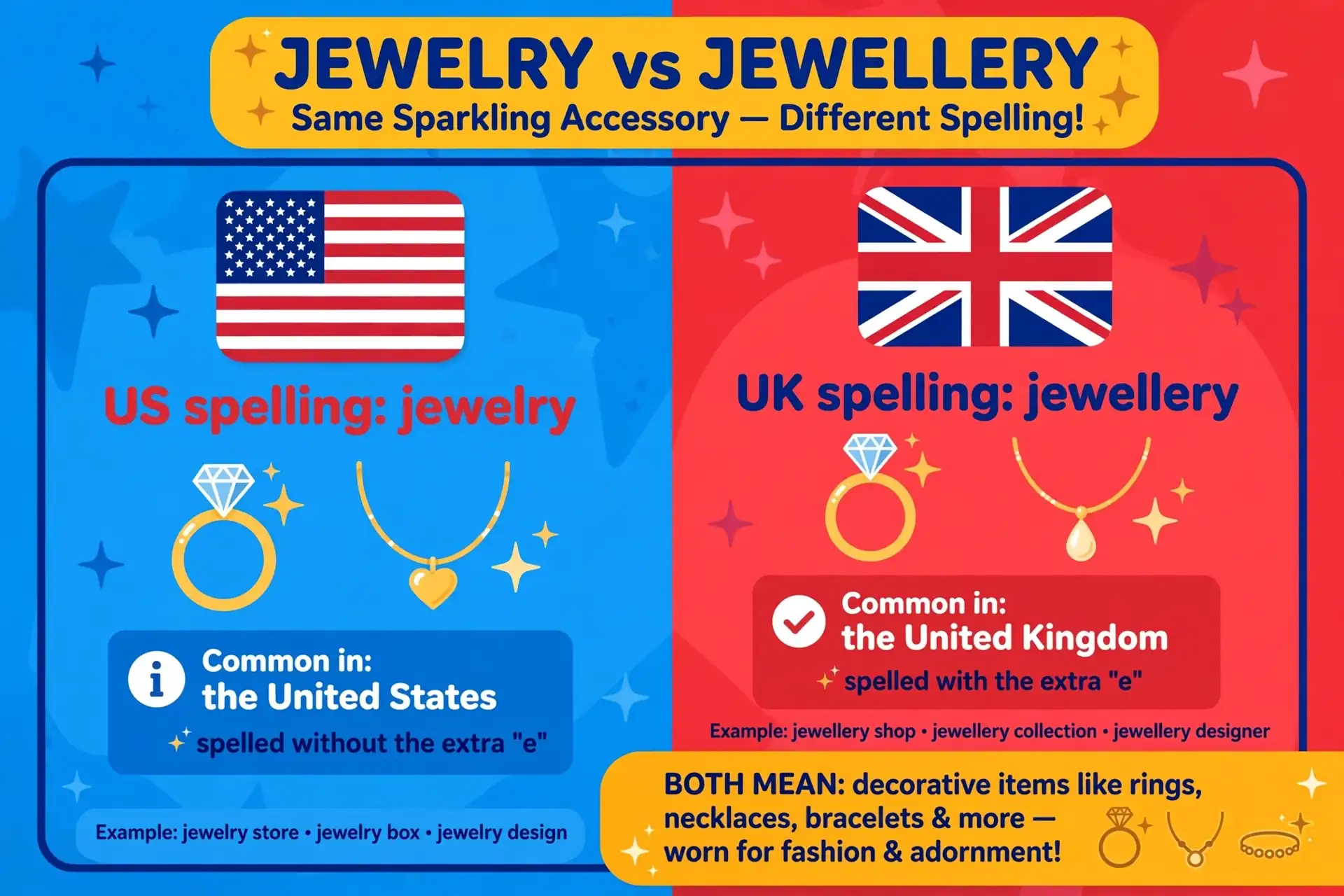
Jewelry is the American spelling and jewellery is the British spelling of the same word — both mean decorative personal ornaments like rings, necklaces, and bracelets. The one-line difference: jewelry if you write for a US audience, jewellery if you write for a UK audience. ‘She bought some jewelry in New York’ is American; ‘She bought some jewellery in London’ is British.
Table of Contents
- Quick Answer
- What Does Jewelry Mean?
- What Does Jewellery Mean?
- Why Two Spellings?
- Jewelry vs. Jewellery: Key Differences
- Related US vs UK Word Pairs
- Spelling in Real Brands
- Usage Examples in Real Sentences
- Common Mistakes
- Pronunciation
- How to Remember the Difference
- Frequently Asked Questions
- Conclusion
Quick Answer
| Word | Part of Speech | Main Meaning | Example |
|---|---|---|---|
| Jewelry | Noun (US) | Decorative personal ornaments | The store sells fine jewelry. |
| Jewellery | Noun (UK) | Decorative personal ornaments | The shop sells fine jewellery. |
Simple rule: same word, same meaning — match the spelling to your audience’s country.
What Does Jewelry Mean?
Jewelry is the American English spelling for personal ornaments made of precious metals and stones — rings, necklaces, earrings, bracelets, and the like. It’s also an uncountable noun in the US (you say “some jewelry,” not “a jewelry”). Cambridge lists both forms under its definition of jewellery.
Examples:
- She keeps her jewelry in a locked box.
- The museum’s jewelry collection dates back centuries.
- He designs custom jewelry for a living.
- Don’t wear expensive jewelry on the beach.
- The jewelry store is having a sale.
What Does Jewellery Mean?
Jewellery is the British English spelling — identical in meaning, pronunciation, and grammar to the American form. In the UK, Canada, Australia, and other Commonwealth countries, this is the only correct spelling. British style guides treat jewelry as an Americanism.
Examples:
- She keeps her jewellery in a locked box.
- The shop window displayed antique jewellery.
- He inherited his grandmother’s jewellery.
- Costume jewellery can look surprisingly elegant.
Why Two Spellings?
American English simplified many words Noah Webster’s 1828 dictionary — jewelry dropped the extra E and L that British English kept in jewellery. The pattern is the same one behind doubled consonants like cancelled and canceled: British English preserved the French-derived -llery ending while American English trimmed it. Neither spelling is “wrong” — they’re regional standards, and consistency within a document is what matters.
Jewelry vs. Jewellery: Key Differences
| Feature | Jewelry | Jewellery |
|---|---|---|
| Region | United States | UK, Canada, Australia |
| Spelling | J-e-w-e-l-r-y | J-e-w-e-l-l-e-r-y |
| Meaning | Personal ornaments | Exactly the same |
| Pronunciation | “JOO-uhl-ree” | “JOO-uhl-ree” (same) |
| Countable? | No — “some jewelry” | No — “some jewellery” |
The difference is 100% regional: meaning, grammar, and pronunciation are identical on both sides of the Atlantic.
Related US vs UK Word Pairs
| American (US) | British (UK) |
|---|---|
| jewelry | jewellery |
| canceled | cancelled |
| color | colour |
| center | centre |
| traveler | traveller |
| gray | grey |
| jeweler | jeweller |
| check (bill) | cheque |
Notice the pattern: British English often keeps doubled letters and extra vowels that American English trimmed.
Spelling in Real Brands
Real-world brands follow the same regional split. American companies use jewelry: Tiffany & Co. describes itself as “America’s house of fine jewelry,” and Zales advertises “diamond jewelry.” British companies use jewellery: the UK’s Goldsmiths chain and countless London hatton-garden shops spell it with the double L. If you’re writing product copy or a business name, match the spelling to the market you’re selling in — an American customer searching “fine jewelry” won’t type jewellery, and vice versa, which matters for SEO too.
Usage Examples in Real Sentences
At Home
US: “Mom, can I borrow your jewelry tonight?” — UK: “Mum, can I borrow your jewellery tonight?” Same sentence, regional spelling.
At Work
A US jeweler advertises “custom jewelry design,” while a London jeweller advertises “custom jewellery design.” Businesses match their customers’ spelling.
In Conversation
“That jewelry looks expensive” and “That jewellery looks expensive” are the same remark — only the letters differ, much like ie/ei patterns in words like receive differ across dictionaries.
Common Mistakes
With regional spellings, the mistake isn’t meaning — it’s inconsistency and mixing forms.
Mistake 1: Mixing both spellings in one document
❌ “Our jewelry collection includes antique jewellery pieces.”
✅ “Our jewelry collection includes antique jewelry pieces.”
Why: pick one regional spelling and use it throughout the document.
Mistake 2: Writing “jewelery” (missing a letter)
❌ “She bought gold jewelery.”
✅ “She bought gold jewelry.” (US) / “She bought gold jewellery.” (UK)
Why: jewelery is a misspelling in both varieties.
Mistake 3: Using the wrong regional form for the audience
❌ A UK wedding blog writing “wedding jewelry trends.”
✅ A UK wedding blog writing “wedding jewellery trends.”
Why: readers expect their own region’s spelling; the wrong one looks like an error to them.
Pronunciation
Both are pronounced “JOO-uhl-ree” — three syllables, rhyming roughly with cavalry and cutlery. The spelling difference is invisible in speech, so this pair only matters in writing.
How to Remember the Difference
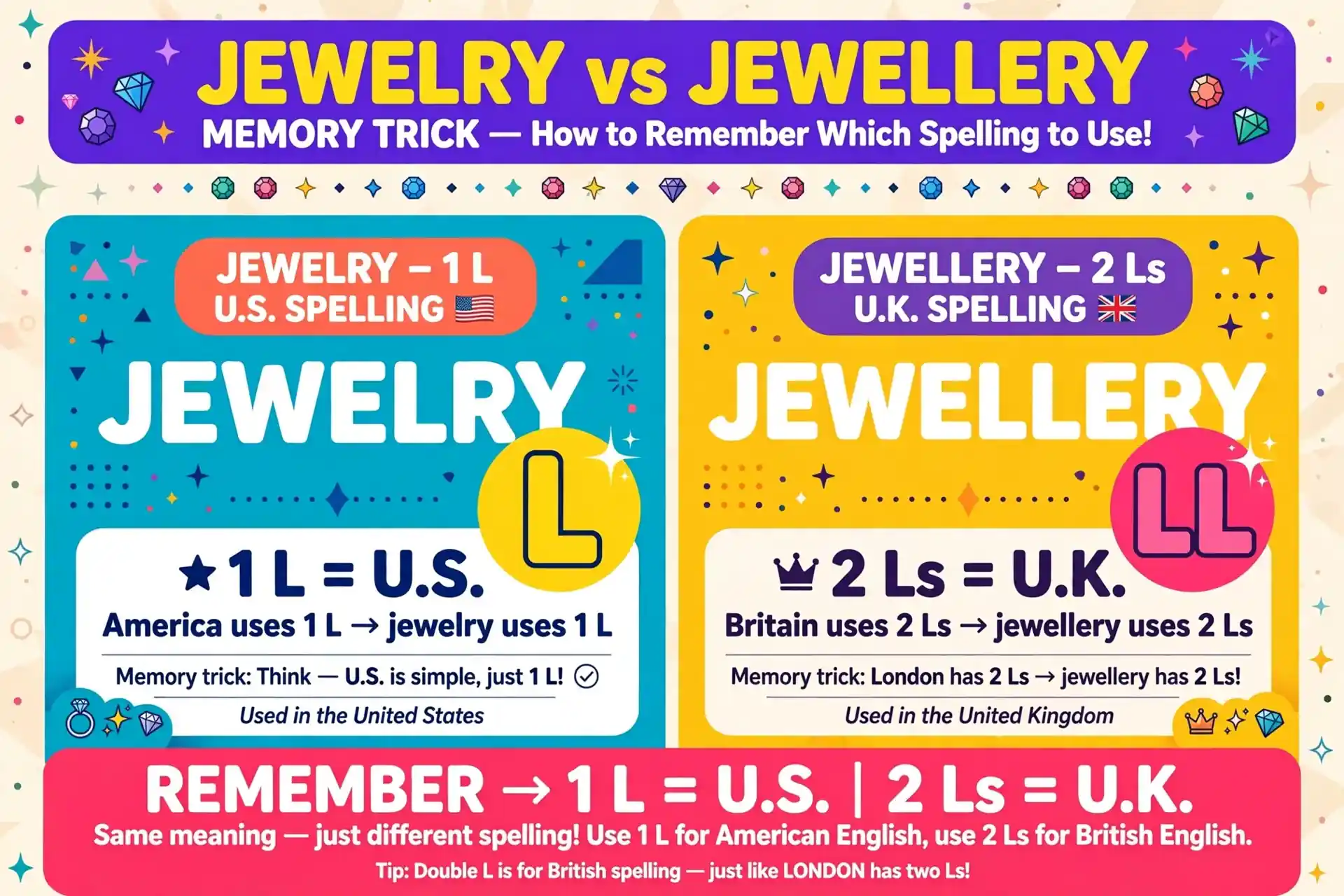
British English loves Letters: jeweL Lery has two Ls for “London.” American jewelry is the leaner, streamlined version. Quick recap:
- Jewelry = American spelling (one L)
- Jewellery = British spelling (double L)
- Match the spelling to your audience and stay consistent
Frequently Asked Questions
Is it jewelry or jewellery?
Both are correct. Jewelry is the American spelling; jewellery is the British spelling.
Which spelling is used in Canada?
Canada generally follows British convention, so jewellery is standard there, though you’ll see jewelry from US-influenced businesses.
Will my spellchecker accept both spellings?
It depends on your dictionary setting. A US English spellchecker flags jewellery as an error; a UK English one flags jewelry. Set your proofing language to match your audience before you finalize a document.
Is “jewelery” correct?
No — jewelery (with one L and no E before the R) is a misspelling in both American and British English.
Is jewelry countable?
No, it’s uncountable in both varieties: “some jewelry” / “much jewellery.” For individual items, say “pieces of jewelry.”
Do Americans ever use “jewellery”?
Only in British-themed branding or quotes. Standard American writing always uses jewelry.
How do you pronounce jewellery?
In British English it is usually three syllables — “JOO-uhl-ree” (/ˈdʒuːəlri/) — which matches the extra E sitting in the middle of jewellery. Americans spell it jewelry but say it almost the same way, so the spelling difference is actually bigger than the pronunciation difference. Either way, never pronounce it “jew-ler-ee” with a hard LER in the middle.
Conclusion
Jewelry and jewellery are the same word in different regional dress — American and British respectively. Choose the spelling your audience expects, use it consistently, and avoid the misspelled jewelery. Two Ls for London, one for the US.