Smelled or Smelt: US vs UK Spelling Explained
Both smelled and smelt are correct past tenses of the verb smell. The difference is regional: smelled is the standard form in American English, while smelt is common in British English.
For example, an American writer says “The kitchen smelled wonderful,” while a British writer might say “The kitchen smelt wonderful.” Neither is wrong — but each sounds most natural to its own audience.

Quick Answer
| Spelling | Region | Example |
|---|---|---|
| Smelled | United States (standard) | The roses smelled sweet. |
| Smelt | United Kingdom (common) | The roses smelt sweet. |
Simple rule: Writing for Americans? Use smelled. Writing for British readers? Smelt is perfectly natural, though smelled is accepted there too.
What Does Smelled Mean?
Smelled is the regular past tense and past participle of smell: “I smelled smoke” / “I have smelled that perfume before.” It is the dominant form in American English and is fully standard everywhere.
Examples:
- The coffee smelled amazing this morning.
- She smelled the flowers on the table.
- He had never smelled anything like it.
- The dog smelled something under the porch.
American style guides, schools, and publishers consistently prefer smelled, following the regular -ed pattern.
See smell on Cambridge Dictionary for the full entry and pronunciation.
What Does Smelt Mean?
Smelt is the irregular past tense and past participle of smell, formed with a -t ending instead of -ed. It is the traditional British form and remains very common in UK writing and speech.
Examples:
- The kitchen smelt of fresh bread. (UK)
- She smelt a rat, figuratively speaking.
- He had smelt the rain coming before the clouds broke.
- The old books smelt of dust and vanilla.
Watch out for a different smelt: as a noun it is a small silvery fish, and as a verb it means to extract metal from ore (“smelt iron”). Context always makes the meaning clear.
Smelled vs. Smelt: Key Differences
| Feature | Smelled | Smelt |
|---|---|---|
| Region | American English (standard) | British English (common) |
| Formation | Regular -ed | Irregular -t |
| Meaning | Identical | Identical |
| Other meanings | None | Also a fish; also “extract metal” |
| Example | It smelled great. | It smelt great. |
Either form is understood on both sides of the Atlantic. The choice is about sounding local, not about being correct.
Why Are There Two Spellings?
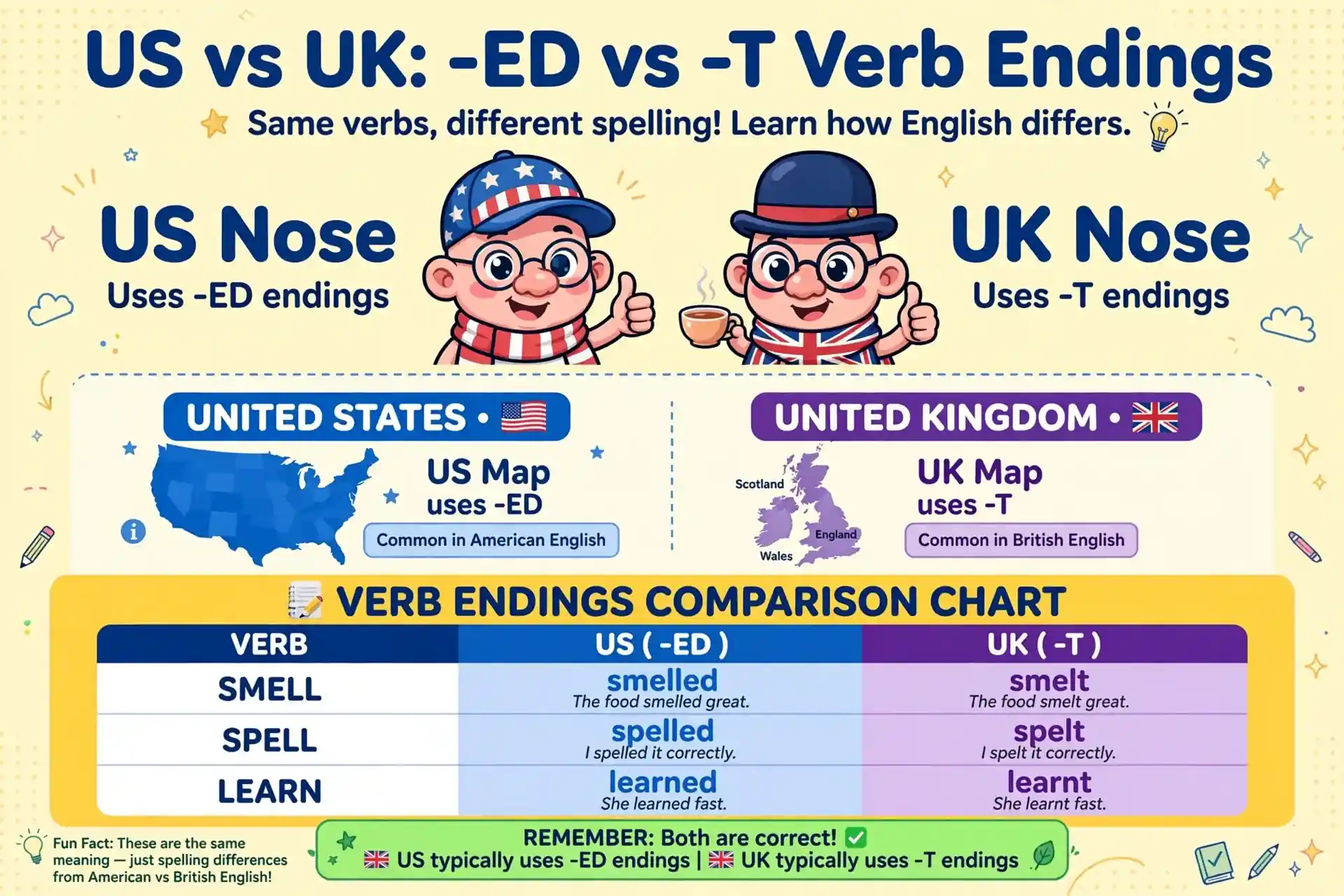
English once formed many past tenses with -t (dreamt, learnt, spelt, smelt). Over time, American English regularized most of them to -ed, while British English kept the -t forms alive alongside the regular ones. That is why the -ed/-t divide runs through a whole family of verbs, just like the -or/-our divide in labelled vs labeled and similar pairs.
Related -ed / -t Verb Pairs
| American (regular) | British (traditional) |
|---|---|
| Smelled | Smelt |
| Spelled | Spelt |
| Learned | Learnt |
| Dreamed | Dreamt |
| Burned | Burnt |
| Spoiled | Spoilt |
In British English, both columns are usually acceptable, with the -t form often feeling more traditional. In American English, the -ed column is the safe default — much like cancelled vs canceled, where the doubled-L form dominates in the UK.
Common Mistakes With Smelled and Smelt
Mistake 1: “Correcting” Smelt to Smelled in British Writing
❌ “Smelt is wrong; it should be smelled.”
✅ Both are correct; smelt is the traditional British form.
Why: In the UK, smelt is standard and natural. “Correcting” it shows American bias, not better grammar.
Mistake 2: Using Smelt for the Fish or Metal Sense by Accident
❌ The chef smelt the iron. (ambiguous!)
✅ The chef smelled the soup. / The furnace smelt the iron ore.
Why: Smelt also means “extracted metal” — in industrial contexts, prefer smelled for the sniffing sense to avoid confusion.
Mistake 3: Mixing Forms Inconsistently
❌ He smelled the roses and smelt the coffee.
✅ He smelled the roses and smelled the coffee. (US)
✅ He smelt the roses and smelt the coffee. (UK)
Why: Pick one regional standard per document and stay consistent.
Pronunciation: Smelled vs. Smelt
Smelled is pronounced “smeld” (/smɛld/), rhyming with held. Smelt is pronounced “smelt” (/smɛlt/), rhyming with felt and melt.
The pronunciation follows the spelling exactly — one more case where saying the word tells you which form you used.

How to Remember the Difference
Memory trick: Americans keep the ED (smelled, spelled, learned). Brits love the T (smelt, spelt, learnt) — think “T for Traditional.”
- US → smelled (regular -ed).
- UK → smelt (traditional -t) or smelled.
- When in doubt internationally, smelled is understood everywhere.
Frequently Asked Questions
Which is correct: smelled or smelt?
Both are correct. Smelled is standard in American English; smelt is the traditional British form. Use the one your audience expects.
Is “smelt” wrong in American English?
It is not wrong, but it sounds distinctly British to American ears. In US writing, smelled is the natural choice.
What is the past participle of smell?
Either smelled or smelt: “I have smelled/smelt that before.” Match your regional choice.
Is a smelt a fish?
Yes — smelt is also a small silvery fish, and to smelt means to extract metal from ore. Context tells you which meaning is intended.
Do other verbs work like smelled/smelt?
Yes: spelled/spelt, learned/learnt, dreamed/dreamt, burned/burnt. American English prefers -ed; British English keeps the -t forms.
Conclusion
Smelled is the American standard and smelt is the traditional British form — both are correct past tenses of smell. Choose by audience, stay consistent, and apply the same -ed/-t pattern to related verbs.